Pick of the Brown Bag
December 2, 2015
by
Ray Tate
Welcome to the Pick of the Brown Bag. I'm Ray Tate, and I review the most interesting and the least interesting comic books of the week. If you're in a rush, I also tweet teensy consolidations of the reviews under: #PickoftheBrownBag. Let's get the party started with reviews of All new X-Men, Aliens vs Vampirella, Angel and Faith, Barb Wire, Doc Savage: The Spider's Web, Doctor Who, Harley’s Little Black Book, James Bond, Red Wolf and Rocket Girl.

Red Wolf is an obscure Marvel character introduced in Avengers #80. I know him from Marvel Chillers.

That’s Right. All Roads Lead to Tigra. Deal with it.
Red Wolf was part of the Native American zeitgeist of the 1970s. The newfound popularity overlapped with a zest for ecology. Every television series and, frequently, movies of the time addressed Native American culture through themes such as progress vs history; as in developments threatening burial grounds or gentrification; as in Native leaves the tribe and becomes corrupted by civilization, or visa-versa.
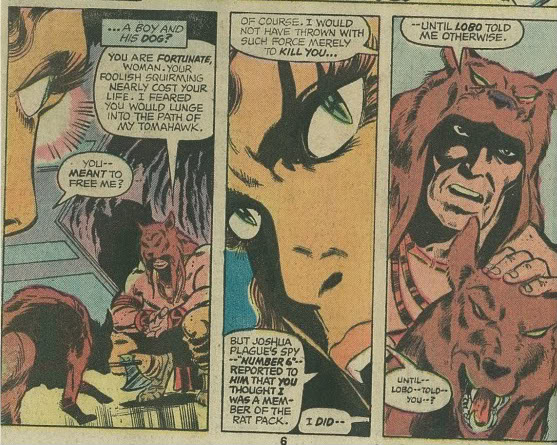
Red Wolf was an interesting character. As you can see by his garb, he wasn’t a gentrified Native, nor was he savage. Could Red Wolf have sustained his own series? Doubtful. However, he added diversity to the Marvel Universe, and he would have been a prize guest-star in any magazine. Tigra warmed up to him. So he gets my vote.

The 1970s Red Wolf was actually Will Talltrees. A guardian spirit of Will’s tribe imbued him with the typical gamut of powers: enhanced strength, senses, etc. He also acquired a wolf pup named Lobo that he raised to adulthood.

The modern version of Red Wolf is a little different. The story begins in 1872 where Mama Red Wolf notes a strange visitor. The book immediately cuts to a fistfight, which Sheriff Red Wolf interrupts.

After this soupçon, Sheriff Red Wolf and the strange visitor soon cross paths. Before you know it, some sufficiently advanced science gets tossed around leading to wholesale slaughter and what I hope to be a promising cliffhanger.

Right now. This premiere didn’t do anything for me. Red Wolf is a little too politically correct. I prefer the shirtless pelt-wearing somewhat hot-headed, chauvanistic version to the clothed, reasonable to a fault lawman. His being a sheriff may be considered by some a step in the right direction, but Red Wolf wasn't the first Native American lawman in comics. That distinction goes to DC's Pow-Wow Smith. Not a great name, but he owned it.

Detective Comics #500
Pow-Wow Smith originated in the late 1940s. His real name Ohiyesa of the Sioux tribe. He also became the Sheriff of a Western town. As you can see, Pow-Wow Smith wasn't forgotten. DC took advantage of the Native American bump in the 1970s and reintroduced him in All-Star Western. After that, he made infrequent guest appearances such as this anniversary issue of Detective Comics.

Detective Comics #500
Red Wolf's artwork suffers by comparison to the mastery of Jim Aparo. Most art would, but overall the illustration by Dalibar Talajic and Jose Marzan Jr. is a little too dull. The action is mechanical. If the sequences in Detective Comics comprise a Leone Spaghetti Western, Red Wolf is a John Wayne oater. By no means is it Cimmaron, the worst western ever made.


Doc Savage returns in Chris Roberson’s updated technopolis. Doc expanded his operation to global proportions. No longer is he one and five men plus a sixth woman darting around the world to put out the fires of maniacs. Instead, he’s a whole conglomerate with like-minded experts fielding away teams. Although, he’s never been a delegator.

The story begins with a devastating earthquake that Savage’s operations should have predicted but failed to do so. That in itself is odd, but the presence of an already dead paratrooper near the epicenter is a clue to a mystery, its elements Doc dealt with in the 1940s.

It’s always a pleasure to revisit Roberson’s Doc Savage because the writer did such an intelligent job imagining how Doc, had he survived to the present day, would have escalated his operations. Part of me says that it was done in Buckaroo Banzai, but another part of me argues that Doc Savage is more serious than Buckaroo Banzai, and this mood changes the dynamic of the setup.

The exact nature of the beast has been done before, most recently in Samm Hamm's Detective Comics, but never has the nature been depicted so viscerally. I would normally be complimenting Cezar Razek on his realistic likenesses of how a reader imagined Doc Savage and his Amazing Crew to look, but for this issue I’m tipping the hat to Razek and colorist Dijo Lima for the visual of horrible consequences that wouldn't be out of place in The Spider.

The exact nature of the beast has been done before, most recently in Samm Hamm's Detective Comics, but never has the nature been depicted so viscerally. I would normally be complimenting Cezar Razek on his realistic likenesses of how a reader imagined Doc Savage and his Amazing Crew to look, but for this issue I’m tipping the hat to Razek and colorist Dijo Lima for the visual of horrible consequences that wouldn't be out of place in The Spider.

It happens in an instant. Flirtation from out of nowhere becomes interrupted by an assassination attempt thwarted by Bond, James Bond.

The rest of the story is all about the plot about a nasty designer drug turning people inside out and intrigue within a so-called ally’s lair. It’s a necessary evil to get us from point lust to point hazard.

Because we’re not reading James Bond for profundity. Hey, if it’s got that. Awesome. If it says something? Brilliant.

Because we’re not reading James Bond for profundity. Hey, if it’s got that. Awesome. If it says something? Brilliant.

Lots of Bond flicks do this, but all of the normal lubricants of drama are really meant to move Bond through loving to killing. That’s what we’re here for. That’s what we get. It’s freakin’ James Bond!

Cavan Scott apes the performances and the mood of the Christopher Eccleston era of Doctor Who. The story picks up where we left off. A seemingly brain-washed Rose Tyler confronts the Doctor, who appears to be chummy with silver Centaur people known as the Union. Naturally, there’s more here than meets the eye.

The warring factions foster different agendas. The Lect want revenge, plain and simple. Although they also want to spare other worlds from the Union's plans. To replace the at the moment absent and thought dead Time Lords.
Scott uses an infrequent motif in Doctor Who to spice the plot of his story. The Time Lords view other aliens playing with time and space as a bad idea. Honestly, they may be right, but they're also arrogant in their pronouncements. The belief furthermore feeds into Time Lord xenophobia. In the series, on two occasions, Time Lords interfere with what could have been considered the natural evolution of time experiments. The indication is that nobody but Time Lords are capable of taming the winds of time. This is how the Union thinks.
Scott uses an infrequent motif in Doctor Who to spice the plot of his story. The Time Lords view other aliens playing with time and space as a bad idea. Honestly, they may be right, but they're also arrogant in their pronouncements. The belief furthermore feeds into Time Lord xenophobia. In the series, on two occasions, Time Lords interfere with what could have been considered the natural evolution of time experiments. The indication is that nobody but Time Lords are capable of taming the winds of time. This is how the Union thinks.

The fly in the ointment may be Captain Jack Harkness, recent TARDIS crewmember and time traveler in his own right. He presents a problem to the Union that turns the whole story on its head, and precludes the Doctor doing something drastic.

The dialogue by Scott and the illustration by Blair She'd and Rachael Stott is as spot on as one can expect. These facets grant even greater strength to a mostly impressive mini-series.

Aliens vs. Vampirella is a solid variation on the Aliens chase their prey. Vampirella and her ally Lars follow each other up the rabbit hole to escape the acid-spewing alien horde. The escape however doesn't follow smoothly.

For a long time Vampirella reader this is an interesting moments because Vee has never been wounded in such a way. The damage also demonstrates how much of a threat the Aliens are to her, but primarily the fascination lies in what appears to be the limits of shape-shifting. Although Vampirella can sprout wings. Those wings are a part of her. She can't just heal over the wounds. She doesn't possess the full capabilities of say the Martian Manhunter.
Though Vee suffers a blow, the pain and marring doesn't down her spirit. In a scene that alludes to Ripley in Aliens, Vampirella scores a victory.

Vee is definitely the hero of this picture, but readers shouldn't discount Lars as typical dead weight. Writer Corinna Beckho gives Lars some choice moments exemplifying self-sacrifice and a devotion to his wife. Aliens vs. Vampirella is an overlooked treat for fans of either or both opponents.

For a long time Vampirella reader this is an interesting moments because Vee has never been wounded in such a way. The damage also demonstrates how much of a threat the Aliens are to her, but primarily the fascination lies in what appears to be the limits of shape-shifting. Although Vampirella can sprout wings. Those wings are a part of her. She can't just heal over the wounds. She doesn't possess the full capabilities of say the Martian Manhunter.
Though Vee suffers a blow, the pain and marring doesn't down her spirit. In a scene that alludes to Ripley in Aliens, Vampirella scores a victory.

Vee is definitely the hero of this picture, but readers shouldn't discount Lars as typical dead weight. Writer Corinna Beckho gives Lars some choice moments exemplifying self-sacrifice and a devotion to his wife. Aliens vs. Vampirella is an overlooked treat for fans of either or both opponents.

The sincerely good writing and the gorgeous artwork continues in Angel and Faith. Writer Victor Gischler examines the relationship between the title stars in the midst of a Big Bad's attempt to acquire Magic Town.

The depth of the conversation is just right for both characters; neither of whom are the most talkative at times. The dialogue bespeaks of Angel and Faith's long friendship, which first began on the television series when unconsciously Faith sought Angel's help to deal with her reconnection to her conscience.
The story is of course much more than just a sit-down; although "chin-wags" turn out to be just as important as slaughtering vampires. They're also more versatile. Gischler uses the dialogue between characters for numerous means. The satisfying discussion Angel and Faith have gets turned around when the Big Bad wants to be reasonable. A telephone conversation turns into a lure and an unfortunate revelation for one of the characters.

The interplay between Angel and Drusilla is also worth noting. Dru is a monster, but suppose Dru decided to give up. Would Angel let her go? Certainly if the condition were the return of Nadira, but suppose Archaeus killed Nadira without Dru knowing it? Would Angel let Dru go as he would a person?

The depth of the conversation is just right for both characters; neither of whom are the most talkative at times. The dialogue bespeaks of Angel and Faith's long friendship, which first began on the television series when unconsciously Faith sought Angel's help to deal with her reconnection to her conscience.
The story is of course much more than just a sit-down; although "chin-wags" turn out to be just as important as slaughtering vampires. They're also more versatile. Gischler uses the dialogue between characters for numerous means. The satisfying discussion Angel and Faith have gets turned around when the Big Bad wants to be reasonable. A telephone conversation turns into a lure and an unfortunate revelation for one of the characters.

The interplay between Angel and Drusilla is also worth noting. Dru is a monster, but suppose Dru decided to give up. Would Angel let her go? Certainly if the condition were the return of Nadira, but suppose Archaeus killed Nadira without Dru knowing it? Would Angel let Dru go as he would a person?

Still under Men in Black scrutiny, Barb Wire, she legally changed her name, relates the day she met Avram Roman. Although, she does this under much duress.

Barb’s reaction to this alleged authority alludes to the youthful energy she once benefitted from. As the flashback unfolds, Chris Warner reveals a very different, less cynical Barb Wire that’s a lot of fun. As is her partner Alonzo.

Drawn by Pat Oliffe, Barb Wire is the perfect model of a 1980s punk rocker. She ripples with energy, clearly not shared by her older self. That pep draws Barb into a car chase so well choreographed that it could have been on film. Car chases are rare in comic books. This one is memorable.

DayYoung decides to become Rocket Girl again despite potentially contaminating the time-line. Frankly, I didn’t see any other option for writer Brandon Monclare and artist Amy Reeder. Nobody wants to read about the adventures of DayYoung without the Rocket Suit. That’s a slice-of-life story. Not the high octane action filled Rocket Girl.

Reeder and Montclare present the possibility that Rocket Girl isn’t the cause of the juxtaposed fluctuating future. If not, who is? Time will tell as the series progresses.
This issue acts as a setup for new readers while not boring the ones enjoying at the very beginning. For the primes, we get to enjoy a realistic argument between DayYoung and her friend Annie Mendez. The argument comes to blows, but in a silly slap-fight sort of way.

Everybody will enjoy Rocket Girl fighting crime, meeting the Rockettes and the authorities starting to view Rocket Girl as a hero. Simultaneously, the time travel implications intrigue, but do not overwhelm the fun in the present.

Who would have thought that the longevity of Harley Quinn would be so resonant that she would spin-off into a second title. Harley’s Little Black Book is essentially The Brave and the Bold with Harley Quinn. It’s especially fitting since when Amanda Conner and Jimmy Palmiotti direct her adventures, the exploits seem to exist in a separate universe: one in which Batman sometimes approves of Harley’s antics, despite being thoroughly illegal, and Poison Ivy actually being a kind heroine and sometime lover of Ms. Quinn.
 The same argument or complaint was leveled at Bob Haney when he wrote The Brave and Bold. Batman appeared to behave like a different person according to these objectors. I never got that, but whatever.
The freedom however allows Conner and Palmiotti the opportunity to team Harley Quinn with DC Universe denizens no matter if they bear the onus of continuity imposed on others. In this case, Wonder Woman. The only thing that Palmiotti and Conner keep from the new 52 additions is that Wonder Woman makes her home in London. Everything else mirrors everything you think you know about Wonder Woman, from costume to characterization to toughness.

In that respect Harley’s Little Black Book is a success. I also find it plausible that Harley Quinn would be nuts about Wonder Woman. That this affection arose from her past. Wonder Woman inspired numerous little girls throughout her history. Why should Harley be any different?

The plot’s a good one. Harley learns that a villain holding a grudge intends to kidnap Wonder Woman and sell her to the highest bidder.

So, the Clown Princess conceives a wild and wooly plan to save her idol. Naturally, it’s a twisted scheme filled with comedy, action and human interest, actually.

The thing about Conner and Palmiotti is that they frequently bring the heroes down to earth while restoring the power of their myth.
Wonder Woman is actually quite willing to get a bite to eat with you if she’s hungry and she likes the company. In this respect, Palmiotti and Conner see no reason why the heroes cannot act like the Super-Friends when they’re around normal people and Bruce Timm’s Justice League when they’re facing villains.

Wonder Woman’s and Harley’s adventure occurs in London, and with this setting, Palmiotti's and Conner’s humor is hit or miss. It’s mildly amusing that they create a London that never evolved past its sixties mod, evident from the Mini-Cooper and the fashions, but the London Legion is not as funny as the Valentine’s Day creation The Mighty Carp.


There’s something in the water at Marvel. I actually understood and felt entertained by All-New X-Men. The massive college level continuity that plagued the X-Men titles for decades doesn’t play a part in the comprehension of All-New X-Men. Writer Dennis Hopeless identifies the characters, relates their specific history and how each one plays off the others all within an enjoyable user friendly story that still doesn’t talk down to the reader.

Our tale opens like a James Bond novel, with Wolverine, now the artist formerly known as X-23, real name Laura Kinney enjoying a ski-date with her beau Warren Worthington, the Angel.
This is perhaps the only point of question. Why does Warren have fire wings instead of feathered wings. Don’t know. Don’t care. Does it matter? He still flies.
All-New X-Men is really a misnomer. The book focuses on the classic X-Men. So we get Warren and Scott Summers before—heh, hold on—he watched Jean Grey become the Phoenix; before he watched the Phoenix die; before he married Madelyn; before he watched Madelyn die; before he found out Jean Grey wasn’t the Phoenix; before he watched new Jean Grey die, etc, etc. Nope. This is Scott "Slim" Summers. The cool-headed Scott. The defacto leader of the X-Men who always has a plan.

His current plan involves stopping a cult of super-thieves using the Cult of Cyclops as a smokescreen for their larceny. As Scott explains, his older self was as we all felt a bit of a dick. Cyclops is the poster child for how continuity can weigh down on a character so much that starting from scratch is the only option left open.

In addition to Scott, Hank McCoy and Bobby Drake are on the team. They with some quickly exemplified newcomers join Wolverine to do what the X-Men used to do; set an example, save humanity and mutantkind. All-New X-Men is basically like the All-New Wolverine a back to basics superhero book, and that’s why it should be on your list.