Pick of the Brown Bag
August 31, 2016
by
Ray Tate
Welcome to the Pick of the Brown Bag. My name is Ray Tate, and I review the best and the worst comic books of the week. I'm happy to say however that all the titles were pretty entertaining. Our subjects are All-New Wolverine Annual, Future Quest, Henchgirl James Bond, The Micronauts, Rough Riders, Spider-Gwen and X-Men 92. I'll furthermore have a review of the first new Star Trek film in honor of the movement's fiftieth anniversary and a say a few words about the horror film From the Dark.

Rough Riders begins with the reminisces of Teddy Roosevelt. The memories of a sickly youth give impetus to Roosevelt's want to participate in war. Although, this war is one with an alien foment, or so it seemed. As the story progresses, writer Adam Glass reverses the trajectory to obfuscate the truth, just how clashing investigations years later either cleared the Spanish for the destruction of the U.S.S. Maine, or damned them. The plot is layered. It favors neither side, or added extraterrestrial oneupmanship. In fact the deeper involved the Rough Riders become the less they know.
In another comprehensive move, Glass demonstrates that even a mere comic book can teach a better history lesson than some texts.

Disregarding the science fiction elements, Rough Riders exposes the bravery and the effectiveness of the Buffalo Soldiers, a black troop frequently glossed over by classroom history tomes. If you want to learn about how it really happened, go to the library and seek out the scholars of history, the ones that back their claims with evidence rather than conjecture or political editing.
Of course, Rough Riders is a science fiction comic book. So, we get scenes such as this.

You know, as much as I admire Pat Oliffe, I never thought he had a Mysterious Airship in him. Happy to be wrong. While Annie Oakley rues the lack of bloodshed she dealt, Jack Johnson and Harry Houdini eliminate another historical meddler, and the whole team reunite to discover how entrenched the alien influence runs. Superb.
In another comprehensive move, Glass demonstrates that even a mere comic book can teach a better history lesson than some texts.

Disregarding the science fiction elements, Rough Riders exposes the bravery and the effectiveness of the Buffalo Soldiers, a black troop frequently glossed over by classroom history tomes. If you want to learn about how it really happened, go to the library and seek out the scholars of history, the ones that back their claims with evidence rather than conjecture or political editing.
Of course, Rough Riders is a science fiction comic book. So, we get scenes such as this.
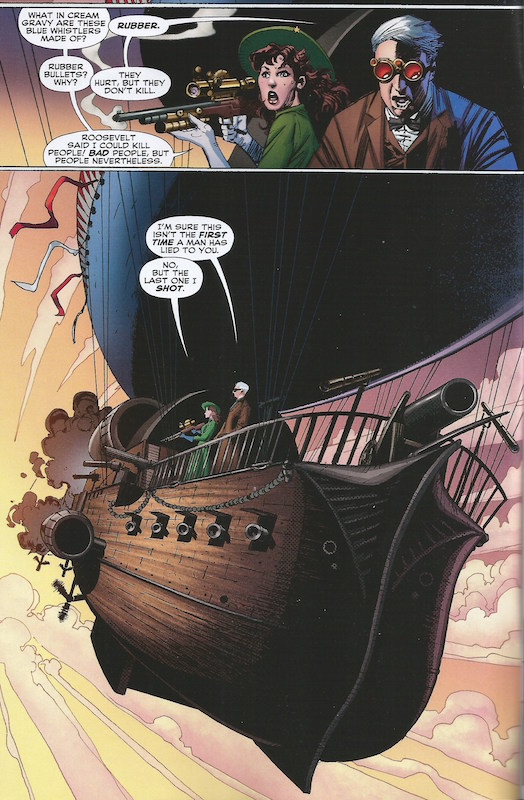
You know, as much as I admire Pat Oliffe, I never thought he had a Mysterious Airship in him. Happy to be wrong. While Annie Oakley rues the lack of bloodshed she dealt, Jack Johnson and Harry Houdini eliminate another historical meddler, and the whole team reunite to discover how entrenched the alien influence runs. Superb.

In Micronauts Baron Karza decides to break out Oz the last Pharoid from Force Commander’s gentle metal hands. There’s a lot of twists in this story. Both Karza and Force Commander are bad guys, heading different ministries that engage in a Civil War. That term’s been overused thanks to Marvel, but each enemy camp is invested in stopping the entropy wave that’s eating the universe. Just as much as defeating the opposite side.
Karza tasks the biomechanoid Acroyears with the deed of “rescuing” Oz, but first Oz must deal with Force Commander’s interrogator.

This bizarre thing was indeed a toy from the Micronauts line, but he was seldom seen in the original series. For obvious reasons. Writer Cullen Bunn exploits the weird look of Membros to give him a real Joseph Mengele vibe.

The whole idea a mutable body, and apparently mind, draws upon the very essence of the Micronauts line. The Micronauts had a great design, and they also added to the pleasure of play by being interchangeable.
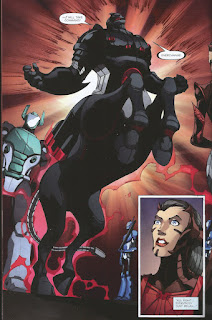
For example, both Force Commander and Baron Karza could detach their lower body, held with the torsos by magnets, and merge with the lower halves of their steeds.

For example, both Force Commander and Baron Karza could detach their lower body, held with the torsos by magnets, and merge with the lower halves of their steeds.

Why am I thinking about Catherine the Great right now?
Bunn eliminates the functional reality of the toy with a science fiction weirdness heralded by the phrase “enerchange.” It all however fits together in an exciting and sometimes comical escape.

Future Quest opens with an origin of Mighty Mightor. The dialogue in this brief scene is a testimony to writer Jeff Parker’s skill.

The choice of words indicates how Parker thought things through. He could have had Mightor say, “The one is my club,” but that just sounds self-explanatory. "Timber" on the other hand is poetic and well-within the speech pattern of Mightor.
With the abduction or displacement of Mightor, the creature reveals its strategy. Take out he power hitters first. In previous issues, we saw the disembodiment of Space Ghost, Tara and Zok of the Herculoids. Mightor makes three.
As the story continues, Parker shifts his gaze to the amnesiac Jan, who gets a helping hand from Blip.

If you’re wondering why Blip doesn’t draw Space Ghost or Jace, he’s only a monkey. A very intelligent monkey, but still a monkey. Besides, it’s more important for Jan to remember her own name and of course to feed the monkey.

As the story progresses, the anomalies deposit Todd, who will become better known as Dino-Boy, into the maw of an Allosaurus. This is the first departure from the canon of the television series, or perhaps it’s just foreshadowing. By the end of Future Quest, all may be restored to proper time and space. So, Dino-Boy will in the future be saved again by Ugh after a plane crash that presumably kills his parents. Alternately, perhaps these will turn out to be false memories to protect Todd from being sought out by a creature that can manipulate the vortex. Lots of ways to go.
The always welcome Ron Randall joins Parker in relating the origin story of Frankenstein Jr. Parker gives this boy-and-his-robot tale much needed depth with the introduction of young Buzz Conroy’s genius mother.

With this seeming digression, Parker neatly ties up several loose ends in a bow. He gives an explanation for the tragedies that befell Linda Conroy and Benton Quest. Linda is a whole cloth creation. So Parker in fact equivocates Conroy with Quest. He furthermore rationalizes the schism between Quest and Dr. Zin and cleverly recapitulates the plot of Future Quest to the very beginning of all the Hanna-Barbera action series. The creature doesn’t just catalyze the advent of Space Ghost. Its self-interested actions alternately and inadvertently creates a counter-burst of goodness that’s felt throughout, we’ll call it earth HB.

X-Men 92 is full of nostalgic fun. First and foremost, you don’t need a guidebook to who the characters are. Scribes Chad Bowers and Chris Sims only rely on unfamiliarity when popping in on Charles Xavier’s School for Gifted Youngsters.

No idea who flaming beard and blue girl are, but referred to as Dead Girl reversed Jubilee’s vampirism. So, yay, Dead Girl! I absolutely loathe that Jubilee is a vampire on Marvel earth proper. It’s pure laziness.
“Man, I hate that character, but I like vampires. I’m stuck with that character, so I’ll make her a vampire.”

Some jackass did it with Looker. Another lackwit did it with Spitfire. If you can’t play with the powers the character came with, don’t play with the character at all. Just send her to college, or traveling. Spitfire can travel pretty far, don’t you know. Dumbasses Anyhow, Bowers and Sims made the vampirism temporary. So, good on them.

Getting far away from the vampires, Sims and Bowers shine the spotlight literally on Lila Cheney, a teleporting singer that I only recently met in the non-sucky Captain Marvel. According to Wikipedia, she has a longer history. The funny thing is I didn’t need to know about it. Sims and Bowers makes X-Men 92 user friendly, and streamlining is sorely needed in the X-Men titles.
Now, intergalactic bounties could invite a number of characters. Sims and Bowers choose the correct one.

If you don’t know who the goofy metal mouth is, don’t worry. There’s a whole bunch of American readers that are scratching their heads with you. Death’s Head is from Marvel England. He was a throwaway killer robot from the British Transformers. However, his real claim to fame arrived when he started to hunt down the Doctor in Doctor Who Magazine. You see. Marvel once owned the license to Doctor Who Magazine. They still may. I don’t honestly know. In any case, an editor who really decided to try something different inexplicably gave Death’s Head his own book.

In the waning run, the Doctor now in his seventh incarnation abandons Death’s Head atop the Baxter Building. It’s one of the weirdest moments in comics not involving uncomfortable relationships.
So Death’s Head now ensconced in the Marvel universe, courtesy of the Doctor, intends to collect the bounty on Lila Cheney. Back at the school, Jubilee intends to stop him, but she may not need to.

So what’s Abigail Brand, a Joss Whedon creation, doing in X-Men 92? Good question. This is the beauty of having your own continuity. Whedon introduced Brand and SWORD much later. In the context of the fiction SWORD, the cosmic gate of SHIELD was around much earlier. So, although there’s a cheat, Abigail Brand’s presence makes perfect sense. Add great cartoony art, and a hilarious conversation between Bishop and Wolverine, and you’ve got a damn fine read.

All-New Wolverine’s first annual is a winner with Laura and Gwen swapping minds.

Obviously not on purpose. The hijinks are many and juicy with comedy. Writer Tom Taylor isn’t however out to only tickle your funny bone. He introduces a legacy character that sprouts from an even obscurer figure in Marvel history.

That said, Taylor grants both avatars remarkable ranges of dignity and evolves the story in such a way that eschews tropes and technobabble. Meanwhile Marcio Takara and Matt Lopes contributes some sweet, sweet artwork. Takara particularly appears to have been itching at a chance to illustrate Spider-Gwen in action. He just relishes in her feats of proportionate strength. At the same time his muse is little Gabby and her pet Jonathan Wolverine. Not to be neglected on the racks.

This is probably the best issue of Spider-Gwen since she lost her powers during the terrible Spider-Women mini-series. I hate the power-ups, chemical infusions that temporarily restore Gwen’s arachnid abilities. They’re like Thing-Rings, only less cool.

And of course Reed is trying to find a permanent solution. He's Reed Richards that's why.

And of course Reed is trying to find a permanent solution. He's Reed Richards that's why.
At least, writer Jason Latour does something with them. He uses the devices and Gwen’s state of need to examine her resolve. Frank Castle is gunning for her. The smart thing to do would be to run. However, Gwen wants to protect the ones she loves and innocent people that might be hurt in the crossfire.

Though Punisher sometimes allied with Spider-Man and Daredevil, the superhero community only tolerated Frank Castle’s existence because of the shreds of humanity he still had left. The Punisher always tried to do the right thing, lethally, but still. He furthermore did care about the potential of innocent people getting hurt in his war on crime. This Punisher is an animal that needs to be put down, and Spider-Woman intends to do it.

Surprisingly, she gets a boost from her unwanted arch-foe the Bodega Bandit. Their quirky conversation exemplifies what distinguishes Spider-Gwen from other titles.

This is easily the least violent and quietest issue of James Bond, but that doesn’t make it any less interesting. The story’s title Eidolon refers to the ghost in the machine of spies. Eidolon created his own network of corrupt agents and siphoned off funding all in the name of greed. This put him at odds with fiscal investigator Cadence Birdwhistle who discovered the leeching.
Eidolon couldn’t let Birdwhistle live with the knowledge of his ill gotten finances. Tasked with what should have been a simple extraction, James Bond immediately found himself at odds with agents pretending to be other agents and friendlies turning out to be foes.
Bond returned Cadence to MI-6 where he discussed the implications with M and Bill Tanner. They’ve concluded that the head of MI-5 who authorized Bond’s defanging may be dirty.
The story begins with another MI-5 agent approaching M over jurisdiction, and Ellis treats the scene with comic paranoia.

The MI-5 agent doesn’t exactly know what’s going on. She knows something’s up, and the MI-6 agents can’t be sure if she’s been sent to kill them, or what. The whole scene is just perfect. The dialogue curt. The visuals indicative of a potentially tense situation that probably isn’t.

Meanwhile, Bill Tanner introduces Cadence to one of MI-6’s hackers, whose punk demeanor disguises a charming personality. So points for that duality, and with Cadence’s discovery, M aims Bond at a cool myth that was also employed in The X-Files. Albeit it works much better in England given the traditions and the history.

Henchgirl kicks off its latest issue with a time travel story that nevertheless fits in with the plight of the title character. A much stronger science fiction tale than the alien invasion. Mary used to be just bad, a thief and flunky, until Monsieur Butterfly zapped her evil with a cursed gem. Last issue, the evil Mary intending to do good wound up executing literally the worst plan ever. Mary knows something's wrong, but she doesn't know how to fix it. Mainly, because she's been twisted by magic.

As time travel stories go, this is one of the more impressive ones. Writer/creator Kristen Gudsnuk studied her subject well. She creates a classic time travel problem with far reaching consequences. It hasn't escaped my attention that the time travel tale was indeed triggered by a Butterfly. Notice how Gudsnuk merges Mary's minds--younger and older. The diary Mary uses is a nice nod to Early Edition, and although still evil, she dopes out that all she must do is the opposite of what was done.
In addition to the main time travel plot, Gudsnuk entertains with dark little touches like Mary's naked willingness to kill. The strange friendship between Coco and Mary; the ever presence of the aliens; the disguise scene and the sorry state of Fred, the artist formerly known as Mannequin, now the pitiable Timekeeper. So much power and wisdom with little to show for it.
Saturday Afternoon at the Movies

From the Dark is a masterful horror movie hailing from Ireland under the auspices of reliable Dark Sky Films. I don’t want to say anything about this flick, and you shouldn’t read the blurb or see the trailer either. In the first few minutes, you’ll glom onto what the story is about, and you’ll feel warm nostalgia in your heart as the filmmakers energize the suspense with superb acting, excellent direction and cinematography in addition to smart writing. So much of the film depends on the cast of light and shadow, but nothing looks murky. Blacks are sharp. Light is bright blue. A judicious amount of gore shocking red. All is as it should be. After the cinematic trickery, you feel as though you’ve had a satisfying treat.

There’s no way I could have possibly appreciated Star Trek in the theaters. The movie just had too much weight bearing down upon it. My own bias against the reboot would have also added to the onus. Maybe had I seen Star Trek in theaters, I would have instantly appreciated it. That’s happened before, but I just wasn’t willing to take the chance. Now that I’ve seen the third movie, I can be analytical about the first two. Star Trek is remarkably intelligent and honors the intent of Gene Roddenberry as well as Gene L. Coon, whose contribution Wired reminded.
The tale begins when a time space invasion forces the hand of freshly appointed Captain George Kirk, father of James T. Kirk, to attack a foe he cannot defeat. All he cares about is being enough of a distraction and protecting the precious cargo of escape pods and shuttle craft. George Kirk’s actions create an entire alternate timeline. The old Star Trek is safe. The new Star Trek bristles with energy and youthful earnestness asking only that you accept it. Absolutely.

Christopher Pine portrays the new James T. Kirk, and he does it with gusto, dignity and humor. Pine’s Kirk is Kirk raised to the tenth power because he never had the steadying influence of his biological father. If the opening scenes depicting a Kirk as a boy have anything to say its that he openly challenged an welcome stepfather. His lack of an authority figure is filled when Captain Christopher Pike, played superbly by Nowhere Man’s Bruce Greenwood, enters his life.

In the original universe, Kirk only met Pike briefly until the phenomenal two parter “Menagerie.” Pike’s constant presence in the new timeline cements the changes.
The plot continues to bounce and pivot between what is known and what is unknown. The bottom line is that the Bridge Crew of the Starship Enterprise meet each other at a much younger age and in situations that bind them together as a family occur quickly rather than gradually during a five year mission. Zoe Saldana’s firecracker interpretation of Uhura for example sparks against Kirk much earlier than any other crew member. What’s amazing however is that almost every shift in history refers to the original series. The source of Spock’s victimization by his Vulcan peers for example can be found in “Journey to Babel,” in his human mother’s dialogue.

Another joy in Star Trek is its effective speed. How the crew of cadets attain the positions in which they will carve a legend demonstrates smartness in the script, decisiveness in the characters and the demands of survival.
As to the main effort of creating a foe worthy of Spock and this old/new crew of Enterprise, I think the Powers That Be did a good job in locating an exploitable flaw in the Utopia of Star Trek. Nero isn’t sympathetic, but what he’s doing is understandable. Why he hates Spock and the Federation makes sense.


