Pick of the Brown Bag
May 3, 2017
by
Ray Tate
Welcome to the Pick of the Brown Bag. My name is Ray Tate, and I'm the creator/writer of this shindig. For this post of the weekly review blog, I examine Aquaman, Batman, Superman, Green Lanterns, Guardians of the Galaxy, James Bond, Jean Grey, The Unstoppable Wasp and Wynonna Earp. First a peek at the new book The Damned.

The Damned doesn't have an original bone its body. Its skeleton is pure Casablanca with tough-guy protagonist Eddie Tamblyn owning a bar like tough guy Rick Blaine.

The difference between the two however can be first seen very easily in the depiction. Not catching it? Look closely. Fine. The demons that seek to visit the Gehenna Room emphasize what's wrong with this picture.

Everybody is welcome at Rick's Café Américain. That is in fact the name of the play on which Casablanca is based. It appears however that only white humans can frequent Eddie's club. To be sure. Eddie has people of color on staff and in the band, but there's not a black person among the white patrons.

Writer Cullen Bunn could not have overlooked such an obvious fact especially after writing that "Lily White" line. So, I presume that one of Eddie's characteristics is racism. I know what you're saying. Hey, it's the 1920s, black people weren't allowed in public. Black and tan clubs dotted Prohibition America. The bars owned by organized crime mainly kept blacks out. Eddie is an independent. So, given the white's only atmosphere, he must be casually racist.
As with Casablanca, The Damned's catalyst is a remnant of the past.

Do you know why Rick Blaine is so memorable? Rick is in love with Ilsa played by Ingrid Bergman. Their love motivates the entirety of Casablanca. Without the love between the two leads, you get basically a tough guy that owns a bar where shenanigans occur. That's sort of Cheers in the Nazi era, minus the tough. Rick's toughness cannot withstand the hot knife of love. It melts like butter. Furthermore, as the movie unreels, it turns out that Rick is selfless. He sacrifices his own wants and needs for Ilsa's happiness. None of this juicy complication train occurs in The Damned. Instead, we get Eddie's friend Pauly Bones who is actually a McGuffin not a character. The presence of Pauly pushes Eddie into uncovering his former friend's secrets and not for good reasons.

Self-serving, racist, can Eddie get any worse without truly becoming a villain? Why, yes. The demons are really in The Damned for window dressing, but Bunn is keen on making the most of that facade. To that extent, he borrows a little from Nancy Collins' Sonja Blue and Grimm.

Then he draws upon a gimmick-themed immortality gag that's reminiscent of Forever.

The difference being that Forever, now available on CW Seed, was far more entertaining and original than The Damned. In addition, Ioan Gruffud's Dr. Henry Morgan who once killed resurrects in water possesses far more depth, humor, quirkiness and morality. Edward Tamblyn doesn't even fascinate as the best antagonists do. So my advice would be to save your dollar and invest it in a copy of Casablanca. As a cocktail watch a couple episodes of Forever.

The Damned doesn't have an original bone its body. Its skeleton is pure Casablanca with tough-guy protagonist Eddie Tamblyn owning a bar like tough guy Rick Blaine.

The difference between the two however can be first seen very easily in the depiction. Not catching it? Look closely. Fine. The demons that seek to visit the Gehenna Room emphasize what's wrong with this picture.

Everybody is welcome at Rick's Café Américain. That is in fact the name of the play on which Casablanca is based. It appears however that only white humans can frequent Eddie's club. To be sure. Eddie has people of color on staff and in the band, but there's not a black person among the white patrons.

He's with the band.
Writer Cullen Bunn could not have overlooked such an obvious fact especially after writing that "Lily White" line. So, I presume that one of Eddie's characteristics is racism. I know what you're saying. Hey, it's the 1920s, black people weren't allowed in public. Black and tan clubs dotted Prohibition America. The bars owned by organized crime mainly kept blacks out. Eddie is an independent. So, given the white's only atmosphere, he must be casually racist.
As with Casablanca, The Damned's catalyst is a remnant of the past.

Do you know why Rick Blaine is so memorable? Rick is in love with Ilsa played by Ingrid Bergman. Their love motivates the entirety of Casablanca. Without the love between the two leads, you get basically a tough guy that owns a bar where shenanigans occur. That's sort of Cheers in the Nazi era, minus the tough. Rick's toughness cannot withstand the hot knife of love. It melts like butter. Furthermore, as the movie unreels, it turns out that Rick is selfless. He sacrifices his own wants and needs for Ilsa's happiness. None of this juicy complication train occurs in The Damned. Instead, we get Eddie's friend Pauly Bones who is actually a McGuffin not a character. The presence of Pauly pushes Eddie into uncovering his former friend's secrets and not for good reasons.

Self-serving, racist, can Eddie get any worse without truly becoming a villain? Why, yes. The demons are really in The Damned for window dressing, but Bunn is keen on making the most of that facade. To that extent, he borrows a little from Nancy Collins' Sonja Blue and Grimm.

Then he draws upon a gimmick-themed immortality gag that's reminiscent of Forever.

The difference being that Forever, now available on CW Seed, was far more entertaining and original than The Damned. In addition, Ioan Gruffud's Dr. Henry Morgan who once killed resurrects in water possesses far more depth, humor, quirkiness and morality. Edward Tamblyn doesn't even fascinate as the best antagonists do. So my advice would be to save your dollar and invest it in a copy of Casablanca. As a cocktail watch a couple episodes of Forever.

Hunting a hacker supreme, Bond runs like a fox after kicking up a ruckus at a Hong Kong gambling parlor. His jogging partner is Selah Shaw, a former British special forces operative that should be dead. Selah eliminated Bond's target on the slopes in the premiere issue, and he's sought her ever since. Instead, she found him.

There will be no fun and games tonight, Mr. Bond. Once back on the trail, Bond encounters an old friend.

Felix Leiter contrasts Bond with a pretense of secrecy and a more open facade. This persona actually combines Felix and Brosnan era spy Jack Wade, but it works fine just for a more modern Felix. He's Bond's loyal friend, but he also works for the CIA. Mind you. This is the most favorable presentation of the CIA since the television series ALIAS.
While Bond hunted his prey, his prey hired a macabre assassin to take out Bond. The killer collects and wears the death masks of his victims. Perhaps not the Buffalo Bill of mercenaries, but certainly his fetish is more reasonable and sanitary. Suitable for a class act.

Naturally things don't go as planned. This installment of James Bond is stronger than the premiere. In fact writer Benjamin Percy could have opened with the assassination on the slopes in the debut, condensed the gambling scene and followed the path of the story right here. Had Percy eliminated the whole shark/tuna metaphor the reader would have benefited, and Percy could have killed the more predictable meeting between the Big Bad and Bond at the shark tank, suffering no loss. Plenty of room then for this tightly written series of set pieces that pay homage to Bond films and books without outright copying them. Viewers of Bond films saw a sumo wrestling match before, but the bout in Percy's book serves more as a common backdrop, rather than a brief exploration of a foreign culture. Among the original additions: anything can become a shield or a weapon in Bond's hands, including a Selfie Stick. The item is au courant. Bond's adaptability is evident in every age. Bond, James Bond.

Wynonna Earp written by Beau Smith and Ms. Earp herself Melanie Scrofano pitches the television series sidewise. That may sound a little off what with the comic book series coming first. However, Smith followed a single character sporadically and through different comic book companies before roosting at IDW. He didn't really world-build for Wynonna until The Yeti Wars. So, in these pages we get Doc Holliday, Deputy Marshall Dolls, Wynonna who looks like Wynonna Earp from the television series, Nicole Haught and Waverly Earp.

The big draw to the book is the reunion between Wynonna and Waverly. The dialogue between the two sisters is a real joy to read. I don't exactly know which writer can take credit for it. I'm hoping it's a true collaboration. The exchange sounds similar to the kind of snappy patter you hear in the television series.

Wynonna found out last issue, in one of those skewed departures, that Waverly worked for the Black Badges even longer than she. In fact, Waverly surreptitiously recruited her and catalyzed her partnership with Valdez. Valdez is Beau Smith's personalized Wonder Woman. The uncovering of the secrets led to a lot of allies and friends getting amusingly chewed up in the Wynonna buzzsaw.

While this chapter of Wynonna Earp deals with blow-back from the revelations, it's also a prison break begun by a confused hybrid prisoner, who has ties to Wynonna. This leads to a short burst of monster art love and the relish of crazy creature behavior.

As previous issues of The Unstoppable Wasp illuminated, Nadia Pym comes from a somewhat seedy background. She's the product of the Red Room, the same orchestration that produced the Black Widow. As a result, and seen last month, Nadia knows how to kill people. She may be bright and sparkly but she's got a darkness in her that's tamped down deep.

Nadia started this romp, looking for asylum in her father's county. The problem is she lacks the proof of pedigree. No problem. Janet Van Dyne sets her up with Jarvis and Matt Murdock, attorney at law. In the meanwhile, Nadia intends to fulfill her legacy by creating an all-woman think tank to balance out the masculine side of Marvel's intellectual giants. So, she's been scouring the Tri-State looking for and bumping into geniuses. She also encountered her old lab mate Ying. At first, Ying makes a half-hearted attempt to retrieve her for the Red Room. Then, Nadia talks her into being her partner. There's a problem the duo must face before embarking on the next level of freedom.

Ying's predicament institutes the first full scale GIRL meeting, and the call to arms brings coffee, tea and hilarity. It's all laughs and scientific mayhem until a voice from the past offers Nadia a deal she must take.

This remarkable book offers comedy, girl positivity and tales of suspense. Nadia's meeting reveals to the reader a bizarre cliffhanger intro, and it's a strange thing to see in a such an upbeat production, but again, there's that undercurrent of origin.

The big draw to the book is the reunion between Wynonna and Waverly. The dialogue between the two sisters is a real joy to read. I don't exactly know which writer can take credit for it. I'm hoping it's a true collaboration. The exchange sounds similar to the kind of snappy patter you hear in the television series.

Wynonna found out last issue, in one of those skewed departures, that Waverly worked for the Black Badges even longer than she. In fact, Waverly surreptitiously recruited her and catalyzed her partnership with Valdez. Valdez is Beau Smith's personalized Wonder Woman. The uncovering of the secrets led to a lot of allies and friends getting amusingly chewed up in the Wynonna buzzsaw.

While this chapter of Wynonna Earp deals with blow-back from the revelations, it's also a prison break begun by a confused hybrid prisoner, who has ties to Wynonna. This leads to a short burst of monster art love and the relish of crazy creature behavior.

As previous issues of The Unstoppable Wasp illuminated, Nadia Pym comes from a somewhat seedy background. She's the product of the Red Room, the same orchestration that produced the Black Widow. As a result, and seen last month, Nadia knows how to kill people. She may be bright and sparkly but she's got a darkness in her that's tamped down deep.

Nadia started this romp, looking for asylum in her father's county. The problem is she lacks the proof of pedigree. No problem. Janet Van Dyne sets her up with Jarvis and Matt Murdock, attorney at law. In the meanwhile, Nadia intends to fulfill her legacy by creating an all-woman think tank to balance out the masculine side of Marvel's intellectual giants. So, she's been scouring the Tri-State looking for and bumping into geniuses. She also encountered her old lab mate Ying. At first, Ying makes a half-hearted attempt to retrieve her for the Red Room. Then, Nadia talks her into being her partner. There's a problem the duo must face before embarking on the next level of freedom.

Ying's predicament institutes the first full scale GIRL meeting, and the call to arms brings coffee, tea and hilarity. It's all laughs and scientific mayhem until a voice from the past offers Nadia a deal she must take.

This remarkable book offers comedy, girl positivity and tales of suspense. Nadia's meeting reveals to the reader a bizarre cliffhanger intro, and it's a strange thing to see in a such an upbeat production, but again, there's that undercurrent of origin.

Jean Grey opens with a concise explanation of the multiple Jean Greys that Marvel unwittingly collected over the years. The time lost Jean starts with the most recognizable version.

She then leads off to the second Jean Grey. Arguably, the first given the retro-origin. This adult Jean Grey was the original. The Phoenix duplicated her body and soul. Not that it mattered to Scott Summers, male whore.

Listen. I support safe, casual sex, but if you're going to hold your so-called soul-mate in your arms as she dies, then marry a dead ringer named Madelyn Prior and finally reunite with the original girl you allegedly fell in love with, I don't think you should be sleeping with the villain of the piece in a costume that mocks the pieta mistress from the first act. Bond makes no bones about it. He's not going to be faithful. You on the other hand suck so much old, dead Scott Summers. No wonder Jean wakes up in cold sweats. Better to be dead than betrayed. With the history lesson out of the way, Jean elucidates why she's in Kyoto eating Ramen.

The mention of the X-Men shows where she is right now. Although Jean Grey will be solo in this title, she's still an X-Man. This series doesn't take place in the past or future with respect to her association. Consider this comic book her place to be alone. Alas, the realities of the Marvel Universe interrupt her reverie.
The vignette would have just been a lovely, pensive brunch if not for the arrival of staple Marvel bad guy collective the Wrecking Crew.

Let me just say that I love it when the Wrecking Crew show up. Everybody does. I first encountered the group in Iron Fist and watched a young John Byrne ply his trade with Danny Rand and Captain America in a free-for-all against these bulky erstwhile nemeses of Thor.

There's very little more that needs to be said. Jean fights the Wrecking Crew because it's the right thing to do. We watch her employ telekinetic tactic after telekinetic tactic in a terse duel that still engages with distinctive characterization.
If you're keeping score Jean Grey easily tops X-Men Blue and therefore X-Men Gold. Furthermore, it avoids the confusion of X-Men continuity by keeping things simple. Jean's goal is straightforward, and when Phoenix material creeps in at the end, it still doesn't dull the adventurous nature of the plot. I understood this more than last week's Mighty Thor which added to the X-Men headache.

She then leads off to the second Jean Grey. Arguably, the first given the retro-origin. This adult Jean Grey was the original. The Phoenix duplicated her body and soul. Not that it mattered to Scott Summers, male whore.

Listen. I support safe, casual sex, but if you're going to hold your so-called soul-mate in your arms as she dies, then marry a dead ringer named Madelyn Prior and finally reunite with the original girl you allegedly fell in love with, I don't think you should be sleeping with the villain of the piece in a costume that mocks the pieta mistress from the first act. Bond makes no bones about it. He's not going to be faithful. You on the other hand suck so much old, dead Scott Summers. No wonder Jean wakes up in cold sweats. Better to be dead than betrayed. With the history lesson out of the way, Jean elucidates why she's in Kyoto eating Ramen.

The mention of the X-Men shows where she is right now. Although Jean Grey will be solo in this title, she's still an X-Man. This series doesn't take place in the past or future with respect to her association. Consider this comic book her place to be alone. Alas, the realities of the Marvel Universe interrupt her reverie.
The vignette would have just been a lovely, pensive brunch if not for the arrival of staple Marvel bad guy collective the Wrecking Crew.

Let me just say that I love it when the Wrecking Crew show up. Everybody does. I first encountered the group in Iron Fist and watched a young John Byrne ply his trade with Danny Rand and Captain America in a free-for-all against these bulky erstwhile nemeses of Thor.

There's very little more that needs to be said. Jean fights the Wrecking Crew because it's the right thing to do. We watch her employ telekinetic tactic after telekinetic tactic in a terse duel that still engages with distinctive characterization.
If you're keeping score Jean Grey easily tops X-Men Blue and therefore X-Men Gold. Furthermore, it avoids the confusion of X-Men continuity by keeping things simple. Jean's goal is straightforward, and when Phoenix material creeps in at the end, it still doesn't dull the adventurous nature of the plot. I understood this more than last week's Mighty Thor which added to the X-Men headache.

Gerry Duggan’s and Action Comics' Aaron Kuder's Guardians of the Galaxy reads like a cross between the movie and The A-Team film. This is due to certain narrative passages and Drax's new found pacifism, which mirrors that of B.A. Baracus. The fusion enhances the already giddy atmosphere.

The Guardians employ a terrific distraction to stage an honest-to-goodness heist.

The Guardians employ a terrific distraction to stage an honest-to-goodness heist.

Points to Duggan for being cognizant of events in The Ultimates. Of course, when one sees Galactus back to his former Devourer state, one doesn’t question the fickle nature of the cosmos, one runs or…
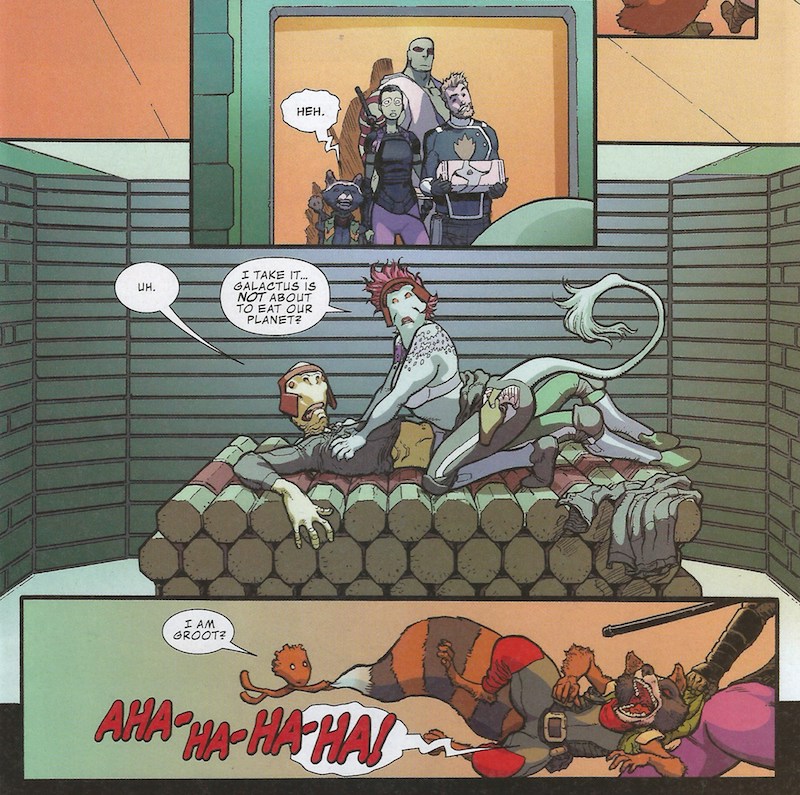
Rocket’s laugh is a dead-on accurate replication of Bradly Cooper’s voicing. One of the many things that Marvel got right in these movies is that Rocket should sound fairly normal, not like cosmos-forbid Scrappy-Doo.
With the vault breached, the Guardians meet their buyer, and it’s an elder friend of any Marvel reader that dipped a toe in the pool of the Power Cosmic.
With the vault breached, the Guardians meet their buyer, and it’s an elder friend of any Marvel reader that dipped a toe in the pool of the Power Cosmic.

The Grandmaster not known for his sense of humor gains one in Duggan's story. This comedy arises from his disdain for fellow elder The Collector. The Guardians however are not just thieves. They possess a sense of honor.

The Grandmaster’s explanation is a valid one, and it’s symbolic of the stakes the Guardians play for. This is the book you want to read after you see the fantastic Guardians of the Galaxy Vol. 2.

The Green Lantern Corps abduct fellow Green Lanterns Simon Baz and Jessica Cruz. This light-hearted issue includes the return of fan-favorite Kyle Rayner, restored to green and happy.

The always welcoming Kilowog.

John Stewart.

The coffee comment is a funny running gag in reverse. And the unlovely Guy Gardner.

Sam Humphries’ writing is so bouncy you expect to follow a ball somewhere in the panels, and Ronan Cliquet’s artwork is utterly gorgeous, perfect for representing the diversity of the Green Lantern Corps. I expect a lot of fun reading from this story.

A surprising dramatic turn in Aquaman upsets an otherwise linear superhero vs. monster treatment. With the secret of Deep Water uncovered, Aquaman finds his friends and enemies in a different kind of danger. To make matters worse, the artist formerly known as the Scavenger initiates the ticking time bomb.

Aquaman's solution gains him numerous allies and laurels, but not from everyone. Mera's opinion raises the depth of the story up a level. The reader will recognize some truth in what she says, punctuated by artist Phil Briones' dramatic renditions of uneasiness in the form of body language and expression.

Aquaman's solution gains him numerous allies and laurels, but not from everyone. Mera's opinion raises the depth of the story up a level. The reader will recognize some truth in what she says, punctuated by artist Phil Briones' dramatic renditions of uneasiness in the form of body language and expression.

During “The Death of Superman” storyline, er, the second one, I kept disparaging Lois Lane or as I unaffectionately referred to her, the Lo-Bot. I don’t apologize. She was lifeless. It looked as if her entire existence got sucked into the black hole called motherhood, which is a stereotype from bygone days of the hell christened the 1950s.

The idea is that if a woman you got married and quit your job to raise the kids while hubby brought home the bacon and served a different kind of bacon to his secretary. Hubby always had one. That paradigm changed when generations became enlightened. Men started to recognize women as people. In turn, women fought for their rights. Equal partners became the norm.

DC restored Superman, and they also restored Lois Lane. If anything Superman presents the revenge of Lois Lane. Everything you want in Lois Lane is here. The story started two issues ago with Batman making an unannounced visit to the Kent Farm, er, the second one.

Batman didn’t doubt Superman’s claim that he made certain Hamilton County was secure before bringing Lois and Jon here, but he knows something's amiss. Being the Dark Knight Detective, he investigates. Batman unfortunately finds what he’s looking for.
Soon, Superman, Robin and Jon start seeking the missing Batman, but the boys fall victim to what lurks in Hamilton County. The Man of Steel on the other hand gets to the heart of the matter, but Superman’s focus is Lois Lane, and writer Peter Tomasi announces her return on the very first page.


That's the feisty take-no-shit Lois Lane I know and love. Lois finds her own sign of threat and mystery.

Her inner thoughts reveal a depth of character. Soon she’s fighting the pod-people…

…but in ways you cannot imagine.

That would be Lois Lane Driving the Batmobile.
This is Lois Lane. Ace reporter, wife to Superman, mother to Superboy and friend to Batman and Wonder Woman. That’s what I wanted to see. That’s what everybody gets.

Batman of course is huge. Another vital piece in “The Button” crossover with The Flash, it involves all sorts of cosmic shenanigans, and there’s no way I can chat about it without spoiling the whole thing. Suffice to say, you need this in your comic book collection.


