Monday, May 29, 2017

POBB May 17, 2017 Part II

Pick of the Brown Bag 
May 17, 2017
by
Ray Tate

Welcome to the Pick of the Brown Bag's continuing coverage of the mother lode of comics books on the week of May 17, 2017.  For this installment, I review Aquaman, the Deep, Justice League and the Might Morphin Power Rangers, Monsters Unleashed and Red Sonja.


Aquaman looks surprised on the cover, and that’s a fitting reaction.  While he investigated the reappearance of the monster Deep Water in “H.20” a recommended “Who Goes There?” homage, the terrorist group, the Deluge took over Atlantis under their leader Corum Rath.

The Deluge are a group of racist Atlantean kooks.  They do not accept Aquaman as the rightful king of Atlantis and abhor the surface world.

Aquaman has been deposed before, but what makes Dan Abnett’s story different is that it reflects current political climate.  


The Deluge mirror the technologically savvy racists that elected Donald Trump.  They do not accept Arthur as King much in the same way Birthers refused to accept Barack Obama as President, American or human.  Unlike Birther vs Obama, Arthur’s humanity disgusts the Deluge, and they believe his heritage diminishes his right to rule Atlantis.


Corum Rath is of course Donald Trump.  Added to what Mera said and an eternal bad hair day, he exhibits the same kind of treasonous bent, such as the desire to destroy Bill of Rights.  


Aquaman and Mera would dispose of Rath and the Deluge quite easily if the loons weren’t enabled by the Council of Elders and goofy fortune-telling cult the Widowhood.  


You can argue the Atlantean high muckily-mucks add a congressional and religious component to the parallel, but that doesn’t quite work.  The Council of Elders are comprised of learned men and women.  The Widowhood consist entirely of women.  These attributes obviously counter real life.  

The Elders are fed up with Aquaman's want to play super-hero.  Do your job as King, Aquaman.  That seems like a valid reason for the usurp.  In truth, Aquaman's role as a champion of justice preserved Atlantis from being wiped off the face of the earth.  Although technologically advanced, Atlantis would not have withstood the horrible might of the U.S. nuclear arsenal.  Indeed, Aquaman's hands-on approach to ruling always benefits Atlantis.  His regent Tula handled the day to day activities. Furthermore, Aquaman's mutant abilities--yes, he's a mutant--make his activity less risky in comparison to true life warrior kings or modern day officials protected by operatives.

Abnett also draws upon Brexit's isolationist attitudes and the overall general idiocy associated with global politics.  However, thanks to the artistic input of Scott Eaton, Wayne Faucher and colorist Gabe Eltaeb Aquaman is much more exciting than "Stupid Watergate."


For all-ages action at sea I recommend Tom Taylor’s and James Brouer’s The Deep.  The focus is on a family of aquanauts: Will, Kaiko, Fontaine and Antaeus Nekton.  Last issue, they discovered the island of Taratuga, off the coast of Brazil, is free-floating.


Usually, when somebody discovers such a thing Gamera can’t be too far behind, but I don’t see any kaiju behind this anomaly.  


This island is inhabited.  The denizens civilized.  The governor’s so civilized that he’d like the Nektons to not upset the tourist trade.  So, it’s up to the family of voyagers to find out what’s going on delicately.


The old man positioned behind Will is named Nereus.  They picked him up in the last adventure when he posed as an ordinary fisherman.  He appears to be a Merlinesque figure, but there are limits to his knowledge.


The Deep is impeccably researched.  Although Taratuga doesn’t exist, the map to which Will refers does.  The ancient map suggests that Taratuga always has been a free-floating island, and Will decides to find out why and how it may tie-in to his holy grail of research.  Meanwhile, Ant and Fontaine go spelunking.

I like that the parents don’t coddle their children.  Ant and Fontaine are explorers and budding scientists.  They send a positive message about both aspects in life.  Though they get into trouble, they don't actually look for it.  Ant and Fontaine are cautious but curious. It’s a long way down the cavern, and brother and sister have a chat about what happened last issue.


Ant taught his fish Jeffrey how to fetch, and that came in handy when the Nektons were trapped in a ravaged mini-sub.  Fontaine has yet to live it down.  She thought it impossible to teach a fish to do anything.  Ant of course lords it over her in hilarious scenes as they descend.  Their rappel-conversation is somewhat reminiscent of Batman and Robin talking as they climb up and down the side of a building ala Adam West and Burt Ward.  


Tom Taylor is also behind Justice League and the Mighty Morphin Power Rangers.  Although I never could count myself among the fans of MMPR, Taylor made this book fairly user friendly.  The kids are all right.  Even Batman approves.


Batman’s really an old softie when you think about it.  He’s gruff and grim because he cares, especially about teenagers that might be biting off more than they can chew.  Chalk that up to his experience training Robin.  However, the MMPR proved their skill and want to do good, and that’s good enough for the Dark Knight.  


Some may object to this personality, and prefer the automaton from the post-Crisis.  I am not one of those people.  I grew up with the Justice League in the Bronze Age of comics and the Silver and Golden Age reprints.  I found the Silver Age to be somewhat silly but acceptable.  The Bronze Age however is cogent, a fine strike between sophistication and the gee-whiz childhood wonder of the Golden Age.  The Bronze Age informs the New 52.


Throughout the series, Taylor builds on Black Ranger Zack’s characterization.  In this issue, we see him experience a horror courtesy of Brainiac.  Taylor creates an excellent reason why the Justice League cannot interfere with Brainiac’s collection process.  Brainiac’s m.o. furthermore sets the ticking clock.


For me though, the coolest thing in the book is without a doubt the moment that the Justice League need to heft the Cern Large Hadron Collider.

Artist Stephen Byrne creates the perfect moment demonstrating that the Justice League isn’t just any supergroup.  They do the impossible.

Like The Damned Cullen Bunn’s Monsters Unleashed is a mess, but because of Marvel’s history, it makes perfect sense and entertains to no end.  In fact this could be a really amazing animated series.  The newcomers to the Marvel mash are Kei Kawande known as Kid Kaiju and his monsters and robots, which literally breathe life from the pages he illustrates.  Kid Kaiju’s creations are distinct and gorgeously drawn to scale by David Baldeon.


Elsa Bloodstone is his bodyguard.  Elsa brings her terrific cynical personality to the mix.  It’s the perfect tonic to the wish fulfillment element.  

As the "pasty toads" may have clued, Kid Kaiju’s not behind all the monsters.  They instead battle the Leviathons, creatures from elsewhere that attacked the earth in the former miniseries.  The Mole Man now commands the Leviathons, but he’s only one in a cadre of mad geniuses.


Wonder Woman and Bionic Woman tried to do something similar.  Shebang all of their bad guys for a mad roundtable.  All we got is a round of boring exposition and biographies.  Bunn and Baldeon do it right.  We’ve got backstabbing, betrayal and threats as each bad brain hold it together while being forced to work with inferior intellects: MODOK, Mr. Sinister, The Thinker and the Leader.  Monsters Unleashed is rated T for teen, but I think this is great stuff for comic book fans of all-ages.  It's how the Hanna-Barbera Godzilla cartoon series should have played.


In a battle against Red Sonja, Khulan Gath cast a spell that transported the and his adversary into the future.  Gath arrived earlier than Sonja who dropped into a present already influenced by Gath, a financier of great renown.  Sonja met Officer Max Mendoza who learns of his own secrets.  She finds the new world she inhabits strange but amenable.  Sonja makes new allies and renews her enmity against Gath, who tries to kill her by sending a dragon at the museum where she and Max confronted Gath.  Gath is certain the She-Devil is now dead, and opts for random carnage.  


Sonja and Max survived the onslaught and now with their friends including, Amy Chu apparently being a G.I. Joe cartoon fan, Lady Jay.  Who was one of the coolest Joes.


As you can see, a new artist helps regular illustrator Carlos Gomez.  Marcio Fiorito has a vastly different style, and a greater love for intricate detail.  I still prefer Gomez’s fluid anatomy which creates a unique frisson.

However, Fiorito still renders within the tradition’s demands, and does it beautifully. 


The whole of the book details the formation of a plan to end Gath’s reign and save the city from the dragon.  Max’s attributes trigger ideas from Sonja’s sharp allies, while she and Max provide the lure.


Gath cannot resist smiting Sonja himself, but this is a trap in progress that Sonja and Max must first test.  This issue of Red Sonja is another winner, filled with interesting interaction between an eccentric cast of characters.  The plot fascinates because its all a test phase, and Chu emphasizes the bravery of the players because they don’t know if their plans will work at all.

Wednesday, May 24, 2017

POBB May 17, 2017

Pick of the Brown Bag 
May 17, 2017
by
Ray Tate

Welcome to the Pick of the Brown Bag.  My name is Ray Tate.   In this blog I pick the best and worst comic books of the week.  

If you don't see a comic book amongst the contenders, it usually means mediocrity or ignored.  However, this posting of the POBB was an epic fail.  

I couldn't process all the reviews in one fell swoop.  Furthermore, a couple of covers threw me.  So, I actually missed titles not on my subscription list like The Flash that I've been following.  

The Tweets are all current.  Therefore, whenever I blow it, or you haven’t any time for the blog, and you need advice, check me out on Twitter: #PickoftheBrownBag.

For this installment of the Pick of the Brown Bag I look at Batman, Green Lanterns, Nightwing, Satellite Falling, Superman, Trinity and Wonder Woman and the Bionic Woman.  


In the latest issue of Satellite Falling, Lily engages in a final duel with a representative of the racist earth.  Her alien ally Holden faces grave danger in the heart of space, and pirates attempt to scuttle her crew's journey home.

There's no disguising my disappointment with Satellite Falling's conclusion.  First, Stephen Thompson isn't on hand to illustrate.  


Martin Morazzo is a decent artist, but this new version of Lilly starkly contrasts her appearance in the first four issues.


I understand that each artist will have his or her own interpretation of the same characters, but these characters shouldn't look like different people.  Why are Lily's ears now so prominent? Why doesn't she have eyebrows? Why does she have a gap between her teeth?  None of these changes make sense.  Especially the gap.  It's the alien future.  Technology should be able to regenerate teeth.

Morazzo's choice of style is a valid one, but I'd wager Thompson studied illustrators like Virgil Finlay, Kelly Freas and Wayne Barlowe.  As a result, Satellite Falling became a stunning tapestry of pulp science fiction aestheticism and exotic diversity.  Now, it looks cartoony.  On the flip side, Morazzo's illustration of the rescue is above competent.


Both Stephen Horton and Morazzo deserve credit for the unseen pirate battle that's nevertheless exciting because of the staging and originality.  Overall however this isn't the best written issue of Satellite Falling.

What exactly happened in act one? I understand that the Ghostbusters Trap went kaboom off of the bad guy's forcefield, but why is there a Ghostbusters Trap floating in the book anyway?


Although the heroes-welcome-home scene makes sense, it and the moments that dovetail are a little too rushed.  The return to Satellite, the recognition, the consequences of the genetic weapon, the adoption, the where are they now reflection, the toast to lost comrades all squeeze together without room to breathe.  Each of these elements offers enough material for issues of exploration.  


Sam Humphries' Green Lanterns training day story is as entertaining as I hoped it would be.  Guy Gardner puts Jessica Cruz through the wringer.


Artist Eduardo Pansica creates a ridiculously over the top Guy Gardner.  Guy's anatomy is realistic.  His cheerfully horrible expressions are unlovely exaggerations.  


Jessica Cruz is a stunner.  That's been a consistency since her debut in Justice League.  However Pansica eschews cheesecake emphasis.  In each panel, Jessica is very clearly exhausted.  This just doubles the comedy.  


Your first reaction to Jessica is that she could be a model.  Guy's got her toting green engines on her back, on long treks up mountains.  The sight of Kilowog startled her last issue, but as you can see, Jessica learned there are worse things in the universe than Kilowog.  All of them named Guy.  Meanwhile, Kyle Rayner takes Simon Baz out of his comfort zone.


In other words, Simon encounters Freakazoid's biggest fan.  Kyle the most creative of the Lanterns humiliates Baz.  You'll also note that the rules Kyle sets down, reflective of Green Lantern history intersecting with Batman, become the enraged fuel for Jessica's revenge.  So there's a nice switch of roles in the plot.


Superman.  Oh, Superman.  I’ve been enjoying the hell out of “Black Dawn.”  So why did you pie me in the face? 


This chapter starts out so well.  What seems to be the Big Bad of the piece ensnares Lois Lane, but this isn’t the lousy Lois Lane from a couple of months ago.


This is the rejuvenated take-no-prisoners Lois Lane that’s a career woman, champion, wife and a mom.  She wears the glove from Batman’s Hellbat armor, which came in handy for loads of awesome tactics last issue.  Lois however contends against something no normal human can overcome.  Even one with a fistful of Batman tech.

If there’s a top ten list of stupid moves a villain can make, torturing Lois Lane must be number one.  When you hurt Lois Lane, you get this.

When Lois is threatened or worse, Superman’s an unstoppable force.  Even Batman would fail miserably against him.  Superman’s rage is palpable throughout artist Doug Mahnke’s panels, yet he’s still Superman and filled with mercy.  


This is in fact the very heart of the plot.  As the story plays out, events become stranger.  Superman and Lois Lane battle against the County of Hamilton and a slew of monsters manifesting from nowhere.  Writers Peter Tomasi and Patrick Gleason juxtapose the parents’ plight against a bound Jonathan Kent forced to watch.


Liar.  The speaker levies bullshit arguments as attractive as his cigar.  The monsters are all his doing.  Their behavior is a result of his chaos.  Superman cannot present a counterargument because of the alien sanctions, nor can he show Jon the monsters in their normal states.  The villain of the piece is a dim memory from Superman’s roster of sphincters and low-level foes bloated with power just to make them punchable.  I hoped never to see this utter twat again.  Alas.  


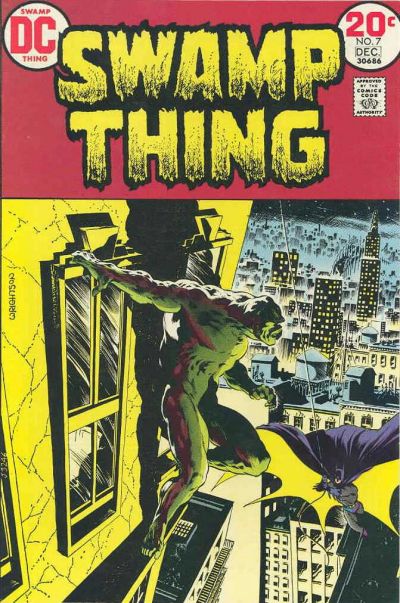
In Tom King's latest, Batman teams up with Swamp Thing to investigate a murder that's personal to the Champion of the Green.


Where to begin with this stand-alone masterpiece? Batman and Swamp Thing have a long history.  In the Bronze Age, Swamp Thing traces the murderers of his wife Linda Holland to Gotham City.  

Batman and Swamp Thing meet again twice in The Brave and the Bold.  Most however are familiar with the edgier Batman/Swamp Thing encounters under Alan Moore’s aegis.  This issue of Batman marks their first partnership in the modern age, and it’s a true mystery.

King’s erstwhile co-creator Mitch Gerads evokes surreal imagery as the swamp comes to Wayne Manor.  Swamp Thing and Batman conduct an unusual dialogue, which seems to be exactly as weird and holistic as you expect.  It however punches with more impact at the conclusion.  After listening to Swamp Thing's case, Batman decides to help.  


Batman’s detective work is sharp and accurate.  He first move is to investigate the strange circumstance of the victim’s death.  This leads him to a mover and shaker of well known status in Gotham City.  From there he interrogates a wheeler and dealer.  Observation and deduction combined with the killer's signature reveals the identity of the culprit.  In one of the humorous undercurrents, Swamp Thing takes Batman right to the killer’s current whereabouts.  So it ends, but it doesn’t.

King’s finale is subjective.  Swamp Thing’s answer to why he came to Gotham is interpretive.  Batman’s reaction is priceless.  The final act incorporates drama and comedy.  Swamp Thing’s actions seem to return Batman to childhood.  He does the only thing he can.  A pyrrhic gesture at best.  What’s furthermore remarkable is that Swamp Thing and Batman smoothly switch definitions.  


I picked the most innocuous visuals in a book brimming with extraordinary panels to keep the secrets and safeguard the comic sensibilities.  In general, Gerads' art is perfect for King’s story.  Gerads adds an extra pulpy spin to the whole affair.  He creates a very human, textured Batman that’s contrasted with the strange beauty of Swamp Thing.  This is not to say that regular artist David Finch or Mikel Janin wouldn't have done as good of a job.  Gerads' rendering is simply different and apt for the quirky atmosphere.


Wonder Woman and Bionic Woman only becomes notable in the last act where Jaime, Diana and visiting Wonder Girl Drusilla breach the bad guys’ lair and fight Fembots.  The cadre of evil doctors though anticipated the Amazon’s arrival and programmed the robots to counter her interference.  This creates a strong cliffhanger.

To get here, we have to wade through an interminable amount of boring exposition, an embarrassing comparison of Steve Trevor and Steve Austin, a sleep-inducing tour of Paradise Island, with far too many introductions and a Big Bad jamboree of lifeless dialogue.  A skippable issue I’m sorry to say.


I avoided Trinity for the same reason I eschewed Superman and Wonder Woman.  I had no interest in the Superman/Wonder Woman romance.  Unlike some fans, I wasn’t vehemently opposed to the match.  I just saw no reason to become invested.  Superman and Lois Lane are eternal.  I felt the tryst was temporary at best.  With the restoration of Superman’s history, we now know that to be true.  


From Action Comics #978

According to the restored history, there never was a romance.  So, I can peruse Trinity, a comic series with a focus on Batman, Superman and Wonder Woman, without any ephemeral distractions.

My original interest in Trinity originates from Francis Manapul as writer/artist.  I’ve kept my eyes open for Manapul.  Way, way back, Manapul illustrated Witchblade.  


His work adhered to the Image style of house-art.  A sort of skewed Anime leaning into traditional western comic book illustration. Manapul however stood out as an overall good artist.  His anatomy and expression were better than most.  The Powers That Be likely chose him to class up what once was merely T & A, to equate with a still highly regarded television series.


Manapul evolved over the years to what you see currently.  The unique look debuted in The Flash.  Because this issue of Trinity guest-stars the Justice League, you’ll get to see Manapul once again rendering Barry Allen spectacularly.


The story, “Dead Space” begins with the aftermath of an attack on the Justice League Watchtower.  Manapul gives the frequently forgotten Cyborg a moment to shine, for he is the one that alerts Batman, Superman and Wonder Woman to action.


The splash page is significant because Manapul knows that this is actually the first moment where Batman, Superman and Wonder Woman have reunited, with respect to Superman’s reconstitution.  On the Watchtower, Manapul characterizes the trio while demonstrating their talents and powers.


Trinity doesn’t disappoint.  In terms of writing and illustration, Manapul exhibits a flair for the three heroes, and his return to the Flash is as funny and eventful as you can hope.  The plot is simple though strong, and this issue is an excellent jump-on point for new readers.


Nightwing is a good, solid stand-alone team-up of once partners in justice Nightwing and The Flash (Kid Flash, if you prefer).  The reunion isn't breaking any new ground, but writer Luke McMillian exhibits empathy with the characters and knowledge about current events in Dan Abnett's Titans.

McMillian's recognition of the now allows for a more cohesive plot and lively dialogue.  His overall understanding of the heroes' strengths fortifies the plot even more.

The story begins simply enough.  Nightwing interrupts a hold up, but McMillian asks the question what if we twisted that ordinary superhero trope this way.  You get an unexpected outcome that requires the timely intervention of The Flash. 


After serving and protecting, Dick and Wally go out for a night on the town.  These scenes read ordinary, yet they're well-written because they still hold your attention.


Nightwing's reputation as a hound from the previous era thankfully diminished with the New 52.  It was extremely annoying how many female superheroes fell into that undeserving ass' bed.   McMillian presents believable occurrences such as instant attraction, but ultimate disinterest.  He furthermore demonstrates that because of Dick's and Wally's strong parental influences, they're kind of square.  Opting for sharing popcorn at a revival of an old pirate movie.

The movie acts doubly.  It's the perfect venue for extraordinary crime.  

McMillian proves himself capable of infusing new life into the typical superhero vs villain device.  I also like how the criminal's successes escalate his level of evil and the natural generation of risk McMillian evolves.  Nightwing's plot never seems forced, and artists Christian Duce and Chris Sotomayor are in perfect synch with the writer's aims.