Pick of the Brown Bag
September 21, 2017
by
Ray Tate
Welcome to the Pick of the Brown Bag. I’m Ray Tate your reviewer d’jour. This week I examine Aquaman, Batman, Bug, Generations: Ms. Marvel, Green Lanterns, Green Arrow, Guardians of the Galaxy, Mighty Mouse, Shirtless Bear-Fighter, Superman and Wonder Woman/Bionic Woman. Due to a hectic week, these reviews are seriously late. However, the teensy versions were published on Twitter well in advance. It's my goal to get the reviews posted before comic book day to inform your decision-making on fence-straddling comic books and save you money by warning you about potentially terrible purchases: #PickoftheBrownBag.

The Cosmic Cube deposits Kamala Khan alias Ms. Marvel unceremoniously to the 1970s where the original Ms. Marvel operates. Immediately you should notice something. A young girl with dark skin appears out of nowhere and the first thing a guy tries to do is help her.

He calls her dear. That’s so sweet.
The 1970s was an era of historical social stability. Normal, every day people were not afraid, were not persuaded to be afraid. An alleged news station promulgating fear and misinformation didn’t exist. Racists were treated like criminals and put in jail not in positions of power. It was not a perfect time, but people valued education and science. Reason guided them. Even the Republican Party.
Anyway. In the 1970s Carol Danvers ran Woman, a lady's magazine, for J. Jonah Jameson. Kamala finds herself drawn into a missing intern’s slot. Another hilarious J. Jonah moment.

At Woman Kamala reminds herself why she adopted the name Ms. Marvel when she discovered she was an Inhuman.

At Woman Kamala reminds herself why she adopted the name Ms. Marvel when she discovered she was an Inhuman.

I liked this special issue of Ms. Marvel. It frames a different time perfectly and subtly. The welcome diversity and a charged women’s lib movement works in the background of a mostly sensible Marvel Universe. Kamala is as engaging as always, and Carol’s purer. The time travel element is trickier, and I didn’t quite understand the importance of Kamala’s trip until I made the Fox News connection.

Barbara Nelson is of course exactly what Kamala identifies. She’s a poorly disguised Shiar warrior, possibly an early version of Deathbird. She battles Carol in the boardroom as well as the rooftops.

If Kamala hadn’t interfered, it’s possible that Jonah would have sold Carol’s magazine to Nelson. The sale would have given the Shiar the potential for a propaganda machine. A Shiar Fox News. Instead, Kamala infuses Carol’s magazine with new life, protects the timeline and impedes an alien invasion centered on the mind. Not bad at all.

Guardians of the Galaxy completes the heist that Peter Quill and his cohorts intended to pull on the Grandmaster. The Grandmaster hired the Guardians to steal a cosmic egg from the Collector. Perhaps for a starry omelette. After a go around with Gamora, the Collector proposed a swap of eggs to sabotage his brother’s scheme. Things go haywire quite early.

The egg swap catalyst does not play out as expected, or even as imagined. In fact Gerry Duggan’s story is a complete pleasant and funny surprise. This becomes apparent when the Collector shows up to chastise his brother.

There’s even more weirdness to come.

From issue one, the Guardians dealt with Marvel’s Elders of the Universe. Duggan hid his secretive ploy amidst the team’s apparent reformation—hence the modifier all-new—and the promise of immediate dissolution. Of course, if you refused to read Brian Bendis’ shenanigans, the cinematic Guardians of the Galaxy always were the Guardians of the Galaxy.

Duggan meant for the heist to be one last hurrah like Doctor Who’s “Mummy on the Orient Express.” Instead, he kept creating reasons for the Guardians to stay together, and all of those reasons figured with Elders. At the same time, some crazy dude cultivated Groots left and right, and that subplot also surprisingly involved an Elder. Duggan reinforces friendship and purpose while maintaining the roster of Guardians of the Galaxy and creating damn entertaining stories bursting with imagination and humor apt for these space-faring heroes/thieves.

DC is the champion of bad time travel stories. Green Lanterns is a rarity. Freed from possession by Volthoom, Rami listens to tale spun by the ancient Tamaranian Tyran’r. The feline's story relates how present day Lanterns Jessica Cruz and Simon Baz preserved history.

If this heady mix disturbs you. Not to worry. There’s plenty of fisticuffs as Simon Baz fights Volthoom in the past with renewed willpower, but the resolution doesn't depend on beatings. It depends on altruism.

The last of the original Seven Green Lanterns, a Martian once bent on vengeance, tempers power with morality. Jessica Cruz who in her past became Volthoom’s pawn carries his last desires to their emotional end.

Humphries' story demonstrates Jessica’s remarkable growth as a confident hero that overcomes fear on a routine basis. She’s actually risking that maturity when willing to sacrifice it for Volthoom's happiness. Unfortunately for psychologically damaged Volthoom, the little blue men show up. They mean to do good but end up triggering the entire event. Although they don’t know it, they and against their wishes Volthoom cleanse the timeline.

For the past year or so, the Green Arrow began uncovering a conspiracy of war profiteers known as the Ninth Circle. As he progressed in breaking the criminal organization, he teamed up with individual members of the Justice League. The last chapter in the Ninth Circle storyarc hits the racks with the promise of the full League roster on the cover. Alas, no. The League arrive late in the game to save lives from the threat of falling debris. The debris is courtesy of the Green Arrow fighting the Ninth Circle’s ghoulish headman in space.

You can argue that the Arrow may be reckless for creating the disaster, but I think his move against the Ninth Circle was justified. The Arrow knows the League is watching his back. He knows they pick up the pieces. Even if he’s one of them. That displays a change of attitude playing out to a greater extent at the conclusion.
Hal Jordan enabled Green Arrow to reach the stars in the first place. I’m no Hal Jordan fan. So I skipped that previous issue. In pat eras, writers used Hal Jordan as a counterpoint to the Green Arrow’s knee-jerk liberalism. In the new 52, Hal’s much improved. I’m still not wild about him, but I must admit. Hal is actually pretty heroic for this adventure.

In addition to the JLA cameos as well as the epilogue that changes nothing and everything, the Black Canary’s solo subplot is an exciting piece of business that subtly decries the crimes perpetuated against her in The Longbow Hunters.

Some people hold Longbow Hunters in high esteem. I consider it distasteful and sexist twaddle detrimental to the Black Canary. Dinah really didn’t recover her glory until the new 52, and it wasn’t until the new 52 that I picked up another Green Arrow book. No coincidence.

Some people hold Longbow Hunters in high esteem. I consider it distasteful and sexist twaddle detrimental to the Black Canary. Dinah really didn’t recover her glory until the new 52, and it wasn’t until the new 52 that I picked up another Green Arrow book. No coincidence.

Aquaman, using his telepathic powers, battles a whackjob beneath the seas. New partner in crime Dolphin assists in a most interesting and non-violent way. Mera and Aqualad seek to breach the Crown of Thorns that isolates Atlantis and keeps Aquaman a prisoner. Vulko and Ondine travel through the land of the dead to reach the weapon needed to stop Donald Trump like usurper Corum Rath.

The maniac behind the coral-magic is Kadaver, enforcer to the Underwater Underworld’s mutant wannabe Kingpin Krush. The fight between Kadaver and Aquaman is an exciting one with escalating threat. In fact Dolphin is the only reason why Aquaman wins. So, you could say they cheated, double-teaming against a single foe. It grants Aquaman a nuance of difference and builds on the idea that Aquaman is better suited as a rogue rather than noble King. In fact I question whether or not Aquaman will regain the throne even after Rath's inevitable defeat.
Contrasting the almost primal duel against Kadaver, artist Stjepan Sejic educes whimsy from the scenes with Vulko and Ondine’s. The duo must run a gauntlet of ghosts.

Writer Dan Abnett chose to make this comedic relief. Sejic is on board with amusing expressions from Ondine and a little bit too chipper Vulko. Perhaps the writer and artist know that most ghost stories suck immensely and they're better off leaning toward the lighter side.

For those who came late to the bijou, Batman took an important step to fulfill his father's want. Like any good parent, Thomas Wayne wished for his son to be happy. Gotham Girl for whom Batman moved planets also wants Batman to be happy. In a surprising twist on history, Batman actually listens. Batman's decision triggers the reminiscence of his second year, and Batman narrates "The War of Jokes and Riddles."
The Joker and the Riddler have given a name to their pain, and it is Batman. Apologies to Tim Burton and company. The Riddler proposed an alliance. That didn’t go well.

With the first shot fired, the indignant mortally wounded Riddler decided to wipe the Joker off the face of the earth. To that end, the Joker and the Riddler gathered allies to form armies and cut through established crime families like scythes through wheat. The "soldiers" then duke it out on the streets. Innocent Gothamites suffer in their wake.

With the first shot fired, the indignant mortally wounded Riddler decided to wipe the Joker off the face of the earth. To that end, the Joker and the Riddler gathered allies to form armies and cut through established crime families like scythes through wheat. The "soldiers" then duke it out on the streets. Innocent Gothamites suffer in their wake.

Through a dinner party as Bruce Wayne, Batman changed the war. Now that plan begins to wind down with an assured victory for the Dark Knight. You can argue that Tom King’s tale isn’t nearly as important as the much hyped “Metal.” It’s after all set in the past. So, you know certain things, like Catwoman will definitely survive whatever’s tossed at her.

She can’t die. She’s here in the now, and King doesn’t try to inflate the importance of his story. He instead writes a tale for generations of Batman fans. The entirety of the Batman community can enjoy Batman’s remarkable intelligence. The humor of such lines in describing Alfred’s mode of transport will appeal to Batman Adam West aficionados and Animated Series watchers. Post-Crisis Batman fans will appreciate Catwoman’s Jim Balent era tights. Historical Batman followers will glom onto a Joker that fits right in with his scarier 1940s incarnation and find a rogue's gallery that spans different periods. "The War of Jokes and Riddles" is for every Batman fan.

Wonder Woman and the Bionic Woman concludes strongly with an a side and b side that work individually but contribute to the legend of both title femme’s worlds. Drusilla is Wonder Woman’s sister in the television series. She teams up with Rudy Welles and Max the Bionic Dog to escape Dr. Cyber's deathtrap. By the way, Max's sobriquet may sound silly, but I assure you. Max's introduction in The Bionic Woman was drama at its finest.

The villains have their asses handed to them on Paradise Island as well. Wonder Woman and Jaime come up with a good plan to eliminate the threat of the Fembots in one fell swoop. The plan involves the very heart of Paradise Island, somewhat undisclosed yet plausibly imagined within the television series confines by writer Andy Mangels. The writer furthermore comes up with a clever means to protect Jaime from damage, a sure outcome of the plan, without Amadonna’s help.

Donna is an interdimensional being introduced on the Wonder Woman television series. She's gifted with psionic powers. Mangels doesn’t cheat in his story. Everything present in the comic book is present in the two television series.

Donna is an interdimensional being introduced on the Wonder Woman television series. She's gifted with psionic powers. Mangels doesn’t cheat in his story. Everything present in the comic book is present in the two television series.

Mangels tale is furthermore notable for the fruition of the Amazon philosophy of love and redemption. The former Nazi Fausta and former terrorist Carolyn Hamilton now transferred to the historical Wonder Woman character Nubia both demonstrate camaraderie and good will.

The entirety of the miniseries was unfortunately uneven. The premiere blew me away. The battles on the enemy ship and Paradise Island are terrific, but there’s too much exposition and padding in the team-ups, such as the nonsensical comparison of Steves, as well as a group of villains who get together for a gabfest before turning to the business of taking over Paradise. I cannot fully recommend the full presentation. However, Dynamite will be including some worthwhile extras--including a reference list--in the collected edition that may sway an curious audience.

This issue of Superman continues to reclaim Lois Lane as a feminist role model. Writer James Bonney presents Lois Lane gutsy ace reporter at The Daily Planet. Her goal to get get the truth about Deathstroke.

I also must commend the artwork by Tyler Kirkham and colorist Arif Prianto. Kirkham creates a modern feel to the book, and Lois' purple eyes are notable.

The villain of the piece updates a Golden Age character that crossed swords against Superman in the Justice League of America. Though he’s more of a Hawkman foe. Deathstroke strikes a balance between post-Crisis Teen Titans nemesis and the new 52’s merciful killer. The ending comes as a great gotcha, and this inventory issue of Superman is more enjoyable than one may expect.

Cartoon cats invade an earth similar to our own. The police and the military are powerless to stop them.

Who will save the innocent bystanders about to be diced and crushed in the crossover?

Mighty Mouse of course. Sholly Fisch’s tale of cartoons drawn to our world continues with a strong issue that defines the rules of a game that only Mighty Mouse stands a chance to win.

The previous issues’ attempt to hide Mighty Mouse until his human pal can send him home falls by the way side when the ruthless felines attack. While Mighty Mouse is an enigma, Fisch defies convention by showing a smart populace willing to accept the operatic TV super hero. The witnesses exhibit a remarkable ability to suspend disbelief. Perhaps because physics is also taking a beating before their eyes.
Technically, Mighty Mouse and the invading cats aren’t breaking any physical laws. Both come from another dimension, and they appear to have carried that dimension’s energy with them. The assumption that a visitor from a different universe that works under different laws would be forced to conform to our laws isn’t necessarily true. If we imagine each visitor surrounded by a field of their home’s particles and sub-particles then it may be the opposite. Anything entering their field would become subject to their laws.
Perhaps this is too quantum an explanation for something like Mighty Mouse, but I see no reason to treat the comic book as something lesser. As such, all of the laws in Mighty Mouse cartoons apply. Including the fact that Mighty Mouse isn’t quite as strong or stress resistant as Superman. He can be overcome, and that’s the threat that treats the reader to a surprising denouement.

Shirtless Bear Fighter has everything drama, comedy and absurdity. The series began with the latter two attributes, but the title evolved with a heinous murder treated sternly. Bear Fighter then followed through with a straight up action sequence in which a CEO named Jaxon Logger suborned bears to his control. Really how implausible is this in comparison to say men and women routinely breaking the bonds of gravity? With the exception of Batman, most comic book stories are impossible.

Still Shirtless Bear Fighter is more comedy than drama, with a scatological theme involving toilet paper sales and a death machine that takes the form of a toilet bowl. The form of comedy was cruder, a characterization of human flotsam, in the previous issue than this one.

In addition, Bear Fighter evenly splits the action between the eponymous hero and his bear father and FBI Agent Silva who starts a revolution. Both Bear Fighter and Silva learn truths about their history, and a secret ne’er do well reveals his reasons for turning against Shirtless Bear Fighter.

Monsters Unleashed opens an intriguing new story that kicks off a problem for Kid Kaiju. Sleep drawing.

For anybody else this might be an annoyance, but Kid Kaiju possesses the ability animate anything he draws, and he’s starting to illustrate an old, uncontrollable Marvel malevolence. By the end of the book, you’ll know that the force is clearly manipulating the lad.
Nevertheless, Kid Kaiju believes this only to be a personal problem. So he looks for a confidant, and although Herbie the Robot is willing, the Kid turns to Elsa Bloodstone, his bodyguard. Elsa Bloodstone isn’t known for her empathy, but for a boy of a certain age being alone with a pretty older woman that probably smells nice is more conducive to opening up than chatting with a television robot. However, there's first work to be done.
A realistic danger and a callback to Godzilla, the feel good movie of its summer, requires Kid Kaiju and his team of creatures to intervene.

One of the problems when presenting giant monsters in comic books is that they seldom issue the majesty and awe that arises from movie behemoths. The beasts in Monsters Unleashed all emanate the proper scale and size, courtesy of artist Andrea Broccardo. They furthermore deal with problems in their weight class.
When the smoke clears, the Kid and Elsa can now engage in a proper talk. Elsa possesses a terrific little plot device called Mordred’s Causeway. So, she takes Kid Kaiju to a place that might settle him.
When the smoke clears, the Kid and Elsa can now engage in a proper talk. Elsa possesses a terrific little plot device called Mordred’s Causeway. So, she takes Kid Kaiju to a place that might settle him.

In the Savage Land, the Kid fesses up, and Elsa behaves like a sensible adult. She takes charge of the situation, but not before the orchestrator of the scheme drops by for a sweet little cliffhanger.

Mother Box is a living artificial intelligence that enhances the New Gods lives. It’s the iPhone before the iPhone. For example, one of it’s apps can open up wormholes called Boom Tubes allowing for travel to anywhere in the universe. Another can fix Orion's butt ugly face. The marvelous device has limits. Forager tested those limits last issue. The strain injured not just his Mother Box, but all of them.

The Mother Box as a gestalt entity, an iCloud, is just one of the many ingenious little tit bits Lee Allred conjectures. With Mother Box cocooned for Odinsleep, Forager and his cohorts need another means to follow Chagra, the Big Bad of the piece.
The method draws upon a set of barter dominoes that culminates in a departure from the very entertaining formula from the previous issues.

The method draws upon a set of barter dominoes that culminates in a departure from the very entertaining formula from the previous issues.

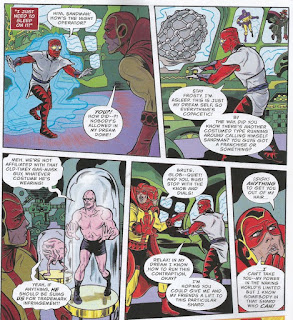
Oh, the King’s characters appear in the pages of Bug, but primarily, the spotlight lies on Deadman, created by Arnold Drake and Carmine Infantino but mostly associated with Neal Adams, the artistic antithesis to Jack Kirby.

The Brave and the Bold #79
Whereas Kirby seldom showed interest in photorealism, Neal Adams put more stock in the technique and revolutionized comic books in the process.
That didn’t stop Kirby from borrowing Deadman for a few stories in The Forever People, and it’s this loose end that truly begins the tale. In order to get on his merry way, Forager must deal with Deadman’s girlfriend.

So Forager seeks out Deadman whose busy beating the snot out of Kobra’s goons. Kirby connection anybody? First issue written and illustrated by Jack Kirby.

Forager and Deadman team up to free Deadman from his robot body, and that involves retrieving the Omphalos, which though broached upon in these pages, actually dates back to ancient Greek mythology and describes several real stone artifacts. The Omphalos in Bug is a device that allows protean changes in any thing, and a group of criminal screwballs are auctioning it off.

In gaining the directions to the auction our heroes learn the solution to a comic book mystery, and they gain another ally from Kirby’s stable.

The reintroduction of the Manhunters indicates Kirby’s pure intentions of comic book nuttiness. This isn’t to say I disliked what was done to the Manhunters after Kirby, but Kirby’s writing is as original as his artwork, and the Allreds are just paying an amazing amount of respect to the source material while still relating their own unique and imaginative story.


