Pick of the Brown Bag
March 6, 2019
by
Ray Tate
Greetings, gentle-beings, welcome to the Pick of the Brown Bag. My name is Ray Tate, and this is my blog. The POBB is dedicated to the best and the worst of comic books. This week it's quality over quantity with Athena Voltaire, Batman, Doctor Who, Immortal Hulk, Red Sonja, Six-Million Dollar Man and the new book via Dark Horse Astro Hustle. Should you not have time for the blog, the Tweets are already live: #PickoftheBrownBag.

A lot of people ask why I don’t review Marvel movies. The answer is simple. They don’t need me. Every Marvel movie will succeed. Sometimes, though. The He-Man-Woman-Hater's Club tries to sabotage films just because they star female protagonists or carry feminist clout.

That of course cannot be allowed. Evil can only flourish when good men turn away.

Brie Larson perfectly embodies one of the most powerful heroes in the Marvel Universe. No, seriously. She is.

You can’t think of anybody else other than Samuel L. Jackson being Nick Fury. Clark Gregg is a youthful Phil Coulson in a cameo that’s pivotal thanks to Iron Man, Avengers and Agents of SHIELD. We also get a well-acted cadre of major and minor characters from Captain Marvel history.

The plot we'll keep secret, but here are a few facts about the history of Captain Marvel that you should keep in mind while watching the film.
Captain Marvel, once Ms. Marvel, didn’t arrive in the Marvel Universe fully-formed. Stan Lee and Gene Colan introduced Carol Danvers in the original Captain Marvel's adventures.
Captain Marvel, once Ms. Marvel, didn’t arrive in the Marvel Universe fully-formed. Stan Lee and Gene Colan introduced Carol Danvers in the original Captain Marvel's adventures.

Head of USAF Security, Carol was meant to be a liberated, potential love interest who had a nod to Supergirl in her name. She never actually dated Captain Marvel, and she kind of sat on the shelf for a little while.

Ms. Marvel didn’t soar into action until the nineteen seventies. She didn’t fly under her own power. She depended on an exoskeleton in her abbreviated Kree uniform, which she changed into instantly, acknowledging Wonder Woman.
Carol didn’t know she was Ms. Marvel. Following the boot-falls of DC's Rose and Thorn, Carol and Ms. Marvel were two different personalities unaware of each other.

The yet-to-be X-Man, Rogue stole Ms. Marvel’s powers. Unlike other absorptions, this one became permanent until those laugh-a-minute Alien rip-offs the Brood tinkered with Carol Danvers’ cells for kicks. They paid for this gag. Releasing the power that Rogue in actuality merely dammed.

It turns out Carol Danvers’ potential hadn’t been reached. She became a being that drew power from a pair of twin stars. Binary. When her friend Captain Marvel died, she took his name and rank to honor his memory.
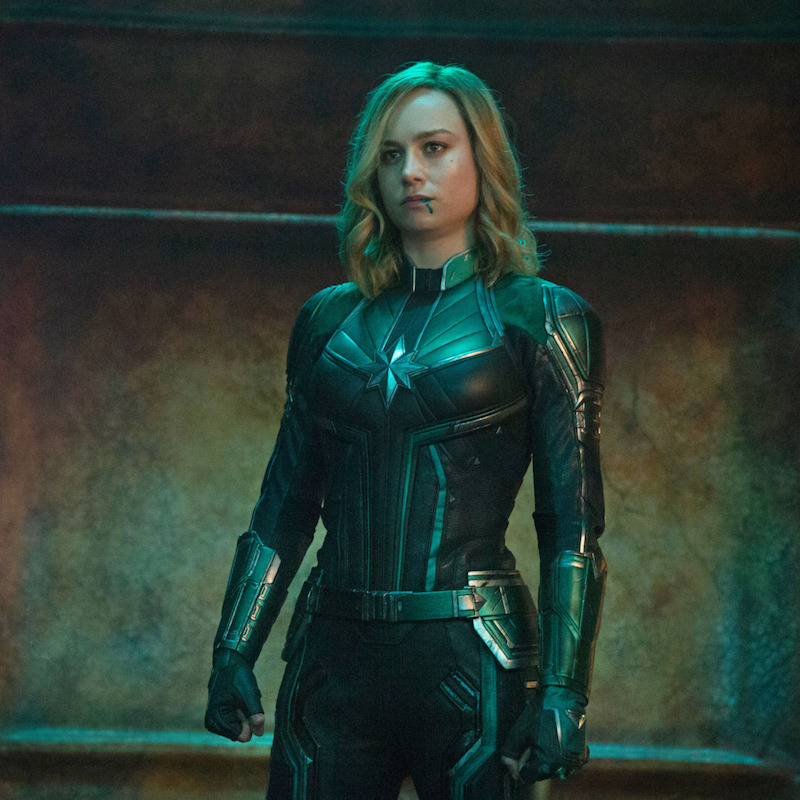
Captain Marvel elegantly addresses each of these tidbits through clever means that snugly fit within the cinematic universe. Captain Marvel in fact loses no history in this movie. The film is one part Wonder Woman. One part Guardians of the Galaxy. All of it good.

Writer Jody Houser drops The Doctor, Yaz, Ryan and Graham in what appears to be a bucolic scene, but the Doctor feels a little different.

The warning alludes to “The Stones of Blood” where The Doctor asks the ladies of the field, the cows, if they’ve seen the Key to Time.
The Doctor could just be pulling everybody’s legs. Artist Rachael Stott deadpans her expression so perfectly that you don’t know. Thus adding to the humor, whatever kind it is.
The Doctor could just be pulling everybody’s legs. Artist Rachael Stott deadpans her expression so perfectly that you don’t know. Thus adding to the humor, whatever kind it is.
The sheep at least for this issue appear to be exactly what they seem. The Doctor leaves them in peace, and in a superb catwalk of body language and face pulling determines the time.

Impressed by her ability, the fam/team are less wowed by her knowledge of earth history. Despite the setting being a fairly obscure period.

The source of that knowledge is hilariously contemporary, and the Doctor's none too pleased with the thunder-stealing. Still, onward and upward.
The Doctor decides to dope out why the TARDIS brought she and the gang to the area. As established, the TARDIS does not necessarily transport the Doctor where she wants to go. She materializes where the Doctor needs to be.
The Doctor decides to dope out why the TARDIS brought she and the gang to the area. As established, the TARDIS does not necessarily transport the Doctor where she wants to go. She materializes where the Doctor needs to be.
Soon, the Doctor encounters a local.

Psychic Paper, introduced in the Christopher Eccleston era of Doctor Who, passively picks the brain of the witness and provides the Doctor with any credentials she needs.
With the chase cut to and a pep talk filled with powerful imagery delivered, the Doctor soon finds something rotten in the Guelders War chronicle.

The creature once revealed is a superb cross between 1950s low-budget science fiction movies and the classic science fiction art book Barlow’s Guide to Extraterrestrials. It is easily the best the archetype ever looked.

It took awhile for the seventh issue of Athena Voltaire to arrive, but once you see the work artist Yusuf Idris put into it, you’ll understand why.

Athena and her friends Desmond and Pippa fly to Nepal in order to beat the Nazis to the punch. The prize is a stolen Da Vinci codex that Athena’s client won at auction.
It might be a key to untold power. It might be a key to a laundry list. Doesn’t matter it’s a MacGuffin for a 3-D chess styled chase.
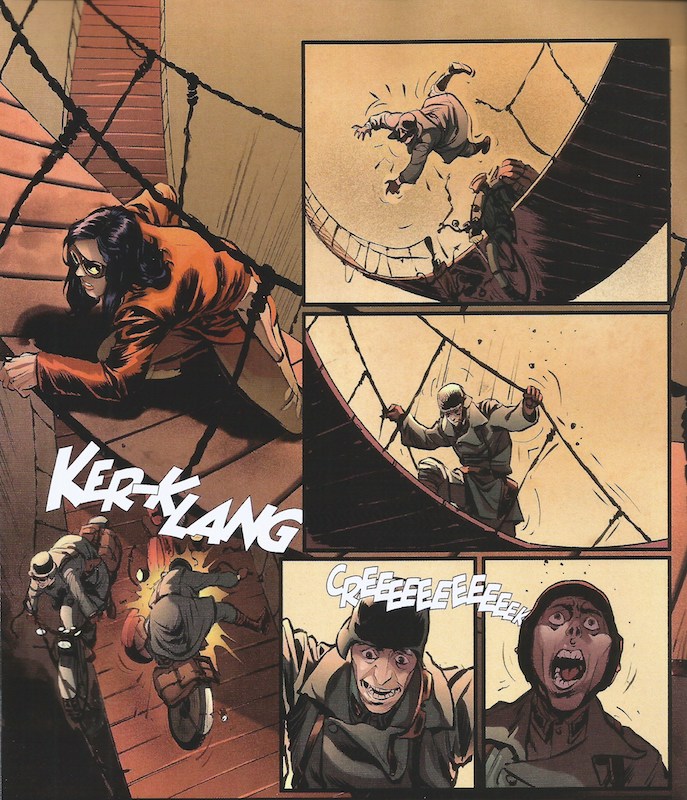
The whole book is like that with Athena, Des and Pippa shooting at, trying to outdrive and climbing away from a squad of determined Nazi soldiers. If that doesn’t float your boat, why the hell are you reading comic books in the first place?

Red Sonja sent out for Cheetos and appointed queen by the People of Hyrkania. Her home town. She must stop a land-grabby self-appointed emperor of the Hyperborea.

Robert E. Howard's Red Sonja is unlike the She-Devil with a Sword. Howard's original appeared during the time of Suliman in the short story “Shadow of the Vulture.”
There’s no real canon to Red Sonja. Roy Thomas introduced Sonja as a barbarian mercenary in his Conan titles. So, she can be reinvented as many times as you please.
Still, very rarely can humor be found in Red Sonja's treks. Amusement? Sure. Generally speaking, Sonja’s adventures are dark and frequently cynical. Often, Sonja barely scrapes a victory. Seldom coin.
Like he did with The Lone Ranger writer Mark Russell infuses a lot comedy to Red Sonja. Former Red Sonja scribe Amy Chu impressed with demonstrations of Sonja's intellect. Sonja figured out our modern age and exploited it quite easily.
There’s no real canon to Red Sonja. Roy Thomas introduced Sonja as a barbarian mercenary in his Conan titles. So, she can be reinvented as many times as you please.
Still, very rarely can humor be found in Red Sonja's treks. Amusement? Sure. Generally speaking, Sonja’s adventures are dark and frequently cynical. Often, Sonja barely scrapes a victory. Seldom coin.
Like he did with The Lone Ranger writer Mark Russell infuses a lot comedy to Red Sonja. Former Red Sonja scribe Amy Chu impressed with demonstrations of Sonja's intellect. Sonja figured out our modern age and exploited it quite easily.

Russell’s Sonja is not only intelligent. She's witty and attacks her opponent with guile utilizing the austere resources of her homeland.
Russell resurrects a surviving family member. This grants Sonja unusual yet fitting warmth without sacrificing her traditonal edge.
Russell resurrects a surviving family member. This grants Sonja unusual yet fitting warmth without sacrificing her traditonal edge.

Illustration by Mirko Colak and Dearbhla Kelly eschews the gloss and bodacious look Sonja acquired and maintained since Frank Thorne artistically defined her.

She would still be noticeable in a crowd. She’s still pretty, a knockout if she took a bath. She still rocks the chain-mail bikini, but there’s a verisimilitude to the newest incarnation of Red Sonja that compliments her tactical mind.

Betty Ross is probably my least favorite Stan Lee/Jack Kirby femme creation. She really had nothing going for her. The daughter of jackass General Thunderbolt Ross, she was an army brat but with none of the brat. Boring best describes Betty.

With the women’s liberation movement taking shape, the Powers That Be at Marvel decided to sex her up a bit and give her some personality. She put on a semi-revealing dress, gussied up her hair in a more natural, lengthier look and exclaimed something like "Look out world, it's a new Betty Ross." Still boring.

Betty at least looked and behaved like a contemporary woman and not a nineteen-fifties fembot. I'll give her that.

Bill Bixby was the best thing that ever happened to Bruce Banner. Mark Ruffalo the second best thing. Natalie Portman was the second best thing to happen to Jane Foster. One the first. Gwyneth Paltrow was the best thing to happen to Pepper Potts. Sharon Carter always a bad ass. Sue Storm always a super hero, but Betty Ross. Nothing. Sorry. You can call her She-Hulk if you want but Bruce’s cousin Jen Walters was first.
So here’s a Betty Ross themed issue of Immortal Hulk, and it’s easily the best anybody’s written Betty.

Even when she’s not kind, she’s nevertheless interesting, and that’s something I never thought she’d be. So kudos Al Ewing. You’ve done the nigh impossible. You got me focused on Betty Ross.

Steve Ditko created Vic Sage alias the Question. The Question asked with his fists in Charlton Comics. When DC bought Charlton Comics properties as a birthday gift to Dick Giordano, the Question misted into focus on Earth-4 during the end of the Bronze Age in Crisis on Infinite Earths.
After the Crisis, the Question morphed into a Mando-format title geared for more mature readers. Although this version of the Question with his puffy coat and pants became quite hilariously dated.

That incarnation of the Question met Batman mainly because Denny O’Neil and Denys Cowan were steering the character’s adventures and neither talent was a stranger to the Batman titles.
Thankfully, Justice League the Animated Series put an end to his nonsense, and the Question returned to his more pulp-inspired outfit.

They also cast the perfect voice, Jeffrey Combs, the Re-Animator himself. Introduced as a Batman colleague, the Question was a conspiracy nut. This worked perfectly.

They also cast the perfect voice, Jeffrey Combs, the Re-Animator himself. Introduced as a Batman colleague, the Question was a conspiracy nut. This worked perfectly.
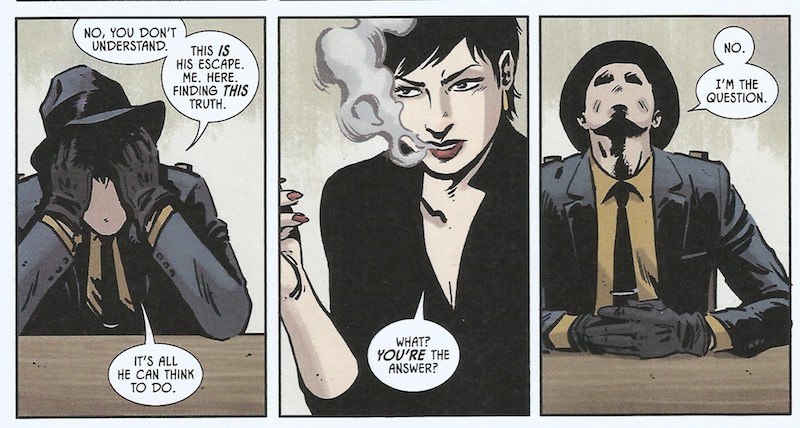
That version of the Question informs Tom King’s even pulpier character. With Batman missing, the Question takes over the title. He corners Selina Kyle and in a hardboiled send-up grills her like a femme fatale from a Philip Marlowe novel.

The Question is in this simply because of his friendship with the Dark Knight. When Batman first met the Question in the canon, he apparently didn’t like the man but admired the workmanship of the mask. Of course at that time, Batman didn't like anybody.

King’s treatment of Batman is as usual much warmer and humorous without losing the bite. We see some of this play out in the flashbacks. In short another astonishing Batman issue, and Batman’s not even in the present tense. King also divulges a trope, I will not. He defies the advice of keeping your secrets close to the vest with scintillating dialogue and Jorge Fornes who illustrates a faceless hero as expressive and a sit-down chat as action-packed.

Despite Steve Austin and Jaime Sommers adorning kids’ lunchboxes, The Six Million Dollar Man and The Bionic Woman were actually dramas intended for mature audiences.

Oh, sure. The majority of episodes were family friendly. Parental guidance advised, but some stories like The Six Million Dollar Man pilot packed an emotional wallop.
Steve Austin survived an experimental plane crash. The tragedy left Steve so damaged and bereft of hope that he asks the nurse to help him die.
That scene adheres to Cyborg by science fiction author Martin Caidin. Producers Harve Bennett and Kenneth Johnson loosely based the series on Caidin’s novels.
With the casting of Big Valley’s Lee Majors, Steve Austin differed strongly from the book’s star. Majors’ Steve Austin though a USAF colonel is remarkably laidback. Though Steve does kill in the line of duty, he lacks the bloodlust that Caidin’s Austin exhibits. Preferring instead to use his bionic abilities to incapacitate in frequently humiliating ways.
Dynamite introduces a new comic book series starring the Six Million Dollar Man Steve Austin. The adventure takes place early in his career as an OSI operative.

Japanese agent Niko uncovers a Sino-Russo plot to build a secret nuclear launch site on Honshu and alerts her “American cousins”—a lovely turn of spy phrasing. She’s none to pleased to see a single Steve Austin in place of say a squad of Navy Seals.

During the car trip, Steve tries to convince her that sending a lone operative is the right move, but Niko’s having none of it. So he demonstrates one of the characteristics that he shares with Jaime. Honesty.

He and Jaime sometimes revealed their superpowers to civilians without a single worry of consequences. That’s because, neither figured the listener would believe them. Niko follows suit.
It’s not until Steve and Niko reach the test facility that she sees that Steve’s telling the truth.

The televison series is famous, some would say infamous, for depicting bionic speed through slow-motion. Not always, but usually. Artist David Hahn with his animated sensibilities chooses another path.

When Steve and Niko infiltrate the base, they find more opposition. Unlike the series, Steve is a chatterbox during this mission, but writer Christopher Hastings makes certain that Steve delivers like Lee.

The humor is also based on imagining how Majors would react as Austin. As a result, the whole sequence sounds and looks authentic.

The humor is also based on imagining how Majors would react as Austin. As a result, the whole sequence sounds and looks authentic.
The Six Million Dollar Man and The Bionic Woman seldom got weird. Only the Bigfoot/alien, Maskatron and the Fembot episodes can be considered outré. Jaime and Steve primarily stuck to fighting well-grounded Cold War spies. This premiere gets a little out there.

These fellows are just top rank Ninjas in Menpo masks, but they're still somewhat odd to see in a Six Million Dollar Man story. All in all, there’s a lot here to interest fans of the television series as well as those casually peeking in.

Astro Hustle is grindhouse science fiction. The story starts with space lesbians getting a little frisky on a starship.

The whole crew appears to be sexed up like Orion Slave Girls and Boys. A couple of dudes appear buddy-buddy however you like it in pairs of tiny swim trunks. So, equal opportunity exploitation.
Though the tale begins on frivolity and wakka-wakka guitars, Jai Nitz’s Astro Hustle darkens considerably with a surprise attack and the introduction of the protagonist Chen Andalou.

Nitz also directs the stellar artists Tom Reilly and Ursula Decay—Ursula Decay, really—to enhance the dramatic impact with a closeup dedicated to the loss associated with violence. The attack wouldn't be so quieting if not for the fact that the victims were so full of life just moments ago.
The creative team next cuts to a carrion planet. The dumping ground of bodies where Chen Andalou rises and tells a little about himself. Though Nitz fills in some history it's really his will to survive that conveys his resonance.

After a fateful meeting with the law, Chen finds himself in an updated scene from the classic Tyrone Power film Captain Blood. Nitz copies nothing from the movie. He just uses the vehicle as a blue print and moves the pieces around to his liking.

Astro Hustle is adventurous swashbuckling in space with a number of deliciously spicy elements. However, it’s not a totally laughable experience. Nitz presents serious repercussions while Reilly and Decay amuse with imagery such as dogs and cats working together with penguins and bears on a space pirate ship.