Wednesday, May 8, 2019

POBB May 1, 2019

Pick of the Brown Bag
May 1, 2019
by
Ray Tate

Welcome to the Pick of the Brown Bag.  Consider for your amusement these timely reviews of Batman, Ghost-Spider, Marvel Team-Up, Red Sonja and The Six Million Dollar Man. In addition I'll examine new books Hashtag Danger and Queen of Bad Dreams.  Should you not have time for the total POBB experience you can look me up on Twitter: #PickoftheBrownBag.


Queen of Bad Dreams from Vault Comics turns out to be better than I hoped.  The concept of dream police existed since the early nineteen-hundreds where Winsor McCay introduced Little Nemo, a tyke that travels to Slumberland for vivid adventuresA bit closer to our subject is the 1984 film Dreamscape in which a psychic played by Dennis Quaid must save the President by entering his dreams.  Queen of Bad Dreams writer Danny Lore doesn’t just regurgitate the concept.

Daher Wei is a an Interceptor Judge.  She and other I.J.s confront dreams that have “fallen out” of the dreamer’s psyche into the real world.  What’s fascinating about Lore’s story is its attention to legality.


I love the idea that a Judge can decide to give a dream citizenship in the real world.  That’s so kind and fair.  The reworking has the legs to carry Queen of Dreams for decades.  Lore adds a number of elements that oils the gears of his machine.  The name choices, the diversity of the cast and hard-boiled narrative feed into the quality of the book.

Artists Jordi Perez and Dearblha Kelly complete a perfect fusion of creative talent.  Perez opens the story with Daher’s well-staged fight against a nightmare.  He's however not a one trick.  Perez demonstrates a skill for animation.


As well as expression.


The woman with the pink hair is Ava, the figment in question.  The mystery lies in why she suddenly became disenchanted with her dreamer Emerson Chase, a connected political wannabe and how she escaped his dream.

With this issue, the Knightmares end.  Batman proceeds to beat up every Arkham Inmate standing in his way.


Seriously.  That’s all this issue is.  There’s a certain visceral pleasure in Batman running a gauntlet and the fact that not a single one of his enemies can stand against him more than five seconds.  He’s Batman after all, and that’s I suppose Tom King’s point.  

In order to truly succeed against Batman, each of these rogues must be in charge of a masterplan.  Physically they’re no match for Batman which is why they can only slow him down with henchmen and catch him surprise.  The problem is that Batman faces each of his enemies, and they face him.  

In Ghost Spider the day in the life of Spider-Gwen goes awry.  It starts out well enough with Gwen apologizing to date Harry Osborn.


Harry is a stand-up guy in this alternate universe.  In fact, he’s ex-SHIELD.  Most importantly.  He’s sane.

Gwen harbors another reason for hanging out with Harry.  She needs the services of her suit-maker Dr. Elsa Brock.

Gwen does not wear a parasitic alien pair of pants.  Her suit is an intermeshed group-mind of lab-created arachnids.  However, terrestrial.  Brock appears to have high-tailed it.


Gwen's universe is so cool that it has its own version of Veronica Mars.

With that avenue closed, Spider-Gwen gets back to the Mary Janes.  

The awesome Mary Janes are a rock and roll girl band comprised of names familiar to readers of the Marvel Universe proper.  

Mary Jane Watson heads the group.  Gwen is the drummer extraordinaire.  Gwen’s been in trouble with MJ since the day she received the radioactive spider-bite.  Perhaps earlier.

Like Spider-Man, Gwen vents her frustrations on the criminal element.

The smackdown is a little too harsh for the burglars.  And in hindsight for Gwen.


The Big Bad, another familiar name to Spider-Man readers, becomes a de facto Killer Moth.  Though Killer Moth became Batgirl’s arch-enemy, he is actually a 1950s character meant to be a criminal Batman.  If a score went wrong, criminals summoned the Moth.  For a price, he became the solution to the problem.

All things lead to the Mary Janes’ return which goes smashing until…


This all seems to be a bid to kill Gwen Stacy, whose secret identity due to jail time is on public record.

The writing by Seanan McGuire Is notable.  McGuire recreates the feeling Jason Latour and Robbi Rodriguez established in early issues of Spider-Gwen.  At the same time, McGuire incrementally advances the episodic plot to a big story.  

Artist Takeshi Miyazawa has a clean and open style that benefits the always moving narrative.  Miyazawa’s overall good artwork is easy to overlook when reading Ghost-Spider.  

Often he illustrates characters in almost ordinary situations that require no exaggerated gestures or body language, nor super-hero styled action.  

It’s in these moments you can appreciate a superb sense of space and character propinquity as well as timing, often comic as the cast interacts.


In the new Marvel Team-Up Ms. Marvel and Spider-Man during their pursuit of classic Spider-Man foe the Jackal switched minds.


Fortunately the situation doesn’t seem permanent.


Although it is sporadic.  With expressive artist Joey Vasquez, Eve Ewing produces an amusing take on Freaky Friday.


The switched superhero gags offer genuine comedy.  Subtle wit involving adapting to new bodies provide laughs.  
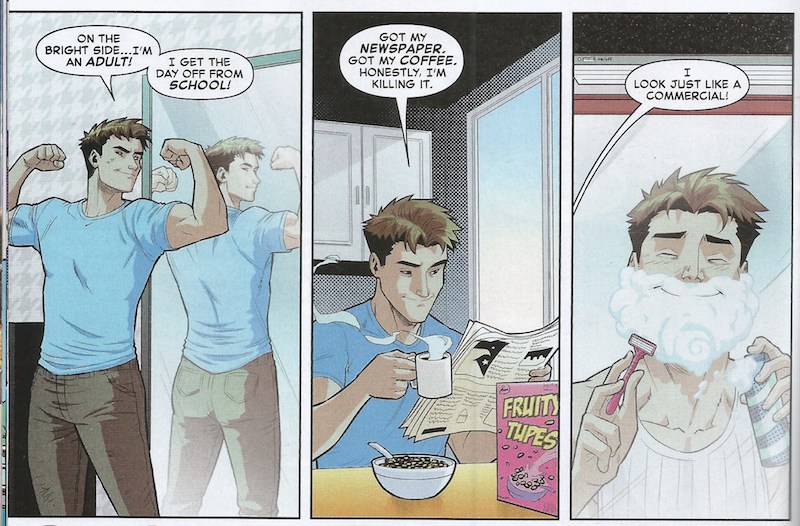

Ewing accompanies these with some hilarity drawn from the cluelessness of those around Peter Parker and Kamala Khan.

The only complaint one can lodge, though for me its not important, is the lack of actual super-hero action. 


Another comedy though darker in mood, flourishes in Red Sonja.  Writer Mark Russell introduced the wannabe emperor of the world Dragan the Magnificent.


He’s more Rufus T. Firefly than your average evil warlord.  Russell is known for infusing comedy to traditionally serious subjects, and visa versa.  Dragan’s latest move concerns chariots.

Hyrkania unanimously nominated Red Sonja as Queen.  In this run, Russell establishes that famed warrior Domo trained Sonja, but in truth, the idea was to exalt Sonja to Queen and run like the dickens.  Instead, Sonja chose to fight.

Sonja leads her rag-tag population of thieves and scavengers in a war of guile versus superior forces and strength. Guile appears to be winning.

One of the more interesting things about the story is Russell’s and artist Bob Q’s avoidance of Red Sonja’s traditional pulchritude.


Sonja is more bedraggled in this story than beauteous.  She stands out amidst her army because of the red hair and the relative shine of her armor, but there seems to be a concentrated effort to downplay Sonja’s sensuality as well as her fire.

It works in this story because Sonja and the Hyrkanians are supposed to be downtrodden criminals and not the much more polished army of the Zamorans.  Still those expecting a lusty, flinty She-Devil ala’ Frank Thorne may be disappointed.

Christopher Hastings’ The Six Million Dollar Man is based on the television series with a few adjustments.  Steve Austin is nearly all bionic.

In the television series bionics replaced his legs, right arm and left eye.  The eye gave him telescopic vision.  In Hastings' story, his eye becomes an offensive weapon.


Previously Steve met his match with katanas capable of cutting through his cyborg parts as if they were butter.  Last issue, he stitched himself together somehow.  This issue, he gains power through lightning.  Hardly a spoiler.  It’s on the cover.  The lightning though empowering Steve produces some unexpected side-effects which help and hurt Steve equally.

Though Hastings departs from the canon of the television series, he nevertheless draws from Lee Majors and makes his Steve Austin such a laid-back, likable fellow that it’s hard not to feel sorry for him when things go awry.  


I have no sympathy for Hashtag: Danger.  Tom Peyer starts out strong with a diversified Challengers of the Unknown updated for the Tweeters out there.  It’s furthermore cool that his strongman is actually a strong woman.

Unusually, Peyer chooses to make his book with the inviting, cartoony Chris Giarrusso art mature in nature.  The characters swear up a storm.  That however didn’t bother me as much as the mission.  


The team has no right to invade the Yeti’s territory, nor “beat the shit” out of it.  It also has no right to commit the crime later in the book.


If the Yeti were a monster that menaces humans.  In other words, invade human territory to maim and kill wantonly, by all means, “beat the shit” out of it.  On the other hand if its just a creature as it appears to be.  Then, it has the right to peace.  Hashtag Danger has the right to study the beast but not capture or injure it.

Sunday, May 5, 2019

POBB April 24, 2019

Pick of the Brown Bag
April 24, 2019
by
Ray Tate


Avengers: Endgame

Elegant science fiction that takes the brave stand of saying no to a Unifying Theory.  Endgame is an expertly crafted celebration of Marvel's positive diversity within its rock solid cinematic continuity.  


Endgame also signifies a rarity.  Marvel listened to its critics and its fans, often one in the same, and addresses caveats to make their universe even better.  


The superb narrative raises newer heroes to pivotal tiers in the original Avengers' attempt to restore what Thanos destroyed in Infinity War.  


The cleverness of the central element at once sublimely tackles the issue and acknowledges long time ethical dilemmas associated with the fantasy.  


The relationships of the characters provide the audience's core emotional investment, and whereas Infinity War became memorably dark, Endgame radiates optimism.  


A drama of the highest order, Endgame also depends on comedy and plot twists that reward the faithful viewer of the entire waves of Marvel.  In short, Endgame deserves every penny made.


Welcome to The Pick of the Brown Bag.  This week I review Avengers Edge of Infinity, Batgirl, Black Widow, Detective Comics and The Fantastic Four.  If you haven't the time for this lovely set of reviews, check me out on Twitter: #PickoftheBrownBag.


In the first chapter of Detective Comics, Batman investigates a perplexing mass murder of Gothamites.  His sleuthing leads him to Francine Langstrom suffering from a malady that appears to have only one cure.  


The Man-Bat formula.  After a wild flight, Batman injects the antidote and saves Francine while picking up another clue, but before he can make any deductions, a specific kind of bomb heralds the Arkham Knight's arrival.


Batman fights the Knight and an army of his followers.  This however is no ordinary cult.  Batman must use every resource to reach his state of being in this second chapter.  Near total collapse.


Batman however is Batman, and he intends to finish this.  That's when the police arrive on the scene.  An on-point Batman theme, guns even in the hands of experts make the situation worse. 


Both opponents declare a stalemate.  Arkham Knight escapes.  Batman attempts to beat a hasty retreat before the  amassing crowd compound the problem.  He doesn't quite make it.
    

Tomasi uses Commissioner Gordon and the Batmobile's A.I. to break the impressive tension expertly timed by artist Brad Walker.  It's a good choice for apt comedy.  Batman's in no shape to pursue, and the villains of the piece absconded.  The comedy carries the momentum and continues in the safety of the Batcave.  As Batman studies the clues he acquired, Alfred tends to his wounds.


At this point, Tomasi properly returns Damien Wayne to the fold.  Some kind of schism developed outside of the Batman books between Damien and his father.  Neither Batman writer Tom King nor Tomasi paid any attention.  Tomasi's been cheerfully using Damien as a co-star in his Adventures of the Super-Sons then brought him back for his double-nine issues of Detective Comics leading to the bloated 1000.

I never wanted any actual harm to befall Damien Wayne, but I never warmed up to the tyke.  However, nobody writes him like Tomasi.  In Tomasi's hands, Damien is entertaining if not likable.  

Damien takes over for where his father left off.  He tries to gather bomb evidence in the amusingly named Aparo Bay.  Walker, inker Andrew Hennessey and Nathan Fairbairn  execute an inspired Thunderball like underwater battle then follow through with a Bond-like escape.  Damien's travels lead him straight into the maw of the beast where he learns far more than even the reader knows.


Writer Mairghread Scott reveals who paid the Cormorant to assassinate then elect Congresswoman Alejo.  This revelation occurs on the very first page.  So it's not really a spoiler.  It's premise.


This is of course a new version of the 1950s Terrible Trio.  Originally, they were inventors specializing in larceny of the sea, air and earth.  Each represented by the displayed animal masks.  Fox, Shark and Vulture sporadically served as foils for Batman and the original Batman Family, but their heyday occurred in Batman: The Animated Series.  Alan Burnett, Michael Reaves and Bruce Timm reinvented them in the mold of the real-life Billionaire's Boys Club.  

Scott draws upon The Animated Series--always a wise move--but uses it only as a skeleton.  Her Trio becomes a psychopathic version of the one-percent and steeps their rationale to kill Alejo in raw greed.

Vulture warns Fox to keep away from Batgirl and deter her investigation from uncovering the Trio's involvement in the Alejo Affair.  Fox has other ideas.


Sending Batgirl a mystery, a ghoulish one at that, is like giving a hound a scent and hoping you're fast enough.  Scott with astounding artist Paul Pelletier makes the case Fox is psychologically compelled to inveigle Batgirl.  Fox however picked the wrong Darknight Daredoll to toy with.


Despite her happy-go-lucky personality, Batgirl is in bad humor.  She found out that Gotham City officials released her psychotic brother James Jr. from his island prison.  She's got to deal with working alongside Jason Bard the man who attempted to frame her father and kill Batman.  She also might be more pissed at the latter. 


Her father and she split ways because of his hardline attitude against Alejo and his keeping James Jr.'s release a secret.  So, Batgirl is just itching to sink her teeth into something that she can actually resolve.  Fox discovers he's that subject.


The reader benefits from Batgirl in amazing form, courtesy of    Paul Pelletier's skill as an anatomist.  


Scott draws Batgirl to her solid crimefighting roots.  This is far more impressive when you consider that Scott must overcome an editorial costume change that should have undermined her want to embroil Batgirl in genuine crime dramas.  The clothes now seem entirely superficial.


Hydra Agents used the Cosmic Cube to travel back in time and alter reality.  Their actions created Captain Hydra who killed the Black Widow.  Of course, the Avengers brought Captain America back.  Black Widow resurfaced as a clone with the original Black Widow's memories. Including her death.  For that reason, Natasha has a serious mad on.  


All of the violence from Natasha's past appears to be concentrated into her new being.  Jen and Sylvia Soska write a very cool Black Widow story in which Natasha deals with her PTSD in a similar way that a fictional male action hero might.  She dishes out some righteous revenge.


She is an Avenger afterall.  Her targets aren't ordinary monsters.  They're the kind that drops children into snuff films.  Did I mention that the Soskas are horror writers and directors?  The Soskas update the mythical snuff movie through streaming services and a chic new name: No Restraints Play.  Surprisingly, the Soskas turn out to be pretty talented mystery writers as well.  Because the reader didn't actually know Black Widow would be a detective story, let alone a whodunit.


Black Widow also takes part in Avengers Edge of Infinity.  The book feels extremely old-timey, but if that's your worst crime when writing superhero comics, you're doing fine.  This is actually apparently a sequel to Avengers Shard of Infinity which slipped under my radar.  

Ralph Macchio's story begins on the moon with Tony Stark's exploratory team attempting to recover important gems among the debris from the LUNAR/Avengers battle.


Never heard of LUNAR?  Neither have I.  Editor's notes spell out the latest evil acronym.  Life Under Natural Authoritarian Rule.  Apparently not an organization interested in the moon other than for strategic availability.  After this episode, the story drops to earth where the Avengers face the Lava Men.


The Lava Men premiered in Avengers #5 back in the sixties.  They've made few appearances since.  So kudos to all involved for stirring up the nostalgic trouble.

As in the prior scene, Macchio includes several lines of clunky exposition, but refer to my previous statement.  The dialogue clears up, and Andrea Di Vito's art no matter what looks scrumptious.


Macchio flips to LUNAR, now located at a new base in the Mojave.  Here, he introduces or reintroduces the main antagonists.  Also new characters.


And classic headman MODOK, who is as nutty as ever.


Soon, MODOK is moving the moon closer to earth causing tidal havoc.  Fortunately, the Avengers notice and using teamwork based on their skill sets, they defeat MODOK and his minions.  Macchio's story as I said is kind of throwback, but it also turns into a good drama with several inspired moment.  

The Fantastic Four didn't go where I wanted it to go, but it's still a pretty good comic book.  Although a little schizophrenic. 

Dr. Doom announced that he intended to preemptively stop Galactus.  Using a technique he exploited to steal the Silver Surfer's Power Cosmic, he imbued a Latverian woman with the astonishing ability of a Herald.  That energy lured Galactus back to earth..  

Dr. Doom embedded the devourer in a mountain, then proceeded to siphon of his energy for the good of his country.  Of course, you can't just imprison Galactus in a mountain.  That's ridiculous.  The Fantastic Four traveled to Latveria to stop Dr. Doom, and as a result ended up in prison, waiting execution.


I thought all of this was a ruse, and Dr. Doom intended to humiliate the Fantastic Four on international television; thus smearing their good name while bolstering his status.  The traps he set up seemed remarkably pedestrian, not worthy of Doom.  My idea's not the case.  So, the FF escape, free Galactus and defeat Dr. Doom.  The end.


Still, The Fantastic Four isn't a bad book.  The escapes which rely on teamwork and familial bonds along with Adam Kuder's artwork make the whole thing fairly easy to digest.  Their goal to release Galctus furthermore frames them as the heroes of the picture.  Galactus is a vital component of the universe.

Dr. Doom's familiarity with the FF creates some weird scenes.  He's frequently standing next to them peacefully as often as he is battling and threatening them.   

Fantastic Four scribe Dan Slott seems to be saying that Doom has a love/hate relationship with the FF.  This all appears to be an effort to restore Doom's enemy aspect  without damaging the evolution of the Doom/FF relationship.

Historically Dr. Doom is the enemy of the FF.  This is an unblemished record in the Lee/Kirby days, but things get shakier once Doom starts giving his word and keeping it.  The honorable behavior develops to the point where Dr. Doom ends up being godfather/obstetric deliverer and christener of Sue's and Reed's daughter Valeria.

I'm really not sure that Slott succeeds.  Doom seems to be more of a bumbler in this story.  Almost a Disney villain in the tradition of the Apple-Dumpling Gang.  That said, this Doom is way better than the sorcerous scab of a Doom that wore the skin of his alleged lost love.  A revolting state of decay for the character.

Slott gets points for ending the story on a hilarious high note that exploits one of Dr. Doom's only weaknesses.  A susceptibility to attacks by hordes of small creatures.  Squirrel Girl embarrassed him years ago.  Slott works FF history in a perfectly timed comeuppance.