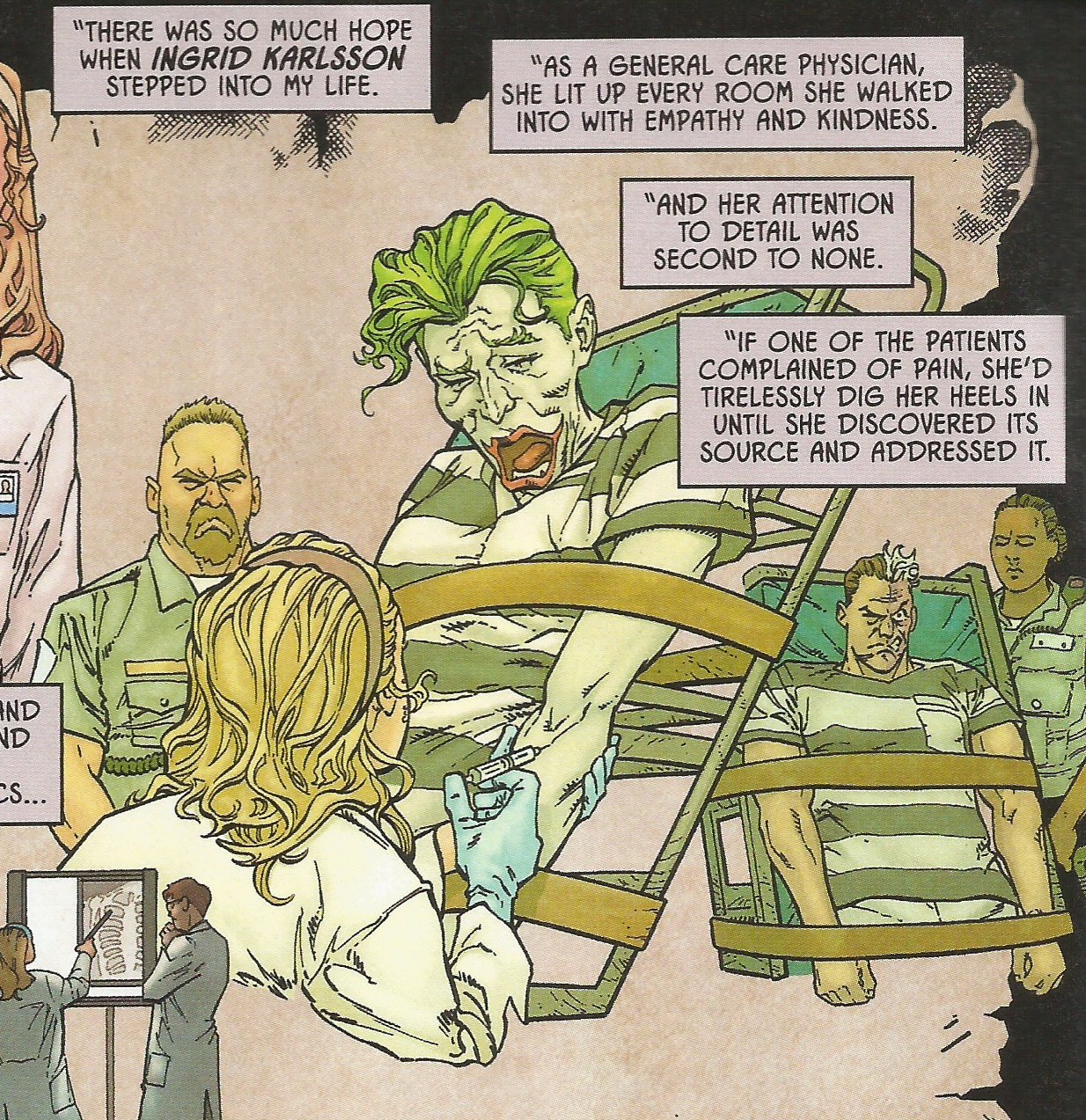
Pick of the Brown Bag
May 27, 2019
by
Ray Tate
Godzilla vs the Cosmic Monster was the first Godzilla movie I saw as a kid, all due to a steady diet of Famous Monsters of Filmland. In that movie, simian aliens that shape-shifted into humans intended to take over the earth. One thing stood in their way.

Oh, yeah. I won’t get into the whole movie, but that film informed my understanding of Godzilla. Later, of course, I would learn about the history of Godzilla.

His beginning as a metaphor for the atom bomb. His death at the mechanism of the Oxygen Destroyer. I’ve watched the original Gojira film twice. Once in a big screen setting uncut, without the American addition of Raymond Burr and again uncut no Burr on DVD. Gojira is stirring and philosophical. Its stark horrible beauty unfolding in crystal clear black and white is remarkable.
I’ve seen Godzilla vs the Cosmic Monster over and over again. As a work of art it does not compare to the original, yet I’ve seen it over and over again. The reason is simple. I like Godzilla as the good guy. I like the surprising absurdity of it all. Imagine. A giant beast, destructive yes, because it’s huge, but the savior of humanity.

When Hollywood remade Godzilla in 2014, they did so with cunning. They released one of the most deceptive trailers, maybe in the history of trailers. It looked like Godzilla was on the rampage again. I know a lot of Godzilla fans appreciate that more vicious version but I don’t.

I went into the theater that day with trepidation. As the movie played, I became more and more delighted. Godzilla is the hero again. Godzilla became the feel-good movie of that summer.
Godzilla King of the Monsters firmly re-establishes that wonderful revelation. Godzilla is the hero again. It’s not a fluke. He’s the custodian of the earth and the defender of we humans. It comes to no surprise that his old nemesis Ghidorah is the destroyer.

Ghidorah is the catalyst of the original Godzilla’s reform. The only creature that comes close to the pure wickedness of Ghidorah is Gaos from the Kaneko Gamera films. Although the MUTOs certainly inspired by Gaos run a close third.

Damn good. Kyle Chandler, Vera Farmiga, Millie Bobby Brown, Brad Whitfield, Aisha Hinds, Zhang Ziyi and returning MONARCH associates Ken Watanabe and Sally Hawkins portray the human cast.

It’s a testament to their acting ability that their drama doesn’t get overshadowed by Godzilla but instead enhances the titanic story.
King of the Monsters begins with the human world accepting that they live among a flora and fauna more diverse than thought. MONARCH, which studies these so-called monsters, faces congressional hearings. Kyle Chandler portrays Dr. Mark Russell a biologist who spends his time watching wolves. His wife, Dr. Emma Russell, played by Vera Farmiga, and daughter live on a MONARCH base. They're separated because of the events in San Francisco. A red alert will upset the peace, and Godzilla will rise in defense of humanity and the earth as monsters manifest with destructive purpose.
I’ve seen some reviews after the fact by unimpressed critics who miss several points about King of the Monsters. The movie features numerous nods to the entire Godzilla oeuvre retouched or reimagined for a new audience. They also do not appreciate the life-and-death aspect of the film. You cannot predict who will live and who will die. Death is far more prevalent in this film than in Godzilla. Though those expecting the totals of John Wick will be very disappointed. The deaths orchestrated in King of the Monsters are full of sacrifice and shock. As well the deaths emphasize that we cannot possibly win a battle against monsters without Godzilla on our side.

Bruce Banner awakens from his slumber and finds himself on the receiving end of Joe Fixit, one of the Hulk’s weirder personalities. For that reason, this issue of The Immortal Hulk adds a bit of humor to the green mix.

Ralph Meeker portrayed Mike Hammer in the quintessential noir Kiss Me Deadly. It’s only loosely based on the novel by Mickey Spillane but good in its own right. So, the Hulk speaks like Mike Hammer, presumably with a baritone.

Artist Joe Bennett takes full advantage of the rare opportunity to illustrate a slicked up Bruce Banner. He superficially looks like his father, but Bennett creates only benevolent and bemused expressions for Bruce.
Despite the after effects of Joe Fixit, Immortal Hulk is nevertheless a horror book. The Shadow Base run by total dick General Fortean does not intend to leave Bruce Banner alone. They tried to kill him with a clever plan the last two issues. This issue it’s brute force mixed with psychological shock.

Abomination used to be Eric Blonsky, Soviet Spy. This version of Abomination is the new and improved model of body horror that bears a familiar face. Let me just say once again that General Fortean is a total dick.
Doc Samson counters Fortean. Writer Al Ewing brought back and redeemed former the former dick. He restored Samson’s professionalism as well as inherent optimism. Samson like all gamma irradiated denizens, cannot be killed. Only forced into dormancy.

Samson finds a rescue in the pursuing Gamma Flight. Gamma Flight is the benign group of Hulk’s pursuers consisting of gamma-cured Walter Lankowski, former Sasquatch, fellow Alpha Flight member Puck, former Shadow Base tool Crusher Creel and his wife Titania.

Titania is an interesting addition to Gamma Flight due to her obsession with She-Hulk. She-Hulk has yet to appear in the pages of Immortal Hulk.
Ewing may be eschewing She-Hulk for practical reasons, Jason Aaron won’t allow the Avenger to make an appearance, or She-Hulk is too historically uncomplicated and good. Former Red She-Hulk, Betty Ross Banner isn’t so lucky, and when reporter Jackie McGee confronts her, she finds a reversion of fortune.
The Immortal Hulk once again keeps giving the reader more depth in the Hulk and Bruce Banner. It addresses the gamma-irradiated club with rare maturity. While it's always great to see the Hulk cut loose, that's not the prime objective. Instead, the cohesion of multiple personalities, the ascension of Doc Samson as a voice supporting the Hulk, even the when hearing his ultimate goal, the superhero/adventurer aspect of Gamma Flight and the exploitative villainy of Shadow Base all create a compelling agency.

It’s a puzzle to me why Detective Comics Annual exists. That’s not to say that it’s bad. Rather, it’s unnecessary. The story is basically a retread of Batman’s previous encounters with the Reaper, a retrofitted vigilante operating in Gotham City before Batman.
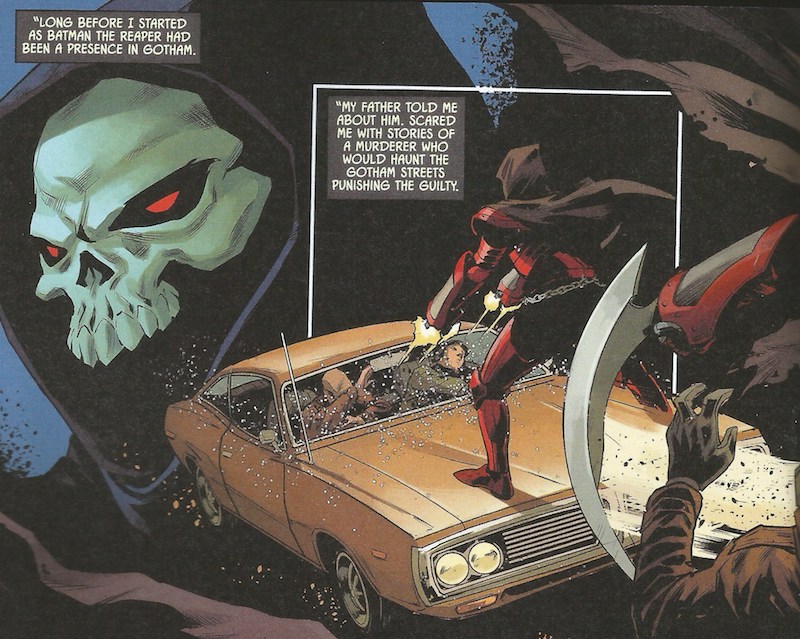
The history of the Reaper arguably begins with a classic Denny O’Neil and Neal Adams story where Batman fought an avenger disguised as the Grim Reaper.

The Reaper also developed from an O’Neil/Irv Novick issue of Batman where The Shadow tests Batman as his successor. The Shadow exposed readers to the idea of a crimefighter similar to Batman operating in the world before Batman.
Mike Barr and Alan Davis created the Reaper as an antagonist for the post-Crisis story Batman: Year Two.

As any Batman reader over fifteen can tell you, Joe Chill murdered Batman’s parents. Barr expanded on the idea in Year Two.
After Chill murders Bruce’s parents, he drops the gun. Bruce takes the gun. Intending to one day use it to kill his parents’ murderer.
The Reaper’s threat forces a truce between the crime families and Batman. They however do not trust Batman. So, they hire contract killer Joe Chill to end the Reaper, and Batman after his utility ends. Batman brings the gun when he teams up with Joe Chill. As vowed Batman comes close to executing Joe Chill.
Batman’s history with firearms is grossly misunderstood, primarily by alleged Batman scholars. Partially Inspired by the Shadow, Batman’s creator Bob Kane ruefully drew a frontispiece depicting Batman wielding a smoking gun to evoke the pulps. Batman did not use a gun in the story.

Batman’s gun use in the entirety of his Gold, Silver and Bronze Age tales amounts to a gun mounted on the Batplane used in an attempt to stop Hugo Strange’s Monster Men.

And a pistol loaded with silver bullets to dispatch the Monk an actual vampire.

Because of these brief blips on the radar, because of the frontispiece, Batman creative talent love nothing better to put a gun in Batman’s hands, usually for pure shock value.
They then smugly point to those isolated moments in time as justification. It’s accurate to say the canonical Batman--Golden, Silver, Bronze, Modern--does not use guns and hates guns.
The Powers That Be at DC expunged Year Two a long time ago for all the right reasons. It no longer logically fit with Batman’s history. That decision nevertheless didn’t censor creativity, nor preclude a sequel.
With the Detective Comics Annual writer Peter Tomasi out of the blue restores Year Two to Batman’s history. But without Joe Chill being part of it.
At the conclusion of Year Two the Reaper kills Joe Chill. In the New 52, Batman no longer suspects Joe Chill of the Wayne murderer. Chill is alive and aging in Blackgate prison via Geoff Johns. This begs the question of why Batman brought a gun to the reordered Reaper party? Joe Chill wasn't invited. He's not Batman's target. So why the gun?

A bigger question of course is who asked for this? I don’t recall anybody breathlessly demanding the return of Year Two, nor the Reaper.
The present day Reaper operates in Europe. Batman learns of his involvement. He investigates the new Reaper through his secret identity.
In terms of writing, Bruce Wayne’s sphere offers Detective Comics Annual's only points of interest. That’s because in this rare instance, Batman actually enjoys being Bruce Wayne giving the reader fresh air.

Bruce is frequently uncovering one-percent corporate corruption, which just reinforces his cynicism. In Detective Comics, Tomasi with stupendous Nightwing artist Travis Moore, introduces Sophia Zervas.

A vivacious supporting cast member who like Bruce has a healthy social conscience, Sophia is Bruce’s plus one on a trip ostensibly to join the elite at a reflective enclave. In reality, she adds to Bruce’s cover while Batman can seek the Reaper.

Sophia recalls Grace Kelly from Hitchcock’s To Catch a Thief. Without her participation, the Annual would have been even duller. That’s right. I said it. This is a ultimately a boring affair.

Although Batman throws down with The Reaper, it’s a yawner because it’s so familiar a situation. Even the reveal is ho-hum, paling in comparison to Batman’s second encounter with a second Reaper, by Barr and Davis. That story offered the reader a real surprise solution to the mystery. This tale depends on multiple tropes, and a kind of borrowing from Tomasi’s far, far more interesting Arkham Knight, running in the current Detective Comics.

The Catwoman Annual is also superior to the Detective Comics Annual. Writer Joelle Jones presents a disjointed narrative caused by the device of a film crew investigating what really led to the deaths of three girls. Though the process jump cuts between points of view, you never feel lost, and the read is smooth. The story begins with a biased witness.

Selina Kyle later testifies to clarify what happened. Jones makes use of Selina’s most attractive attribute, feminism. Catwoman is always wiling to help a wounded woman. In this case Chesa.

As time flows, Selina grows closer to Chesa. This is one of her strengths and weaknesses. Despite being the world’s greatest thief, Selina let’s people in. That aspect will play a part in the surprising conclusion later.
Jones takes a turn away from others who played on Catwoman’s feelings. Holly and Karon came to Selina without entanglements. Chesa has friends. Those friends will be the death of Chesa.

We discover what really happened at the first meeting between Catwoman and Chesa’s friends. It doesn’t go well, but neither does it go murderous, as Amanda Burress would have you believe.
Jones once again demonstrates Selina's inspirational fortitude and her feet of clay. She cannot deny helping women fight men. Thus, Selina finds herself training a group of budding female thieves. Including Amanda.

As the story progresses, the thieves will strike out on their own, but they pick the wrong target, and this is where things get really interesting.

Jones went out of her way to separate Catwoman from the DC universe as much as possible, but this Annual draws her back. The DCU is all over the last act of the story. It’s however not a gratuitous move. Everything makes sense, and it’s rather sweet who leaps to Selina’s aid.
In addition to this, the reason behind the murders packs an extra punch. Jones in fact builds on a mystery that does not seem a mystery throughout. That is good writing, some of the best I’ve seen from Jones.

X-23’s clone sister Gabby left home when another clone of Laura Kinney sacrificed herself. Laura’s DNA has become a hot commodity on the scientific black market. She and Hank McCoy aim to destroy it before it’s used for nefarious purposes.

Gabby seemed to be on board with this goal, she’s lately started to think that more of she and Laura wouldn’t be such a bad thing. So Gabby strikes out on her own to rescue rather than destroy.
In deference to Laura, Gabby is exaggerating. Laura isn’t out to kill herself or her clones. Her innate cynicism and skepticism persuades her to readily abandon clone redemption. Whereas Gabby is the optimist. The split between them appears to be short-lived in this comedic issue of X-23.
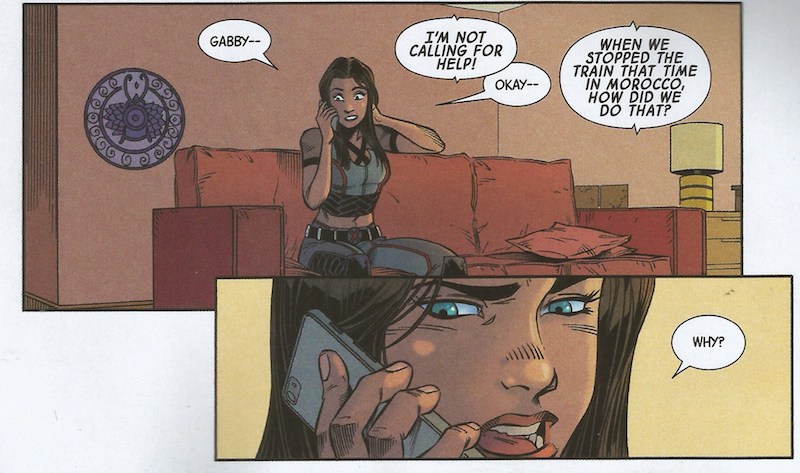
Gabby tracked down more clones, only as it turns out, it’s not what either sister thought. The nature of the clones, provides laugh aloud humor, and presents difficulty neither sister is used to.

Writer Mariko Tamaki seldom displays this sort of comedic bent. Meanwhile Diego Olortegui still coups plenty of opportunity for a tapestry of action.

It’s funny. It really is, but even this absurdity outlier demonstrates the creative team’s skill. The premise is silly. Nevertheless the value of the cargo excuses a complement of armed guards and a few surprises that give Laura and Gabby pause. Given a second chance, Laura throws herself all-in on Gabby's quest to save the innocent. She intends not to lose her sister again.

Last issue of The League of Realms, Spider-Man convinced the provincial ruler of Lagos, Malekith’s conquest, to turn. This issue, we discover why he immediately sympathized with Fernande and why her switch of allegiance was relatively easy.

The tragedy that befalls Anemone catalyzes Fernande’s want for revenge. Spidey simply tapped into that human part of Fernande to remind her of her conscience.

Fernande commands her Angels to fall in with the League. As you can see, some of the League are skeptical. The angelic additions split the team with the departing members expressing more disdain for Spider-Man's "soft" ways.

The Lagos army is more welcoming after the sorcerous Ro Bitteroot keeps everybody getting diced from gunfire.
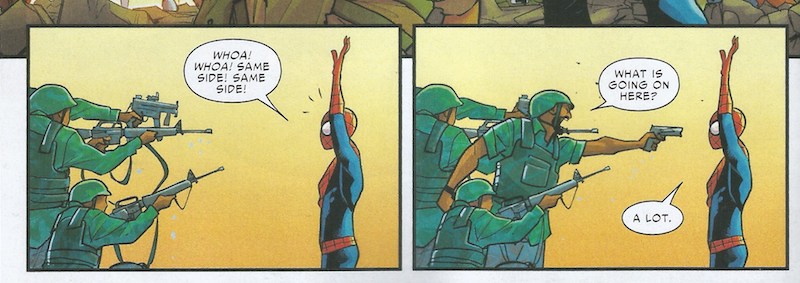
What fascinates me about this book is that it seems like a Spider-Man comic rather than a War of the Realms epic. Writer Sean Ryan shows how Peter Parker really is your friendly, neighborhood Spider-Man. Free from the constraints of an ever confusing continuity and the familiar big city environment, Spidey becomes the most empathetic and pacifistic of heroes. During a time of war, he's the man who just wants to save lives.

We Doctor Who fans refer to the creatures the Doctor fights as monsters. Seldom is this designation true. The Doctor occasionally fights monsters, such as a giant rat in the sewers of London, but really the Doctor fights single-minded alien species.
As countless episodes demonstrate, the aliens seldom want to live in harmony with humanity. There are exceptions, but largely it’s all or nothing. The Daleks and the Cybermen are worse, but even these nemeses produce exceptions.
Jody Houser’s latest Doctor Who series presented a group of blood sucking parasites called the Stilean Flesh Eaters. The Doctor encounters them on numerous occasions, and one even takes a bite out of her.
This issue concludes the Doctor’s dealings and answers one of the last questions bugging her.

A podcast has been surreptitiously directing the Doctor's recent travels, and wherever she ended up, Stileans preyed. The obvious answer of course is that the Doctor herself is behind the podcast, but Houser scotched that paradoxical future tense. Can it be an old companion? An old masterful enemy?
The answer is brilliant. Like The Soskas’ Black Widow, Houser's Doctor Who reveals itself as a fair play mystery as well as science fiction. With the artistic guidance of Rachael Stott and Roberta Ingranata, this is really an anthology of superb short stories that interconnect, and each is well worth your time and coin. If you haven't picked up new Doctor Who comic book series, I highly recommend the trade.
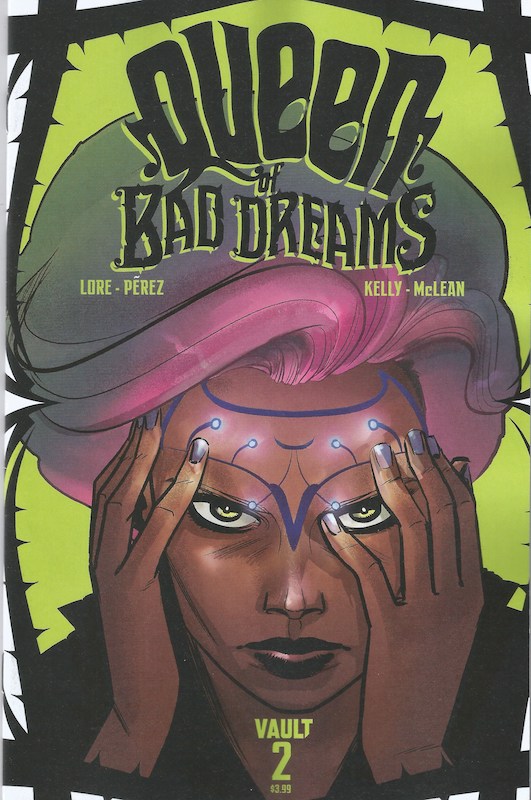
Queen of Bad Dreams second issue offers a very simple mystery buried beneath a fantastic idea. What if the stuff of dreams became real? Such a Figment as writer Danny Lore refers to them can be returned to the dream, expelled or most intriguing integrated with the real world. That's up to for the Inspector Judge to decide.

The Judge in white is Daher Wei, one of the most famous. Ava the Figment drifted from the head of Emerson Chase, a presidential wannabe with a politically connected family. Ava relates her story to Judge Wei, and it's not a sudden disembarkment. It's a gradual build up of recognition that her dreamer didn't deserve her. Things look good for her integration of course, she knows too much. So, Wei gets the opportunity to display her more material skills while Ave exemplifies her role as Emerson's protector.


The Judge in white is Daher Wei, one of the most famous. Ava the Figment drifted from the head of Emerson Chase, a presidential wannabe with a politically connected family. Ava relates her story to Judge Wei, and it's not a sudden disembarkment. It's a gradual build up of recognition that her dreamer didn't deserve her. Things look good for her integration of course, she knows too much. So, Wei gets the opportunity to display her more material skills while Ave exemplifies her role as Emerson's protector.