Pick of the Brown Bag
July 3, 2019
by
Ray Tate
Welcome to the Pick of the Brown Bag! My name is Ray Tate. In this blog I present the best and the worst of current comic books.
This week, I look at the merits of Batgirl, Captain America and the Invaders, Ghost-Spider, Heathen, The Immortal Hulk, Magnificent Ms. Marvel, Star Bastard, Superman: Up in the Sky and Unbeatable Squirrel Girl. If you’re taken aback by the size of the POBB, head on over to Twitter for capsular reviews: #PickoftheBrownBag

I don’t normally review Marvel movies. There’s no real point to that. The worst Marvel can do is produce a good movie.

Spider-Man Far from Home surprised me. I didn’t expect it to be that good. Here’s the Spider-Man and Mysterio you remember, adjusted for time. Yes, Jake Gyllenhaal wears the fishbowl.

Oh, and you know all the other stuff you like about Marvel cinema? Yeah, we got that as well. Stay after the credits.

Spider-Man makes an announced appearance in Ghost Spider.

If anybody’s confused by this scene, don’t worry about it. The comic book will be very clear. However, if you want some background just watch Into the Spiderverse. You should have done that anyway.
More so than most examples of parallel universes, the Spiderverse offers a simple demonstration of Hugh Everett’s many-worlds quantum theory.

Anybody watching the fateful science experiment that bequeathed Peter Parker his powers could have been bitten by the radioactive spider. Instead of Peter Parker, on Earth-65, Gwen Stacy gained the spider-abilities, which is why she’s visiting.

Overall, this is a pretty fun, breezy team-up between Spider-Man and Spider-Gwen who quickly gloms onto something amiss.

Or is this something to do with her malfunctioning powers and easily dismissed. I’m not telling. I will say that Gwen’s and Peter’s holiday involves more than corn dogs. It did however puzzle me why hypothetically Venom would help the spiders, or why Spider-Man would be okay accepting help from Venom. Then I realized that Venom probably never terrorized Mary Jane Parker. That was wiped out by Mephisto. Venom never does show. So, it's a moot point anyhow.

The War of the Realms ended up freeing Ratatoskr. She’s the deific squirrel from Norse mythology that runs up and down the Tree of Life, spreading messages from top to bottom. Other legends identify her as a chaos god, teller of lies, sower of discord.
Squirrel Girl helped put Ratatoskr in the Asgardian prison, but Ratatoskr found Malekith’s sense of egotistical order insulting. So, she takes the form of a human and in disguise helps Squirrel Girl battle the Frost Giants sent to tame Canada. Squirrel Girl and Ratatoskr initially found the team-up fraying, but Ratatoskr has come to realize Squirrel Girl is right about her.

This is not a repeat of what occurred previously. Ratatoskr is on the up and up for good. Literally. Taking the form of Rachel Oskar she and Squirrel Girl figure out tactics, inspired by Alberta’s true to life successful war against rats.

Disrupting an enemy’s food supply is a classic in The Art of War. So, Squirrel Girl and Rachel decide its time to take a page from Star Trek.

Stemming the flow of food leads to some comedy and action, just like Star Trek. Although obviously not the same plot.
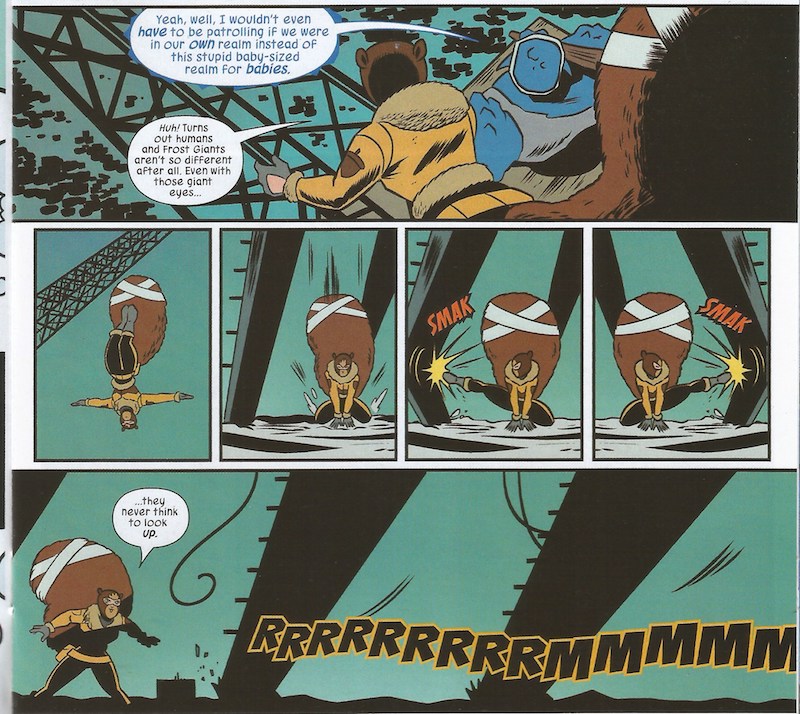
The scene also demonstrates just how powerful Squirrel Girl is. Something you don’t often think about given that this is is ostensibly a funny book and Squirrel Girl frequently deals with her opponents non-violently.
It turns out that humans, Asgardians and Frost Giants have something in common. Nobody wants the Frost Giants on Midgard, and the Frost Giants don’t really like it on earth either.
Exploiting the fact, leads to one of the whackiest moments in the comic book. Squirrel Girl and Ratatoskr teach the Frost Giants philosophy. This scene only works because Ratatoskr is god of chaos. She doesn’t actually think that much of Odin and the organized government of Asgard. So not only would she be familiar with the philosopher in question, but she would also likely embrace his philosophy. Seeing his words as a catalyst for chaos. It’s really far more brilliant than you expect.

The epilogue displays Ratatoskr now firmly Rachel Oskar celebrating victory with Squirrel Girl. Loki shows up in a most unusual role to potentially sour the milk but ultimately a new future awaits the chaos squirrel god thanks to Squirrel Girl.

Gotta be honest. I like Ms. Marvel, but I wouldn’t count myself as one of her fans. No, it has nothing to do with her being a Muslim. That would make me an ass. You can argue that I’m an ass for many other reasons if you like. Just not that one.
I just found Ms. Marvel pleasant, nothing really special about her. That said, I’m not eschewing her comic book as some protest or boycott. She’s no Hal Jordan. So, if something looks interesting I’m open to reading it.
The Super-Skrull counts as interesting. I’d give you a history of the Super-Skrull, but I don’t need to. Writer Magdalene Visaggio and artist Jon Lam do it for you, and guess what, I’ve read all of those comic books.

The Kree version of the Funky Flashman, or Harry Mudd if he’s more in your wheelhouse, attempts to sell the Super-Skrull a load of Trump.

Hey, kids. Let me build a wall to keep out those pesky immigrants, and I’ll get Mexico to pay for it.
Earth really had nothing to do with Galactus eating the Skrull home world. He’s Galactus. He felt peckish. Nevertheless, the Kree salesman convinces the Super-Skrull that revenge is an earth overwhelmed by Skrulls.
To that effect, he sells the Super-Skrull a device that requires the genetic code of Ms. Marvel to carry out his scheme.
The Super-Skrull enters Ms. Marvel’s world under a false flag. This isn’t a spoiler. Visaggio makes it hilariously obvious before losing all pretense.
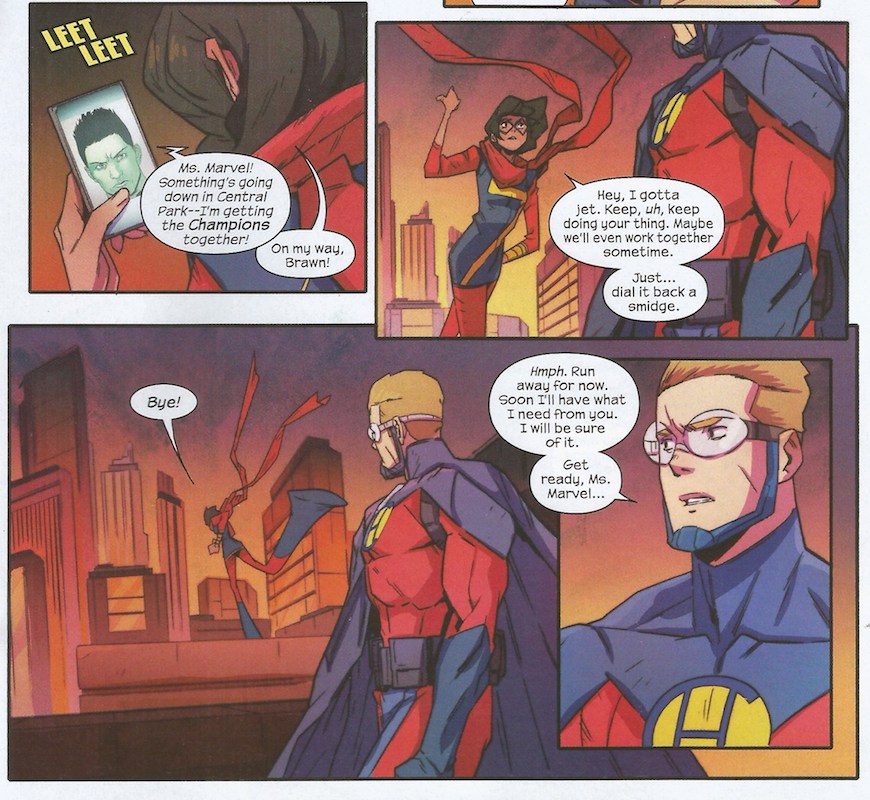
Captain Hero makes his presence known in Jersey City, against a number of familiar miscreants. The trouble is that he’s a little too rough on the opposition, and he starts to alert Ms. Marvel that something’s up with him.

That will have to wait though. Ms. Marvel quickly finds herself at odds with a new villain.

The throw down is well-directed and well-executed. This is probably the most I’ve seen Ms. Marvel cut loose, and I like it. She displays her metamorphic abilities in such a way that doesn’t make me recall Elasti-Girl from the Doom Patrol, and she continues to try to talk down the villain.

Things really hit the fan when Captain Hero shows up. Yet again Ms. Marvel comes to the fore in an impressive splash page. Things really escalate when the Super-Skrull reveals himself.

As you can see, Shebang is starting to have pangs of conscience. Will this play into the fight against the Super-Skrull? You’ll have to buy this strong Magnificent Ms. Marvel annual to find out, and there’s plenty more story beyond what I’ve detailed here. Visaggio and Lam do not waste their page count on padding.

The conclusion to Mairghread Scott’s and Paul Pelletier’s run of Batgirl gives the reader just what they expect: potent story with great art.
The Terrible Trio returned to Gotham City. Though Vulture warned her compatriots to keep Batgirl and the Batman Family out of their machinations, Fox could not help himself. He lured Batgirl into range with a puzzle.
Batgirl infiltrated the Fox’s Den. A new club that caters to perverse whims of the wealthy. Fox with Shark waylaid Batgirl and stuck her in an old fashioned death trap for the amusement of the crowd.

Batgirl of course escaped and found herself in a life and death struggle against Shark, who given size and muscle mass must be a metahuman. During the escape and the fight, fire broke out, and now Batgirl must try to save the patrons and the Terrible Trio from the inferno.
In this story Scott flips the roles of the Terrible Trio. Vulture wisely didn’t want to call attention to the Trio. Now, that everything’s gone to hell, she demonstrates a cold-bloodedness that surpasses Fox and Shark.

Organically, Vulture becomes Batgirl’s biggest obstacle. What's fascinating is that Vulture still does not mind if Batgirl just leaves.

A Bat knowing the Terrible Trio is back in town doesn’t appear to be an issue. It’s the natural order. The wealthy patrons however are witnesses that can’t be allowed to live.

Mairghread Scott's presence on Batgirl was a boon for the hero. Rather than holding back, she upped the ante, putting Batgirl through a ringer of damaging adventures that contrasted the friendliness of her new costume. With Paul Pelletier producing anatomic artwork filled with thrills realism, she steered Batgirl into a strong series of memorable bona fide detective stories.

Batman is a dark, urban warrior. A veritable thinking machine who doesn’t have time for friends because he’s too busy fighting in the upheaving sewers of Gotham.
That would be a fine description of Batman if DC never entertained the idea of a shared universe. Back in the post-Crisis some creators attempted to pretend DC never did. This led to a number of really bad Batman stories, and even worse Batman characterization.
Welcome to the New 52 where Batman discovered the technology in South Africa to repair Barbara Gordon’s spine. Where Batman has friends known as the Justice League. Where Tom King writes canon.
Tom King always embraced the history of these characters and the shared universe concept. Indeed, Superman, Wonder Woman and the Flash—all of them—guested in King’s quintessential run of Batman.
So it’s no real surprise that King’s debut Superman title Up In the Sky is good. Of course, you really couldn’t predict it being this good.

Batman calls Superman to help in an investigation. The case has an interstellar footprint. Superman consults his contacts, who gives him an idea.

This leaves Superman with a problem. Does he leave the planet unprotected to follow the lead, or ignore the fate of Alice?

Earth needs a Superman. I mean that in the broadest sense. Our earth needs a Superman, but to suggest that the planet earth in DC comics can’t survive a few weeks without Superman is silly. Besides Green Lantern, there’s Wonder Woman.

Superman carries the weight of the world on his shoulders. He’s as Batman stated in Man of Steel, “The number one defender of the planet.” Nevertheless he has no choice. Alice is as important as a planet.
Superman takes a closer look at the first clue, but there’s a problem.

Before Superman became more Smallville than Krypton, he possessed the power of total recall. His mind was alien. He understood nearly everything and advanced technology would only give him pause if more advanced than his people.
King of course incorporates the entire history of Superman in reconstructing his version of hero, and so things do not go as Rannian scientist Sardath predicts.

In the 1940s Timely Comics, a precursor to Marvel, united Captain America, Bucky, The Human Torch, Toro, Namor, Whizzer and Miss America to form the All-Winners Squad. They appeared in only two issues of All-Winner Comics, before Timely canceled the title. Roy Thomas with artist Frank Springer brought the team back in the 1970s under the snappier aegis The Invaders.

This is one of comic historian Thomas’ meatier works. Not only does he remind readers of Timely and Marvel history, he also mixes real history with fictional personages. To an even greater extent than usual. For example, you don’t expect the former ruler of England and Nazi sympathizer Edward VIII and his reviled wife Wallis Simpson.
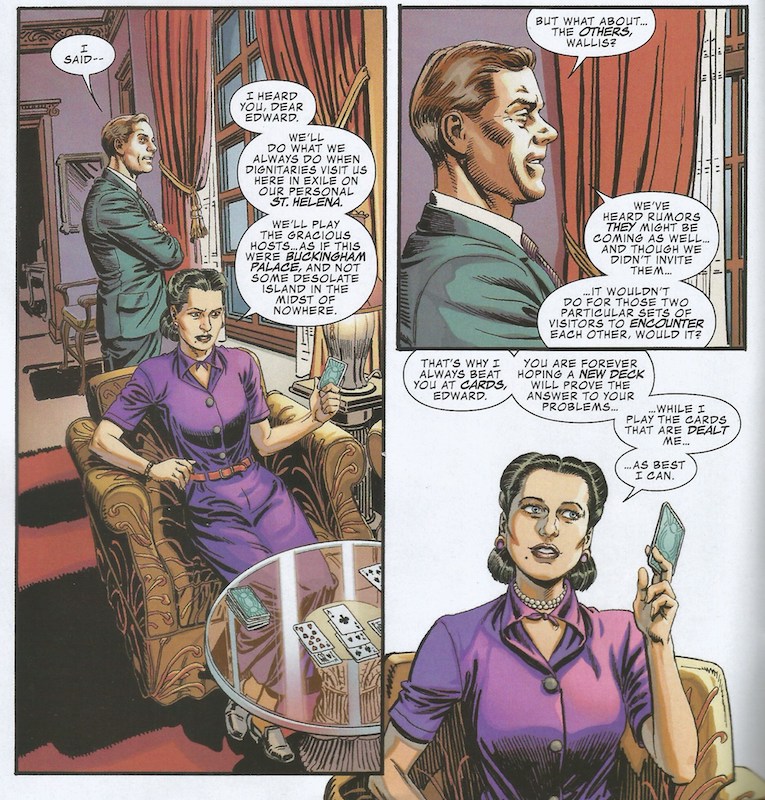
This is another comic book where I learned something. I had no idea that King George appointed Edward as the governor of the Bahamas.
After foiling the Nazi bund, Cap finds himself on a ship guarding FDR on one of his fishing trips to the Caribbean, which is cover for something else. Yet, again true.

Thomas amuses the reader by showing one of Cap's failings. He's no seaman. Neither is the gentleman he bumps into.

Spoiler Ahoy. It's the Human Torch. Before they left port, policewoman Betty Dean contacted a certain wing-ankled mutant. He comes into play later.
Thomas' gimmick is that the Invaders have yet to form, and this turning point in history is the precursor to their unification. It's not the only protype.
Thomas' villain of the piece is an unrecognizable yet well known figure from the 1940s.

Note it doesn't take Jerry Ordway six panels to sling Captain America's shield, even if it's the one not designed to fly. Ordway is the perfect artist for historical accuracy as well as slam bang action and ghoulish spurts of violence indicative of the Golden Age. Nazis, though. So, they deserve everything they get.
After foiling the Nazi bund, Cap finds himself on a ship guarding FDR on one of his fishing trips to the Caribbean, which is cover for something else. Yet, again true.

Thomas amuses the reader by showing one of Cap's failings. He's no seaman. Neither is the gentleman he bumps into.

Spoiler Ahoy. It's the Human Torch. Before they left port, policewoman Betty Dean contacted a certain wing-ankled mutant. He comes into play later.
Thomas' gimmick is that the Invaders have yet to form, and this turning point in history is the precursor to their unification. It's not the only protype.
Thomas' villain of the piece is an unrecognizable yet well known figure from the 1940s.

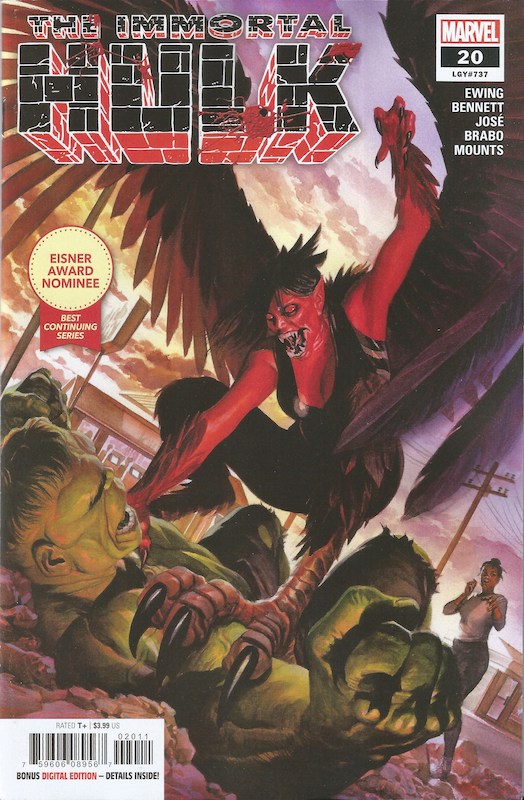
Though perhaps not Stan Lee’s and Jack Kirby’s intent, the Hulk evolved or devolved into many versions. There’s the Big Guy whom we all know.

The Hulk/Banner combo platter. The mindless Hulk and other varieties like the peculiar Joe Fixit. Al Ewing started out celebrating the closest thing to the original Hulk, a shrewd fellow with the strength of a small gamma bomb.
More of a protagonist than an actual hero. At the same time, he reintroduced the idea of Banner being a fugitive, like David Bruce Banner from the television series. Banner even had his own Jack McGee, updated for modern viewing.

The Hulk/Banner combo platter. The mindless Hulk and other varieties like the peculiar Joe Fixit. Al Ewing started out celebrating the closest thing to the original Hulk, a shrewd fellow with the strength of a small gamma bomb.
More of a protagonist than an actual hero. At the same time, he reintroduced the idea of Banner being a fugitive, like David Bruce Banner from the television series. Banner even had his own Jack McGee, updated for modern viewing.

As the story unfolded like an origami crane, we learned more things that veered away from mere nostalgia and good storytelling. The Hulk actually loved Banner and saw himself as the kid’s bodyguard.

Bruce, physically and mentally abused by his dad, created the Hulk as a safeguard.

The Gamma Bomb granted mass and manifestation to this split personality. Recently Bruce and the Hulk had a heart to heart. They also seem to be on the same page. Neither the Hulk nor Bruce Banner like what humanity’s done with the earth. So they intend to end humanity. Traditionally that makes them villains, yet they don’t act like it.

Bruce, physically and mentally abused by his dad, created the Hulk as a safeguard.

The Gamma Bomb granted mass and manifestation to this split personality. Recently Bruce and the Hulk had a heart to heart. They also seem to be on the same page. Neither the Hulk nor Bruce Banner like what humanity’s done with the earth. So they intend to end humanity. Traditionally that makes them villains, yet they don’t act like it.

That’s the Hulk rescuing Jackie McGee from the gunfire of a Shadowbase warship. Ah. Now, Shadowbase is true villainy. Run by a sphincter named General Fortean, Shadowbase seeks to use the Hulks to turn soldiers into monsters and monsters into soldiers. To that effect, Fortean launched a new Abomination at the Hulk, and he seemed very effective at killing the Jade Goliath.
Enter Betty Ross Banner. The Hulk’s wife, former Harpy, former Red She-Hulk. Now, Red Harpy. She seemed to finish the job of killing the Hulk, but the Immortal Hulk isn’t just ballyhoo.
The Hulks combine forces to help a lost friend, protect Jackie McGee and the other civilians in the area, which Fortean sees as collateral damage and yet to be killed witnesses. So you tell me who are the heroes in this comic book? The Hulk and Bruce Banner that’s who.

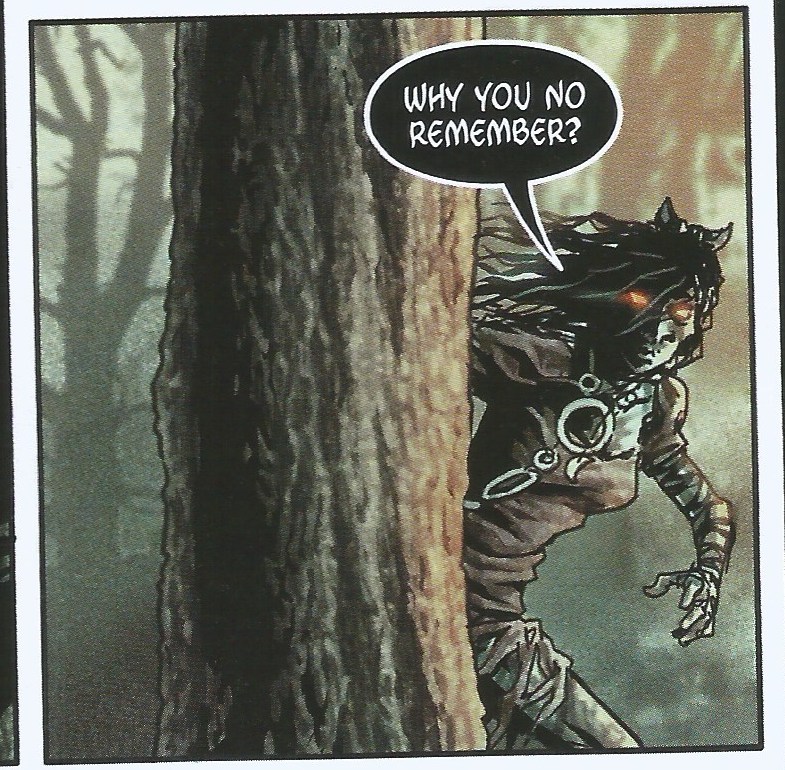
Natasha Alterici’s Heathen is an LGBT secret on the shelves. The story began off panel with the Viking teen Aydis romantically kissing a girl from her village.

The villagers demanded that she be killed. Her progressive father instead takes her away from the village to leave her at her resourceful best.
Aydis forms a plan: free Brynhild from the Ring of Fire to prove herself. Brynhild at first believes Aydis like all the rest and pledges herself to her, but Aydis doesn’t want that.

She just wants to show the villagers that women can be warriors, and women who love women can be warriors. Everybody deserves respect.
Honestly the Vikings with their Shield Maidens proven to exist by recent archaeological finds probably knew. That’s immaterial and I can’t speak of Viking attitude toward gays, lesbians and bisexuals.
Honestly the Vikings with their Shield Maidens proven to exist by recent archaeological finds probably knew. That’s immaterial and I can’t speak of Viking attitude toward gays, lesbians and bisexuals.
Alterici however isn’t presenting a historical comic book but a metaphor for still rampant homophobia with some historical and Norse mythology context.
Freeing Brynhild from the fire isn’t enough. She’s been freed from the Ring before only to be returned. Aydis intends to break this curse and give Bryhild her freedom.

During this quest, Aydis meets Freyja, former wife of Odin, now the Goddess of Love and the leader of the Valkyries.
Aydis met up with a female band of pirates last issue, and that thread continues here.
Aydis met up with a female band of pirates last issue, and that thread continues here.

Far more interesting though is Freyja’s confrontation with Odin.

Odin proves himself to be intolerant of the ways humans love each other. Freyja sees herself as an alternative to Odin’s traditional, harsh ways. Providing shelter. Freyja however is guilty of her own hubris. She underestimates Odin at a precious cost.
Alterici relates a pertinent story that still a saga of adventure. With this issue, she changes the themes of one woman's journey to two. Freyja began as a kind of frivolous Utopian character, but now she's face to face with a stark realism.
Alterici relates a pertinent story that still a saga of adventure. With this issue, she changes the themes of one woman's journey to two. Freyja began as a kind of frivolous Utopian character, but now she's face to face with a stark realism.

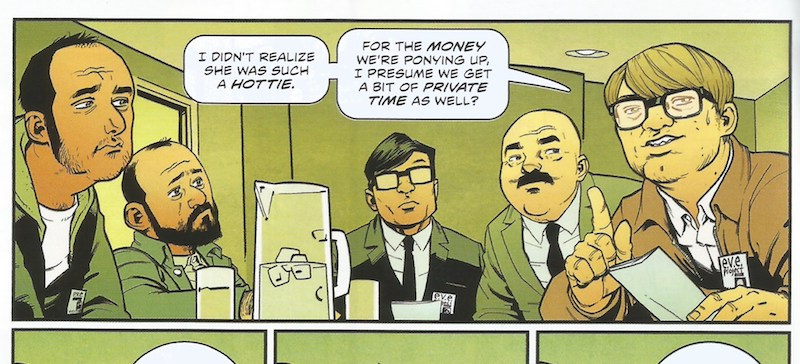
Star Bastard surprises by going off the menu of machismo sendup and comes up with a surprising origin for Captain Greeves, the title character. It turns out he’s not quite the idiot he seems.

Greeves’ history is somewhat tragic, and original. It’s also solid science fiction that grants sympathy. The Greeves we see now is actually the product of a five-year lifetime of creating pieces that fit. He apparently started out being a civil, decent human being, loosely speaking, we don’t know what he is exactly. He bartered as much as battled. Something happened though to change him. That remains to be seen.
I don’t want to give too much away because this issue of Star Bastard is less satiric of the nineties badass male hero and more contemplative drama with the theme of identity. It's well worth your time and coin.