Pick of the Brown Bag
February 6, 2020
by
Ray Tate
Welcome to the Pick of the Brown Bag. We've got a ton of comic books to review. So, let's skip the preamble and go right to the contenders, which include 4X, Adler, Ant-Man, Black Cat, Conan Battle for the Serpent Crown, Dark Agnes, Dr. Doom, The Immortal Hulk--Power, Justice League and Vengeance of Vampirella. If these reviews are too much for the time you can spend, pop on over to Twitter: #PickoftheBrownBag.

Hawkman's Robert Venditti takes over Justice League. He's brought along one of the classic Justice League artists Doug Mahnke. As such, the heroes appear as they should. Bigger than life, looking like any one of them can deck a god. The story begins with the League investigating a crash landing.

The fellow who crashed is a former Daxamite Green Lantern goofily named Sodam Y-at. There's no hyphen, but autocorrect is a bitch. Sodam warns of an invasion of earth by The Eradicator.

This one split me right down the middle. Venditti's Justice League is way easier to comprehend than Snyder's. It's also scientifically sound.
On the other hand, I've never found the Eradicator to be all that. He's maybe the second worst big name Superman villain after Doomsday.
I like Venditti's Madame Xanadu. She's the best part of the story.
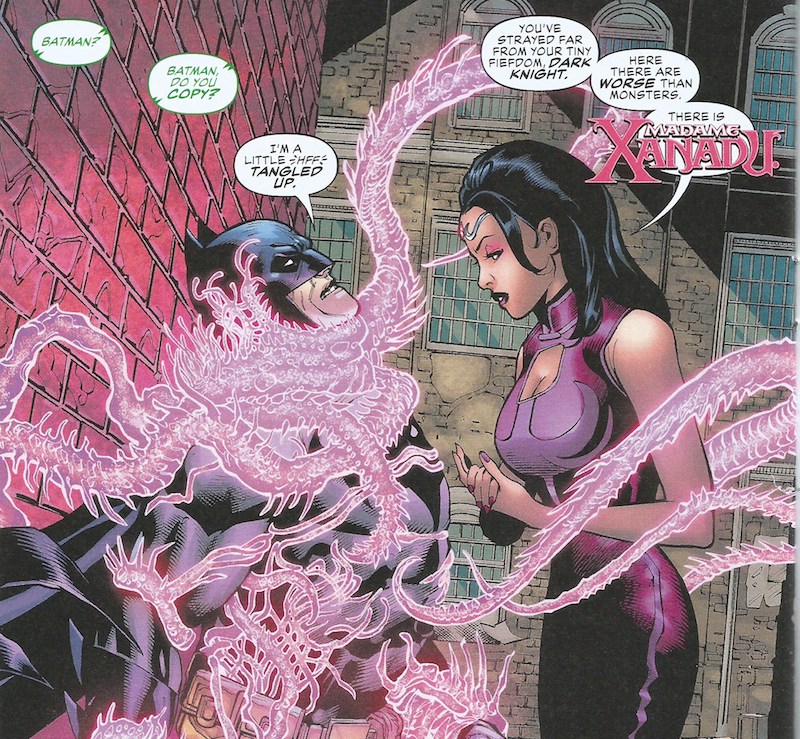
The flip-side, Venditti's nods to continuity clogs dialogue and characterization.

At times, I didn't feel that I was reading so much an adventure but instead receiving a lesson in current DCU affairs: John Stewart was dishonorably discharged from the Lantern Corps; Wonder Woman is part of Justice League Dark; Alfred's dead; Superman stupidly divulged his secret identity; something's up with the Flash. Etcetera, etcetera, etcetera.

Will Omega Level Mutant Franklin Richards choose to live with his biological family the Fantastic Four, or his genotypic family the X-Men?

The truth is that you lost Franklin the moment Kitty Pryde welcomed him to rest his head on her boobs.

Never has there been a better unwitting mutant honey trap. Throughout 4X Kitty is the only X-Man that questions the prudence of procuring Franklin from the FF. She even stresses that Franklin would always be close to his family.

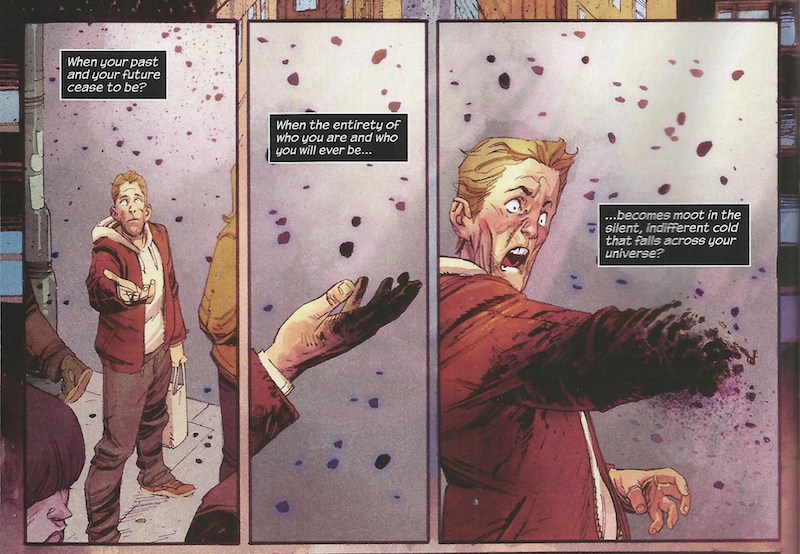
Teleportation in the Marvel Universe isn't as prevalent as it is in the DCU, Doctor Who or Star Trek. Teleportation is a game-changer in The Immortal Hulk.

The Thor films transformed the Bifrost into a highly sophisticated matter transmitter. The comic books followed suit. The X-Men travel through the world via organic portals.

Only mutants can use them, but they are two-way. So whatever Franklin chooses, he's not far from either the FF or the X-Men. This isn't the lady or the tiger, and for that reason, I don't see the need for a mini-series.
In other words I care about Franklin's Choice as much as I care about Blade Runner 2049. I don't hate it. I just don't see the impact. Though, I have more caveats with 4X than the lackluster film sequel.

I am an FF fan. Nevertheless, despite their ever muddying ouroboros history, I never really loathed the X-Men until now. That's because in 4X the X-Men are mostly sleazy, smug, self-serving sphincters. Except Kitty.

Awww, Kitty. You're so sweet. That just makes you sexier and more irresistible, which these old perverts know.

The chap looking like the silhouette of a circumcised penis is Charles Xavier. He used to be a good guy. The moment he started spouting double-entendres about Kitty's "special history" with "young Franklin" is the moment the old Charles Xavier died in my mind.

"And Kitty thank you for this." Fuck you, Magneto. Magneto was at least honest when an outright villain with a bucket on his head. Of course he wouldn't have thought to say what this smirky son-of-a-bitch had in his head. "And Kitty thank you for exploiting your body and femininity to sway young Franklin Richards to our better way of thinking."
Surely, there's one mutant, just one, in addition to Kitty, that stays true to memory. One other mutant that won't turn into a scuzzy prostitute trying to lure Franklin into a back alley where he's cudgeled?

Et Tu, Logan? Turns out every skank X-Man wants Kitty to bait Franklin into becoming one of them.

Oh, yeah. Right to the heart, Ben.
Storm has apparently been lobotomized to spout the company line. She also seems to have forgotten that she was a member of the Fantastic Four and far more livelier.

From Fantastic Four #547
I suppose you can argue that Kitty is in fact worse than all the pimping X-Men combined. After all, she's the custodian of the cushy C-Cups. She's the one that ultimately convinces Franklin to join the freak side. Oh, they're not freaks because they're mutants. We're all mutants. They're freaks because they're the X-Men, and they've stopped being heroes. The hell if I know what they are now.

In Black Cat, mentor Black Fox tasks Felicia Hardy and her reprobate crew to steal the companion painting to the one she lifted previously. The painting was last seen in the hands of one, Mr. Patch.
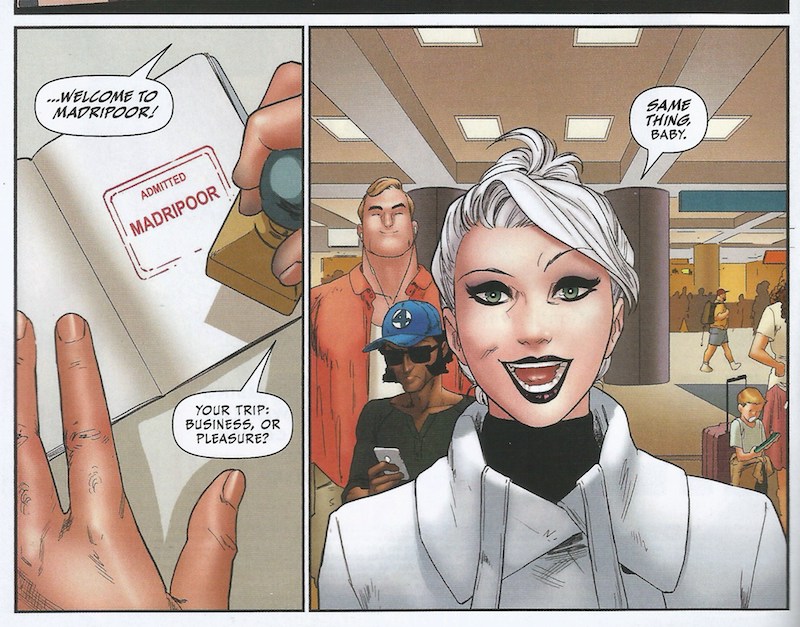
The beauty of Jed MacCay's whacky, happy go-lucky heist is that it doesn't have a serious bone in its body. Black Cat is like a crisp blast of fresh air after being trapped at home with the flu.
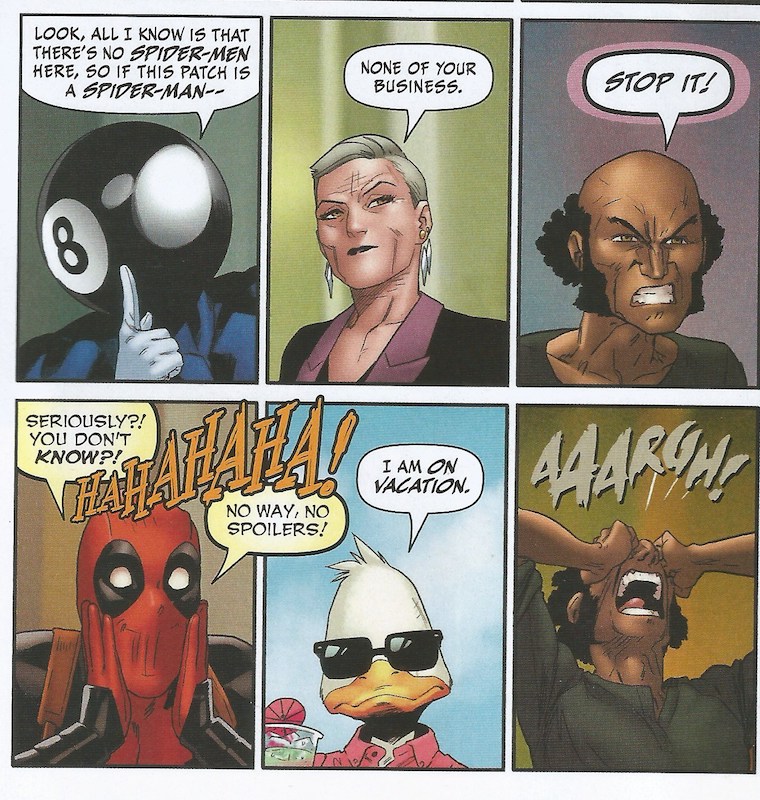
Once Felicia learns where Mr. Patch's secret room can be found. She stages an impromptu visit. Imagine her surprise when she learns Mr. Patch is an old friend.

I love that artist Kris Anka remembers that Wolverine is a little fellow. So many forget that Logan is a runt, or they're embarrassed to give him any scale.
So, yeah. Somebody beat Black Cat to the punch, and once she makes a deal with Wolverine, they go a hunting for the culprit who turns out to be Kilgore Kade.
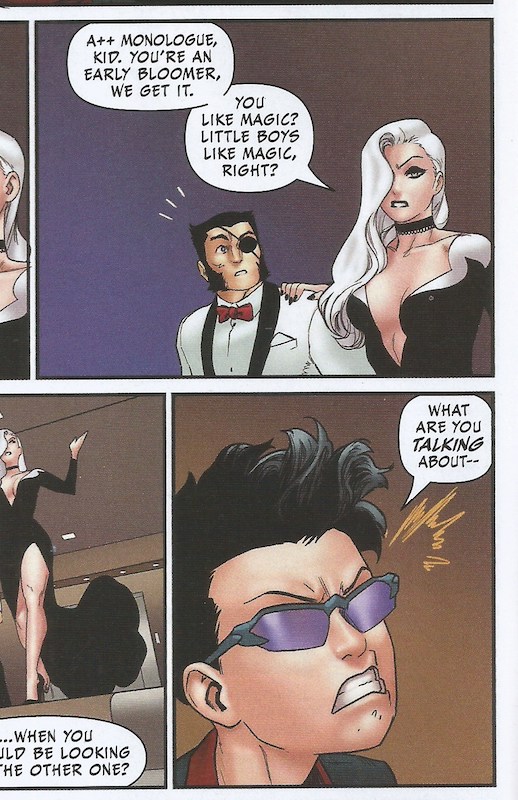
I guess X-Men fans know who Kilgore Kade is. Nobody else, but it's 101 for X-Men fans. It's an immaterial "spoiler" anyway.
MacCay doesn't create even the pretense of mystery. Kade left his calling card. He's out to humiliate Wolverine. Of course you can't humiliate him more than what's done in 4X. This necessitates a visit to Kade's casino where Black Cat's luck powers come into play.
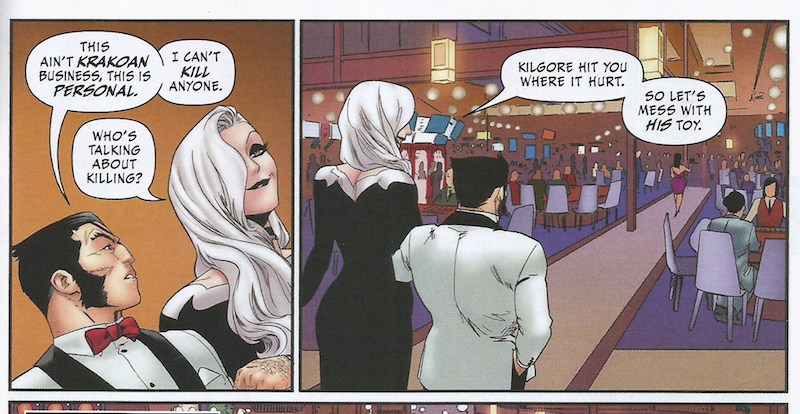
Black Cat's preternatural sabotage nets her a meeting with the Big Man who's not big at all.
She refuses to be impressed by the even runtier runt and embarrasses him something fierce. Suffice to say that Wolverine fans will want this issue of the Black Cat, and Black Cat fans already have it on their subscription list anyway. Watch for the payoff of a joke referring back to Black Cat's break-in of Stephen Strange's home.

Immortal Hulk Great Power by Tom Taylor and Jorge Molina is five bucks but double-sized, done-in-one and filled with the Marvel Universe framing the central story.

Spidey somehow becomes the Hulk. This isn't the Banner Hulk. It's a personalized Spider-Hulk. So, Spidey is out stomping around looking for Norman Osborn. The Green Goblin that is.

The Osborn obsession is more of a red herring. It may also be a joke alluding to a giant hedgehog named Spiny Norman looking for Dinsdale in Monty Python's Flying Circus. In any case, Spidey doesn’t come remotely close to Osborn let alone smashing him.
The writer injects some science in the whole body/power swap trope. I’ve always found this kind of plot device to be confounding scientifically. At least in the way most writers describe. Taylor’s tale makes sense.

Taylor expounds on a particular issue of Al Ewing’s Immortal Hulk. In this story, Bruce Banner is more mature and together. As the Hulk he exhibits a new power that comes into play at the climax.

Taylor gives the reader that saner more self-assured Bruce Banner in spades. The scientist, the wise man who can actually help Spidey see this trauma through.

As you can note by the depiction, he's not alone. Bruce called in Spidey's best superhero friends the FF.
Normally I would keep the team's appearance under the hat, but the FF guest-starring is too good of an asset to keep under cover. Besides, the real surprise, how this situation happens, is buried deep and a secret I'll keep.
In addition to all of these pluses, we have the winning personality of Spider-Man. His comedy.
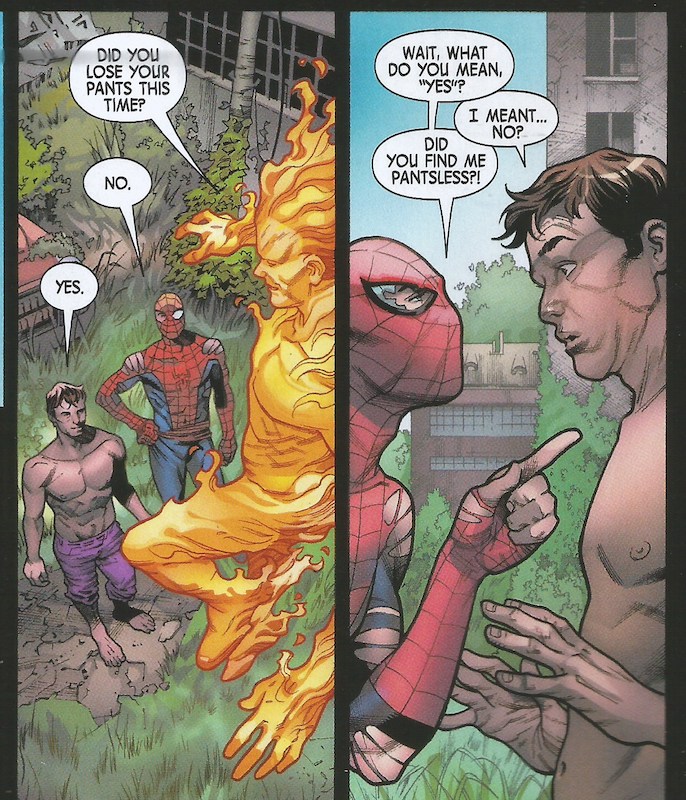
His genius. For pure Hulk fans, when the Big Buy returns he makes an important comment that fits the history of when the two Marvel lunchbox icons occasionally intersected.

As evidenced by Savage Avengers, Conan roams the present day, and in the Battle for the Serpent Crown, Conan hits Las Vegas.

Civilization hasn’t changed that much from models of the past. So, he immediately acclimates and stages a robbery for all the right reasons.

In the process of robbing the armored truck, Conan meets another thief named Nyla. Which is a lucky break for the barbarian.

Together, they intend to heist the Tower, where Conan believes Kulan Gath, him again, nests.

Whether or not this is true, is anybody’s guess because inside, the Tower looks modern. Las Vegas is known for its architectural mimicry. Gath is also nowhere to be found.
The latest Conan foray is wildly entertaining. Conan is once again portrayed as a hero and acts the part. His blunt method is often funny and always amusing. As is the way the ordinary man keeps underestimating this Hyborean bruiser.
Just when you think things are leveling off, the writer introduces an unpredictable element from the Marvel Universe to complicate matters at the conclusion.

Dark Agnes De Chastillion is a Robert E. Howard character that featured in two short stories: "The Sword Woman" and "Blades for France."
Marvel took notice of her when they lost or sold the rights to Red Sonja. As I described in previous reviews, the Powers That Be at Marvel introduced Sonja in Conan the Barbarian. Thus, they altered her character to fit the Hyborean Age.
Ironically, Marvel takes no such license with Dark Agnes. She plies her sword trade in the 16th Century, where we find her friend Etienne Villiers about to be executed. C'est la Vie.
Marvel took notice of her when they lost or sold the rights to Red Sonja. As I described in previous reviews, the Powers That Be at Marvel introduced Sonja in Conan the Barbarian. Thus, they altered her character to fit the Hyborean Age.
Ironically, Marvel takes no such license with Dark Agnes. She plies her sword trade in the 16th Century, where we find her friend Etienne Villiers about to be executed. C'est la Vie.

The story opens predictably, but that adherence to tradition allows for an exciting swashbuckling scene.

Cleverly, writer Becky Cloonan delves into Agnes’ history as artist Luca Pizzari choreographs the duels.

In the second act, Agnes and Etienne find themselves in unfriendly territory.

One that soon offers the opportunity of coin. This is where the story proper begins.

One that soon offers the opportunity of coin. This is where the story proper begins.

Having never read these particular Howard yarns, I cannot really compare Marvel’s new exploits. Taken at face value this is a strong beginning to a new series, reminiscent of Zorro only transplanted to France.
The darkness in Agnes telegraphs a definite feminist vibe. I’d like to know if Howard actually built on her history or if this is in fact the Marvel viewpoint. There’s argument for both possibilities.
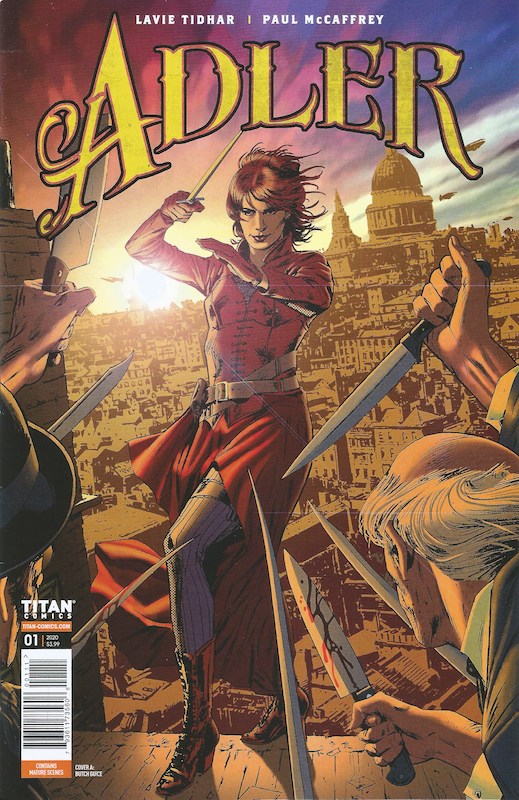
Arthur Conan Doyle introduced Irene Adler in “A Scandal in Bohemia.” She is one of the few people to soundly outwit Sherlock Holmes. For that reason, Holmes refers to her as “The Woman.”
Various productions stressed the words to create different syntaxes that described Sherlock’s feelings toward Irene. Most often talent attaches a romantic relationship. Holmes in fact asks for the photograph of Irene that she left behind before escaping. He has no logical reason to do so.

Because of that majority Irene’s adventures perpetuated beyond a single canonical short story and inspired the creation of so many other bad girls that fall for the detective. Indeed, one can argue there would be no Catwoman without Irene Adler.
The eponymously named Adler isn’t the first comic book about Irene. It is however the fullest and details everything Doyle described in a respectful homage.

Part of this success occurs because Irene isn’t a pastiche of Sherlock Holmes. In other words, she doesn’t replace Holmes, but lives in the same world.

That of course is Professor James Moriarty referring to an equally infamous Holmes and Watson case.
The Professor and the criminal organization he heads tangles with Irene as they never do in the canon. It is of course difficult to resist the urge to direct a clash between these icons.

Adler once again possesses information the other party seeks to possess, but what's in those letters remains to be seen.
The Professor isn’t the only one who seeks the letters, and this is where Adler differs from other presentations. Although, Irene Adler teamed up with Jane Porter in her Dynamite comic book debut.
The Professor isn’t the only one who seeks the letters, and this is where Adler differs from other presentations. Although, Irene Adler teamed up with Jane Porter in her Dynamite comic book debut.

I would imagine that many will think of the League of Extraordinary Gentlemen when they see Rider Haggard’s She, Sheridan Le Fanu’s Carmilla and Agatha Christie’s Jane Marple.

Actually that’s Jane Eyre, yet, it really can’t be. Jane Eyre’s life is finite and confined to one novel. The Jane of Adler possesses a colorful background which includes war time nurse and a lost love argues strongly for Miss Marple. Whatever. In any case, you should think of this mash of characters not as The LEG but in terms of Walter Scott’s Ivanhoe which brings together the title figure with Robin Hood and the Black Knight. Published in the 12th Century, surely this masterwork is the first confluence of legends.

In addition to a good fight against the blood controlling monster Hemorrhage, Vengeance of Vampirella operates on a unique theme.

Vampirella is not and never has been a true vampire. She is not undead. She does not become lethargic, nor burns in sunlight. She is an alien from the planet Drakulon.

Her resurrection somehow heralds the return of the sun. She restores hope in the survivors of a slow apocalypse. She inspires the people to fight. In other words, Vampirella is their hero. The idea of a vampire being such a motivating, inspirational force for good is probably the most subversive thing ever done in a Vampirella book.

The populace can't know Vampirella's full story. To them, she appears to be a vampire. However, they embrace her unconditionally. This indicates how bad the world has had it. Better a vampire hero rather than a demonic hell mouth.

Dr. Doom has problems. Somebody's framed him for blowing up a Reed-Stark technological wonder on the moon thereby murdering a helluva lot of people.
Doom turned himself in, but it didn't stick. The same unsubs behind the sabotage tried to assassinate Doom. That didn't stick either. They staged a coup and now a Fortunov sits on the Latverian throne. I know what you're saying. Where have I heard that name before? Howard Chaykin's Dominic Fortune's real name is Fortunov.

Doom is on the run, but his head is filled with bees. He keeps having visions of a future that seems not possible, yet one Kang, his descendent agrees is real.

In this issue, Doom meets his dream lady. That creates a new problem. She's less than happy to see him.

To compound his growing headache, former Ultimate Dr. Adam Brashear and FF droid Herbie are on his tail along with Silver Sable and his regent Victorious, whom he's not happy with.

On the whole though, if Doom seems a little tetchy, you just have to look at what's on his plate. This well orchestrated comic book by Christopher Cantwell and Salvador Larocca generates sympathy for the antagonist just through the shear number of issues he must overcome. At the same time, it seems that Brashear isn't really out to tag him. Reed's seeking him out to help the brains figure out the sabotage before the solar system is swallowed by a Black Hole.

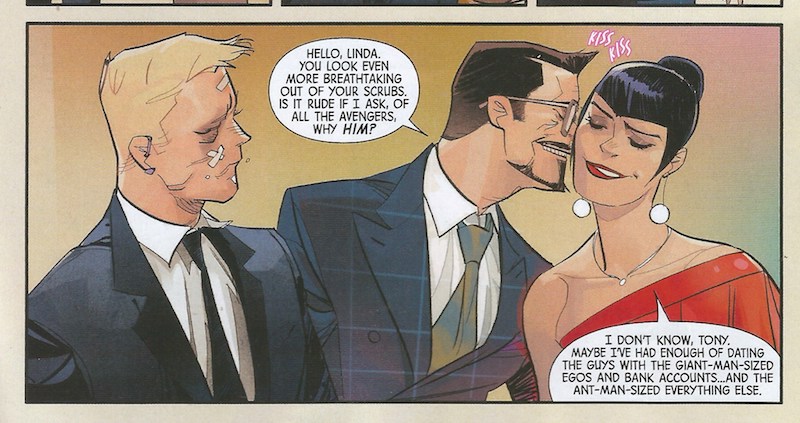
Thanks to Marvel cinema, nobody on the face of the earth will think of Ant-Man as anybody but Paul Rudd and/or Scott Lang. For that reason, Marvel gave back him back the gig. Most recently, he became and lived up to the name of Guardian of the Galaxy.

Unfortunately, despite Rocket Racoon's larcenous aims, writer Zeb Wells is correct. The Guardians didn't pay except in room, on a spaceship, and board. Presumably replicated food. Scott returned to earth and his daughter Cassie.

There's some issues there as well. Cassie though is a superhero in her own right, much to AIM's chagrin. The amusing opening anecdote with Marvel's favorite hazardous beekeepers is filled with comedy and an everyman vibe.

AIM's presence also foreshadows the Big Bad of the book, and here's a hint.

The new adventures of Ant-Man is hoot, but its also surprising and there's a surprise on top of that one. With art by Dylan Burnett that suits the comic atmosphere but also does well with the raw super-heroics.

In addition to a good fight against the blood controlling monster Hemorrhage, Vengeance of Vampirella operates on a unique theme.
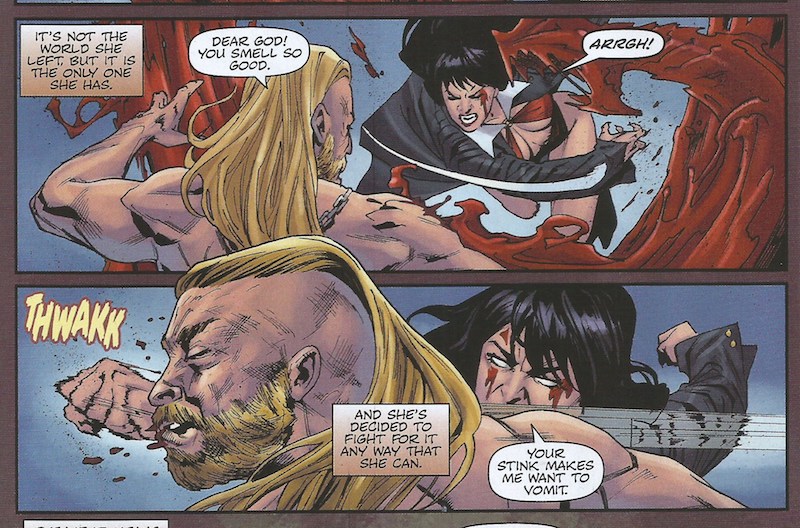
Vampirella is not and never has been a true vampire. She is not undead. She does not become lethargic, nor burns in sunlight. She is an alien from the planet Drakulon.

Her resurrection somehow heralds the return of the sun. She restores hope in the survivors of a slow apocalypse. She inspires the people to fight. In other words, Vampirella is their hero. The idea of a vampire being such a motivating, inspirational force for good is probably the most subversive thing ever done in a Vampirella book.

The populace can't know Vampirella's full story. To them, she appears to be a vampire. However, they embrace her unconditionally. This indicates how bad the world has had it. Better a vampire hero rather than a demonic hell mouth.

Dr. Doom has problems. Somebody's framed him for blowing up a Reed-Stark technological wonder on the moon thereby murdering a helluva lot of people.
Doom turned himself in, but it didn't stick. The same unsubs behind the sabotage tried to assassinate Doom. That didn't stick either. They staged a coup and now a Fortunov sits on the Latverian throne. I know what you're saying. Where have I heard that name before? Howard Chaykin's Dominic Fortune's real name is Fortunov.

Doom is on the run, but his head is filled with bees. He keeps having visions of a future that seems not possible, yet one Kang, his descendent agrees is real.

In this issue, Doom meets his dream lady. That creates a new problem. She's less than happy to see him.

To compound his growing headache, former Ultimate Dr. Adam Brashear and FF droid Herbie are on his tail along with Silver Sable and his regent Victorious, whom he's not happy with.

On the whole though, if Doom seems a little tetchy, you just have to look at what's on his plate. This well orchestrated comic book by Christopher Cantwell and Salvador Larocca generates sympathy for the antagonist just through the shear number of issues he must overcome. At the same time, it seems that Brashear isn't really out to tag him. Reed's seeking him out to help the brains figure out the sabotage before the solar system is swallowed by a Black Hole.

Thanks to Marvel cinema, nobody on the face of the earth will think of Ant-Man as anybody but Paul Rudd and/or Scott Lang. For that reason, Marvel gave back him back the gig. Most recently, he became and lived up to the name of Guardian of the Galaxy.

Unfortunately, despite Rocket Racoon's larcenous aims, writer Zeb Wells is correct. The Guardians didn't pay except in room, on a spaceship, and board. Presumably replicated food. Scott returned to earth and his daughter Cassie.

There's some issues there as well. Cassie though is a superhero in her own right, much to AIM's chagrin. The amusing opening anecdote with Marvel's favorite hazardous beekeepers is filled with comedy and an everyman vibe.

AIM's presence also foreshadows the Big Bad of the book, and here's a hint.

The new adventures of Ant-Man is hoot, but its also surprising and there's a surprise on top of that one. With art by Dylan Burnett that suits the comic atmosphere but also does well with the raw super-heroics.