Tuesday, April 7, 2020

POBB April 7, 2020

Pick of the Brown Bag
April 7, 2020
by
Ray Tate


Batman: The Adventures Continue is one of the "books" I knew I'd be purchasing online.  Comixology hashes it out in the form of comic strip, which suits the reading experience.  Written by Alan Burnett and Paul Dini, Batman: The Adventures Continue is essentially a slideshow of an episode from a hypothetical season never made.  As you read, you cannot help but hear the voice cast of Kevin Conroy and Efrem Zimbalist Jr.  It even kicks off with an attractive title card.

The story begins in Gotham City.  It's an average night for Batman.  With average villain Bane ranting like Dolph Lundgren on uppers.

DC considered Bane the biggest of deals back in the nineties.  The Powers That Be set him up to deliver the crippling blow to Batman.  Of course, emphasis on Man, he was up and walking in an eye-blink.  Batgirl, emphasis on Girl, stayed in a wheelchair for twenty-three years until the glorious New 52 in 2012 restored her mobility.

The creative team behind Batman:The Animated Series thought very little of Bane.  Batman readily defeats him in a better story than the Powers at DC conceived.  He returns in the original animated video Mystery of Batwoman only for Batman to hand him ass again.  Finally, in "Knight Time" Superman disguised as Batman doesn't even work up a sweat.

After kiboshing Bane, Batman soon finds a more suitable threat.

Retro-styled robots are a staple of Batman: The Animated Series.  That's largely due to the influence of the Fleischer Superman cartoons from, believe it or not, the 1940s.


The homage is significant, since Batman: The Adventures Continue stakes out its period with open references to Superman.

Steeped in Batman:The Animated Series signatures brought to life by Ty Templeton, who graced the original comic book tie-ins, The Adventures Continue likely takes place after the first season of Justice League.  Batman refers to Superman as a friend, and they weren't really friends until then.  This actually works well with the premise.

S
P
O
I
L
E
R
S


A
H
O
Y


You can add to that voice list Clancy Brown and Marilu Henner.  Since the bubbly Veronica Vreeland and sour but personable Lex Luthor spice up the proceedings.  We also have a surprise guest star in the shadows watching Batman battle the robot.


My guess is that this is Jason Todd.  The creators of Batman: The Animated Series once considered using Jason Todd, but in the end simply merged his personality with Tim Drake's persona for a second Robin, rather than a third.

This is not a done-in-one comic book.  Notably, Burnett and Dini start out with Bane as an allusion to "Knight Time," because the opposite occurs in Batman: The Adventures Continue, Superman is missing.  This will likely enmesh in the robot-theft angle.  How Lex and Jason will play a part is anybody's guess.  Once again, all of this seems apt because of Batman's growth from a lone vigilante to a distinguished member of the League.


Tuesday, March 31, 2020

POBB March 31, 2020

Pick of the Brown Bag
March 31, 2020
by
Ray Tate


Everybody knows the story of the Fantastic Four.  Determined to reach the stars, Reed Richards and Sue Storm convince brother Johnny Storm and best friend Ben Grimm to take the risk of a life time.


Alas, the shielding on the rocket proves inadequate.  Cosmic rays bombard the ship and force an emergency landing back to earth.  The four survive, but the cosmic rays mutate them into The Invisible Girl, Mr. Fantastic, The Human Torch and the Thing.

Recently, the FF decided to readdress their epic fail.  Reed and Johnny rebuild the rocket from scratch.  No cheating with superpowers.  Just using the tools they had in the past.  This time with bitchin heavy cosmic ray resistance.  The FF end up on the planet Spyre, and the people of Spyre expected them.  They refer to the FF as the Fourtold.  


In subsequent issues, the FF learn how the Overseer of Spyre affected their original rocket flight.  They also learn something of the culture, and the idea of soul mates, symbolized with arm bands.  

These pairings appear to be omniversal.  The Great Eye confirms Reed and Sue.  Johnny on the other hand discovers his soul mate is a beautiful bird woman from Spyre named Sky.

This most recent issue of the Fantastic Four focuses on Sky.  Last issue, Sky intended to be with her soul mate.  She therefore asked to accompany the quartet back to earth.  Everybody’s talking about her.


Essentially, Sky is Hawkgirl without the mace and helmet.


Oh, sure, she has a different personality and everything, but her power set is analogous to Hawkgirl, with a smidge of Black Canary thrown in for good measure.


She’s a woman of color, but that's not ground breaking.  DC already contributed a black Hawkgirl when the Powers That Be reimagined their multiverse.


Earth 2

I’m not trying to disparage the character.  Sky is actually kind of nice.  She’s a stranger in a strange land and all that.  Her want to help is sincere, as is her belief in the soul mate paradigm, granting her a sort of innocence.  Sky though is no dummy.  Like Hawkgirl, she comes from a culture facilitated by advanced science and technology.  She also understands that Johnny has yet to accept what's inevitable to her.  It’s furthermore interesting to see how the Fantastic Four react to Sky.  Reed of course welcomes her.  Cause that’s Reed.


Ben is noncommittal, and Sue is positively icy.  The Black Cat commented on never crossing paths with Sue if she can help it.  To be fair, Sue thinks Sky wasted this trip, and her flighty brother, the soul mate, will cast the winged woman aside.  

The running joke being Sky’s another Crystal.

Crystal is an Inhuman.  She’s sister to Medusa and took Sue’s place on the Fantastic Four when Sue became pregnant.

Writer Dan Slott fosters a running joke throughout the arc, saying that Johnny’s romance with Sky is like that of his relationship with Crystal.  The implication that it was fleeting.  Yet, Stan Lee and Jack Kirby introduced Crystal way back in Fantastic Four #45.  She lasted until issue one-zero-five.  Quite a run.

Johnny is a really clueless banana in this issue of the Fantastic Four.  However, he starts seeing Sky in a different light when the Mole Man attacks the Keewazi Reservation.  


The Mole Man faced the Fantastic Four in their debut issue, and he’s been nutty ever since.  On occasion, the Mole Man seems content, but these moments are mere blips on a radar. 

The Keewazi are a Marvel Native American Tribe.  Wyatt Wingfoot is their most famous member.


That may change since the Keewazi though fictional behave under the authentic traditions of the Natives.  The Keewazi react to the earth movement with fear and trepidation.  After the Moloids appear, the townspeople accept and welcome the strange visitors.


This issue of the Fantastic Four ends much differently than one expects, and that’s all thanks to Sky.  We expected a big brouhaha drama pitting the FF against the Mole Man.   Instead, it’s a done-in-one comedy that eschews the usual violence associated with the FF’s dealings with the little fruitcake. 

In the context of pop culture, Dan Slott is actually reimagining Superman and the Mole Men.  He built the subplot a few issues ago, with rumblings from beneath the tribal earth.  

In the Superman film. mankind uncovers the existence of the Mole Men, and unlike the Keewazi, the humans are not keen to live in peace and harmony.  It's up to Superman to show these asses the error of their ways.  

The movie's available for streaming on Youtube and Amazon for about three bucks, if you so desire.  The cynicism toward the human race and confident acting overcome the horrible, horrible cheapness of the affair.  Adventures of Superman broadcasts on television a year later with much better production values.

Wednesday, March 25, 2020

POBB March 18, 2020

Pick of the Brown Bag
March 18, 2020
by
Ray Tate


Good Night, Major.
You always brought a smile to my face.

Welcome to the Pick of the Brown Bag.  In these trying times the Phantom of the Attic still came through with a bounty of comic books, and we have some reviews that just couldn't be included with the previous editions of this posting.  Up to date decisions however can still be found on Twitter: #PickoftheBrownBag.

As you may have learned Diamond, after this week, will no longer distribute comic books.  The floppies anyhow.  This is due to the fact of unfortunately necessary stay-at-home orders and government shut-downs to business.  

What this means to the POBB is this.  After the current posting, there will be one final issue of the blog as you know it.  The POBB is not going away, but it's going to change.  

I have a number of comic books and graphic novels in my collection, and I think I'll review them.  As always, I'll try to avoid major spoilers, unless it's a classic.  In which case, I may decide to showcase the issue and spoil the hell out of it.  You'll be warned of course.  

If you're wondering about online comics and such.  Yeah, I might.  Maybe.  I'll probably still be reading, but you know what? Not as quickly.  

The portability of the floppies as well as that of magazines was a major attraction.  I have never gotten used to reading things on-line.  I didn't grow up in that era.  Enough doom and gloom.  Let's get on with the current issue of the Pick of the Brown Bag.


In a previous review, I praised Adler for not taking Sherlock Holmes out of the picture.  Unfortunately, the book does indeed substitute Irene Adler for Sherlock Holmes.  


"The Adventure of the Sussex Vampire" is a canonical Sherlock Holmes short that elegantly applies reason to a supposed supernatural event.  With few clues, Holmes at his best solves a confounding mystery.  Doing most of the thinking on the train ride to the scene of the crime.  Damn!

The detective Professor Moriarty mentioned in the debut of Adler appears to be another Victorian literary figure who shows up this issue.


It's certainly novel.  I'll give you that.  Phileas Fogg is of course the protagonist from Jules Verne's Around the World in Eighty Days.  


So where does that leave me? Difficult to say, since this issue of Adler focuses on the villains of the piece.  


In that respect Adler succeeds admirably.  Carmilla is Sheridan Le Fanu's lesbian vampire.  She is one of the most transformative figures in literature, and it's a surprise that she appears quite early in history.  

The world of film would be a different place without Carmilla.  Carmilla became a major influence not just to horror but to lesbian film in general.


Dracula's Daughter (1936)

In Adler, Carmilla serves Ayesha.  Created by H. Rider Haggard for the novel She, Ayesha is also known as She Who Must Be Obeyed.  I know you've heard the phrase, but what you may not know is that it originates from Haggard's novel.

Ayesha is an immortal queen who learns the ways of magic and preserves her two-thousand year old body with supernatural flame.  Any man who sees her will instantly fall in love with her.  Prostrating themselves before her.  The enchantment seems to work on lesbian vampires as well.  

I love this imagery by Paul McCaffrey.  It demonstrates the sensuality of the relationship and indicates that the feeling may be one-sided.  There is nothing but ambition in Ayesha's eyes.  The dispossessed queen may not be satisfying any of Carmilla's needs.  She instead may see Carmilla as a killing tool, but a dangerous one.  So, she allows her a modicum of familiarity.  Though perhaps not the freedom to enter her bedchamber.

Haggard granted Ayesha empathy through a love story subplot.  However, she was power mad and killed to get her way, no matter how petty the desire.  In Adler, writer Lavie Tindhar bestows Ayesha dignity through her resistance to British Imperialism.  Irene as well expresses a distaste for the practice.  Ayesha saves Jane Eyre's life.  Her motivation in this case appears to simply be sisterhood.  Jane is Irene's Watson.  I have no idea why.  I can only assume that Jane's common name with Miss Marple, not a public domain figure, triggered the inclusion.


Jordie Bellaire reestablished Vampirella in the nineteen sixties where she meets a time lost Red Sonja.  Together they solve a real life mystery and put an end to a Soviet experiment.  

After that Bellaire produced two-stand alone tales for each female hero.  He then introduced a time-tripping element that confused and irritated me.  I thought this would be a series where Red Sonja and Vampirella would adventure in the sixties, not backwards through the ages.  However, I'm willing to overlook a premise if the story's good.  This issue is pretty good.

After leaving some medieval fantasy nonsense, Red Sonja and Vampirella find themselves in the roaring twenties.  Here they're under the gun.


Not to worry, neither is any slouch in a fight.  After disposing of their would be attackers, by non-lethal means, V and Sonja pull a classic switcheroo.


They find a clue in the pocket of one of the goons and decide to rendezvous with the unknown parties.  Feeling peckish, Sonja decides to sate her hunger.  


The rat objects.  The rodent is actually the witch that gifted Sonja with the Generation Stone, which allows her to travel through time.  Instead of eating the rat, Sonja incorporates the witch/rat into her ruse.  Further investigating uncovers crooked cops common to the period.


The whole shebang is in service to horrors that manifest only after Sonja and V scratch the surface.  None of these developments are common to the period.  

The pace moves at a fast clip.  Vampirella and Red Sonja's interaction is a hoot, and they're on the same page regarding what's hidden in the dark.  


In Tom Sniegoski's Vengeance of Vampirella, Vampirella relates how she became a monster.  In this stand-alone tale, Vampirella claims to be a split personality.  One side human. The other a creature.  

In reality, by the tale's conclusion, you'll see that Vampirella is in fact all too human even if in actuality an alien.  

The story takes place in a relative calm period in Vampirella's life.  She's working with the Danse Macabre.  An organization that confronts the supernatural.  


The untamed jungle seems to affect Vampirella, and this is an original idea.  Vampirella's release of the beast so to speak isn't due to any stress involved in a typical battle with an unstoppable foe such as a Golem or what have you.  She's basically using her abilities to combat nature and becomes more savage as the world reverts to a primeval state.

It gets remarkably worse as Vampirella struggles through the unchecked flora.  She encounters carnivorous plants of all ilk  and a callback to Charlton's Phantom.


This allows artist Robert Castro to show that he's not just dynamite with the depiction of a painfully sexy woman that walks around with spaghetti straps covering her erogenous zones.  He's also a skillful illustrator of dynamic action.   

The spider encounter is just one of many allusions.  Her whisper of "Satyr and Circe..." is reminiscent of Wonder Woman's Greek exclamations such as "Suffering Sappho!"  In a humorous sequence she basically encounters some Terry Gilliam inspired Trolls followed by dryads.  She is also welcome when saving the day.


As I have suggested in many a review, Vampirella isn't so much a monster or creature as a horror-themed superhero for an adult audience.  This idea Sniegoski conveys in the consistent tension.  The tale's antagonists are pulpy, but Vampirella's narration is not.  Her bemusement of the cockney speaking Trolls is her only respite from an otherwise harrowing encounter that ends logically but tragically in a deliverance not from evil put unbridled power.


In Vampirella's mothership title, Christopher Priest details how her enemies brought down the plane that she and witch boy Benny were on.  This reads like a Mission Impossible styled espionage piece that's conducted by the anti universe Jim Phelps and the IMF.  The spotlight lies on the villains, but Priest also includes an operatic ending for one of the cast as well as a incremental descent into madness for another.


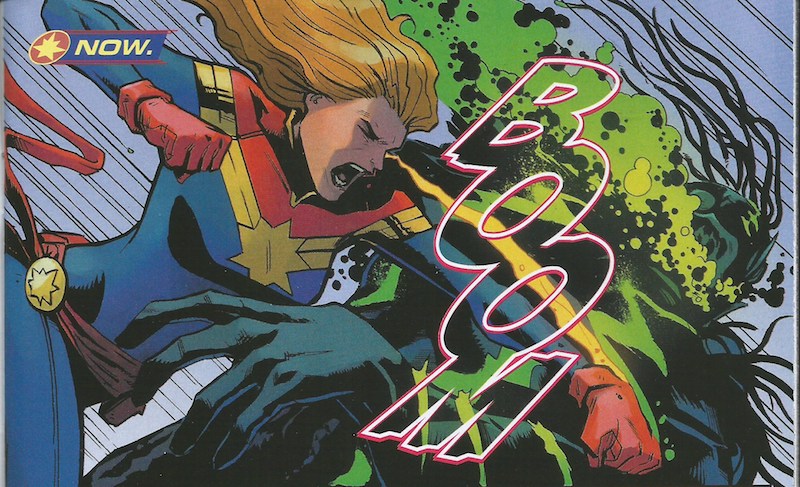
Captain Marvel is a showstopper conclusion to the latest story in which a fruitcake cosmic wannabe forced Carol to kill the Avengers for him.  Early in the tale, I had serious misgivings and doubted writer Kelly Thompson.  

I'm still not happy with that brutal fight against Iron Man.  I'm not a fan who wants to see superheroes duel.  These things usually bore me to tears, and the fisticuffs end up being the equivalent of padding in an ordinary drama.


So naturally, Carol hasn't been killing Avenges.  She's been pocketing them in another dimension while turning in handy dandy clones in substitute for their bodies.  


This afforded Captain Marvel time to learn Vox Supreme's plans, most of them and give Tony Stark the opportunity to brainstorm a way out of the mess.  

It all comes to a head this issue.  Carol beats the snot out of Vox Supreme while the Avengers rescue the innocent, but my telling you this doesn't cover the wonderful twists in that fight.  The graphics I've included only give you a taste of the startling visuals to come.


Spider-Woman is Jessica Drew.  A long time ago, in a hidden city on Mount Wundagore, uranium deposits irradiate young Jessica to the point of death.  To save her life, her scientist parents and the High Evolutionary place her in cryogenic stasis while they work on a cure.  They derive this cure from the venom of multiple spider species.  That cure grants Jessica spider-like powers as well as an immunity to poisons and a venom blast.  She also once issued a unique pheromone.  Exposure either turned you on or turned you off to her.  When Jessica emerges in this altered state, she emerges as a young woman.

Why bring up old history, asks you? For one thing, Karla Pacheco's story recalls a lot of it, not in specifics but in characterization and action.  After being shunned by the High Evolutionary's Moreau Project, Jessica fell under the thrall of HYDRA and ended up fighting the Thing in Marvel Two-In-One.  She leaves HYDRA, not on good terms, of course, and becomes a criminal to survive.  In London, she meets SHIELD agent Jerry Hunt who eventually turns her to the good.  Pacheco's tale starts off thusly...


A billionaire named Marchand hires Jessica to be security at his daughter's birthday party.  This ends up being more than a milk run.  Though milk men do appear.


A lot of Jess' battles capture the flavor of the original stories.  For one thing, they were more mature in nature. That expression on Jess' face is indicative of a series of hard knocks delivered by life.  She gets back up again.

The violence choreographed by Pere Perez is more realistic in nature and edged sharper than most depictions.  When Jess' best friend beats the tar out of Vox Supreme, she's a Kree smacking around an inky alien.  It's a level removed from reality.  Jessica is fighting mortal men and holding back just enough to avoid a kill.  Jessica's fighting while ill.  This sickness is a callback to the feelings of loneliness due to the consequences of the pheromone.


Even the fantasy super heroics bear a certain amount of creepiness that became a Spider-Woman signature.  Unlike Spider-Man, Spider-Woman told no jokes.  She silently stalked from a variety of vantages before waylaying the villain with a venom blast.  It's for these reasons Spider-Woman will appeal to faithful fans of the character.  

The back up story is geared more for the modern Spider-Woman reader.  Here we see Jess with baby boy in tow.  Indeed, while Jess' struggle to make ends meet echoes the past, it's very much a present day problem as well.  Avengers get stipends, but Jess is no longer part of that team.

During this immediate past event, Jess gains a new costume and a host of problems.  Artist Paulo Siqueira gives Jess a lot more pulchritude in this short, but he also grants a powerful musculature.  This is in fact a return to the character, since Siqueira is the original artist for the 2000s Captain Marvel, where she guest-starred.