Friday, January 1, 2021

POBB January 1, 2021


....From Hell's Heart I Stab at Thee....


Pick of the Brown Bag

January 1, 2021

by

Ray Tate


Happy New Year! Welcome to a fresh era of Pick of the Brown Bag.  If you've just stumbled onto the blog, allow me to introduce myself.  My name is Raymond Tate, and I review the best and the worst of the current comic book yield.   


For this post, I look at the first issues of Commanders in Crisis, Dungeons and Dragons--The Spine of the World, The Black Cat, Red Sonja--The Price of Blood, The Union and Vampirella--The Dark Powers.  The Pick of the Brown Bag also has a Twitter presence: #PickoftheBrownBag.


Crisis on Infinite Earths is one of the most literally ground breaking stories ever conceived.  The Powers That Be at DC wiped out every parallel earth it ever introduced.  That's a lot.  Before the Crisis, wholesale destruction of alternate universes would have been unthinkable.  However, multiverse genocide became commonplace.  Each shakeup less satisfying.  Seldom anything changed afterward, especially wheel-chair bound red-heads.  Until the New 52, these disasters identified as cynical company cash-ins.


Frequent DC writer Steve Orlando and artist Davide Tinto aim to return drama to the concept with their new indie creation Commanders in Crisis.  


The premise takes a page from eighties television series The Greatest American Hero.  The Commanders are the survivors of dead mirror earths.  They're trying to protect the earth on which they now reside.  Orlando and Tinto furthermore add a neat twist to the title of the book that's revealed at the conclusion of the premiere.  This plays into the teams' common goal.


The world threats come from different quarters.  For the debut, the team must contend with time traveling thieves stealing something precious worldwide.  There's also an ongoing political threat that savvily establishes an insane idea that could very well be prescient.  Orlando and Tinto conclude the debut with a strong mystery that sets off Crisis Command's Trouble Alert.


Despite being inspired by Crisis you'll not find pastiche, parody or satire in Commanders.  So, for example, there's no Dark Owl skulking around in the night, dishing out vigilante justice while pretending to be a millionaire playboy.  Orlando and Tinto instead design well-constructed characters that resonate off the pages.  They shape interesting superheroes with cultural and aesthetic significance.


Prizefighter becomes empowered by fan interest.  Seer is the most potent creature on the planet for one minute.  Sawbones is an instinctive doctor and action hero.  Originator alters time and space by coining new appropriate words.  Leader of the team Frontier is a sharp minded tech guru.


The adult nature of Commanders also sets it apart from the Crisis and DC comics.  Nudity and sex scenes generate dramatic impact that informs a philosophical argument, granting the story greater weight.


Vampirella is not undead.  As established in her christening magazine, Vampirella is an alien from the planet Draculon.  She drinks blood, but does not burn in sunlight.  She exhibits invulnerability and super strength and doesn't fear wood.   Vampirella shape shifts but only to a certain extent, such as when she forms bat wings for flight.  She can't turn into cat, bat or wolf.


Habitual POBB readers know that I like Vampirella.  A lot.  I've referred to her as a horror version Kryptonian.  Supergirl's flipped sister.  Dan Abnett and The Powers That Be at Dynamite take the extra step.  Vampirella is a fearsome superhero.  What if she joined a superhero team?


Vampirella--The Dark Powers is just fun.  The fruition of  Ella allying with 1940s public domain heroes, their adventures oft published by Dynamite as Project Superpowers, is darkly hilarious.  


Vampirella's method of "crime" fighting is decidedly more lethal than her comrades.  


This leads to some highly amusing friction.


Notable exceptions to the rule.  The very first masked female hero in comic books, The Woman in Red, appears to like Vampirella's spunk.


Dark Powers isn't a dark book.  It's pure entertainment, comfort reading, if you will, borne from a killer Ella interacting with more innocent superheroes and fighting an interesting menace.


To be sure, you can argue that Vampirella isn't the first killer superhero to serve as contrast to an otherwise straight-up shiny league.  Wolverine, for example, but Vampirella's history just puts a unique spin on the whole banana.


Vampirella debuted in a black and white magazine from Warren aimed at adults.  She only became a comic book character twenty years later back in the nineties.  That comic book always straddled the fence between an adult and adolescent audience.  It still does.  Superheroes on the other hand always benefited from an all-ages appeal.  Some would still argue them to be mostly kids stuff.  When comic books become too dark, too violent, or the execution of these elements becomes too realistic, the books you may have been reading all your life ring false.  The Powers at Marvel Comics always meant for characters like Wolverine, the Punisher and Conan the Barbarian to still be human enough to attract kid readers.  Vampirella, from any publisher, not.  Thus, Vampirella Dark Powers is wonderfully schizophrenic.  


For a while, I really enjoyed Mark Russell's Red Sonja.  I liked his political satire and philosophical trappings seasoning a wiser, older She-Devil with a Sword.  Nevertheless, there's something to be said for just getting back to Marvel basics.


Though Robert E. Howard never intended to place Red Sonja in Conan's world, that's how Roy Thomas introduced the most familiar version of Red Sonja to the comic book reading public.  It's this Red Sonja that in addition became the star of paperbacks, film and television.  Mind you, I never said any of these projects were good.  Just that they exist.


Reliable Red Sonja writer Luke Lieberman, and bonus, superb Red Sonja artist Walter Geovani inveigle Sonja in a new adventure.  The foray takes place shortly after the events of Birth of a She-Devil.  Essentially, Sonja haps upon the Hyborian equivalent of Burning Man.


Of course, uptight conservatives hate hedonistic displays, and in the sword and sorcery genre, you don't get legislated to death.


The extreme prejudice riles Red.  Soon she kinetically explains why she's known as The She-Devil with a Sword.


Sonja being young doesn't quite realize what it means to bite off too much you can chew.  So, she's caught and sentenced to death.


Or would have been had it not been for the timely intervention by new character, Yfat.  


The lady's motives for helping Sonja may be less than altruistic, since she has assassination on her mind.


Yfat's aim suits Sonja.  Following the assassin's plan, Red soon finds herself in striking distance for her revenge.  


Simple yet satisfying I recommend Price of Blood for anybody yearning for more bloody bawdiness from the flame-haired hellion.


Stop me if you've heard this one before.  A Lawful Neutral musher ends up between two warring factions of Chardalynn brokers.  


Chardalynn is a magical gem from the Forgotten Realms of Dungeons and Dragons.  The factions kill each other, but a Lawful Good giantess of the mountains rescues the musher.


Sort of.  After bona fides are established, a monster interrupts their parlay.  Requiring more Lawful good saving.


Fortunately, our giantess gets backup in the form of a Lawful Good reptilian ranger.  Incidentally, I'm basing the alignments on the group's actions.  


Saarvin and Runa being of the same disposition escort Amos, the Musher to town where they seek a Druid, a type of Cleric.  He however has his own problems.  Fortunately, Belvyre also has backup in the form of a Lawful Good warrior, amusingly named Patience. 


She's gifted not just with an awesome visage but also a magic staff.


With so many Lawful Good characters, it's not too long before Amos thanks them for their services with a scam.


I haven't played Dungeons and Dragons since my college days, and I have with few exceptions little interest in fantasy books.  Martin Coccolo's and Katrina Mae Has' vivid and vivacious artwork in Spine of the World persuaded me to take this book home.  It would be different if the characters turned out to be just a bunch of white humans, elves, dwarves or Hobbits, but the diversity spreads to lizard people, red women with horns and black giantesses.  I expected to lose interest in the tale, and just look at the pretty, pretty pictures. However, Aimee Garcia's and A.J. Mendez's mostly Lawful Good cast seeking balm for a dying village is easy to digest, with strong dialogue and plausible situations.


A long, long time ago, in a galaxy far, far away, Spider-Man found a lonely, alien pair of pants.  He decided to wear them and discovered one of the poorest fashion choices he ever made.  Now, there's a whole planet of alien pants in Marvel's latest Big Event, and one of those jet black extraterrestrial Levis is Knull the King in Black.  


I never heard of him either.  


This means a lot of comic book talents are diverting their attention to transforming bell bottoms.  Some comic book titles arise brand new just to stop this invasion of bug-eyed dungarees.  The Union is one such book.


The Union interested me for three reasons.  One, the team is from the United Kingdom.  


Two, it's written by Paul Grist who launched the successful indie Jack Staff, also centered around a British superhero.  Three, Union Jack.


For those that don't know Jack, Roy Thomas and Frank Robbins created the figure in The Invaders.  He was Lord Falsworth a World War I hero who battled Baron Blood, a Dracula sired vampire.  Falsworth's son stepped up to become the second Union Jack.  The third and current Union Jack is Joey Chapman, unrelated to the Falsworth line, notable for being a working class Briton, originated by Roger Stern and John Byrne.


Paul Grist writing for Union Jack is basically perfect, and he relishes the opportunity in a plot that pits Union Jack against the up and comers of The Union in a game of Capture the Flag.  


So this isn't a dreary tale of superheroes fighting it out until one falls or one reaches an understanding and joins forces.  It's just a game with superpowers, lovely bouncy dialogue and a bit of good-natured rivalry.  When the metamorphosing outfit from outer space shows up, things get serious, resulting in a surprising conclusion.


The reason why I purchased The Black Cat in The King in Black is simple.  Jed MacKay made me love the Black Cat, and he's still writing for Felicia Hardy.  I was concerned that King in Black might damper the free-wheeling Lupin III attitude, but I was happy right at the start.


Black Cat and her crew, the irascible Doctor Korpse and Bruno, conduct a heist that involves a certain Web-Slinger's discards.  It's all fun and games until the cousins of Spider-Man's evil couture come literally crashing on the scene.


MacKay and stellar artist C.F. Villa segue Black Cat from arch-thief to sometime superhero.  Soon, she's taking orders from none other than Captain America.


The book ends with the heroes caught in a web of dark denim deceit and Felicia making a riotous, free-wheeling announcement that smacks this book right out of the lot of typical King in Black tie-ins.


Faithful Black Cat readers need not worry.


Monday, November 9, 2020

POBB Nov 8, 2020

Pick of the Brown Bag
November 8, 2020
by
Ray Tate

Welcome to the Pick of the Brown Bag.  For those of you that discovered the blog late, my name is Ray Tate.


Sink Me.  I'm a poet.

I read and review comic books.  I first started the Pick of the Brown Bag in the nineties on the usenet groups.  I later became a part of Comicsbulletin.com before rebooting the POBB in blog form.  

This used to be a weekly column where I'd look at the best and worst of the Wednesday yield.  Practicalities of the world we now live in killed a lot of my free time.  I'm hoping to someday return to my normal schedule, but for the now, the POBB is an occasional publication.  

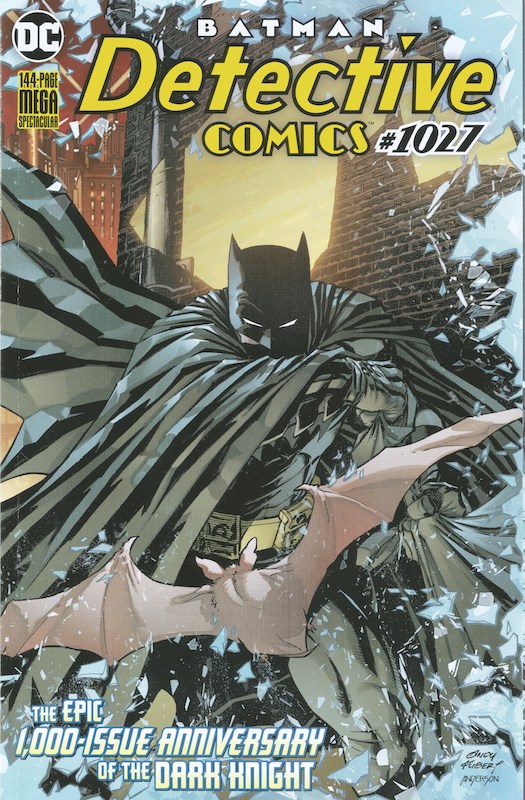
Today's subject is a Detective Comics special, likely still available at your local comic book store.  It can even be purchased at various book dealers.


What's so special about 1027? Batman first appeared in Detective Comics #27 in 1939.  


Yeah, that's pretty wild. 

Let's talk meat and potatoes.  The book costs 9.99, which is a bit pricey for a comic book.  However the Powers that Be at DC treat this issue of Detective Comics like a graphic novel.  

It's not floppy and benefits from a thicker, non-glossy paper-stock.  Square-bound, Detective Comics lacks advertisements and runs 144 pages; comprising twelve tales and the here and there pin-up.

Art by Lee Bermejo based on the 1940s Batman serial

Each of these stories offers something good for the Batman Family fan.  Even the writers I usually do not care for impressed me, and all the artists give their best.

A death trap courtesy of the current Detective Comics creative team opens the anthology.


For some, death traps are hoary melodramatic cliches.  I do not share that opinion.  I like a good death trap.  I think against larger than life heroes, they fit with the arrogance of the villain.

Tomasi revamps this particular Houdini stunt.  Through the villain's anticipations, he factors in Batman's past escapes, his skills and his tactics.

The gist of Tomasi's story allows for Brad Anderson, Andrew Hennessy and Nathan Fairbairn to dedicate a few pages to each of Batman's rogues gallery and gorgeously illustrate either actual moments from the Caped Crusader's crime fighting career or unseen tales.


Why, yes, Batgirl's eyes are blue.  Why do you ask?

Our Dark Knight foils the trap-master's ploy through a traditional Batman method.  Esoteric knowledge that some may consider a cheat or as equally cheesy as a death trap.  Once again, I do not share that opinion.

Murder attracts the entire Batman Family in Brian Bendis' and David Marquez's pleasant read.  


Blue eyes courtesy of Alejandro Sanchez


Who killed Gotham City Police Detective Dungeon? The World's Greatest Detective teams up with his prized students: Batgirl, Robins, plural, Nightwing, Red Hood and Spoiler to determine the truth.  


Oh, I should point out that a lot of these stories only pay lip service to continuity, proper.  Though if you're really obsessive you can place this short before the shot to the scalp that made Dick Grayson not dead, but screwy in the head.  

As you can see by the acrobatic pose, David Marquez presents each hero with distinctive visual personalities, adding to the quality.  Some of this is no doubt stage direction from Bendis, but the subtle movements of the characters I expect is all Marquez.

The next tale by Matt Fraction is a dark comedy in which we discover the Joker gives Batman a birthday present every year.


I'm not a fan of villains.  You'll never see me wearing a tee-shirt that celebrates the Joker.  Even I must admit.  This investigation is funny and twisted.  It brilliantly demonstrates that chaos is the logician's nemesis.  

Chip Zdarsky, known more for his writing, provides technically accomplished artwork.  You may be very surprised by how good Zdarsky's tableau looks and how it resonates through a range of mood and tone.

Greg Rucka is a former Batman writer.  He also created the highly regarded spin-off Gotham Central which focused on Gotham PD.  His contribution to Detective Comics blends the two works.  

The focus character is a rookie police officer.  Hence the name of the story.  Batman operates tangentially.


The rookie enters Gotham Academy and stays clean while operating amongst a group of corrupt cops.  

Smudges of dirty cops in Gotham City always irk me.  In Year One, Batman waged a war on Gotham corruption.  That campaign should have been successful at the very least by Year Three.

It's believable that some dirty cops like flies may gather and think to start up the band again.  It's unbelievable to think Batman would let that happen. 

Rucka's story works as a personal vignette for the rookie as well as an exemplar of Batman's decisive presence.  He inspires and determines the honesty of Gotham Central.   

Artist Eduardo Risso presents duality in a brevity of pages.  He contrasts the realism of the Gotham City street against the fantasy of a hero in black who lives in a cave with a magnificent computer and a robot trophy dinosaur.

James Tynion's "Ghost Story" isn't just an outstanding Batman and Robin duet.  It's also the best Deadman story I've read since the post-Crisis began back in the 1990s.  I kid you not.
  

Created by Arnold Drake and Carmine Infantino, Deadman is the spirit of a slain acrobat named Boston Brand.   The deity Rama Kushna employs Deadman as her agent and grants him the power of possession.  During Deadman's hunt for the Hook, the lone sniper that murdered him, Boston meets Batman and artist Neal Adams who puts the Deadman feature on the map. 

While ostensibly writing just a throwback team-up that pits Batman, Robin and Deadman against a new spectral foe, Tynion provides depth to Batman's character.  We discover why Batman isn't afraid of ghosts.

"Ghost Story" is Deadman tonic after Brian Azzarello's character assassination in the bloated, gassy Batman: Damned.  Tynion's words and Riley Rossmo's playful art make the narrative a joy to follow.  Colorist Ivan Plascencia compliments with a bright, cheery palette that suits the freewheeling mood. 

Kelly Sue DeConnick, mostly associated with Marvel Comics, presents a rare Batman story that demonstrates Batman and his alter-ego Bruce Wayne making Gotham City a better place.  


Half of the tale takes place in the rain.  There Bruce plays a stupid golf game with an unscrupulous businessman that's also dirty in crime.  His name is Mr. Steele.  No relation to Cliff.

The second half drops in a recent flashback where Batman breaks Mr. Steele's racket and uses his methods to find out who's the boss.  

As with "The Rookie," DeConnick's story deals with crooked cops in a smart way.  John Romita's artwork energizes the optics of the whole affair. 

Marv Wolfman, scribed Batman for a short run and The Teen Titans for oodles of years.  In "Odyssey," Wolfman connects the clues for a strong detective yarn.  Wolfman's tale also adds to the reading pleasure by updating a handful of gumshoes that moseyed through the pages of DC Comics.  


The legacy of Roy Raymond TV detective, Captain Mark Compass, Slam Bradley and Speed Saunders combine forces with Gotham sleuth Bruce Wayne and Batman.  Together the investigators solve a historical mystery on the Scottish Coast that ties into Wayne Family history.   


I'm of two minds about the artwork.  Emanuela Lupacchino is best known for her cartoony style vividly displayed in the too quickly cancelled Starfire.  The presence of legendary Bill Sienkiewicz as inker results in a grittier look to Batman.  While the images of regular folk at times resemble a cast Neal Adams may have illustrated.  Mind you.  I love Jordie Bellaire's nuanced colors.  Nevertheless, I'm curious to know how the pencils appeared before embellishment.

Grant Morrison goes straight for the funny bone with "Detective Comics #26."  An above average wannabe Mystery Man after studious research becomes...


He even puts together pieces of "The Case of the Chemical Syndicate," Batman's first foray.  Alas, things don't go so well when Batman shows up. 


Artist Christopher Burnham infuses the original Batman adventure with an astonishing amount of energy.  He replicates the events to the letter but creates kinetic imagery unheard of during the historical period.  

I'm being pretty cagey with the graphics, and that's because I don't want to spoil a single of the laughing Scotsman's perfectly executed jokes.  Trust me on this.  "Detective Comics #26" is laugh out loud funny.


Tom King, him again, and Walter Simonson also re-imagine a Batman episode.  This time, Batman's fight against Dr. Phosphorous.

There's not a whole lot I can say about this thoughtful exercise in history.  Walter Simonson co-created the glowing ghoul, based in part on Golden Age foe Professor Radium.  It's fitting that Simonson solos in the orchestra that Tom King conducts.


For those not in the know, Tom King in his impressive run of Batman restored much of the Batman Family's classic and Bronze Age stories.  I respected and enjoyed the hideous amount of Batman goodness that King produced.  

This piece is the final piece in the continuity King rewove.  Starting in the street, reaching a crescendo with Batman and Catwoman, following through with the birth of Helena Wayne and finally concluding here.

Before Tom King, Scott Snyder was Batman's mad guru.  He returns with "As Always."  Commissioner James Gordon narrates, and in this narration, you can feel the friendship he shares with Batman.  


That hasn't always been the case.  

Historically, Gordon is as old as Batman.  He also premiered in "The Case of the Chemical Syndicate."  


From 1939 to 1941, the Gotham P.D. officially hunted Batman.  Treated him as a vigilante.   Then, something weird happened.  Gordon shook Batman's hand and in a succeeding story granted him special deputy status.  Since these canonical moments unfolded, Gordon and Batman became trusted allies and at least by the 1950s friends.

The hunt, the meeting, the alliance and friendship rewound through every new reiteration of the Dark Knight and Lieutenant James Gordon.  The friendship fractured at times, and occasionally it stopped making sense, but history always seemed to repeat itself regardless of the context of fiction.

The Bat Signal, constructed in 1942, is a symbol of Batman's and Gordon's long history together.  When real-life Batman Adam West died, Los Angles lit up City Hall with a make shift Bat Signal.  Snyder's story is about the signal and the friendship of two men making Gotham City a better place.

The story begins with the definition of a Black Rooster Case. This is essentially something that looks big but turns out to actually be small.  The story segues to Batman being called to the Justice League satellite where he discovers the League detected something affecting the sun.


Gordon learns of this second hand, but just having the knowledge indicates what Batman thinks of his friend.  Gordon then imagines the events that led up to the discovery and how the League addresses the situation.  This is where Justice League artists Ivan Reis, Joe Prado and Marcelo Maiolo express their imagination.  


The editing knocks me out the most.  Snyder begins the story with tradition.  He flashbacks to explain the verbal McMuffin.  The artists create a mini-Batman story within that explanation.  Batman's called to the Justice League, where the gist unfolds.  The League investigate.  The artists create the essence of big blowout issues where the League facedown their most powerful foes.  They consult with their friends and colleagues in the summation of fan-bait team-ups.  They cannot find the solution.  Batman figures it out, and his answer recapitulates to the beginning of the story and the verbal McGuffin.  The creative team accomplish this breadth of plot and information, this scope of street level to cosmic all in twelve pages.

Dan Jurgens, not really a Batman writer.  However, Jurgens had his run-ins with the Caped Crusader in crossovers and Big Events.  He often made Batman a pivotal part in his story.  In this tale Jurgens produces words and pictures.


Jurgens cleverly uses Batman's status as the inheritor of Sherlock Holmes who eliminates the impossible in the opening.  Jurgens also corrals Kevin Nowlin, an excellent known quantity Batman artist for finishing his bare bones illustration.  The combination creates a sense of certainty in reading.  Ah, hah, says you, what I'm actually perusing is a variation on The Hound of the Baskervilles.  

When Jurgens adds a new wrinkle to Batman's first-person narration that reveals the madman behind the whole plan you cannot help but applaud.  The confrontation is special.  The conclusion expected but exciting no less.  You think the story will end, but turn the page, and the tale goes off the rails in a good way.

The final story by writer Mariko Tamaki introduces the Joker War.  Generally speaking I've enjoyed Tamaki's writing.  You'll find reviews on this blog of Tomb Raider and X-23.  I plan on giving her new run of Wonder Woman a go.  

At the same time I usually hate Big Stupid Events.  I've avoided the main Joker War thing, mainly because I'm not hung up on villains.  They don't appeal to me.  By dint of subscription, I do have some of the Joker War tie-ins, and I'll be doing a special POBB for them in the future if I spot something notable.  

Tamaki's tale serves as a prelude to the Joker War is good because of what it's not.  The Joker material is almost incidental, which works in the tale's favor.  It could have been any madman creating havoc.  It didn't need to be the Joker.  There's nothing significantly Jokerish in the story.  No "rictus grins" for example.  Not even extortion.

The story opens with Bruce getting ready for patrol.  For some reason, he's staking out a target at a hotel.  Soon, though, he's off into the night, investigating a break-in at Wayne Enterprises and saving cops from being diced in the crossfire.  Typical Batman stuff with his thoughts turning to his father, and artist Dan Mora and Tamra Bonvillain providing a neon-noir.


And that's all folks.  One last inside cover pin-up before the book bows out.  I think you'll agree, this is a lot of entertainment for the value.  1027 also may be that perfect Christmas Gift for the casual Batman fan on your list.  These stories require no deep dive into Batman lore nor an understanding of how he is now, just a love for the character and the want for good, solid detective stories accented by great art.


Tuesday, October 6, 2020

POBB October 6, 2020

Pick of the Brown Bag
October 6, 2020
by
Ray Tate

Welcome to the Pick of the Brown Bag by yours truly, Ray Tate.  You probably thought I was going to say Jack the Ripper, but no, yours truly, Ray Tate.  This week I look at the impressive debut of The Devil's Highway.  This one is by writer Benjamin Percy and artist Brent Schoonover, under the aegis of AWA Studios.  AWA stands for Artists, Writers and Artisans.  Pretty cool, huh?

Devil's Highway opens in the fictional territory of Drift County, Wisconsin.  A snow storm pelts a diner on the strip.  In the diner we meet a local and Joe, the diner's owner.  Percy casts it as a typical dwindling evening in a typical life in a typical midwest.  Then, this happens.


The woman, an apparent victim of crime, changes the landscape.  Soon the owner of the diner will be dead.  Joe's death in turn draws a heroine back to her home town.  Joe's daughter is Sharon Harrow.


Sharon breaks out a whole different kind of hell in Drift County.

I favorably encountered Benjamin Percy's work in Dynamite's James Bond and DC's Nightwing.  In the latter I discovered Percy is a helluva Batgirl writer to boot.  Nevertheless, I didn't know what to expect when putting Devil's Highway on my subscription list.  Based on Percy's work I decided to gamble.  I didn't expect Sharon.

The first moment when you see Sharon, you know this woman has agency.  As you read on, you see Percy meshing his skillful characterizing with artist Brent Schoonover's striking design.  And a shoutout to Nick Filardi's muted colors.

Sharon walks into the police office like she owns it, and in a way, she does.

This is not a happy reunion.  Sharon recounts her shared past with the cops, when they weren't cops.  The story now becomes realistically dark.  The art thankfully doesn't.  

I hate how the creators of some horror, mystery comic books equate their genre with literal darkness.  I like to see things.  

The experience Sharon recounts describes what it's like to be a woman in a man's world, and Sharon is a survivor of that world. She gets some more flung at her as the narrative unfolds.


I really love that line.  "Maybe you could try smiling when you ask somebody to do something?"  I mean, he's savvy enough not to conclude with Missy, but can you imagine a man saying that to another man.  The sexism just drips until misogyny oozes from the non-supporting cast.  Neither attitude impedes Sharon's investigation.

Percy and Schoonover present Sharon as a woman of mystery.  They show she definitely has a past.  One that's quite normal apparently.  She however possesses skills. 


This panel cropped to save from spoiling the delightful surprise. 

Percy, at least in this issue, doesn't explain where her skillset comes from.  She's clearly a trained observer or an absurdly good natural amateur.  Is she police, mountie, FBI, CIA, or does she come from the opposite side of the fence? Nobody's talking in the premiere, but that underlying question intrigues as much as the way the visual pacing engrosses you into following Sharon wherever she takes you.