Tuesday, February 2, 2021

POBB February 1, 2021

Pick of the Brown Bag
February 1, 2021
by
Ray Tate

Welcome to the Pick of the Brown Bag.  My name is Ray Tate, and I review the current comic books that should be available at your local comic book store.  This issue is another delve into independent publishers: American Mythology, Aftershock and Ahoy.  If you haven't the time for the full reviews.  Check me out on Twitter: #PickoftheBrownBag.


Boy howdy!  Just look at that cover.  Molto bene.  You get a lady with a badge in a sort of proto-punk outfit with a 1930s hairdo and a long, cool coat.  Kind of a cross between an aviatrix and a police woman with Mrs. Peel attitude thrown in for good measure.  Look closer at the badge, and you'll see she belongs to the FBI.  Perfect.

Our mystery woman stands in front of a bulletin board filled with photos, one depicting a statue of Cthulhu.  If that doesn't get the blood pumping, I don't know what will.  Miskatonic is the Sucker Punch of Lovecraft-based comic books.

You may not remember Sucker Punch, since it's entirely forgettable, but I'm sure you'll remember the ad campaign.


And there were a handful more like that!  Whetting the appetite.  Introducing you to archetype female fighters.  Like Sky Captain and the World of Tomorrow, only with more estrogen.  Guess what? 


Turns out, one, just one Franky Cook is worth more than a hundred Sucker Punch baby dolls.

When I first saw Sucker Punch, I felt I had seen one of the worst films of all time.  Equal to Batman Forever.  As my rage cooled and the imagery faded into a sepia haze with vague girlish faces and figures, I realized that, no, Sucker Punch wasn't a truly bad movie.  Just manipulative and stupid.  

The ad campaign however was resonant.  The stories that burst into your head when you saw the images were all better than the story you got.

Miskatonic isn't truly bad.  It's just dull and predictable.  Its ad campaign, the cover of the book, is superior to the book itself.  The stories bursting in your head about the vivacious Cthulhu fighter on the cover are better than what you get. 

For example, no Amelia Earhart fervor.  


Just plain Jane Agent Miranda Keller blackmailing her way to a plum assignment.  The investigation of murder by bomb.  She meets her contact, a retired NY detective Tom Malone.


They become a sort of Woolworth Avengers In a little town called Innsmouth with a group of curious and familiar looking mutants.

I swear.  Miskatonic almost seems like a send-up of Lovecraft.  It's one thing to be a ground-breaking Corman film like The Haunted Palace, bringing Lovecraft to the screen for the very first time.  


Quite another to assume nobody reading saw that film or read the original Lovecraft work.  We honestly didn't need to see the mutants hanging around. 

The agents look over the scene of the crime, and writer Mark Sable throws in a little science for mostly no reason.


Oh, look!  Goo!  

The absence of goo at a Lovecraft crime scene would be remarkable.  More important to the story, such as it is.  There's this.


But how did Detective Malone find the framed photo?  The art isn't very telling.  One minute, he's got his hands in his pockets.  The next...Presto.

Did he find the photo among the ruins? The glass isn't cracked in the frame.  Was he carrying it in his coat pocket? Odd thing to do if true.

As the story goes on, and does it.  The agents run afoul of the Order of Dagon and witness a fish flesh fete.
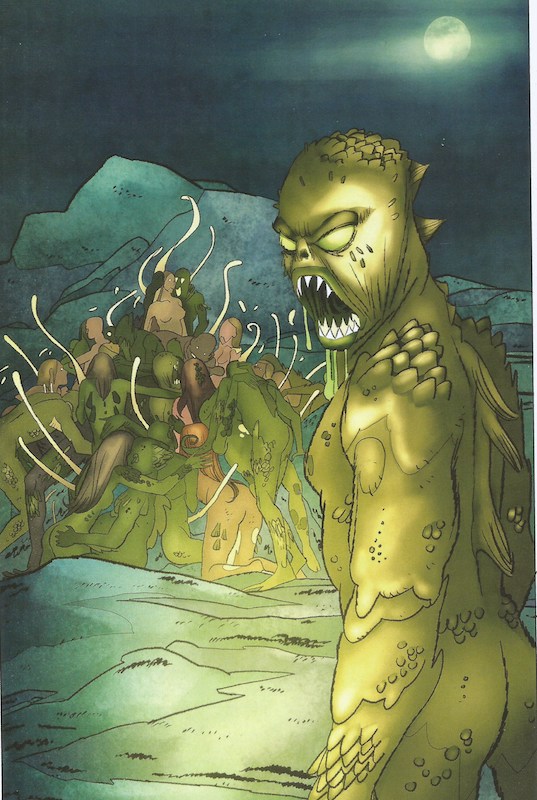

This image is neither raunchy enough nor disturbing enough to be a Lovecraft orgy of Deep Ones and mutant townsfolk.  I'll never unsee the body-horror orgy in Society.  


No, no, I'll not impose the visuals.  This movie isn't made for newbies.  As for the congress of skin and scale? Old woodcuts were more explicit, and exciting.  

In the second issue, after running from the Order, our agents escape via train.  Arriving at Arkham, Massachusetts, it's as though nothing from the previous night ever happened.


C'mon.  You can do better than this.  Most of Lovecraft's protagonists end up stark raving mad after encounters with Cthulhu and his lot.  


Yes, Dagon certainly counts.  

Despite all she's seen in the universe, even the Doctor winced upon seeing the villain Zellin's method of dream-theft. 


Keller's blasé attitude is unbelievable.  Agent Keller may be made of stronger stuff, but she should be affected by the events of the piscine pumping party in some way.  Tom is at least reminded of horrific incidents in Red Hook, New York.  Miranda Keller though focuses on her contempt for Tom.  Whom I may add did absolutely nothing to deserve it.  

Oh, and for the record, the sexual innuendo between Keller and Malone, if you want to call it that, is tiresome and juvenile, not humorous nor witty.  Make it stop.

Some minor frivolity comes in the form of an unadulterated guest appearance by one of Lovecraft's greatest contributions to mad science.  Just as things might become interesting, we must enter the Dunwitch Horror.
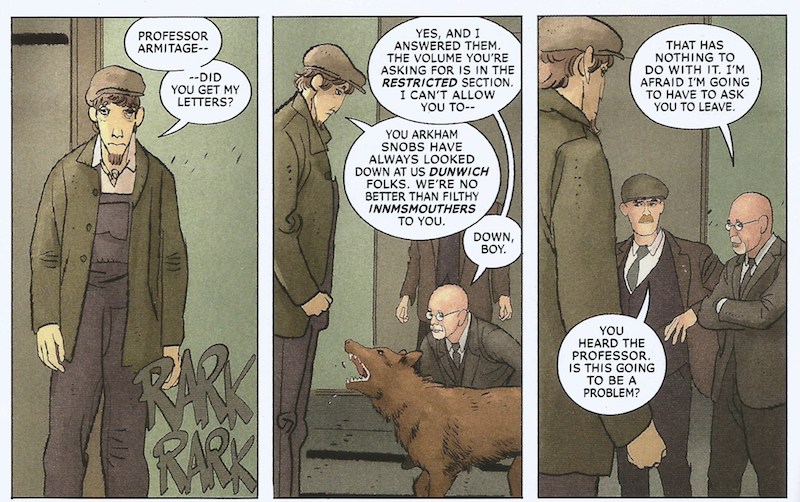

From there, we side-swipe into lesbian subtext.  
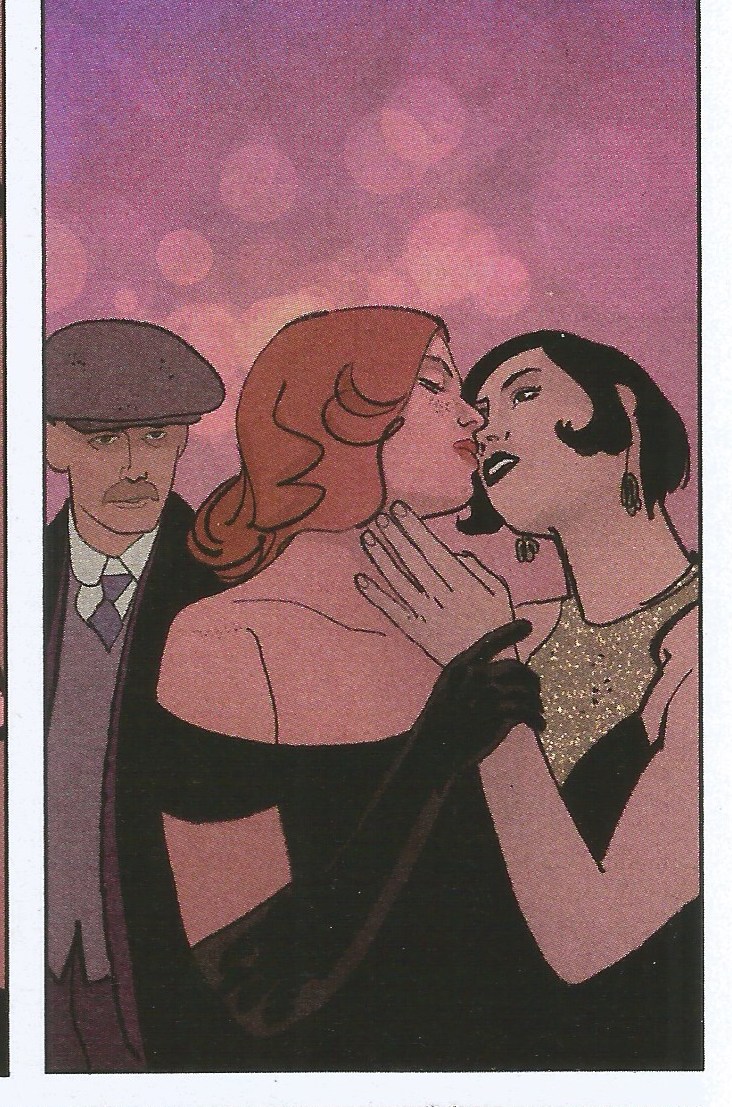

Everybody likes lesbian subtext, am I right?  Hell, yes, they do, but I must ask was this trip via The Conformist necessary?  I don't think so.  Because Sable exploits LGBT as perversion.  

Aseneth Waite isn't in her right mind when seducing Miranda Keller.  Whatever's possessing Waite uses her body and sensuality to lure Keller into the world of Dagon.  


Keller doesn't appear to be gay.  Perhaps she has some deeply buried attraction.  Waite is a thrall of Dagon, so her orientation is immaterial.

Furthermore, Aseneth didn't kiss Keller into the mind-swap-control.  So why must she kiss her out of mind-swap-control? Seems like desperate grandstanding to me.

Miskatonic drags the reader through Lovecraft short-stories with name checks for famous Lovecraft characters via two ordinary investigators that lack the spark of that girl on the cover.


The hit indie series with a superb concept and equally impressive artwork returns.  The story is simple, and if you don't believe, me writer Tom Peyer and illustrators Jamal Igle, Roy Castro and Andy Troy explain in one page.


One of the good things about Wrong Earth is that Peyer doesn't take sides.  Both gritty Dragonfly and the more innocent Dragonfly Man have admirable qualities.  Dragonfly actually was the innocent Dragonfly Man until a crazed villain murdered his sidekick Stinger.  He's been given a second chance with the dimensional travel.


Dragonfly's more flexible morality also allowed him to accept the offer of another crazed villain's henchwench.  He didn't turn the thieving artist formerly known as Deuce into the cops.  She's bad, not evil.  She risked her freedom to save Stinger, when mortally wounded.  She risked her life to turn against Dragonfly's nemesis the One.  As a result she becomes a teammate.

One helluva teammate.  Unlike Stinger, Deuce knows Dragonfly arrived from the wrong earth.  She's also not into the straight-laced Dragonfly Man.  He likely would have demanded that she turn herself in for her past crimes.  I should point out that Dragonfly did not materialize in a television series.  Lady Dragonfly's earth is just as real as Dragonfly's earth, as are the dangers.


The villains of Dragonfly Man's earth simply have more flair.

One really wonders how exactly this earth's society evolved into such a wacky reflection.  No explanation is needed for Dragonfly's Earth-Omega.  You may think the Adam West inspired Dragonfly Man is at a disadvantage on Earth-Omega, but both incarnations of the hero are brilliant and resourceful.


The answer is at once hilarious and impressive.  Not to mention intrinsic to Dragonfly Man's insect motif.  Dragonfly Man acquired the new deadly Stinger after Dragonfly discovered him amongst the riff-raff of the One's hideout.  He wasn't in good shape, and Dragonfly rescued him.  When Dragonfly Man appeared, he took the young man under his wing.  It's been a bumpy road.

These scenes set the mood of the worlds and establish the characters, on each side of the coin.  They also introduce the gist of the new series.  Somebody is poisoning both earths.  
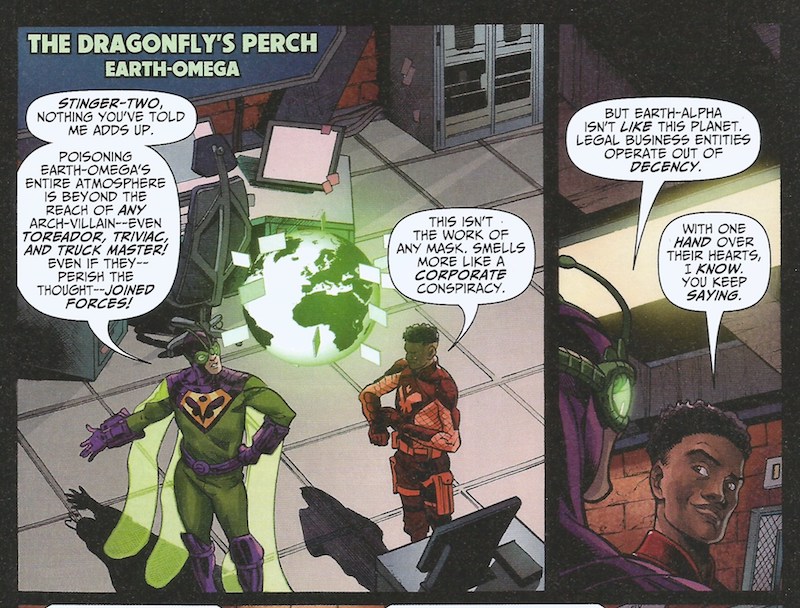

The initial investigation indicates maybe both heroes can go home again, but do they want to.  Dragonfly found a modicum of happiness on Earth-Alpha.  Dragonfly Man is needed on Earth-Omega.  Neither however belongs, yet perhaps there's a happy medium.

Sonya Devereux is an actress who takes on a number of roles in a series of Z grade to B movies.  In her latest film, she becomes the superhero Violet Vixen.


So, let's get this out of the way first.  This is not the most outrageously entertaining issue of Starring Sonya Devereux.  Despite always being a number one, it is a series.  You can find the reviews of all those absurd and damn funny past issues here.  I know, I know.  You know how to operate tags.  Maybe you've had a rough day.  Maybe you were digging out of two feet of snow.  Just relax and click the link.

Starring Sonya Devereux is funny, but familiarity breeds contempt.  Frankly, the superhero genre is pretty absurd to begin with.  For that reason, I'm intimately up on the whole, freedom of movement argument to excuse the depiction of female flesh. 

Violet Vixen's costume is actually pretty conservative when compared to any of the Legionnaire outfits from the nineteen sixties and seventies.


The introduction of Madame Midnight surprises with an actual credible costume.  There may also be a nice reverb of comedy in the more modest Midnight's powers being a copy of the more hedonistic Shadow Lass' abilities.


The origin stories of VV and MM also aren't that far-fetched when compared to "belted by gamma rays" or being infused with the energy of an experimental Kree engine.  Granted the science is garbage and doesn't even try to be accurate, but still.

The running gags in Sonya Devereaux however are throughout amusing.  Violet Vixen is secretly a vegetarian cook influencer, which helps her survive her alien imprisonment.


Writers Nick Livingston and Nick Capetanakis also play up the tradition of secret identity blindness.  Neither Violet Vixen nor the cameo champion Captain Attraction know each other's secret identities despite the flimsy disguises and their serious dating.

The best gags arise when the aliens return at an opportune moment.  Their funky dialect is a riot, and their cheesy look smile-inducing, indicating the money from this production just ran out.

Still better looking than anything from Prometheus.  The art by Brendon and Brian Fraim with Sarah Perryman for the important colors is top of the line.  It would be welcome in any serious comic book.  In fact they cannot help but treat the knock down, drag out fight with cinematography and editing that's enviable for any medium.


For fans of Sonya Devereux this is a must buy.  For those that want to experience the full Sonya Devereux hilarity I recommend any of the past issues. This mild superhero spoof nevertheless is consistently amusing when not being solid superhero fare.  So consider it as an auxiliary addition to the yield of your brown bag.


Wednesday, January 20, 2021

POBB January 19, 2021

Pick of the Brown Bag
January 19, 2021
by
Ray Tate

Hey, gang.  It's Ray Tate with a triple dose of reviews from the Pick of the Brown Bag.  This week, I examine another handful of DC's Future State titles: Dark Detective, the Flash and Kara Zor-El Superwoman.  Should you not have the time for the full critiques, look me up on Twitter: #PickoftheBrownBag. 


Don't buy The Flash.  Writer Brandon Vietti recycles Flash plots of yore to present a crossbreed of dark, dull and dim.

The story opens with Checkmate and their annoying chess lingo.


Using Rogue's Gallery weapons, the Flashes infiltrate Checkmate's stronghold.  That's two, count 'em two, old Flash plots in one: powerless Flash and Flash wielding Rogue's Gallery weaponry.  


In case you still don't know what's going on, artist Dale Eaglesham telegraphs the loss of superpowers with a silly bandage on Avery, the grape Flash, and a grunge-look knee-hole in the Flash uniform for a beefed up Barry Allen.  

The New 52 Flash debuted as this svelte runner.


That gibes with the Silver Age Scarlet Speedster. 


The original television Flash, John Wesley Shipp, wore a sculpted bodysuit designed by Dr. Tina McGee meant to protect him from the physics of speed.


That doesn't appear what we have here.  If the Flash Family lack powers, why sport a costume at all?  Why not don, lighter, red body armor like a powerless Wally West did in the Elseworld series JLA Act of God.  


Martian Manhunter, The Flash, Aquaman, Supergirl and of course Batman

This bulky Flash of Future State just looks silly, and of course angry.  Because it's the Future State, and in the future everybody but the new Wonder Woman is angry.  


Grrrr!

Of course, when it comes to inane design, little can top The Thinker's dynamite shower cap.


That's not the Thinker.  New or old.  It's the Calculator.  The reveal exemplifies the kinda surprise.  A surprise that's yes, in essence unexpected but empty of impact.


Like, if you see a bunch of Joker-piranha in the Gotham reservoir, you would naturally think the Joker behind the scheme, only to discover the Penguin is the culprit.  


It must be casual Friday at Checkmate, because the Calculator used to look like this guy.


That's nowhere near as bad as the shower cap.  Hey, but don't underestimate the Calculator.  Yes, he's now one of many in the legion of loonies with buckets on their heads, but he can still use his trusty Texas Instruments pocket calculator to do stuff like this.

Nooooooo! He killed Bart! I can't believe he killed Bart, somehow.  

This is the typical moment you get in The Flash.  Attempts to escalate drama with death, that doesn't count anyway, and no explanation as to what happened.  

Bart employed the Rainbow Raider's gear.  The Rainbow Raider is a lackluster Flash villain from the eighties.  His rainbows are multi-colored force fields.   How can Calculator's destruct ray turn a force field into shrapnel?  Why didn't the ray bounce off the force field?  Why not just shoot the kid? So many questions.   Ah, well.  Bart's dead.  Let's move along shall we.


Oh, that takes cheek.


After whittling down the Flash family, Vietti reveals Wally West is a murdering psychopath.  A speed vampire, if you will.


Nooooo! Not Black Wally West! Ohhhhhhh, the tragedy! 

Keiynan Lonsdale portrays the only Wally West on CW's The Flash.  

Lonsdale and the CW writers turned this version of Wally West into somebody impressive, completing his growth on, where else, Legends of Tomorrow.

Of course Black Wally West's death doesn't mean beans either because we're in the The Future State.  However, killing Flashes is another recycled Flash plot combined with the old Flash turns killer or Flash wanted for murder.

In an attempt to connect with Wally West's mind in the Speed Force,  Barry rejiggers the Thinker's cap to reflect something more elegant.  Behold.  


Thank goodness, we focused on science.  Once the team track down Wally, we learn about recycled Flash plot number six: I didn't do it.  I'm possessed.


Brandon Vietti commits a cardinal sin here.  He spells Apokolips Apocalypse.  Vietti clearly hasn't spent enough time in the DC editorial office.  I kid, of course.  This Rider isn't the Black Racer from Apokolips, which would make a wee bit of sense.  It's the Rider of the Apocalypse.  Famine.  There's that kinda surprise again.  The biblical dude is behind this whole thing.  Famine, one of the Four Horsemen of the Apocalypse.  Because, stuff.  Sounds to me like we need the Seventh Son of a Seventh Son.


Mariko Tamaki skirted the edges of the Batman titles with a short story in the massive anthology Detective Comics 1027.  This little fella served as a prelude to the Joker War, which I didn't care about and never read.  

In the prologue, Tamaki introduces Nakano a disgruntled GCPD officer who blames Batman for the death of his partner and the loss of an eye.  Nakano, a budding detective, misses the Joker's rather overt culpability.  DC appears to have liked Tamaki's take on Batman.  So much so, that they gave her stewardship over the Dark Knight in Dark Detective.


Dark Detective is somewhat similar to The Flash.  The differences lie in the quality of writing and illustration.  Mariko Tamaki presents a compelling first person narrative in Batman's voice.  Dan Mora and Jordie Bellaire construct a Gotham City that appears to be evolving into the Gotham of Batman Beyond.  Yet, it seems off kilter.  

Certainly the people seem to like it.  Gothamites are out and about, without fearing the dark.  Indeed, the bright and cheery technology damns the darkness of former Gotham.  


Batman of course hates it.  Not just because of the overabundance of light.  Though that doesn't help.  He hates the state of Gotham because somebody called the Magistrate perverted his dream.  

Batman and his alter-ego Bruce Wayne have for eighty odd years attempted to do one thing.  As Batman, Bruce attacks crime head-on.  As Bruce Wayne, Batman uses his philanthropic resources to better a society that breeds crime.   Batman is utterly selfless.  He hasn't used a single penny of his wealth for himself.  Batman seeks to heal Gotham City.  

The Magistrate sterilized Gotham City.  Turned it into a police state and sent his possibly robotic Peacekeepers in to slaughter the heroes that protected Gotham in the past.


Ah-hah.  Mayor Nakano.  Remember that disgruntled police officer I spoke about.  This is how Tamaki's character comes into play.  Nakano wins the mayoral race in Detective Comics. As Mayor, he made the deal with the devil.  Batman of course suffers because of it.     

At the onset, Batman was an outlaw, from 1939 to 1941.  In the seventies, some politico wanted to ban Batman.  In the eighties, Rupert Thorne intended to prohibit Batman.  In Batman: the Animated Series, incoming District Attorney Janet Van Dorn saw no difference in Batman and the criminals he puts behind bars. 

Batman in the future is also hardly breaking any ground.  As early as 1941, Batman descendent Brane a portmanteau of Bruce Wayne assumed the guise of Batman and fought alien overlords.  Batman found himself whisked to the future in The Brave and the Bold where he allied with the Legion of Super-Heroes.  Artist/writer Paul Pope in 2014 transported Batman to dystopian future Gotham City for the superb Batman: Year One-Hundred.  

In many ways Dark Detective is the same old-same old Batman is a renegade theme.  Tamaki's careful execution though gives these cliches their worth.  Dan Mora's depiction of Bruce Wayne's haunting future shock convey what's at stake.  Batman sees the flaws in this Utopia.  The light doesn't envelop the entirety of the city.  It still needs Batman.


The Magistrate and his Peacekeepers feel differently.  We first see them hunting and wounding Bruce Wayne.  The Magistrate appears to know Batman and Bruce Wayne are one in the same, but to protect their fiefdom, they keep his identity secret.  Batman is dead.  Bruce Wayne is dead.  Two entities.  One a beloved benefactor.  The other a hated vigilante.  Begs the question why does Gotham City buy such rot? No matter, if Gotham ever learned the secret of Bruce Wayne, they might start questioning the Magistrate's methods of eradication.  The Magistrate cannot afford questions, for that reason, the hiding of the truth, Batman remains a tantamount threat. 


The second story strangely enough involves Cole Cash, the Grifter.  The Grifter briefly met Batman in JLA Wildcats, but for the life of me I have no idea why he's in Gotham City.  Until his creator Jim Lee made it so, the Grifter hadn't even been part of the DCU.  For those not in the know, Image under the banner Top Cow first published oodles and oodles of Wildcats.  

No matter, Matthew Rosenberg's story, fueled by Carmine Di Giandomencio's kinetics, is a ton of fun.


Still, there's little reason why this tale couldn't have centered on Jason Todd, the Red Hood.  The Red Hood would have attracted the same kind of clientele and made the same type of ruckus.  He and Grifter operate in similar fashion. Red Hood however is associated with Batman and belongs to Gotham City.


If you buy one Future State book this week, spring for Superwoman.  Both Dark Detective and Superwoman feature accomplished artwork, but Margueritte Bennett's story draws upon a greater depth of ideas.  If you want to get mercenary about it.  Dark Detective is six bucks.  Superwoman four.  

Bennet's tale begins with Krypto.  Never actually seen in Superwoman he nonetheless makes a greater than average impact with his absence.


Before Jor-El sent his son to earth, he tested a smaller rocket with the family pet, a dog named Krypto.  This is a lot less meaner than it sounds.  Trust me on that.  Things go wrong.  Krypto becomes lost in space until the rocket comes crashing down to earth.  Superman finds Krypto, and the doggy gains all the powers of his master Kal-El.  Krypto is also smarter than an earth canine.  

In 2019, writer Marc Andreyko created a memorable run of Supergirl where she set out to avenge Krypton.  Apparently, Krypton didn't just explode.  Superman accepts her decision but refuses to lose his only cousin to dark emotions.  He gifts her Krypto.  


Together, Kara and Krypto become partners in bringing justice and peace to all sentient kind.  She gets revenge, but she doesn't lose herself in the process.

In the future Krypto dies.  Of course, this death means nothing in the context of the actual DCU.  Rest assured.  Krypto is alive and well.  

I Have This Hilarious Scene by Amanda Conner on a Tee-Shirt


Krypto's future death, for lack of a better phrase, actually weighs heavily in the story.  Superwoman visits the grave and reveals her deep love for Krypto in her first person narration.  The revelation, her love for Krypto sets the tone for the entire book.  

The death of Krypto could have symbolized the utter nihilism of Future State.  That's neither Marguerittes Bennett's and Savauge's game.  They instead use Krypto and Kara's love for her dog to deliver a timely feminist message.  

In conjunction they raise another point of contention I had with last week's Superman in Metropolis.  Something I couldn't work into the previous review.  Superman should have entrusted the earth's care to Supergirl as he intended in comics and as he did in CW's Supergirl.  


In 1959, the original Supergirl arrived on earth at age fifteen, guesstimate.  I doubt she could be any older than that.  She saw Superman as her elder and her only family.  She therefore acquiesced to his want to keep her existence hidden.  You can argue that Superman was being chauvinistic, but the reality of it is that the writers wanted the character Supergirl to stand on her own two feet and gain a readership independent of Superman's fans.  This is the best idea they could come up with at the time, and it wasn't a horrible one.  


In the New 52 Supergirl arrives as a teenager unimpressed by earth, what with its armed forces immediately attacking her.  As with her most recent television tweaks, Supergirl often babysat Kal-El on Krypton, but she finds Superman needs no sitting.  In a proper example of the Twin Paradox, baby Kal-El grew up to be Superman while time seemed suspended for Kara.  

Though reluctant at first, Kara began caring about innocent lives.  She wasn't as noble as she was in the previous cosmos, but in a way her growth was more realistic.  

From, I'm not earth's defender.  They hate me.  To, I suppose some humans aren't that bad.  I don't really want to see anybody hurt, and I have the power to protect.  So that's what I'll do.  To hell with anybody that wants to stop me.

All of these factors come into play when delving into Kara Zor-El's backstory for the Future State.  At some point, Supergirl and Johnathan Kent came to blows over being the protector of the earth, and why not? 


She's even the proper product of the Twin Paradox.  She worked hard to come to the realization that she is a superhero.  The brat though gets the planet handed to him.  Supergirl, angry and ashamed of her behavior turned to the Moon Colony which houses refugees of all ilk.

The problem is that Supergirl appears to be facing the same distrust, even from aliens.  


We discover in Marc Andreyko's series that Kryptonians are not and never have been well liked as a species.  That disdain contributed to their planet's demise.  It's complicated and somehow involves a cosmic contract killer with an axe.  I prefer the classic idea proposed by Dr. James Kakalios.  Krypton was unstable due to forming around a neutron star and reached a natural death, sans Axe-Guy, but whatever.  

The dislike for Kryptonians carries over, and this is where we encounter Kara's suppressed resentment for being treated so shabbily: by her cousin, his jackass son and the people she begrudgingly swore to protect.  She even creates the fiction that Krypto taught her lessons about a complex philosophy of submission.  When in fact...


Lynari is correct.  In the Bronze Age, writers occasionally identified Krypto's thoughts to the readers, but never did Krypto actually talk to humans or Kryptonians in comics.  Krypto is smart as a whip.  Smarter than some humans, including Hal Jordan, but he never could convey the kind of life lessons Kara appeared to learn.  Kara inferred the submissive lifestyle, perhaps symbolized by the long skirt made from her cape, from Krypto's naturally loyal behavior.  Kara became a loyal dog.

Kara's entire life falls under scrutiny when Lynari an escapee from a dreadful planet crashes on the moon.


After a brief set-to against Lynari where she displays a vast array of power, Kara becomes her mentor and friend.  However, the lessons she teaches are flawed because they derive from that same mind set that Kara constructed from her loneliness.

Superwoman is a satisfying deep dive.  It's not however staid nor without humor.