Tuesday, April 20, 2021

POBB April 15, 2021

Pick of the Brown Bag
April 15, 2021
by
Ray Tate

Welcome to the Pick of the Brown Bag.  For those of you who came late to the show, my name is Ray Tate, and I review comic books.  

I've been reviewing comic books since the nineties: on the usenet, Comics Bulletin and this blog.  No matter the strata; from raw, self-published independent to well known Marvel.  

Of late, I've been concentrating on the DC Multiverse.  After this post, I'll be breaking from their Infinite Frontier brand and returning to the potpourri approach.  You can also find encapsulated reviews on Twitter: #PickoftheBrownBag.


The Joker War took a big chunk of same Bat-Time.  It must have been successful because nobody wants it to stop, even if Infinite Frontier gave everybody an excuse.  

I've had good experiences with Mariko Tamaki's writing.  I liked her stint on Tomb Raider.  I enjoyed her run on X-23.  She gets Batman, and the artists uniformly present fresh dynamism.


Tamaki notes that Batman is far from dour.  He has a very twisted sense of humor.  Updated for modern times, Batman texts a knock, knock onomatopoeia and distracts his targets.  Sticking to the shadows, Batman scares the living hell out of them as he picks off the gang one by one.  I really couldn't ask for anything more.

Yet.  

I give up.  

The environment Batman now operates in isn't for me.  The creative teams seem unified.  There appears to be no escape from the lukewarm Mayor One-Eye and a mediocre supporting cast.

The patch doesn't make Mayor One-Eye any more intriguing.  Nick Fury, black and white, was just as interesting a character without the patch.   Neither can One-Eye be considered original. Rupert Thorne marketed the technique of legally stamping out Batman in the Bronze Age.


Rupert uses the full weight of his mob/political machine to ban the Bat.  He nevertheless maintains the pretense of being an upstanding citizen.  Rupert Thorne is ingrained in the Batman mythos for a reason.  Mayor One-Eye will be forgotten tomorrow.

Rupert debuted in the first issue of Steve Engleheart's historic run of Detective Comics.  Engleheart took great pains to explain Thorne's consistent presence in Gotham City.  Deborah Donovan exists in Batman just because DC Editorial says she does.


I'm sorry.  Where the hell did you come from? If you're the Kolchak of Gotham City, from when and how? 

Gotham City only had three journalists of note: Vicki Vale, Summer Gleason and Alexander Knox.  Deborah, you're older than Lois Lane.  How is it that I've never heard of you before?  Never mind.  I don't care.


I loathe all the leftover Joker War villainy.  Why do the antagonists need to be Joker-inspired thugs? Incidentally, we have a failure to communicate between Tamaki and artist Daniel Mora, however stellar.


Whoops.

That looks like jewel theft to me.  Other logistical problems manifest.

Bruce Wayne just happens to be at Mayor One-Eye's function, to gather intel.  The jewel thieves happen to break in at the same time Bruce is there.  They also somehow happen to elude the Huntress, positioned outside on page one.


She does nothing to stop the hoods.  She never cameos again in the book.  So, I don't know why she's also on the cover.  In fact, given her participation, why is she here at all?

This poorly planned heist isn't the gist.  The central mystery occurs within Batman's new sphere of influence.  


Something happened in the Joker War that reduced Batman's fortune down to measly townhouses and satrap caves.


I know.  I wish I were that poor.  None of this affects the way Batman operates.  So I don't know why you would turn your back on the cool robot dinosaur and the giant penny just to create a superficial man of the people.  I assume this is the whole purpose.  Batman's just one of us.  He's not one of the one percent.  

You know what never interfered in my relishing the Batman stories? Batman's wealth.  I never said to myself.  Gosh, I could appreciate Batman's superior intellect and his status as the World's Greatest Detective if only he weren't so wealthy.  

Never.  

No, I never aspired to be as wealthy as Batman.  I aspired to be as smart, skillful and good as Batman.  The whole idea of expunging Batman's wealth so he can crawl out of a sewer is ridiculous.

Batman's wealth is simply another tool to wage a war against crime.  Present tense.  Cause, let me clue you in on a little secret.  If you own multiple townhouses with caves under them.  You're still super-wealthy.  

In fact post Joker War Batman is still wealthier than the original, who only owned one stately Wayne Manor and the acreage surrounding it.  Batman happened upon the cave on his estate and gradually added more expensive equipment: the Batgyro and a modified roadster that would evolve into the Batmobile.  My point is.  You didn't go all the way.  Something tried before.  You didn't impoverish Batman, which would have sucked.  However, this wishy-washy wealthy but not business is just as bad.

Batman's fall from status reduces him to sleuth rather than professional.  See, if Mayor One-Eye weren't in charge, Commissioner Gordon would be calling in Batman to solve this kidnapping.  Who's Commissioner these days? Perhaps some chap with one ear.


Instead, Bruce just stumbles upon the mystery like a butch version of Jessica Fletcher.  Furthermore that five dollar price tag is a killer. I'm not poor enough to buy a townhouse.  Drop.


This is the first time since the advent of the New 52 Harley Quinn reconnected with continuity.  To be sure.  Harley Quinn appeared in DC proper, but she had nothing to do with the more familiar Amanda Conner and Jimmy Palmiotti incarnation.  That version of Harley Quinn joked through about sixty plus issues and three spin-off series.  Unfortunately, the newest volume of Harley Quinn is just another consumption of the Joker War.

You may argue that I'm being unfair to writer Stephanie Phillips. Surely, Harley Quinn in continuity would naturally, in some way, link with the Joker War.  I disagree, and that's mainly due to Riley Rossmo's art.


The illustration is so different from what is considered House Art or even classical comic book art, such as what's seen in Detective Comics, that it's better suited for an unique universe.  

Renewing and Rebirthing the multiverse was the whole point of Infinite Frontier, yet Harley Quinn is set in the Townhouse Universe.  I don't understand why.  

Palmiotti and Conner basically related their stories in a bubble.  I get the impression, they would have done that any way, whether or not a multiverse existed.  Just try to recoup as much as possible--an Earth-Two Power Girl for example-- before the editors caught on.  The Powers That Be at DC now have a contextual reason to do the same.  So, why not use it?

The best part of the book is Harley Quinn's quest to get a Bat Toaster.  

That's the kind of absurd humor I want to see.  The lion's share is underwhelming.  

The story opens in what looks to be a stand alone vignette with Harley apologizing to Killer Croc.  


I don't know.  Maybe their schism occurred in the Joker War.  Maybe not.  It's not important.  Gibing with the Townhouse Universe motif, Harley leaves the arena via a manhole.  She immediately meets up with some disgruntled Gothamites.  


I'll give Harley this.  She's exhibiting far more restraint than I expected.  You also won't find any slapstick violence in the style of Conner and Palmiotti.  A damn shame because I'm sure Rossmo would be astounding at the depiction.

Harley finally plays on team Batman.


Though it should be noted, Harley Quinn creators Paul Dini and Bruce Timm established Halrey's inevitable reform when they explained that she was in an abusive relationship with the Joker.  

This is why audience members were so pleased when Harley found Poison Ivy.  It's not the male gaze lesbian erotica.  At least not totally that.  With Ivy, she remains a criminal, but Ivy is a loving partner.  
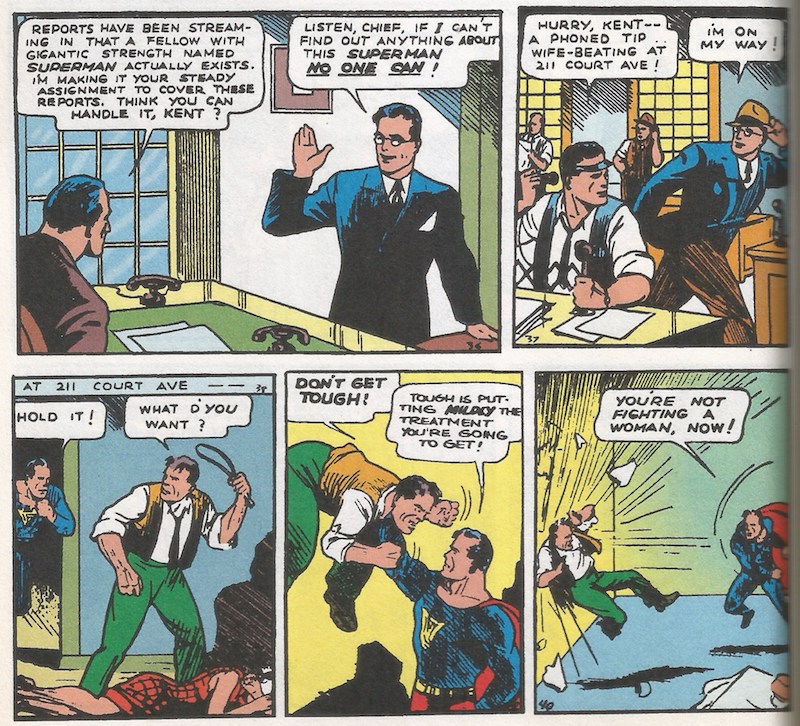
Traditionally, nobody with a conscience likes a wife beater.  So, it's no surprise that Harley joined Team Batman or that Batman's checking up on her.

After explaining that she intends to apologize to everybody she hurt and make amends for her partnering with the Joker all these years, things become a little meta.

So, apparently, the Joker attracted a cult.  They tattooed his face on various parts of their bodies.  They did his bidding, and now, it's payback time for ordinary Gothamites.  


It's difficult not to see a parallel between the clown tattooed yahoos and treasonous bastards that attacked the Capitol at  the behest of Donald Trump.  Especially when one of the Gothamites speaks of accountability.  


Batman is of course a way better person than I am.  I'm not sure I would have lifted a finger to save a Capitol Rioter from being beaten up by a crowd.  The events culminate in a House of Mirrors where Harley makes a decision that I'm guessing is the theme of this series.


Good point about the medical license.  For those not in the know, Dr. Harleen Quinzel is a former Arkham Asylum psychiatrist, which means she's also, believe it or not, a medical doctor.  That's right.  Harley could have hung up a shingle had she not been brainwashed by the Joker.

One of the things about Batman: the Animated Series that I feel helped propel it to the level of love is that the writers never exalted the criminals to a higher level than they were in the original comic books.  

The Joker in the Animated Series is a dangerous, psychopath, but that's all he is.  He's not supernaturally persuasive enough to attract a cult.  He doesn't have the resources or the ingenuity to mount a successful war against Batman that leaves Gotham in ruins.  

Batman is a deterrent in the Animated Series.  Plain and simple.  The Joker can never be the almost James Bond villain he is in modern comics because Batman exists to thwart him.  

This is why I avoided the Joker War in the first place.  I am philosophically opposed to the whole concept.  For Harley Quinn.  Ignore.  Perhaps pick up the trade for Rossmo's artwork.

Gene Luen Yang adapted the Adventures of Superman radio serial, "The Clan of the Fiery Cross," into a superb all-ages mini-series; viscerally known as Superman Smashes the Klan.  I therefore shouldn't be surprised by the quality and pure fun of Yang's delightful debut issue of Batman/Superman, yet given the shape of the Batman titles, I am.


The book is four bucks, but you get two stories unfolding simultaneously, illustrated to utter perfection by Ivan Reis, Danny Miki and colorist Sabine Rich.  


Been a fan of Ivan Reis since his Ghost days.  I'm also aware of Danny Miki's accomplished inks.  I've never heard of Sabine Rich.  So, let me just emphasize despite Yang essentially relating two stories occurring in two different universes inspired by black and white serials, the colors are luxurious.

The mechanics of the tale unfold classically.  A threat presents.  The hero notices.  Takes a stand.  except each spool of film manifests a deeper secret to uncover.


Yang draws upon numerous old time sources to enrich the art team's vivid visual kinetics.  For example...

Carol Forman portrayed the Spider Lady in the Kirk Alyn Superman serial.

Gale Sondergaard debuted a year later as The Spider Woman in the Basil Rathbone Sherlock Holmes films.  Nobody called her Spider Woman in the movie, but the name stuck to her and became zeitgeist. 

Soon Spider Woman would become synonymous with femme fatale.  Yang resuscitates the Spider Lady for his spiffy double feature.

Looking smashing to boot, but Yang isn't just interested in bringing back memorable imagery to the World's Finest tales.  These changes pack substance and take full advantage of a multiverse.  So far this is the only book living up to the Infinite Frontier label.

If you'd like to take my word for it and subscribe or follow, nothing more needs to be said, but if you'd like a few spoilers to sauce the goose, read on.

S
P
O
I
L
E
R


A
H
O
Y

The premises of both filmstrip universes is that something changed to deprive the Superman period of Batman, and the Batman period of Superman.

The stories start out naturally with Superman battling a familiar bald gentleman and Batman pursuing the Rogue's Gallery from Arkham Asylum plus one.  Batman hunts in a superb reconstruction of the 1940s Batmobile.  His costume is a throwback as well.


Note how the creative team emphasizes the leathery texture, more organic look to Batman's classic costume.  The boots, the ears are all practical.  The cape snaps onto the collar of the cowl.  I love this.  Can this be Batman's look from now on?  

Superman also gets a makeover that mimics his original outfit almost perfectly, especially the trunks.  The only difference lies in the Shield on his chest.  The S replicates the era's S, but there's a few flourishes outside the original.


You think you have an idea of where Yang is headed until the very end of the book, where something truly weird and wonderful happens.  It's a surreal metaphor turned real.  That's all you get from me and spoiling all that was just traumatizing to a tight-lipped someone like myself.




Thursday, March 25, 2021

POBB March 25, 2021

Pick of the Brown Bag
March 25, 2021
by
Ray Tate

Welcome to the Pick of the Brown Bag.  It just hit me.  I could have called this group of POBB reviews Infinite Madness or March Frontier Madness, or some kind of Madness.  You know, for the basketball.  Oh, well.  This week I examine Catwoman and Wonder Woman.  You can also find capsule snap judgements on Twitter: #PickoftheBrownBag 

Catwoman begins a new story, while tying a few loose ends.  Apparently, a lot happened between Joker War and Future State.   Writer Ram V makes it pretty easy to catch up.  Although I do have a few questions, just not about the plot.

How big is Gotham City? We discover another corner of undeveloped Gotham from whence Catwoman now operates.
  

Calling her building The Nest doesn't make a whole lot of sense given Catwoman's sobriquet.  I would expect Robins or Owls to nest.  Surely Cradle would have been a better designation.  
  

Catwoman now runs a group of Irregulars to better her schemes.  I hesitate to refer to them as a gang.  Since the Bronze Age of comics, Selina has always been more Sherlock than Fagin.

When the reader reacquaints herself with Catwoman, she finds the femme fatale lounging in the sun, along with her sister Maggie.

This is artist Fernando Blanco's sharpest contrast to what you're about to experience.  The scene exemplifies Blanco's ability to illustrate jet set elegance and tasteful anatomical beauty.  Jordie Bellaire accompanies Blanco with bright, warm colors, which will strike against the noir and eerie hues to come.

Those surprised to see Maggie up and about should check out the Catwoman 80th Anniversary Special.  The short story by Ram V and Fernando Blanco foreshadows what's seen here.  


Those who were unaware of Catwoman's sister need not go any farther than "yes, she has a sister."  Maggie's life wasn't pretty, and it's not to be revisited by those with weak stomachs.  


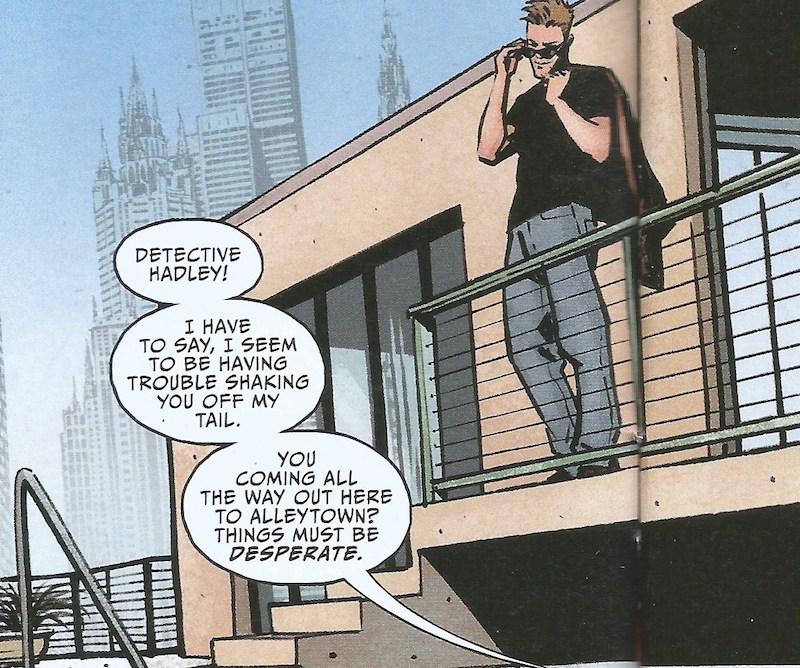
See.  That's how a rational person introduces a character.  Unlike James Tynion and his new pet thug Ghost Scouser.  Now, what's Detective Hadley's relationship to Catwoman?


Why thank you.  That clears up everything.  On the other hand, I don't understand this.

So, Lucius Fox embezzled Bruce Wayne's fortune? Catwoman set the money free to be adopted by needy Gothamites?  I don't think that's quite what happened, but it doesn't matter because the tale doesn't really pertain to any of that.  Whatever that is.


Hadley leaves a file with clues that lure Catwoman into a mystery that involves the Riddler, a second surprise Batman-Catwoman character and this new assassin.


Previously Ram V inveigled Catwoman in several pulpy heists for inventory issues during the Joelle Jones run of the series.  This is his first turn to write Catwoman as essentially a super-hero.

I know what you're thinking.  She hasn't any superpowers.  Neither does Batman.  A superhero partially can be defined by the company he keeps.  Nine times out of ten, Selina's hanging with the Batman Family, if not contributing to it.  Superheroes fight super-villains.  Selina battles a super-villain to keep the Riddler alive.

She has no rationale for the risk, other than she doesn't want to see the Riddler killed.  That's very Batman.  Furthermore like the superhero genre, Catwoman crosses into science fiction.  The assassin is more than just a Ninja with an odd dress sense.  She packs some strange tech, best not spoilt here.

Now that The Joker War is over, Ram V with the superb artwork of Fernando Blanco appears to be ushering in a new era of easy-to-comprehend, entertaining Catwoman stories.  Subscribe.  


In the Infinite Frontier, Wonder Woman appears to awaken in....  


I know what some of you may be thinking.  Is this a Marvel/DC crossover? Nah.  Norse Mythology is public domain.  Thor may show up in Wonder Woman, but he'll probably look more like this guy.

Thor and the Midgard Serpent (by Emil Doepler, 1905)

In any case, Thor is not accompanying Wonder Woman in battle.  The dusky-skinned warrior is none other than...


Siegfried is mostly known from Wagner's Ring of Nibelungen.  Wagner, a racist, would probably have done a spit-take upon seeing artist Travis Moore's and Tamara Bonvillain's gorgeous Moorish version of the legendary figure.  Suits me fine.  

Siegfried and Diana battle on the fields of Asgard, and as the saying goes, when you're dead, you're...


Some may balk at Diana dying so easily, but she's nor all there in this story.  Her memory is hazy.  Her powers halved at the least.  So the magical deaths are allowable in my opinion.  

As the story unfolds, we discover that Diana may or may not actually be in Valhalla.  When slain, or when recovering from a hangover, Diana experiences visions, memories or an altered state.

That figure looks a lot like the classic Ray Palmer Atom, but that's only an educated guess based on scant evidence.  Read on.  Diana meets a Norse Squirrel Girl cast-mate and other Viking figures of myth.  Soon she discovers that within Valhalla, something is amiss.

In addition to the central theme of Wonder Woman clashing with, fighting alongside of a different pantheon, Becky Cloonan and Michael Conrad fill the tale with character and humor.


Wonder Woman also features a backup story by Bellaire that's sound and pretty.  The aesthetic is courtesy of Paulina Ganucheau and Kendall Goode.  Older Wonder Woman fans will get a kick out of the Kanga returning as part of Amazon culture and discover the Amazons' surprising relationship with sharks. 

This type of story depicting Young Diana is a staple of Wonder Woman comics.  After William Marston and H.G. Peter left the series, Robert Kaniger and Ross Andru took over to present the modern romance between Diana and Steve Trevor as well as the adventures of teenage Diana as Wonder Girl and toddler Diana as Wonder Tot. Even if you find this short a little too childish, subscribe for the artwork and the more mature main attraction.

Tuesday, March 16, 2021

POBB March 14, 2021

Pick of the Brown Bag
March 14, 2021
by
Ray Tate

Welcome back to the first POBB marathon spotlighting the Infinite Frontier.  For this posting, I look at The Crime Syndicate, Suicide Squad and Swamp Thing.  If you're out of time and need a snap decision-- #PickoftheBrownBag --on Twitter.


Gotta admit.  It takes balls to write the Crime Syndicate after Grant Morrison and Geoff Johns.

Created by Gardner Fox and Mike Sekowsky, the Crime Syndicate of America debuted in Justice League of America #29 in 1964.

The Crime Syndicate was unlike any other group of villains the Justice League faced.  That was because they were the top dogs of Earth-Three.  

Earth-Three is a distinctive mirror earth where several opposites in history occur.  I won't go into details because you can only make sense of them after some deep, deep thought.  

Originally, the changes were just flip and superficial like Lincoln shooting President Booth.  When you ponder though, the Crime Syndicate's entire timeline must be radically different.

At the onset, the Crime Syndicate bore no doppelgänger relationships to the Justice League.  In other words the villainous Johnny Quick was not secretly John Chambers, nor Barry Allen nor any of the other Flash Family of speedsters.  These villains merely mocked the colors and style of the Justice League.  

The original Crime Syndicate returned to plague the Justice League and the Justice Society several times before dying in The Crisis on Infinite Earths.  Since the multiverse no longer existed.  Neither could the Crime Syndicate.  Then, Grant Morrison happened.


Morrison began recreating the multiverse in JLA.  The Justice Society were in metaphorical limbo.  Earth Two was vacant.  It became the Syndicate's new home.

Again, these reconfigured villains are nobody we know.  Ultraman isn't Kal-El.  Superwoman though adopting the identity Lois Lane is actually an Amazon just like her predecessor.  Owlman is Thomas Wayne Jr.  

Geoff Johns for the New 52's Forever Evil preserved a lot of what Grant Morrison reconstituted,  He furthermore added a clever purloined letter in the form of Atomica, a female, gun-moll version of the Atom.  By the by, Johns' sleight of hand plotting in this event is his most masterful.

Andy Schmidt's story presents the formation of the latest version of the Crime Syndicate, resurrected from Death Metal.  I know as much about Death Metal as I do the Suicide Squad.  Let's just say something happened to reboot the multiverse and move on.  

The book opens on the JFK assassination, but it's somewhat different than what you expect.  


A lot of people are going to accuse the Crime Syndicate of ripping off Brightburn.  Sorry.  Ultraman was Brightburn long before Brightburn.  No matter the incarnation, the Syndicate were always a nasty bunch of bastards.

The elimination also exemplifies the unique history of the Syndicate's planet.  That incarnation of JFK was an authoritarian dictator.  People cheer after the assassination, until they see what did the deed.

This version of Earth-Three may not have stayed rancid like the previous copies.  We jump forward to the now, where Cat Grant runs The Daily Planet.


A long time ago, post-Crisis creation Cat Grant was just a reporter of fluff pieces.  As writers started giving her dignity and depth, she evolved into a substantial character, making her transition to founder of media conglomerate Catco on Supergirl a linear, short step.

Cat editing and publishing the Daily Planet has only been a polar opposite for a few brief formative years.  The real strange thing about the scene is that on a corrupt Earth-Three, newspapers exist and still print the truth.

Other Syndicate members get their piece and highlight the unsual nature of the earth they occupy.


Oliver Queen became President.  Superwoman in this story is an evil version of Donna Troy.  I doubt Schmidt would have thought of that if not for Dan Abnett's remarkable Titans run. 

The post-Crisis repeatedly kicked Donna Troy in the teeth.  She suffered greatly from having her history ripped out from under her.  More so than her fellow Titans.  The New 52 hasn't been any kinder.  

At first rewritten as a homunculus fashioned to kill Wonder Woman, Donna experienced a fuzzy memory composite of her previous Teen Titans life.  Rejoining the Titans, she learns her future self will conquer the planet and murder not just Wonder Woman but every other hero.  Sucker...It was Wally West all along.

Adding to the roster, Schmidt revives Crime Syndicate also-rans like the new Johnny Quick who looks like a refugee from Mad Max Fury Road.  We also get a new Atomica and a new John Stewart as Power Ring.


A new ring of Volthoom, as well.  The New God Black Racer destroyed the evil intelligence in Justice League during the Darkseid War.  Another really good Geoff Johns production.

Last but not least, Owlman shows up toward the conclusion, being part Morrison Hoots and part Scott Snyder Court of Owls.


The Crime Syndicate forms this time to combat an invasion by Starro the Conqueror.  Starro first attempted to conquer     earth-one back in the Silver Age.  He shows up every once and awhile for a repeat performance, heckled by the League.  He's an A-Class threat even if thwarted by a mascot with a snapping fetish and worth the Syndicate's mettle.  Still there's nobody here to root for.


Starro's a cunning alien, monster.  The Syndicate are evil.  Schmidt raises them above the level of ordinary criminal.  They all foster different rationales for fighting Starro, and becoming sort of champions of the innocent by default.  Still, evil though.

Art by Kieran McKeown and Dexter Vines offers a solid visual narrative filled with emotive characters, and Steve Oliff's hues add zing.  This is about as colorful a comic book reveling in villainy can get.  Subscribe if you're a Crime Syndicate fan.  Follow for possible hero guest stars if you're not.


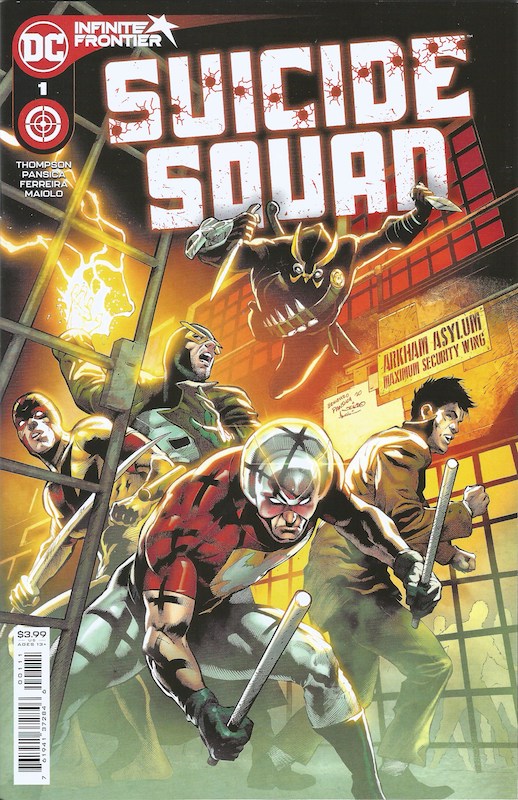
So, guess what? I know beans about the history of the Suicide Squad.  I know that the original team were a handful of expendable, human operatives led by Rick Flagg, and that's about it.  So click on the wikipedia link if you're super-interested.  I'm not even mildly curious.

The basics of the modern Suicide Squad is simple.  Amanda Waller controls a team of expendable villains and sometimes heroes from the DC Pantheon to handle tasks too dirty for higher grade Leaguers, Legionnaires, Titans, and sure, even Outsiders.  The carrot is usually a reduced sentence.  The stick is a remote control explosive device in the head or neck.  You only get hit once with the stick.

Usually, I don't give a rat's behind about the Suicide Squad.  I agree with Batman, who despises Waller and the Squad.  However, Charlton cover heroes Peacemaker and the Judomaster, of all people, make picking up at least one issue difficult to resist.

This is not to say Judomaster or Peacemaker are favorite characters, or even good characters.  I've never read a single one of their original adventures.  Nevertheless, I'm aware of their existence and that DC bought these oddities as part of a birthday gift for Dick Giordano.  True.  It's their rarity that makes them sauce for the goose.  Dan Greenwald from the Comic Book Pit podcast referred to such figures as stray puppies.  I've not heard of a better description.

Suicide Squad didn't change my uninformed opinion of Judomaster and Peacemaker.   Marvel cornered the market in super-cool martial artists in the seventies at the height of the Kung-Fu Fighting era.  


DC has the Batman Family and Black Canary.  Why on earth would I waste my time on some lame "master" of judo?  Ever hear of the original Black Cat from the humble Harvey Comics?   


That's some tastier eye-candy, let me tell you, and I'm sure she can kick Judomaster's ass.  Of course, so can Tinker from Speedy Buggy.  

As for Peacemaker, what the hell is up with that headgear? How? Why? 

So this is the Infinite Frontier Suicide Squad.  Two Charltons, Bolt, who I know from Who's Who in the DC Universe? All led by Amanda Waller, of course.  


Here's the funny thing.  I still don't give a rat's behind about the Suicide Squad.  I'm either still neutral or disdainful toward this particular team.  However, writer Robbie Thompson makes The Suicide Squad compelling.

Amanda Waller is a paranoid lunatic control freak.  She believes that every hero she cannot command is her enemy.  This includes the Justice League.


That's Rick Flagg.  A character who lived far beyond his expected sell date.  The Squad's objective.  


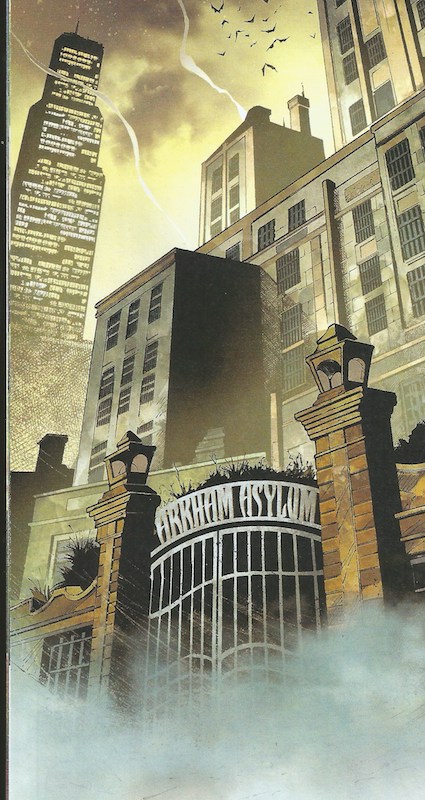
Infiltrate Arkham Asylum, and that's really all I can say about the book without giving away all the intriguing twists and turns.  Somehow Amanda Waller believes these actions will create a countermeasure to the Justice League.  She's setting herself up for another loss.  Waller should retire somewhere and take up Buddhism.  She's just a delusional, ball of hate.  In the real world, if she weren't Black, she'd be a pundit on Fox News.

One other impressive thing I can divulge about Suicide Squad.  It's actually set before some of the events in the anthology Infinite Frontier, and links up smoothly.


The release of Joker gas catalyzes the Batman story in Infinite Frontier.  So, extra points for that.  

DC gave the thankless task of making nobodies look good to Eduardo Pansica, Julio Ferreira and Marcelo Majolo.  They all measure up to the challenge, and sisters and brothers they were challenged.  If you're keen on the Suicide Squad, subscribe.  I'll be honest I'm tempted to pick up a second issue.  At the very least, follow.


My favorite Catwoman writer Ram V introduces a new Swamp Thing, kind of, to the Infinite Frontier.  Will it take root?  Damn good question, and it's too early to tell.  

Being a fan of Swamp Thing, I'm naturally a little leery of the whole exercise.  I'm an old school kind of guy.  


I still love this movie.

Swamp Thing for me is Alec Holland, who's slain in a lab explosion, splashed with a bio-restorative formula of his own invention that merges him with the swamp and extinguishes his flaming body.  

Alec spends the rest of the series seeking revenge for his wife Linda whom the opposition murders in cold blood.  He actually doesn't want a pound of flesh for his own fate.  Killing Linda is the crime.  Hence, Swamp Thing's initial success.  Alec Holland is selfless.  Most people would be pretty raw about being turned into a muck monster.  For Alec, all that matters is making the people who killed Linda pay.


After the vengeance, Swamp Thing becomes a fringe figure in DC Comics stopping the monsters, both human and otherwise that threaten humanity and nature.


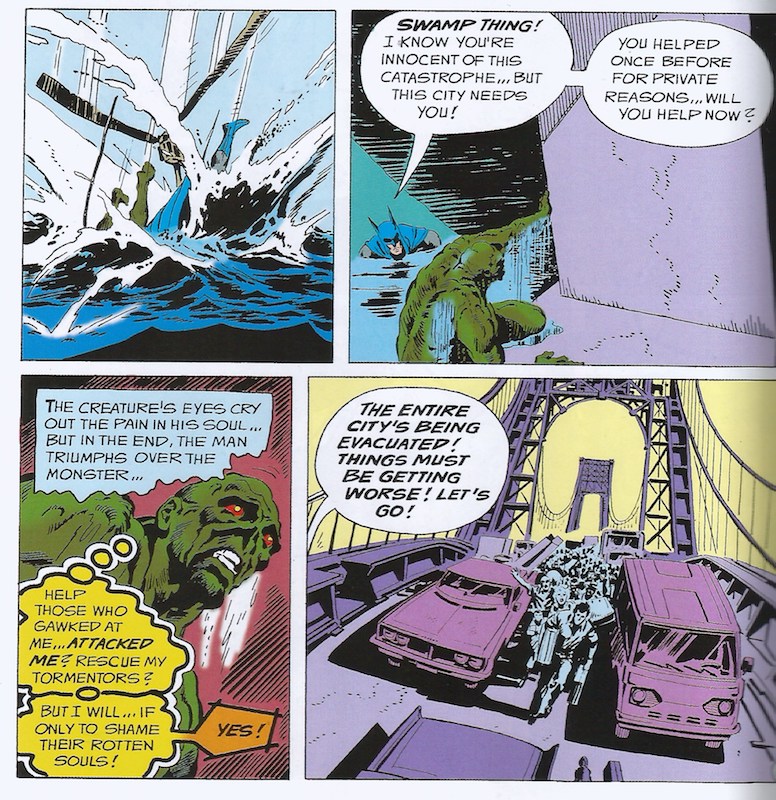
My very first encounter with Swamp Thing
The Brave and the Bold #122

In the post-Crisis, Swamp Thing became something else.  I'm cognizant of Alan Moore's run.  I wasn't a huge fan, but I respect it.  Moore created a lot of continuity; including the idea that Alec Holland never really was Swamp Thing.  Rather the bog plants duplicated Alec's mind.  Alec's corpse still lies at the bottom of the lake.  Or something like that.  Honestly, I never understood any of this.  I'm a hard science kind of guy.  Moore furthermore originated the idea of Swamp Thing not being one creature.  Multiple Swamp Things exist throughout earth's history.  I presume it's only earth's history.  So, there's a germ that somebody else can be Swamp Thing.  Enter Levi Kamei.


Ram V's story is very literate and reads like the opening of a novel rather than a typical comic book.  The unsettling mood differs strongly from the bouncy pulpy Catwoman.  Mike Perkins' artwork leans into the idea that you're going to be experiencing a work of horror set in the real world. 


The Pale Wanderer is Ram V's cryptozoic conception, steeped in folklore.  He's a combination of Wendigo, Skunk Ape and Chupacabras.   We see the Wanderer's origin story related as a legend by the officer who first broached the subject and later meet the thing in detail.


The incident with the Pale Wanderer juxtaposes with the unfolding of Levi Kamei's transformation into a new Swamp Thing.  The first stage occurs in dreams of an uncontrollable germination, but this is only the setup.  A suspenseful foreshadowing one may find in The Night Gallery or Sixth Sense.  The Gary Collins television series not "I see dead people."  The setting of the plane may be homage to The Twilight Zone.

Levi travels to New York to reacquaint himself with a friend, and the plot thickens in a very unexpected way.


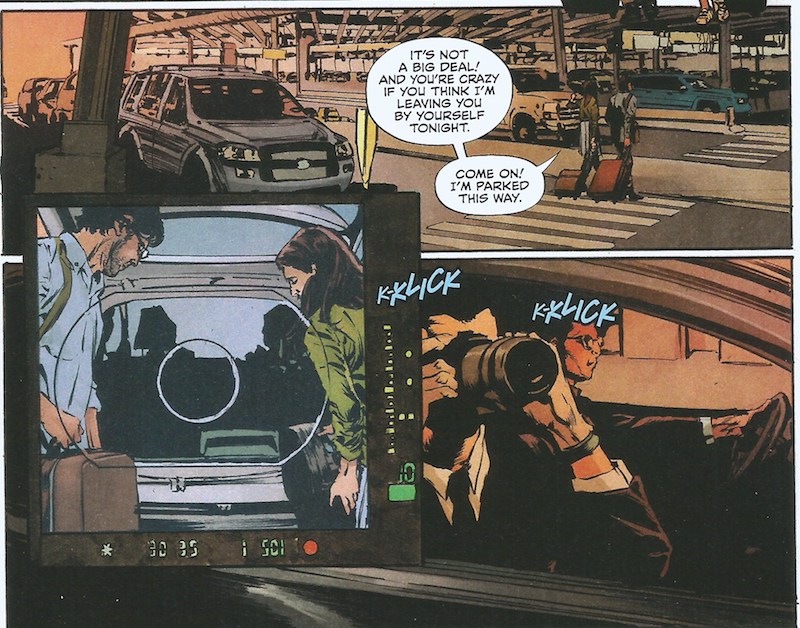
Even if Levi becomes the new Swamp Thing, it doesn't explain who is photographing him, or why.  Do they have anything to do with Swamp Thing, or is this a tail of Levi the human, not who he will become?  So many puzzles.  I found Swamp Thing to be tantalizing. Subscribe.