Pick of the Brown Bag
July 10, 2013
by
Ray Tate

"I cannot ethically defend the constitutionality of Pennsylvania's version of DOMA where I believe it to be wholly unconstitutional."--Pennsylvania Attorney General Kathleen Kane. Not to be confused with...

Though I can see how you might make that mistake.
This week in the Pick of the Brown Bag, I review Justice League, Smallville, World's Finest and Paul Pope's The Invincible Haggard West.

After the false start in Justice League of America with the rumor of Catwoman's demise being greatly exaggerated, The Trinity War properly begins in Justice League.

The story unfolds with a mysterious woman visiting Madame Xanadu. Johns takes a moment to display the Madame's credentials to readers unfamiliar with the character.

Johns also smartly uses Xanadu as a framing device as well as foreshadowing. He furthermore takes advantage of the vast DC archive to create encounters no reader could have seen coming.
 Having tricked Black Adam into exposing his alter-ego and therefore canceling Teth Adam's protection from aging, Captain Marvel (Shazam) decides to return the remains of Black Adam to Kahndaq, where the antagonist was born.
It's a surprising example of the massive upheaval in the characterization Johns introduced in the Captain's backup serial, characterization I might add everybody agreed was terrible.
Conflict arises because the United States banned Americans from visiting the terrorist nation, and that includes superhumans.

For once, Batman is wrong. Billy had already decided to return Black Adam's remains to Kahndaq. Billy's trip has nothing to do with Superman's and Wonder Woman's incursion. In fact very little strife arises from Superman and Wonder Woman dating.
The Superman/Wonder Woman relationship has been a massive red herring that no reader fell for or cares about. No matter how much the Powers at DC wish it otherwise, no matter how many times you beat this dead horse until it rises up again, no matter if you produce a comic book series about the tryst, you cannot convince me or anybody else that Superman will end up with someone other than Lois Lane.
Smallville teased the possibility that Superman would stick with either Lana Lang or Chloe Sullivan for about five seasons. They even suggested Chloe was actually Lois Lane, but no.

Clark Kent still ultimately became involved with Lois Lane. This even after the two professed an initial dislike for each other. So yeah, Wonder Woman and Superman dating. No big deal. It's not serious and has nothing to do with the Trinity War.
The Justice League decide to intervene in Kahndaq before Captain Marvel escalates the discord that itchy trigger fingers instigated. The team probably would have talked down Captain Marvel with no problem, had not Justice League of America arrived.

The presence of the Waller team facilitates some choice dialogue and interaction, and the battle between these champions makes perfect sense. What's surprising is the Justice League's unification. Despite seeing with their own eyes what occurred, they still back Superman. They know there's an explanation, or they blame Justice League of America for their interference in matters best left to professionals. Even in Xanadu's apocalyptic vision early in the book, Batman, Superman and Wonder Woman really are an unbroken Trinity.

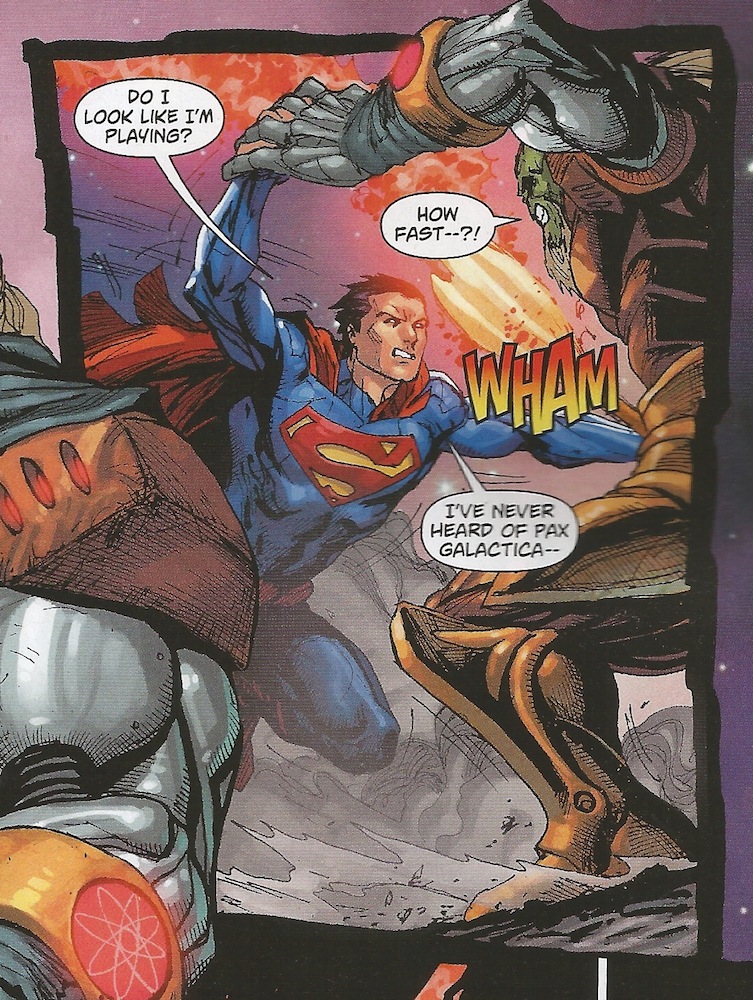
Smallville shares much with Justice League. The story is about a war. Superman plays an integral part. Classic characters from DC's history take sides, and there's a superhero throw-down.
 The war in Smallville occurs between the humans of earth and the new Kryptonians, descendants of Zod's army given a new lease on life by Kal-El. This war is less of a boxing match and more of a strategic initiative.
The cover to Smallville indicates the reintroduction of Doomsday, a lousy ends to a means, only given depth in the television series.
Doomsday was designed in the nineties to kill Superman. The concept, for the creature was scarcely a character, was even shallower than Bane. Even Bruce Timm couldn't wrench anything out of this craggy cipher.

Miller doesn't give Doomsday any added layers here. He doesn't even try to make Doomsday anything but an weapon aimed at Superman. However, he exploits Doomsday's very utilitarian nature as a plot device well.
First, Miller uses Doomsday to define the dirty trickery of human zealot Minister Neidrigh.

Second, Doomsday gives Superman the opportunity to demonstrate his leadership skills, and the people of Argo respond.

Third, Doomsday allows Superman yet another moment to express his selflessness. Truly, this is Superman at his finest.

The Kryptonians at the same time launch a gravity bomb at the earth. Miller is clearly showing that both sides are completely wrong for waging war and that both lines suffer their base instincts. Miller consolidates the debate in a brief, exciting and humorous skirmish between Supergirl and Superman.

Above all this racial turmoil, the very symbol of universal harmony, the Legion of Super-Heroes organizes and saves lives. Not only do they act like heroes. They as well put aside their personal differences.

Cosmic Boy indicated that he and Lightning Lad have been fighting over Imra, Saturn Girl, but Lightning Lad is amongst the Legion, and he obeys Cosmic Boy's orders.
Furthermore, the Legion preserve history in a standout moment that would have been spectacular on the screen but still fairly impressive and eventful within the pages of a comic book.
Kudos to all involved. Bryan Q. Miller and artist Daniel Hadr balances an enormous cast and multiple plots and subplots with seeming ease.


As to the rest of the DC stable, meh. Only World's Finest really rocked the week, and I'll get to that title in a second.
Superman Unchained demonstrates how the Man of Steel would have mitigated the tragedy of September Eleventh, but this is mostly Scott Snyder talking at the reader, not allowing her to engage in the comic book.
Superman visits Batman at the Cave. So there's more DCU integration but the book is chatty and the art is boring. Besides we've seen this sort of thing before.
When Superman drops in on General Lane, we discover the Pentagon developed all sorts of technological marvels like black hole bullets to stop Superman.
 That sound you hear is my suspension of disbelief snapping in two. Let's suppose you could produce a black hole bullet. Still, the amount of money needed to construct a single munition would without a doubt bankrupt the entire nation. So, Scott Snyder, pull the other one.
Snyder's Batman is a little better with the first encounter between a Batman yet named and the Penguin, the continuation of the Red Hood/Batman war and the introduction of Vicki Vale to the new 52, but it just feels a little bloated and gassy. It should be exciting with its dirigible setting, but Bruce Wayne is decidedly dense in this book, despite impressing the neophyte Riddler.

It's great to see Batgirl dancing again. Don't get me wrong. This book is light years ahead of Michael J. Straczynski's abomination The Brave and the Bold #33 where Wonder Woman and Zatanna take Babs dancing one last time before they position her to receive the Joker's bullet. Gail Simone however tries too hard to make me like Ricky, the felon Babs rescued from the vigilante Knightfall.
Overeagerness is really one of the most enviable things you can do. I admire Simone's ambition, but her execution is a little too sunshine and lollipops for me to accept.
Ricky isn't bad. He's just drawn that way. He's got this lovely family, and although his brother is a low-tiered criminal, he still loves his little b. That car jacking incident? Purely a misunderstanding, and boy Ricky can show a girl a good time. Ricky. Love him.
The thing is had Simone showed him to be a bit nastier and slowly rehabilitated him, rather than make him suddenly care about people and having him feed the homeless, I would feel better about the character.
I can see her side of the argument though. Surviving that one bad night changed his life, but his life just didn't seem so bad to begin with. He's not fighting for anything. He's just being handed chocolate covered cherries. His mother makes delicious tamales for crying out loud.
That said. The worst of the book is totally dependent on the fallacy of James Jr.'s death.
Commissioner Gordon goes flying off the deep end. The top cop joins Peter Tomasi's version of Batman in the rubber room.
The irony here is that Simone writes Batman perfectly sane and in fact as a smart, fully engaged character who would probably ask Babs why she took off her symbol and work with her to address her guilt.
Incidentally, I find it difficult to believe that Batman knows of Amanda Waller but doesn't know that James Jr. is alive. So once again, Simone is hamstrung by events outside of her book. Damn fine Batman and Batgirl writing though.
Nightwing is a real pill to take. So, during Nightwing's hunt for Tony Zucco, including a visit to the Chicago Mayor, Nightwing dawdles with his new bud's subletting roommate. Then the Prankster blows up a train. Yeah, who cares?

In Ghosted some rich collector of the occult orchestrates the release of the brains behind a series of heists to steal him a ghost. Um...no.

Though beautifully illustrated by Goran Sudzuka, this story unfortunately only has enough material in it for a trailer. All the comic book made me want to do is watch this again...

That film is still seven kinds of awesome.

Now we get to Paul Pope's The Invincible Haggard West, cheekily numbered 101.
I think there are about a hundred words in this story, and the rest short hands the essence of any comic book adventure series into a heart pounding frenzy of action.
First Pope introduces the threat, and his singular style of artwork makes that threat mighty strange.

Second, Pope rockets the hero into action. He designs the character with archetypes in mind, and smooshes them all together into a delicious sandwich: an artistic graham cracker s'more if you will.

Third, he actually spares a few seconds for an aside to focus on another character in the mythos of Haggard West.

This is basically like a Hanna-Barbera cartoon with a mature audience in mind, and somehow Pope makes this whole buried cosmology in the figure of Haggard West so inviting that you're actually surprised when the story title lives up to the promise.

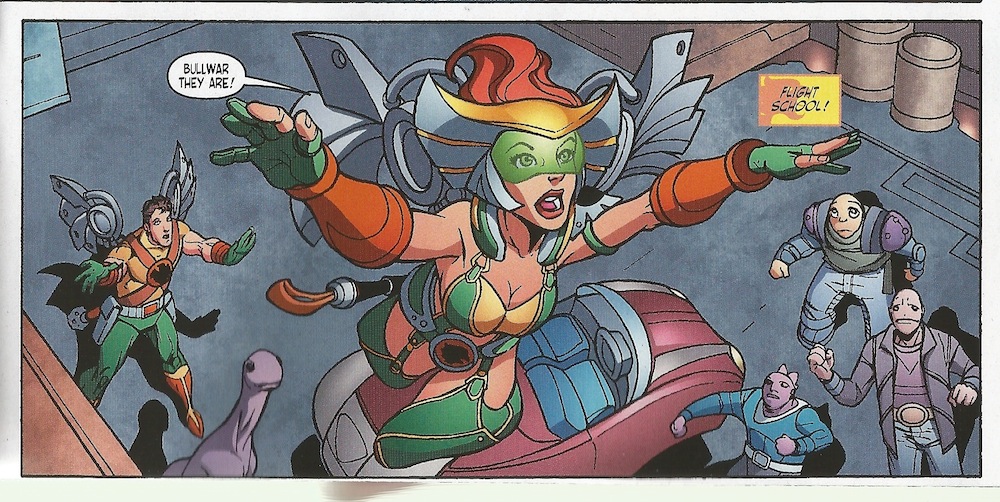
Very close to the feeling of Haggard West. World's Finest. This is DC's perfect comic book. It could not have happened without the new 52 reintroducing Helena Wayne as the Huntress and Power Girl from Earth 2. It banks on their long lasting friendship, and their mutual want to seriously kick ass wherever they are. Writer Paul Levitz has been given a second chance to use the characters that he created, and he's not wasting an iota. This chapter opens up with Helena escaping a fire.

Levitz adds a nuance of character dynamics.

He then has Apokoliptan evil Desaad calling out the duo by attacking another Starr Technology Facility.

All of this awesomeness is illustrated by Robinson Rocha, a major find. He brings an experienced freneticism that belies his relative freshness to the field, and he perfectly blends pulchritude with attitude.
The Saturday Matinee

I think everybody knew that Johnny Depp would be as impessive as Tonto. Depp is such a natural chameleon. For me, what would make or brake The Lone Ranger was Armie Hammer. I'm pleased to say, we have a second Lone Ranger.

Hammer does not send up Clayton Moore's performance as the quintessential masked rider of the plains. Instead, Hammer offers the viewer a sincere portrayal of a bona fide shiny hero placed in the antithetical spaghetti western. The fun in this gorgeously shot picture is watching the Ranger adapt but not abandon his ethics. I was thoroughly entertained.
The Pick of the Brown Bag was setback a day, which is why this review is so late, but on the bright side, it affords another short critique. This time. Pacific Rim.
Pacific Rim is an outstanding tribute to the Godzilla/Gamera films of yore. Guillermo del Toro and his team did some wonderful things to bring the CGI to a Harryhausen standard of visual character, and they maintained the illusion that these things could be men in suits.

From a dramatic point of view, the plot is an engrossing, smart exploration of science fiction, and the cast flesh out roles that could have been cardboard, but here as well Pacific Rim exceeds in expectations. It's what the writers don't do that's important, and almost all of Pacific Rim eschews cliche, apart from the first few moments of character introduction. Still, this is sauce for the goose. The bird in question is realized battles between mobile, giant suits of armor and deadly monsters. This movie delivers.