Pick of Brown Bag
February 10, 2016
by
Ray Tate
This week, the comic book reviews come in droves. My name is Ray Tate, and I am the creator/master of the Pick of the Brown Bag Each week, I peruse the best and the worst of the current comic book yield. If you haven’t time to check out the full reviews, just pull up the teensy versions on Twitter: #PickoftheBrownBag.
Let’s get this party started. First…

Shaft returns in “The Imitation of Life,” and let me just say if Shaft were actually in The Imitation of Life, it would have been a far, far better film. Such a dreadfully dull melodrama.
No acting. No plot. No direction. No budget. No boobies. No beadings.
Doubtful MST3K could do something with it.
In the case of Shaft “The Imitation of Life” pertains to superb writer David Walker’s philosophically rich narration. Shaft relates to the reader how he can kill without compunction and still be a human being. Dissection though fails to demonstrate the gritty beauty in these words.

You’ll read every line because Walker crafts remarkable rhythm, and that rhythm carries you through the breakdown of Shaft’s character. The narration further draws your attention to twin plots that mirror each other. Two months ago Shaft took a job for a connected father looking for his daughter.

In Shaft's present, he attempts to rejoin society through the search for another missing teen. What he finds is savagery that must be dealt with instead.

These two cases fit snugly in the private eye genre. The seediness of the seventies drop Shaft in the grindhouses. The art of Dietrich Smith classes everything up without losing a hint of the blaxploitation beginnings.

Though Shaft is period-specific, the prejudice toward the individuals Shaft seeks is unfortunately timeless, and it brings to mind a lyric from Shaft’s theme, “Who is the man that would risk his neck for his brother man?” Shaft. John Shaft.

Though Shaft is period-specific, the prejudice toward the individuals Shaft seeks is unfortunately timeless, and it brings to mind a lyric from Shaft’s theme, “Who is the man that would risk his neck for his brother man?” Shaft. John Shaft.

Doc Savage continues to travel along the spider’s web, but this particular cloth hasn’t been woven by Richard Wentworth. Instead, a group from Doc's past called Arachne unspools the anarchy.

In previous issues, Doc uncovered a mystery with ties to a loose cadre that set house in the 1930s. The group of filthy rich individuals intended to plunder the wealth of the world and use whatever mad designs available to enforce their positions as we mere peons’ overlords. Doc of course thwarted them, but Arachne always comes back because it’s difficult to kill an idea. Even harder to reform it.

This issue we learn of a connection to a nineteen seventies kidnapping that at once reflects the abduction of Patty Hearst and the madness of various Doomsday Cults. Arachne's plans depended upon the itchy trigger fingers on the hot buttons of the Cold War. Doc of course sees the flaw in their ultimate plan.

It’s just like Doc to combine optimism and logic in one fell swoop, and it’s an example of writer Chris Roberson’s excellent characterization for the Man of Bronze.
Roberson’s story compels for a number of reasons. Primarily though the tale confronts the near infallibility of Doc Savage in the presence of a particularly hardy disease. This miasma spans the decades: from Doc’s well known operations in the thirties and forties to the current Doc Savage conglomerate dedicated to helping the world on multiple fronts.
Roberson’s updating of the Doc Savage mythos is the same system the writer introduced in his first Doc Savage miniseries, and I understand now that “Spider’s Web” is the story that he wanted to scribe first. However, Roberson had to establish the present day Doc Savage protocols. Thus, the first Doc Savage miniseries from Dynamite was actually Roberson’s first chapters to this saga. Those chapters related the adventures of Doc Savage within each succeeding era, explained how his Amazing Crew expanded and backed Pat’s explanation for still looking spry for her age. Doc would be lost without his cousin.

In order for Roberson’s story to work Doc had to continue. For maximum impact Arachne couldn’t be just another group of nutjobs for Doc to repair at his Crime College. Instead, they had to be the group of nutjobs, the Illumanti, the Trilateral Commission, the conspiracy believers' darlings all rolled up into one.

Lester Dent’s defacto creation rarely earned less than total victory. The exception being John Sunlight. Arachne had to be so complex through a culmination of incremental growth that Doc Savage could plausibly miss them. The group also had to evolve. It had to become, no less than an organization intent on overthrowing civilization. It had to deserve Doc Savage.

Lester Dent’s defacto creation rarely earned less than total victory. The exception being John Sunlight. Arachne had to be so complex through a culmination of incremental growth that Doc Savage could plausibly miss them. The group also had to evolve. It had to become, no less than an organization intent on overthrowing civilization. It had to deserve Doc Savage.

Our other good Doctor this week plays up his investigation into a case companion Clara Oswald intended to solve herself. The Doctor wasn’t about to let Clara succumb to any dangers. He has a duty of care.

The disappearance of a fellow teacher and friend Christel Dean triggered Clara’s infiltration of Ravenscaur. There she finds a headmistress that’s a pill-and-a-half.

She however is the least of Clara’s worries. Whoever heard of eerily well-behaved students that clash with the cool teacher’s relaxed means of education? Expertly delivered in the illustration of Rachael Stott.

While Clara ferrets around Ravenscaur, the Doctor takes a page from his previous incarnation and investigates the goings on from the point of view of gossip. The pub.

He finds a most unwelcome audience.
Morrison's and Stott's Doctor Who is almost as entertaining as the real thing on television. They portray the Doctor at his most boisterous and dangerous. Peter Capaldi’s Doctor in a nutshell. Clara harnesses the acumen she picked up on her travels with the Doctor, and an exciting cliffhanger awaits Doctor Who fans old and new.

In the last issue of Batman/Superman, the World’s Finest team found themselves lured into space by the death of an alien. In her last moments, she dramatically requested their Batman's and Superman's assistance. Tom Taylor’s story just gains momentum with the second issue.

Batman deduces the entire puzzle with all the skill and delivery of a ratiocinator stepping out of the mold of Sherlock Holmes. Taylor’s elegant murder mystery falls like dominoes before the world’s greatest detective, and Batman doesn’t see just the enigma before him. He figures it all out.

At the same time Batman defends himself against Lobo, and goes just as you imagine.

Lobo finds himself in the rare position of being so woefully unprepared for his quarry. This is consummate Batman, and insanely entertaining.
Meanwhile, Taylor demonstrates just how super is Superman.

Seriously. I got chills.
That’s really all you need. Variations on a theme. Batman is hyper intelligent, and there’s nobody more powerful than Superman. Each hero supplements the other. They perform these feats in uncanny milieus, and the setting creates a greater sense of wonder actualized by artists Robson Rocha, Julio Ferreira and Blond.

In Batman: Arkham Knight, Tim Seeley relates a substantial updating of Batgirl’s mythology. Batman originally welcomed Batgirl into the fold. Batman: the Animated Series duplicated the scene. In contrast, the flashbacks of the modern era suggest that Batman deterred Batgirl from joining his ranks. On the flip-side, the new 52 followed through with ideas postulated by the non-canonical Batman & Superman: World’s Finest.

There, Batman actually trained Batgirl, and this is today’s currency.

Seeley tries for a balance. Batman strongly suggests Batgirl quit and stay safe, but not in a mean, sexist way; which is how Batman always sounded in the flashbacks.

Though Harley Quinn features on the cover, Seeley primarily draws Batgirl’s arch-nemesis the Killer Moth to the flame. Killer Moth first encountered Batgirl in her Silver Age debut. Ever since, she trounced the goofball, Killer Moth fostered an itch to end the Darknight Daredoll.

Seeley’s Killer Moth is rather spectacular. At once a Silver Age specific baddie but also a potentially dangerous realistic criminal. Kudos for Matthew Clark’s depiction of the villain as an obviously disturbed individual. Kudos actually for the whole thing. Clark’s art depicts a diverse, modern outlook rich with detail.

Oh, and if you’re wondering. When Harley Quinn does take the stage, she’s less of villain and more of a menace. No less entertaining.

Batman/Man from UNCLE picks up the pieces left from newly anointed THRUSH agents Egghead, Poison Ivy and Mr. Freeze. The rogues intended to steal a satellite prototype from Bruce Wayne’s soiree but found resistance from the Dynamic Duo and UNCLE Agents Ilya Kuryakin and Napoleon Solo.

Definitely not forgetting Batgirl.
This issue we discover that Batman’s well-laid plans fruited in thwarting the dirty birds, but there’s a catch.

Whether or not our avian d’jour speaks the truth is moot. The Gothamite THRUSH agents strike again for a two-part plan that means definite dastardliness. Their near simultaneous chicanery means that Batman and UNCLE must lose this round. Our heroes cannot be in three places at once and lacked the intel to stop the enemy.

The plan concocted by Jeff Parker neatly bridges the gap between the weird ploys of the Arkham criminals and the oft-effective disruption generated by THRUSH. Thus, Parker satisfies both thirsts. As does the characterization and organization of Batman and UNCLE.

Parker even remembers the little niceties like Batman’s penchant for knocking out Batgirl when she visits the Batcave. This gag paves the way for a wonderful cliffhanger that most Batman fans will see through. It’s never the less a fun little moment, and it will no doubt put to rest Mr. Waverly's suspicions about Bruce Wayne while protecting Batman's secret identity.
When Batman contacts UNCLE, Parker remembers UNCLE’s pattern of involving an innocent person to aid them in eliminating the opposition.

I’ve often thought that this motif in The Man from UNCLE actually served as a safety net. The inclusion of an ordinary man or woman in a case kept UNCLE honest. UNCLE agents can never think themselves above these common people. They work with them.

Agents of SHIELD ripens with a fantastic plan that’s all kinds of cynical. SHIELD on the other hand is a positive force, and it’s refreshing to see this kind of openness. SHIELD has been too often been portrayed as the bad guy or the inept guy that constantly finds itself being eaten within by double-agents.


Okay. Fitz just may not be our Fitz, or he could have been brain-washed by this NEXUS. However, everybody else is on the up and up, and that’s what’s so great about Agents of SHIELD.

Raising a hand to ask question is such a Daisy/Skye Thing to Do.
While some of the behavior of the SHIELD agents is a little Marvel off kilter with respect to the television series, the personae of the agents seems familiar enough. Phil Coulson and Melinda May are dead-on.
SHIELD's goal is to stop the sale of a spoilsport ultimate weapon pointed at every super-hero in the Marvelverse. That is a worthwhile aim and it’s one of those so obvious why hasn’t anybody done this before kind of plots. A law enforcement organization in a superhero universe would try to stop the sale of superhero secrets. It’s such a no-brainer.

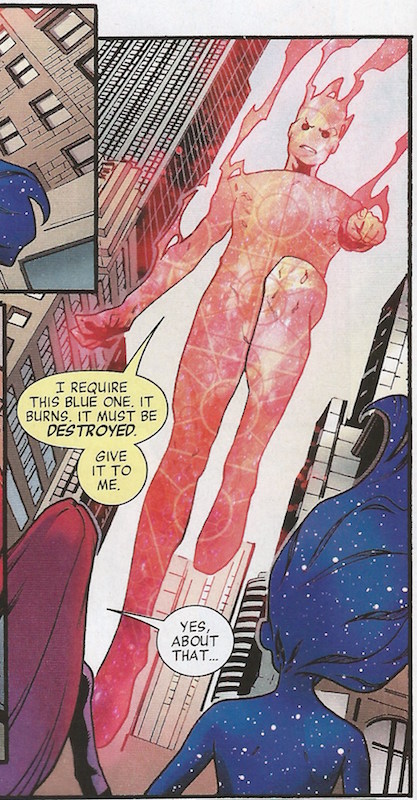
The Ultimates failed the test this week. The reason I didn’t connect to the story is that it’s built on artificial continuity. The more laudable goal and much more interesting story to fix the timeline falls by the wayside in favor of a personal vignette that draws on history of the Blue Marvel. I like the Blue Marvel. I want to get to know him in The Ultimates, but not in one glob of information.

 The Ultimates encounter an Anti-Man, former friend and comrade to Blue Marvel. Alas, also the killer of his wife. See this is just getting way too complicated. A trip down memory lane leads to a vengeful confrontation, interfered with by yet another character from Blue Marvel’s past.

LSD meets "Game Over, Man!"
 The Ultimates encounter an Anti-Man, former friend and comrade to Blue Marvel. Alas, also the killer of his wife. See this is just getting way too complicated. A trip down memory lane leads to a vengeful confrontation, interfered with by yet another character from Blue Marvel’s past.
Kevin? Who's Kevin?
The very reason why Doc Savage works is why The Ultimates doesn’t. The Blue Marvel is a new character. He shouldn’t have a villain from his past. This character doesn’t really have enough strength yet to support a past. His history is just blurted out. It doesn’t have any build up. The Ultimates is a shoulder shrug.
The very reason why Doc Savage works is why The Ultimates doesn’t. The Blue Marvel is a new character. He shouldn’t have a villain from his past. This character doesn’t really have enough strength yet to support a past. His history is just blurted out. It doesn’t have any build up. The Ultimates is a shoulder shrug.

Writer Dennis Hopeless’ All-New X-Men is the all Wolverine issue. Although the lion's share of the p.o.v. comes from her current beau Warren Worthington aka Angel.


Angel loves Wolverine, but he cannot stand the way she recklessly faces dangers because like any of Logan’s ilk, she can heal almost instantly. This also creates the fickleness of celebrity.

All of the episodes are fun and games. Laura faces fire and flood, saves lives and and always comes out alive sometimes bringing a friend with her.

This playful mood shifts however when Angel confronts Laura about her blasé attitude toward harm. Hopeless gives Angel a fair point, and I kind of would have liked Laura to acknowledge his very reasonable argument. Instead, a situation wedges the discussion aside. Laura faces the Blob, and this is truly a very painful exchange to witness.
The fight with the Blob grants Hopeless' story a certain amount of meta. Mark Bagley's, Andrew Hennessy's and Nolan Woodwar's depiction of the Blob's rage-fueled violence against Laura is frightening...

...and for the first time we who have been voyeuristically enjoying Laura's carefree attitude when facing of danger as well as the girl's ability to bounce back in feat after feat of escapist body injury fare begin to fret that there just may be a limit to how often Laura can regenerate her wounds. We may even feel a bit of guilt in goading on Wolverine.
The fight with the Blob grants Hopeless' story a certain amount of meta. Mark Bagley's, Andrew Hennessy's and Nolan Woodwar's depiction of the Blob's rage-fueled violence against Laura is frightening...

...and for the first time we who have been voyeuristically enjoying Laura's carefree attitude when facing of danger as well as the girl's ability to bounce back in feat after feat of escapist body injury fare begin to fret that there just may be a limit to how often Laura can regenerate her wounds. We may even feel a bit of guilt in goading on Wolverine.

Wolverine is a lot more circumspect in her eponymous book. Perhaps that’s because she’s in charge of a group of ladies with personal connections. One of those charges found themselves gravely wounded in battle last issue. The injury forced Wolverine to take drastic measures.

Tom Taylor’s story of course recalls Fantastic Voyage and for my money it’s an entertaining descendent that allows artist David Lopez to let loose with some more fantastical art and science fiction motifs. In a broader sense, I'd be curious to know if Taylor and Hopeless are in contact. Because if I were to judge Wolverine in conjunction with All-New X-Men, I'd say the former takes place after All-New X-Men. Laura seems a little wiser in Wolverine than in Hopeless' book.
That's all for now, folks. I had to split the reviews into two this week. So, you'll get to see the reviews of Black Canary, Catwoman, Death-Defying Doctor Mirage, James Bond, Radioactive Spider-Gwen and Starfire in the upcoming set posted next week. I haven't forgotten about the Black Canary and Scooby-Doo specials. They'll be on the band before you know it.
That's all for now, folks. I had to split the reviews into two this week. So, you'll get to see the reviews of Black Canary, Catwoman, Death-Defying Doctor Mirage, James Bond, Radioactive Spider-Gwen and Starfire in the upcoming set posted next week. I haven't forgotten about the Black Canary and Scooby-Doo specials. They'll be on the band before you know it.