Thursday, April 13, 2017

POBB April 5, 2017

Pick of the Brown Bag
April 5, 2017
by
Ray Tate

Welcome to the Pick of the Brown Bag, the weekly comic book review blog.  I’m your host, Ray Tate, and for this entry, I’ll be critiquing All-New Wolverine, Aquaman, Batman, Green Lanterns, Motor Girl and Superman.  I’ll also have a few words about James Bond.  As usual, if you haven’t time for the main event, I tweet capsules of the reviews under #PickoftheBrownBag.


Batman highlights the third Batman/Bane fight, and what it proves is that Bane is a punk.  The narration is key to adding depth to the battle, and the choice for the narrative voice is just as important.  


Writer Tom King picks up some of the little threads that seemed only to be characterization gems from all the way back in the story “Gotham” and expands them to weave an overall philosophy of Batman that’s refreshing and raw.  Needless to say, this issue is not to be missed.

Comic books can be very complicated to explain.  The English language often fails spectacularly when winding its way in and out of the sometimes convoluted histories of comic books, real and fictional.  For example, the earth is approximately 4.6 billion years old.  Happy birthday, earth, but what about the multiverse of DC Comics, and which DC Cosmos are we talking about?


Actually, every earth in the multiverse is about the same age as the real one.  Barring the third Earth Two from Earth 2 Society.  See what I did there? In the context of the superb Dan Abnett series, the Justice Society’s new, new earth has a false history.  It was born out of something called the Pandora Casket.  It’s only a few weeks old.  The heroes not evolved from the Pandora Casket know the truth.  The populace remains blissfully unaware and behave as if their earth is 4.6 billion years old.

The mutual understanding between comic book readers, discussion and argument is vital for the continuity of any series thick with history.  Conversation allows readers to discern what is factual within a framework of fiction, and what must be false.  A case in point.  The multiverse of the new 52 must be as old as our real universe because of The Judas Coin, All-Star Western, Demon Knights and Vandal Savage.


This comprehension of vicarious experience plays a role in accepting the restored Superman and Lois Lane.  I’ll not dwell on details.  They involve far too many paradoxes and happenstances.  In the most reduced summary, like Flashpoint, two multiverses overlap.  In other words, the Superman and Lois Lane of the post-Crisis were in fact offshoots of the new 52 Superman and Lois Lane.  The new 52 Superman and Lois Lane manifested first.  Of course, historically speaking that’s a load.


Writer Peter J. Tomasi touches upon these changes, but he comments through improved characterization.  Regular readers of this blog know how disappointed I’ve been in Lois Lane.  The writers seemed to translate Mom Lois as lifeless little helpmate.  My argument.  Mom or not, Lois would still be just as lively as the historical Lois Lane.


Bingo.  Lois Lane isn’t passive.  She’s edgy.  She’s hopelessly in love with Clark Kent.  She can be a mom, but don’t even think once that Lois Lane would be content to be Superman’s shadow.  That’s not happening.  

I never really thought of Lois being a cook or hosting anything, but the domestics is a side effect of the memory fusion.  Lois gained some chef-fu.  Superman got some balls.  New 52 Superman grew some optimism.  Both of them reunited got some exuberance.


Putting aside the ch-ch-changes.  Peter Tomasi just writes these characters better.  He never dropped down to the level of his peers, but you could clearly see hesitance in his writing.  As if he wasn’t sure about where to go with Superman and Lois Lane given that he didn’t know how they would end up.  DC could have in fact stated that the post-Crisis versions were completely false.  So, although Tomasi achieved moments… 


…he really didn’t seem comfortable writing these avatars until he knew for sure they were what they claimed. 

Superman reads like an excellent episode from the Batman/Superman Animated Series.  How much more of a compliment can I give?  Tomasi establishes the new status quo with people looking up to the sky.  It’s a Bird! It’s a Plane!


And they’re happy to see him.  Early in the New 52, Grant Morrison, Geoff Johns and others established that Superman wasn’t necessarily welcome on the scene.  The people of the new 52 considered Superman to be more alien than before, but unlike the Man of Both Worlds from the Bronze Age, this newest version lacked inspirational power.  He instilled as much fear as he did hope.  That changes right here.

From Superman’s patrol in the skies we go back to the farm.  The Kents are no longer hiding under assumed names.  The farm though still lies in Hamilton County, and once the reader sees Lois, she knows Lois also received a character face-lift.


All is not perfect in Lois and Clark land though.  Lois is wondering if she gave up her independence, and this will no doubt motivate her to get back to The Daily Planet and reclaim her by-line.  By the way, Lois, you baby, are independent.  You may go by Lois Lane Kent now, but you’re still you.  I’ve seen when you’re not, and it ain’t pretty.  The main plot however involves an unadvertised visit from Batman and son Robin investigating a mystery and discovering more than he anticipated.


Aquaman is now in its second chapter of the “Who Goes There?” homage.  The Aquamarines and FBI Agents Ajar and Irving requested Aquaman and Mera to investigate an abandoned U.S. Research Station.  Abandoned as in Roanoke.  What Aquaman and Mera find is a monster.
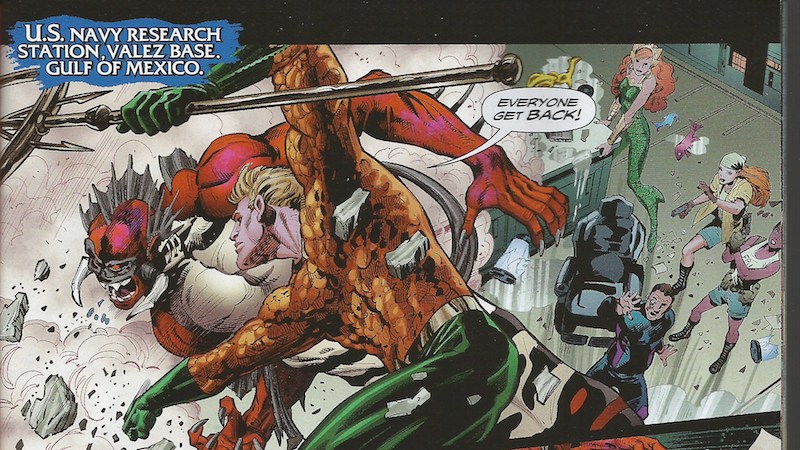

The difference between the classic science fiction/horror short that eventually became a television and movie staple is that Aquaman is a super-hero book.

If the hero decks the monster in your production, then chances are that you’ve got a super-hero story or at least a hybrid.  Fisticuffs do occur in straight-up horror films, but these moments are rare and so out of place that they come as a giddy surreal visual.


In any case, Aquaman is more of an artist’s book this time around.  That’s not to say writer Dan Abnett has nothing to do.  He spices the typical proceeding—i.e. the expected plot of isolated group combatting monster that can appear from anywhere—with Mera’s disgust over the unethical behavior of the Aquamarines and The Scavenger’s duplicity.  

Mera though with her power over water is the most valuable asset on this adventure.  Even Aquaman’s impressive strength and his intelligence is secondary.


Nevertheless, Philip Briones and Gale Eltaeb’s displays of superhero/monster fighting and the sight of Mera’s remarkable abilities are the main reasons to buy Aquaman.


Green Lanterns also gains thrust from the femme de la vive.


Watching Jessica Cruz’s transformation into this calm force of will is a pure pleasure.  Even more so, if you followed her plight in issues of Justice League.  These expressive treasures are perfectly realized in the art of Eduardo Pansica, Julio Ferreira and Blond.  J-Bird’s actions also define hers and Simon Baz’s partnership.  

The Lanterns actually seem like space cops.  Jessica backed up  Simon for the longest time, or both took independent action, however heroic.  This scene though looked like a police show standard, where the partner’s under fire and the second initiates a daring rescue.  It’s just beefed up with science fiction.


The Lanterns’ predicament is a direct result from an encounter with Dr. Polaris.  So far so treaded by other Lantern books.  Where Sam Humphries differs is that he makes Dr. Polaris a genuinely sympathetic character.  Polaris’ love for his brother Sean is genuine.  His concern for his brother, afflicted with brain tumors, pushed him over the edge.  His history, which we get to see in flashback, also grants Polaris dignity.  Don’t forget.  The Suicide Squad alerted the Lanterns because they wanted to use him.  So, he’s a victim as well and in need of the Lanterns’ protection.


The usually comedic Motor Girl gets serious as the Big Bad himself Mr. Walden pays a visit to Libby’s junkyard.  Mr. walden unlike Larry and Victor are well aware of whom he faces.


He brings her a much stronger offer than money.

Then he backs it up with teeth.


Sam’s survival instinct represented by Mike a Gorilla that only she can see kicks in even as she tries to rationalize.


From there, creator Terry Moore gently alleviates the tense mood by enlightening the reader as to the fate of Larry.  Abducted by aliens, Moore checks in with Walden’s hapless goon.  This however is a mere respite as Walden declares interstellar war.  Motor Girl is a drama disguised as an absurd comedy.


Writer Tom Taylor reignites All-New Wolverine with two stories erupting A material.  In tale number one, Laura Kinney alias Wolverine and her clone-sister Gabby take out the last levels of garbage orchestrating the human trafficking ring that Gabby uncovered in the previous volume.


As you can see, we get a nice bit of slice and dice action from Supergirl, Power Girl and Ultragirl artist Leonard Kirk.  Girl power.  Laura in addition plays a brilliant psychological tactic to reach the shred of conscience left in Big Bad of the piece.  Possibly the direct result of being reunited with her family.

Laura’s sponsor for the mission appears to be SHIELD. Perhaps Nick Fury experienced twinges of guilt what with trying to hunt her down for a crime she didn’t commit and kitted her out in some practical costuming.  With Gabby’s helpful hints.


Let me just say it’s nice to see SHIELD actually doing good.  For far too long SHIELD has either been tearing itself apart or playing shady espionage games.  SHIELD was always a Law agency first and a spy agency second.


SHIELD in conjunction with Captain Marvel commence the second story, which actually begins simultaneously with Wolverine’s infiltration of the human trafficking ring’s ship.


An alien crash prevented by new hero Iron Heart and her A.I. Mentor Tony Stark leads to the rescue of an alien child.
Naturally, those final words commence Laura’s involvement.  There’s only one problem.


With an enticing mystery as a hook, and Laura at the helm, the reader cannot help but follow.


Last but not least, the second chapter of “Black Box” is little too overtly true to Bond.  There’s a goofy Asian Big Bad and sharks.  That last trope is something I don’t get.


Writer Benjamin Percy and artist Rapha Lobosco juxtapose the meeting of Bond and Genji with the Shark and the Grouper.  This allusion doesn’t make sense.  Neither Bond nor Genji is bleeding.  They’re coming at each other in full health and on an equal footing.  

Regardless, the shark metaphor is rather silly.  Bond is a shark.  He’s a constantly moving predator.  Except Bond fought sharks before and stayed the hell out of their way when possible.  Bond is not a shark.  He’s a pragmatic assassin, not driven to kill.  Genji is the shark.  He’s not in constant motion.  So that’s nixed.  In fact the whole point of Bond’s infiltration is to flush him out at a card game, recalling Casino Royale and Goldfinger.  

Why on earth are there sharks at this casino in the first place?  Wouldn’t koi be more likely?  Turtles? I know they’re not lethal, but they would have made more sense.

Putting aside the sharks for the moment, Bond’s avenging angel reappears and announces her lethality, and she perks things up considerably.  Not the greatest Bond I’ve read and not the worst.

Wednesday, April 5, 2017

POBB March 29, 2017

Pick of the Brown Bag
March 29, 2017
by
Ray Tate

Hello, my name is Ray Tate.  Welcome to the Pick of the Brown Bag, the weekly comic book review blog.  For this post, I look at the Batgirl Annual, Green Lantern/ Space Ghost, Suicide Squad/Banana Splits, the Teen Titans Annual and Wynonna Earp: Legends.  I’ll also have a few words to say about Adam Strange/Future Quest, The Old Guard and Rough Riders.  

The POBB can be found on Twitter: #PickoftheBrownBag.  I still haven’t worked out a good schedule for tweeting.  So these teensy reviews are likely late.  For immediate satisfaction, always check out the blog first.

For the last week of March, DC teams up its caped and cowled champions with Hanna-Barbera toons.  The specials are pleasant surprises, but the mashup concept is nothing new.  Sholly Fisch's and Dario Brizuella’s Scooby-Doo Team-Up does precisely the same thing on a monthly basis and there’s only been a few mediocre issues in the impressive run of thus far twenty-four.

Is there a rhyme or reason to any of these partnerships? Are for example the Watchmen behind this queer splice?  Is it a Mr. Mxyzptlk antic? Nope.  From what I can tell, each writer benefited from remarkable latitude and addressed or didn’t the bizarre happenstances in different ways.


Green Lantern for example is answering a distress call that’s coming from another dimension.


One of the things I immediately enjoyed is that Green Lantern Salaak doesn’t like Hal Jordan.  Brother, let’s start a chorus.


My hatred of Hal Jordan is on record, but that was the old Hal Jordan.  The sexist conservative pig created in the Silver Age lasting through the post-Crisis era. Hal Jordan he who inspired HEAT members to dream wetly.

The New 52 redefined Hal Jordan as a complete ass and dropped the unattractive sexism.  He’s now just a horn dog and vainglorious, which is a lot easier to take.  


Justice League #1

That reworked characterization plays a big part in generating the conflict in James Tynion’s best to date.  I give you the fantastic Green Lantern and Space Ghost.


Others seek the weapon that Salaak and the distress beacon refer to.  One will be familiar to any Green Lantern reader, but even a casual peruser will know Larfleeze.  


I say this because until the new 52, I didn’t know what a Larfleeze was.  The Daffy Duck of the stars entered the DC Universe at the end of the post-Crisis, and since he was part of that Lucky Charms ring nonsense, I never paid attention to the weirdo.

In addition to Larfleeze somebody else wants the weapon, and that creature is better known.


That is the calling card of Space Ghost, who owns the scene.  Hal Jordan serves the role as a mere confused spectator until he makes things worse.

Idiot.  Space Ghost actually looks like a hero, and he looks extra amazing in Ariel Olivetti’s style of illustration.  This artist is a perfect fit for this story.  Normally, when superheroes fight each other its a cliche depression, but because this is Hal Jordan leaping to the erroneous conclusion, even after watching Space Ghost blast Lafleeze and Zorak’s forces, the misunderstanding makes complete sense.

Our heroes end up on a world with a backward attitude toward science.

Hal is so full of himself in this scene.  Not in his dialogue but the way he comports himself.  Olivetti again.  He gets that Jordan is a boob.  That said.  He’s contrasted against a group of astronomical luddites.  So there’s no reason not to root for him.  


The way Hal gets out of this situation distinguishes him from the previous version of Hal Jordan.  He’s far more imaginative, leaning more toward Kyle Rayner’s vast creativity, and he’s got his own boogeyman preying on his mind.  The end result is a laugh out loud funny moment.  Previously brokered by Mark Waid, but this version of the tactic with build up and visual is much more satisfying.  Of course, the battle between Space Ghost and Green Lantern isn’t over.


You know.  If this were a fight between Space Ghost and the Hal Jordan of old, I would be screaming for Space Ghost to end that bastard, but because this is the new 52 version, I can just sit back and enjoy.  There’s no personal vestment, and as you can see the repartee between our opponents is hilarious.  It only gets better as the story progresses.  Really, Green Lantern and Space Ghost is so worth it.

Heila is a native to the planet, and as such, she possesses the same cultural belief.  Her obstinance however allows Space Ghost and Green Lantern to finally turn the same page.

The partnership between Green Lantern and Space Ghost is almost as engrossing as the animosity between them.  Their characterization is just perfect.  Space Ghost’s dialogue taken out of context could be considered arrogant, but there’s not an arrogant bone in Space Ghost’s body.  He just is what he says he is.  Green Lantern realizes that Space Ghost is the lead, and he follows.


Changing the belief of an entire world seems to be hubris in the presence of the Prime Directive, but the Directive does not apply in this case.  The facts were manipulated.  Space Ghost and Green Lantern interference is actually a repair to the mnemonic of the planet.  Thus, Tynion’s brilliant and meaningful tale ends on an upbeat note.

Suicide Squad and Banana Splits is easily the most out there concept.  The Banana Splits in Tony Bedard’s story are not visitors from another dimension like Green Lantern.  They always existed in the same universe as DC Comics.


The LAPD overreacts and before you know it the innocent band is taken to Belle Reve.  Incidentally, artist Ben Caldwell presents a unique take on the Banana Splits that takes the fake out of the costumes while still making them unusual denizens of the animal kingdom.  You’ll not get an origin story here or an explanation of why they are the way they are.  Instead, Amanda Waller sees a use for them that surpasses any need for a genesis.


So, the Banana Splits nip off to rescue the Suicide Squad.  Writer Tony Bedard seems to be having the time of his life with this fresh zaniness, and he imbues that new verve to the pages.  The fun doesn’t stop when the Splits meet Squad.


The back up story by Mark Russell and Howard Porter at his cartooniest drops Snagglepuss, the most cultured of the Yogi Bear bunch into the hot seat at, I kid you not, the House Committee of Un-American Activities.  It does not go well for the dimwit Congressmen.  This story actually could have been related outside of DC comics because it falls under the category of fair use, but I’m glad that DC let this ballsy short go through proper channels.


The Adam Strange/Future Quest crossover is entertaining.  A Zeta Beam lands Adam Strange in the world of Future Quest.  For those not in the know, Future Quest is the slam-bang Hanna-Barbera Adventure Heroes collusion.  Space Ghost, Birdman, Mightor, Johnny Quest, just to name a few battle a mass-absorbing monster called Omikron.  

The series hasn’t yet finished, but you won’t need that last issue to understand Adam Strange/Future Quest, and it doesn’t reveal anything shattering about the conclusion of the series.  Nobody really thought anybody would die in Future Quest.  So, it’s no true surprise to see Birdman lend an important helping hand.  Marc Andreyko’s and Jeff Parker’s story is entertaining and Steve Lieber’s artwork is terrific.  It’s just not a knockout like Green Lantern and Space Ghost or as outré as Suicide Squad and the Banana Splits.  

Dan Abnett’s latest Titans foray could have easily reiterated several Justice League/Teen Titans conflicts from the past, but in Abnett’s story the Titans and the Justice League more or less get along while being imprisoned in a mysterious location.


Yes, Batman is in the book.  It’s refreshing to see that the new 52 Batman can go anywhere he pleases and that makes sense.  The proprietary nature that some editors wielded over the characters hurt a lot of stories in the past.  The cohesiveness of the DC Universe in modern times is its greatest strength.

In fact, I’m going to spoil something that would probably turn off a lot of people from buying this title.  There are no imposters among the prisoners.  The Justice League and the Titans are who they say they are.  Dan Abnett doesn’t really even try to erect this facade for a plot device.  He uses the question of identity for comedic fodder and background reinforcement.


During this story we learn a lot about what still counts and what does not.  Arguably, Wally West is the cause of all the memories returning.  

The Flash would have filled in the Justice League about the rest.  So, on some level the Justice League and the Titans did work together and teamed up on occasion.  Sometimes in the five years of their existence, but other times must be considered phantoms of memory.

This is the story where we learn about Donna Troy.  It’s good.  I’m sure a lot of people wouldn’t mind wiping out the Finches disturbing and distasteful new origin for Donna the Homunculus in Wonder Woman, but Abnett uses it creatively, and it’s much as what I suggested in previous reviews of Titans.


The rest of the Justice League and the Titans search for their missing friends, and already Superman after being restored starts sounding and looking like Superman again.  This group work a little smoother together, given they have no impetus to distrust each other and a common goal.


If anything, Abnett is taking the opposite tack of so many other writers.  That drama must be generated from cynicism.  The foe’s ploy to turn the League and the Titans against each other is an epic fail.  Although there’s tension, the heroes work together to become victorious.

I’m of two minds for Hope Larson’s Batgirl Annual.  On the one hand, it is way better than the current storyarc pitting Batgirl against the Penguin’s son, or dating him.  Whatever.  Of course, that’s not saying much.  That last issue was so awfully written.  On the other hand, Larson’s Supergirl irks me, but I’m not absolutely sure I can lay all the blame at her feet.  For what it’s worth, the book is mostly painless to read, and I’m willing even to make the concession that Batgirl’s and Supergirl’s first new 52 encounter in the Batman/Superman Annual was too fleeting to be anything memorable.  Batgirl worked more with Steel and Supergirl with Jason Todd.  Ultimately, the artwork by Inaki Miranda and colorist Eve De La Cruz is far better than the writing and worthy of a Batgirl and Supergirl team-up.  So this is a must purchase for the fans of these two superheroes.  For example, Miranda plays with bat imagery on the first page.


That’s the most Babs has looked like Batgirl since her return to Burnside.  Miranda also has a great handle on Supergirl.


I like how Miranda has her floating all the time.  This just seems like a Kryptonian natural state, and Kara arrived on earth as a Kryptonian, only speaking Kryptonian in fact.  Her squeee is a little too human for me, but Larson could be just following regular Supergirl writer Steve Orlando’s example, which I didn’t like.

The story posits a telepathic distress call to Kara in Kryptonian by a prisoner of Cadmus.  She needs Batgirl to break through Wayne Security.  This leads to a potential disaster.


Now, I have no idea if those laser are the slice and dice kind of Resident Evil or fancy eye-beams that will set off the alarms.  It was a stupid mistake, but even if lethal, I’m not penalizing Larson for this one.  Babs being tagged by a Penguin thug in her regular story is one thing, but she’s in this situation because of Supergirl.  So, yeah, bad mistake.  She however has backup and might have been showing off a bit.  No excuse for the Penguin lackey.

As the story continues, Miranda maintains the level of illustrative quality.  Supergirl finds her quarry, but this proves to be a bad thing.

The second story in the Batgirl Annual by Vita Ayala and Eleonora Carlini is actually pretty good.  I’m surprised because back-ups have a bad reputation, and I had enough of Alysia back in that noisome issue of Batgirl.  Turns out a skillful writer can dispel a recent miasma.  First, we get a lot of Batgirl action.


This is more like it.  None of this static crap of Babs going to the library and meditating for no good reason.  Ayala takes advantage of a simple fact of heroes that maintain a dual identity.  They have to sometimes lie to the ones they love.  Babs’ putting off meetings with Alysia, forces her friend’s hand.


And here’s where the story becomes not just decent but very good.  Rather than spiral down the drain as a soap opera, Alysia sticks with Babs and gets sucked into the action.


Friendship renewed over fisticuffs.  Ayala concludes her short with a genuinely cute ending that draws upon Babs’ status as the Commissioner’s daughter.


This is without a doubt the strangest issue of Wynonna Earp you’re likely to read.  Oh, it’s still engaging, but the deviations from the television series and Beau Smith’s previous works can make your head spin.  

Briefly, Beau Smith created Wynonna Earp in the nineties as a Bad Girl, one of many originals that proliferated the modern comic book era.  However, Smith injected his creation with just enough personality to make her stand out.  Her legacy is the hook.  She is the descendent of Wyatt Earp.  Her take no prisoners attitude is the payoff.

As comic book audiences began to look for more realistic presentations, Smith rebooted his creation with artists adhering to anatomic structure.  The updated Wynonna Earp was still blonde but not gifted with knockers that can sink a battleship.  She wore jeans, western boots and a black leather jacket; normal clothing not a costume.  Smith later linked her to the Black Badges, a secret division of the U.S. Marshals Service.  Though she always belonged to the Marshals.  This occurred in the Yeti Wars.  All of these fragments seeded the television series, which I strongly recommend.

The newest story begins with Wynonna and Valdez, Smith’s Wonder Woman, transporting a prisoner to Black Rock, a Black Badge holding facility.  The name also likely gives a nod to the Spencer Tracy classic A Bad Day at Black Rock.  It’s not the only reference.

I suspect this scene pays homage to Justified, based upon Elmore Leonard’s stories about U.S. Marshal Raylan Givens.  In the television series, Givens uses chicken to talk down a prisoner that’s taken hostages.  The alternate universes of both television shows cannot be a coincidence.

Wynonna Earp her own bad self Melanie Scrofano co-authors this issue.  So I’m guessing that she’s the one that’s fusing the Earp avatars, with Smith’s permission naturally.  Frankly, Smith is magnanimous when letting actors from the television series play with his characters.  


If memory serves, Smith never actually talked much about Wynonna’s past, but on the television series Wynonna has a Buffy styled history of being thought of as crazy and being a black sheep.  This could have however always been Wynonna’s back story as imagined by Smith.  It simply may not have been pertinent for any of the stories he wrote.

This authentic voice is perfect for viewers of the television series, and Wynonna Earp with greater range for Beau Smith fans can’t be a bad thing.  As the story continues, Smith and Scrofano employs a recognizable twist to Mount Rushmore that a lot of readers will recognize, but this twist actually goes back a little farther than you think.  Like I said, there’s a lot of references from movies, television and books to appreciate.


This scene captures the perfect explanation of what’s going on in Wynonna Earp.  Dolls and Doc Holiday don’t like each other—television series.  Wynonna greets a different version of Nicole Haught who originates from the television series.  Mind you, she still could be a creation of Smith’s.  Smitty, the Big Boss from the comics, is also hand to dispense with humor and surprise.


Waverly is Wynonna’s sister on the television series.  As far as I know, this is her first appearance in the Wynonna Earp comic books.  Though, I read Smith’s originals a long time ago.  So, hey, maybe she showed up in a panel or two, or got a mention.  Regardless.  This is new Waverly, with a dead on likeness to actress Dominque Provost-Chalkley, written by Smith and Scrofano.  However, this isn’t how Waverly debuted on the television series.  

The goofy thing about this strangest issue of Wynonna Earp is that if you ride with it, you’re bound to come out with smiles and laughs as well as a fascination with the dialogue.  And oh, that artwork by Chris Evenhaus is sweet.


Adam Glass’ and Pat Oliffe’s Rough Riders extrapolates on the assassination of President McKinley.  According to history, McKinley was slain by a lone mentally disturbed individual.


Not necessarily so in Rough Riders.  The imagery is quite striking, and linking them to a cult of chaos isn’t a bad or inappropriate twist.  The lion’s share of Rough Riders amuses however with the frequently funny reactions to the resurrection of Annie Oakley.  She appears to suffer no ill effect, and her aim and creative strategies emerge intact.  A terrific issue that serves as a strong follow up as well as a good start.

The Old Guard are a collection of nigh immortal beings.  Creators Greg Rucka and Leandro Fernandez fill in some blanks while keeping other elements close to the vest.  Whereas most immortal-based shows center on the hows, Rucka and Fernandez instead spotlight these characters.  Since they are mercenaries under the command of Andy, I can’t help get a Modesty Blaise vibe from the whole thing.  This issue is no different.  Despite many non-Modesty moments happening, there’s a texture here, a taste that’s pure Modesty.  Maybe it’s just me.  However, what’s not subjective is the skill behind the story and the artwork.