Pick of the Brown Bag
April 4, 2018
by
Ray Tate
Welcome to the Pick of the Brown Bag, a comic book review blog that looks at the most enjoyable and the most disappointing titles of the week. For this posting I examine Analog the newest work from Guardians of the Galaxy writer Gerry Duggan, All-New Wolverine, Batman, The Green Hornet, The New Mutants, Red Sonja and Runaways. If you haven’t time for the in-depth reviews, check me out on Twitter: #PickoftheBrownBag.

Tom King’s Batman run will go down in history as one of the most literate and entertaining. In his latest, King reweaves archival moments from the seventy-eight year relationship of Batman and Catwoman.

What makes this restoration so fascinating is that King chooses classic Golden Age and Silver Age vignettes as his reconstitutes.

The Batman scribe practically uses the same dialogue. He shifts the order of speech and the timing of the delivery to execute a different feeling and generate friction between Batman and Catwoman.
Frequently King elicits genuine drama and humor out of innocuous material.

At the same time, he makes a joke out of reboots, soft and hard, often designated by the costumes of the characters. For King, these are superficial changes. The characters remain who they are despite any writer that may attempt to create an upheaval in persona or artist that tries to go completely off model.
Batman now generally speaking relies on two impressive illustrators and you may be torn over who visualizes the best Batman adventures. The Pick of the Brown Bag recognizes that every artist has her own style, and neither artist should be compared. This issue of Batman however makes it easy for you. Both Joelle Jones and Mikel Janin provide the fantastic exploration of Batman and Catwoman.
Jones embellishes the present day where Selina searches for the purrfect dress for a most important turning point.

Janin takes care of the memoirs.

The entire team create a remarkable experience for Batman fans of every generation.

Green Hornet will surprise the hell out of mystery buffs while amusing faithful Hornet buzz-seekers. The story opens with new Green Hornet Mulan Kato and her father the classic Kato reestablishing that the city belongs to the Green Hornet.

The Hornet is unique among heroes. He is the only champion known to operate as a villain. Whereas the Shadow allowed people to believe his motives were nebulous and the police hunted the Spider as if he were a crook, only the Green Hornet directly fostered the ruse that he was a gang boss that involved himself in criminal affairs for a taste of the honey.
Writer Amy Chu next segues to new Hornet cast member Clutch. In a few strokes Chu defines the character and simultaneously reinforces Green Hornet continuity.

The reason for Mulan’s unexpected inheritance is due to the mysterious disappearance of Britt Reid. Under Kato’s leadership the reporters of the Daily Sentinel seek information about their publisher’s whereabouts and seek to deter a hostile takeover.

The bullpen includes Hornet staple Michael Axford and updates the roster with new investigators Tai and of course Mulan. The ladies quickly take their lead to Turkey.

This is where mystery fans will feel that they’ve seen the story before, but an attack and a superb cliffhanger reveal throws the jaded sleuth completely off kilter. Chu’s study in green is as entertaining and authentic as her run of Red Sonja.

For those who came in late, Red Sonja fought her arch-enemy Khulan Gath in the village of Meru. His spell sent he and she forward in time along with a few of the Meruvians caught in the backdraft. One of those Meruvians was a dabbler in sorcery who renamed himself Wallace. In combat against Gath’s forces the combination of science and magic either sent Wallace and Sonja back through time or their supernaturally crafted doppelgängers.

In other words, Sonja could still be in the present riding a motorcycle and carving up drug-dealing biker gangs. A lovely sentiment. In any case, for all intent and purpose, Sonja and Wallace found themselves in Hades. After a helluva battle, Sonja and Wallace now seek passage to face Gath, hopefully for the last time.

Amy Chu and Erik Burnham take Sonja back to the basics of sword and sorcery. The three bs. Boobs, blood and beheadings. Except it’s really not that quite simple. Charon’s weird sense of humor foreshadows that perhaps Sonja’s tales are about to take a thematic twist despite still being set in the Hyborean Age, or thereabouts.

Most of Red Sonja’s stories are fairly stoic in terms of comedy. Humor underlies the latest foray. Sonja’s exposure to the modern world shows in her dialogue. It's a flavor. There's a nuance between the unexposed Sonja to the seasoned time traveling Sonja.

As to the boobs and the blood. They’re there, thank the cosmos. Carlos Gomez has become one of the best Sonja artists. I’d rank him up there with Thorne, Buscema and John Byrne. This is due to Gomez’s insistence on muscular proportion. The more balanced a figure, the more attractive. His Sonja doesn’t just look pulchritudinous. She looks powerful. You look at Sonja’s beauty from afar because any closer, and you’re going to lose a hand.

Series writer Tom Taylor takes All-New Wolverine into the future where Latverian terrorists meet more than their match.

That is not Laura Kinney. Instead, Gabby, Laura’s clone sister, dons the costume. In an outrageous moment, Gabby demonstrates her healing powers and her hilarious personality before unsheathing her spruced up claws. So whatever happened to Laura Kinney?

Madripoor. Marvel’s cross between Tortuga and the Pacific Islands circa World War II. Laura Kinney’s association with Madripoor lies in her legacy.

Logan the original Wolverine for some reason recreated himself on Madripoor as Patch, apparently a bizarre take on Rick Blaine from Casablanca.

Laura recently saved Tyger, Tyger, ruler of Madripoor, when she was once again brainwashed by arch-nemesis Kimura. This act and no doubt heretofore future excursions put Laura in good standing with the citizenry. So, Laura is Queen. She’s not the only Marvel hero who rises.

Taylor elects a person that would make Donald Trump’s skin crawl, but given the way this character is written in the present day, the progression to the White House makes perfect sense. Laura as you can see below still takes the costume out of the closet on occasion. This occasion serves as the premise. Laura intends to save another clone sister and kill a Marvel staple that triggers a war.

Taylor appears to be the only writer that believes the contextual Mariah Hill is worth something. I’m not convinced. However, she and Wolverine’s bad cop and insane cop routine to elicit information is quite entertaining.

I don't know why Marvel decided to put a Frost Giant on the cover of The New Mutants. Writer Matthew Rosenberg clearly wanted that to be the solution to a mystery that starts off in classic Doctor Who fashion.

See? He's clearly building up to the revelation of a Frost Giant. That would have been surprising given The New Mutants' newfound penchant for horror. Frost Giants are more fantasy figures in Thor mythology. So having one in a horror story is an outlier.

Though Marvel spoils the discovery, there's still much in Rosenberg's story that entertains. Before the New Mutants find the Frost Giant, they have a confab about their away team leader Ilyana that goes horribly wrong.

Illyana is Peter Rasputin's little sister. I remember when she was this sweet kid that befriended Kitty Pryde. I'm not exactly certain what happened to Illyana because I dropped out from X-Men College at an early stage. From what I gleaned from the classes I audited here and there, some being from hell tortured Illyana. Her personality afterward fluctuated. Other writers straightened Illyana out or ignored the psychological torment all together, but Rosenberg straddles the middle ground. Illyana is whole, but her experiences left her with some scars that express in an off-kilter persona.
Illyana's behavior is such a boon to this title. She's a marvelously strange character. Although she's not being a deadpan wit on purpose, nevertheless, that's how she comes off. Whether suddenly conjuring uniforms or defeating the Frost Giant in a certain way that's laugh out loud funny. Rosenberg furthermore adds an element of conspiracy to the supernatural occurrences that some may find tantalizing. For me, it's enough to delve into the ribald way our super-powered paranormal investigators deal with the occult.

See? He's clearly building up to the revelation of a Frost Giant. That would have been surprising given The New Mutants' newfound penchant for horror. Frost Giants are more fantasy figures in Thor mythology. So having one in a horror story is an outlier.

Though Marvel spoils the discovery, there's still much in Rosenberg's story that entertains. Before the New Mutants find the Frost Giant, they have a confab about their away team leader Ilyana that goes horribly wrong.

Illyana is Peter Rasputin's little sister. I remember when she was this sweet kid that befriended Kitty Pryde. I'm not exactly certain what happened to Illyana because I dropped out from X-Men College at an early stage. From what I gleaned from the classes I audited here and there, some being from hell tortured Illyana. Her personality afterward fluctuated. Other writers straightened Illyana out or ignored the psychological torment all together, but Rosenberg straddles the middle ground. Illyana is whole, but her experiences left her with some scars that express in an off-kilter persona.
Illyana's behavior is such a boon to this title. She's a marvelously strange character. Although she's not being a deadpan wit on purpose, nevertheless, that's how she comes off. Whether suddenly conjuring uniforms or defeating the Frost Giant in a certain way that's laugh out loud funny. Rosenberg furthermore adds an element of conspiracy to the supernatural occurrences that some may find tantalizing. For me, it's enough to delve into the ribald way our super-powered paranormal investigators deal with the occult.

I know less about The Runaways and Power Pack than I do the X-Men. I've always heard good things about both. I furthermore encountered several of the characters in Avengers Academy.
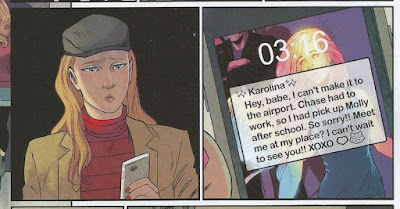
Although the cover promises lesbian romance, that's not the reason why I bought the issue. On the flip-through at the Phantom of the Attic, free plug, guys, I discovered Runaways features a special guest star that always makes a book better. No, it's not Tigra. I wish it were Tigra, but no. So, his presence catalyzed the extra purchase, but is the book good enough without it?

Runaways is well-written, humorous with a strong cast. The art is clean lifework benefitting from a gamut of color. The characters that interested me in Avengers Academy interest me in the new title. Although, I would have liked to seen Nico be more participatory. The single-spell witch impressed me in the far too short run of the all-female hero A-Force. Unfortunately, something happened to her to voluntarily negate her magic-use.

Julie Power acts more than just a girlfriend. Her guest appearance serves to help the Runaways become a more cohesive force for good, and youngest Runaway Molly Hayes is a hoot. Her interaction with Julie is some of the best, and I like that Julie doesn't act like a hypocrite. She and her brothers were a super-team, facing dangerous situations. She shouldn't curtail Molly's want for action, and she does not.

Although the cover promises lesbian romance, that's not the reason why I bought the issue. On the flip-through at the Phantom of the Attic, free plug, guys, I discovered Runaways features a special guest star that always makes a book better. No, it's not Tigra. I wish it were Tigra, but no. So, his presence catalyzed the extra purchase, but is the book good enough without it?

Runaways is well-written, humorous with a strong cast. The art is clean lifework benefitting from a gamut of color. The characters that interested me in Avengers Academy interest me in the new title. Although, I would have liked to seen Nico be more participatory. The single-spell witch impressed me in the far too short run of the all-female hero A-Force. Unfortunately, something happened to her to voluntarily negate her magic-use.


This issue of Monstro Mechanica is quite substantial. If you haven't followed the story. Leonardo da Vinci hired an apprentice named Isabella, and together they craft a primitive android. This machination isn't entirely fictional. Leonardo drew plans for an autonomous knight that modern scientists engineered.
Leonardo's support of a female apprentice is purely the idea of writer Paul Allor. Women were not held in such station despite the scandalous adoption of pants, which begins our chapter.

We take pants for granted, but in this day in age outside the golden site of civilization called Pittsburgh, idiots continue to force women to wear what they want. Not what she wants. The cretins of the world punish women for "inciting" male hormones. Since most of these wardens of purity are men, heaven forbid they punish the males for bad behavior and lack of control. No, that's just boys being boys. The problem lies in women, their comeliness and slutty fashion sense. A sincere fuck you all.

The pants are mere preamble however to the events of previous issue. Leonardo sent Isabella and his creation to rescue a vital Vatican supporter. Their energetic assault on the city also secured their favor in the Court of the Medicis. This results however in Alessandro's curfew and more.

The writing filled with dark humor matches the streamlined narrative of Chris Evenhuis. The war between the Medicis and the Vatican adds historical spice to the fiction.

Everybody wants Leonardo da Vinci to work for them, but he just wants out. In a beautifully bittersweet scene, Leonardo voices his desires plainly.
Isabella shows an interest in bettering herself and using her mind and body for something other than seeking out a husband and spitting out babies from her nether region. No, there's nothing wrong with that, but that's not the be all, end all to womanhood. Nor should it be. Monstro Mechanica is thus a feminist story, which should come as no surprise. Mary Shelley was a feminist.

Isabella respects Leonardo, but she also as previous issues detail prepares to thwart him if necessary. This created an antagonistic underpinning, but it seems that the cards are all on the table for this issue. The transparency in Isabella's hope for honest dealings instills more comedy to the affair, which is much needed since Leonardo's soldier is a blunt weapon. It's attacks brutal and jarring in this tableau of Renaissance beauty so ably rendered.
Leonardo's support of a female apprentice is purely the idea of writer Paul Allor. Women were not held in such station despite the scandalous adoption of pants, which begins our chapter.

We take pants for granted, but in this day in age outside the golden site of civilization called Pittsburgh, idiots continue to force women to wear what they want. Not what she wants. The cretins of the world punish women for "inciting" male hormones. Since most of these wardens of purity are men, heaven forbid they punish the males for bad behavior and lack of control. No, that's just boys being boys. The problem lies in women, their comeliness and slutty fashion sense. A sincere fuck you all.

The pants are mere preamble however to the events of previous issue. Leonardo sent Isabella and his creation to rescue a vital Vatican supporter. Their energetic assault on the city also secured their favor in the Court of the Medicis. This results however in Alessandro's curfew and more.

The writing filled with dark humor matches the streamlined narrative of Chris Evenhuis. The war between the Medicis and the Vatican adds historical spice to the fiction.

Everybody wants Leonardo da Vinci to work for them, but he just wants out. In a beautifully bittersweet scene, Leonardo voices his desires plainly.
Isabella shows an interest in bettering herself and using her mind and body for something other than seeking out a husband and spitting out babies from her nether region. No, there's nothing wrong with that, but that's not the be all, end all to womanhood. Nor should it be. Monstro Mechanica is thus a feminist story, which should come as no surprise. Mary Shelley was a feminist.

Isabella respects Leonardo, but she also as previous issues detail prepares to thwart him if necessary. This created an antagonistic underpinning, but it seems that the cards are all on the table for this issue. The transparency in Isabella's hope for honest dealings instills more comedy to the affair, which is much needed since Leonardo's soldier is a blunt weapon. It's attacks brutal and jarring in this tableau of Renaissance beauty so ably rendered.

Analog seems a lot like That Man Bolt. Fred Williamson portrayed a fully-bonded courier named Jefferson Bolt. That's what ordinarily named Jack McGuinness is in Analog. The difference lies in the setting.
Whereas Jefferson Bolt operated in the seventies, Jack works in a future where everybody's internet secrets have been exposed. So you get scenes with two people screwing in a car in broad daylight. However, the setting doesn't really differentiate Bolt and Jack. Thanks to Fred Williamson's performance as well as the more exciting execution, That Man Bolt is still better than Analog. I may be willing to try another issue, but unless it's spectacular, I'd rather re-watch That Man Bolt.
Whereas Jefferson Bolt operated in the seventies, Jack works in a future where everybody's internet secrets have been exposed. So you get scenes with two people screwing in a car in broad daylight. However, the setting doesn't really differentiate Bolt and Jack. Thanks to Fred Williamson's performance as well as the more exciting execution, That Man Bolt is still better than Analog. I may be willing to try another issue, but unless it's spectacular, I'd rather re-watch That Man Bolt.


