Wednesday, May 16, 2018

POBB May 9, 2018

Pick of the Brown Bag
May 9, 2018
by
Ray Tate

The Pick of the Brown Bag returns with reviews of The Green Hornet, Oblivion Song, Peter Parker Spectacular Spider-Man, Red Hood and the Outlaws, Rough Riders, Runaways, Savage Tales Vampirella and Unbeatable Squirrel Girl.  The POBB can also be found on Twitter: #PickoftheBrownBag.


Oblivion Song by Robert Kirkman intrigued me enough that I put it on my pull list.  The second issue was a flashback story, mostly, with foot rubs.  Nary could two issues be so different in tone.  

For the third, we’re back to exploring a monster-filled dimension with scientist Nathan Cole.  Nathan is also seeking his missing brother, but he never loses sight of his role in the greater scheme of things.


Suggesting that the monsters are just innocent animals despite their devouring human life is the kind of the thing a scientist would argue. Nathan jumps into this masterfully illustrated kaiju to rescue people trapped there not to execute the beasts.  


I also like how phenomenal artist Lorenzo De Filici emphasizes the Red Cross medical kit.  It’s a constant reminder that Nathan is here to help.

The Lone Ranger bids you an adios and disappears with a hearty “hi-ho silver.” Kirkman examines the consequences after the rescue.  Nathan and his team question whether or not he should be saving people that have lost their humanity to a horrible environment.


In this sense, Oblivion Song is actually like Terry Moore’s Motor Girl.  Kirkman accurately exposes the vagaries resulting from PTSD making it a thoughtful exercise amongst the monsters.

Kicking off the latest volume of Rough Riders, the legendary magician/escapist Harry Houdini uncovered a supernatural plot that threatened the world.  He called together his old comrades the Rough Riders: Monk Eastman, Annie Oakley, Jack Johnson, Thomas Edison and President Theodore Roosevelt to thwart the menace. 


It appears however that this was all a trap.  Roosevelt’s ancestor wronged an innocent person.  


In Baron Blood tradition, the spooks answer the curse put on the Roosevelt line.  Fortunately, the Roosevelts are notoriously tough, even tougher in the steampunk world of the Rough Riders.


Alice Roosevelt was Teddy Roosevelt’s only daughter.  Writer Adam Glass introduced her into the tale innocuously at her wedding.  She seemed to exist in the story to demonstrate strife between she and the President and add more historical context to the book in general.  Little did the reader know that Alice would play such an integral part in the current series.


Artist Pat Olliffe conjures Alice’s accurate likeness with the same skill he did and does for all of the Rough Riders.  He furthermore seems to relish cutting loose with turn of the century styled Iron Man suits, Evil Dead themed demons and demonic possession and a particularly explosive comeuppance for Thomas Edison, who betrayed the team in the first two volumes.  

I still think Nikola Tesla was beyond Edison.  I will always admire his genius more.  However, the historical Edison differs strongly from Glass’ schemer.  Look him up if you want the truth.  


Rough Riders is an action-packed horror story of excellent vintage.  In addition, as you can see by the scene above, the characters exhibit more heart this time around.  Unlike the flawed previous volume, I can recommend this entire series, and if Aftershock ever collects all three volumes in one nice hardback, the entirety would be well worth the price.


Savage Tales is the name of a classic black and white Marvel Magazine that featured such Robert E. Howard creations as Conan and Kull.  When Dynamite inherited Red Sonja from Marvel, they also acquired the Savage Tales title.  An odd acquisition since Savage Tales later became the home to Ka-Zar and Shanna the She-Devil.  So, it wasn’t as though Marvel was just using the magazine for licensed properties.

Literature’s first altruistic vampire headlines this Savage Tales one-shot.  Vampirella began her adventures in the sixties.  She since operated in the present day, of every era hence.  In Savage Tales, Vee is thrust into the Hyborean Age.

The story by Erik Burnham showcases Vee’s abilities while Anthony Marques and J. Bone, reminds readers that Vampirella is not for kids.  


Though Marques adheres to a cartoon style, the fullness of Vampirella’s figure is straight out of the spicy pulps.  Mind you.  Vee exudes dangerous curves.  She’s certainly not sylph-like.

Traditionally bards, authors and script writers treated vampires as the ultimate corruption or the ultimate sin.  As a result, vampires frequently preyed on children.  For example, Dracula feeds his brides with a freshly snatched baby.  At least that’s the presumption.  Stoker isn’t explicit, but the scene in Dracula was enough for filmmakers to fill in the blanks.

What better way to show Vee’s differences from the normal bloodsucker than to pair her with a child?  Wait.  I guess Vampirella is for kids after all.
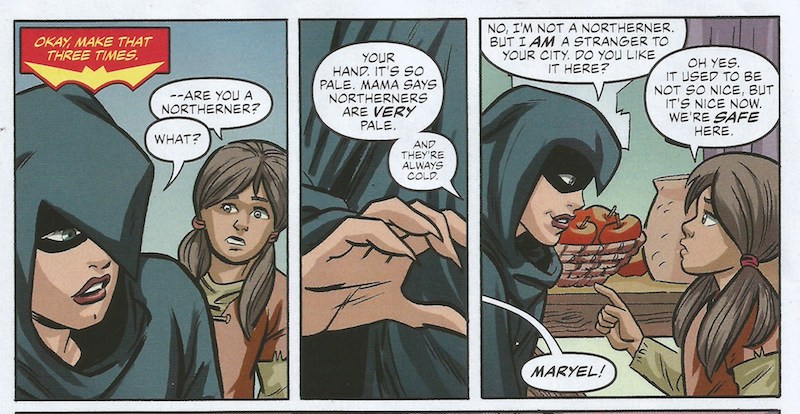

Fernando Ruiz provides the artwork for this chapter, and though in early scenes he depicts Vampirella as a hooded “Northerner” he gets the chance to strut his stuff when Vee discovers not the conductor of the danse macabre but at the very least a percussionist that’s styled as a Robert E. Howard villain.

Amusingly, Vampirella tries to eschew violent confrontation, but lucky for the reader, our Big Bad wouldn’t have it any other way.

The remainder of Savage Tales reprints a serial from the Dynamite vault called “Valaka.”  Valaka is not exactly Vampirella, but the artist took some license to depict her with the same dress sense and blood thirst.  Although, Vampirella usually feeds on blood from a bottle not a throat.


“Valaka” fits the definition of mostly harmless.  The warrior that teams up with Valaka is mostly forgettable if not for the anachronistic soul patch, memorable for all the wrong reasons.  

The story also features a double-edged sword of how to hide nudity.

The design of the woman’s hair is beyond bizarre, but that it should accidentally fall upon her breasts thus hiding her nipples is astounding.  


The whole point of the blood rite is to combine sexuality with violence.  That’s why a lot of the followers attend.  To see naked women bound and killed.  Hammer styled cults are evil.  Why on earth would a self-respecting High Priest allow such modesty?  


What’s weird is that the artist actually pulls off a really good hiding of the nudity by creating the depicted gutter break in the panels.  

“Valaka” is a passable story with a few notable scenes of vampire action.  Combine it with the better Vampirella tale at the forefront, and Savage Tales would be a good purchase from a bargain box.

Peter Parker the Spectacular Spider-Man, Peter’s maybe sister Teresa Durand and J.Jonah Jameson visited an alternate timeline to gain knowledge from the Tinkerer.  This in order to stave off an alien invasion in their home continuum.  Unwittingly Spidey changed that timeline’s future.  Young Peter Parker overheard his older self speaking of the tragedies in his life, and Peter wanted none of it.  So, Peter gave up the webs for good.  The timeline changed, naturally for the worse.


With Norman Osborne and Doc Ock in charge, the whole world seems at peril.  Fortunately, Spidey has an ally in Peter Parker.  Guess again.


Okay.  Fortunately, Peter has an ally in Gwen Stacy.


Yes.  Absolutely.  Once again, we have the two Amazing Spider-Man films with Andrew Garfield and Emma Stone to thank.  

Although the Marvel Adventures titles sharpened Gwen Stacy’s character, it wasn’t until Emma Stone’s rich performance as somebody best remembered as the girl that goes off the bridge that called forth a zeitgeist.  

A universal hatred of Gwen Stacy’s needless death killed a third film, allowed Marvel to buy back the rights to Spider-Man and evolved the creation of Spider-Gwen.

Scientist Gwen Stacy—just like Emma Stone’s essay—helps Spider-Man gain access to the resistance.  These heroes consist of exactly who you might think and reveal the fates of others.  The story also grants Jonah an epiphany.


The way Jonah phrases the tone of the alternate timeline neatly expresses what ephemeral qualities a Spider-Man gives to the world.  Before Deadpool, Spider-Man was the hero with all the wisecracks.  He’s the one who humiliated his opposition and brought hope to anybody who saw him swing through Manhattan skyline or crawl along the wall.  Spider-Man really is your friendly neighborhood hero.  While you could be saved by Thor, Cap or Iron Man.  Chances are it’s a Spider-Man that’s coming to your rescue.


Unbeatable Squirrel Girl gains a stellar new artist in user friendly illustrator Derek Charm.  Meanwhile, steadfast writer Ryan North advances Doreen Green’s and Nancy Whitehead’s vocations.


I don’t mind admitting that I found this entire explanation of binary involving The Library of Babel absolutely fascinating.  I wish somebody had explained binary to me in this way before.  Doreen’s course serves as a catalyst for a very naturally sounding off-tangent topic.


This gets Doreen thinking about Kraven the Hunter who serves as a frequent guest-star in Unbeatable Squirrel Girl. 

So for those of you not in the know, Kraven is one of the few Marvel antagonists that defy Marvel’s sliding-scale of time.  Everything in Marvel once occurred six to ten years ago.  You can use the same scale for the first cycle of James Bond films.  For example, James Bond ends with Pierce Brosnan.  Brosnan’s Bond met Honey Rider and experienced the events in Dr. No, ten years ago.  He fought the Roger Moore Bond villain Zorin six years ago.  The same applied to Marvel, but Kraven doesn’t work that way.  Kraven is a family.  The Kraven in Unbeatable Squirrel Girl is no fan of Spider-Man, but he’s not the same Kraven that buried Spider-Man alive in Kraven’s Last Hunt.  He can’t be.  This is also not the Kraven that humiliated Tigra.  Mind you.  Tigra’s presence among the Kraven clan appears to be indelible.

Squirrel Girl and Nancy want to keep Kraven on the straight and narrow.  So they feel that if they spend time with him outside of fighting crime, they’ll help him feel self-worth and become a better person.  Doreen is so determined to keep Kraven honest that she’s willing to give him knowledge of her greatest secret.


It’s absolutely charming that Doreen thinks that her identity is so carefully calculated when any fool should be able to figure it out because Doreen doesn’t wear a mask.  To that end, they invite Kraven to an Escape Room, and along with their other friends, they have a lark.


That is until our mysterious bandaged man learns that actual super-beings comprise the latest contestants.  Good job on concealing this fellow’s identity.  I haven’t a clue.  


Though I’m not a fan of Runaways I could not help grinning at the humor from this issue.  There’s a big joke involving Doctor Doom who’s on the cover so hardly a spoiler.  His interaction with the Runaways is unexpected, and writer Rainbow Rowell explains how this situation coalesced for those that came late to the story.  Rowell furthermore demonstrates that each Runaway possess certain skill sets that offset their juvenile and occasionally thoughtless behavior.  Visiting Julie Powers experiences the latter in spades, and the subplot involving Molly and a special cupcake blooms into something darkly funny.


Artist Kris Anka and his sometime inker Craig Yeung create entrancing body language for Doom, who was my original draw to the title.  Doom is just wildly entertaining in every element of the story.  His dialogue is brilliant.  His movement so watchable.  His function to the plot hilarious and surprising.

Mulan Kato is the newest Green Hornet.  She takes over the role when current Green Hornet Britt Reid disappears.  In truth, Britt has been working undercover to expose the new machinations of an old foe.


Britt comes from a wealthy family.  That wealth derives from a silver mine in the old west.  Heh.  The fact is only tangential to the story.  When Britt was a younger lad, before he founded The Daily Sentinel, he fell into a crowd that could nicely fulfill the dreams of conspiracists. 


These are the men behind the hostile takeover attempt at The Sentinel and the bombing of Britt’s friend Sebastian’s boat.  Home grown hero Oko makes a startling discovery.


Oko appeared the same time Britt disappeared.  It seemed like writer Amy Chu implied that perhaps this was indeed Britt Reid donning a different garb.  Chu quickly dispelled the notion.  I’m wondering if Oko connects to the Espada at all.

Oko appears to be framing the Green Hornet, but Mulan or Britt could have lost the hornet during the fight.  The Green Hornet gets the blame for numerous crimes.  Remember.  The Green Hornet pretends he’s a criminal.  This is an occupational hazard.


After an exciting chase executed perfectly by artist German Erramouspe, the Hornet and Kato induct Kato’s friend Tai into the fold.  Tai is a great character that provides comedy relief and a common person’s perspective.  

The television series emphasized that the Green Hornet and Kato were not ordinary men.  They never seemed to rest.  Their lives always filled with danger and speed.  The frantic speed of The Green Hornet matches the thrills of the television series.  

Red Hood and the Outlaws splits the trio up for a kind of anthology.  Jason Todd alias the Red Hood sets up the Penguin and meets with Faye Gunn, granddaughter of Ma Gunn.  A reformed criminal with a link to Jason’s past.  The portion is the least interesting of the three vignettes.  In terms of writing, Artemis takes the cake.  Scott Lobdell creates a very interesting and plausible scenario.  Artemis number one was a hit woman.


Number two, she worked for Lex Luthor.  Lobdell characterizes Lex Luthor and Artemis superbly.  You do not doubt this new continuity because of the characterization.


Lobdell established that Artemis was not entirely heroic.  He created a rivalry between she and Wonder Woman arising from her post-Crisis history.  You can see a twisted version of Wonder Woman in Artemis’ path.  

She’s no fan of Diana, and she would work to be the least like her without giving up a sense of honor.  Sword for hire suits that intent.  Aligning with Lex creates status and distinguishes her farther from the sterling Wonder Woman.

The old Lex is just the kind of guy that would get off on suborning a warrior woman.  It would exalt him to a level of prestige few men can attain.  

Originally, Lex Luthor was casually sexist.  He for example underestimated Supergirl because she was a girl.


In the post-Crisis, John Byrne sometimes focused on Luthor’s outright misogyny.  Lex Luthor tortured Lana Lang to force her to divulge Superman’s secrets.  A short Lex Luthor story depicted Byrne’s version of Indecent Proposal with a hint of Robert Louis Stevenson’s Mr. Hyde in Lex’s characterization.

While the New 52 hinted at Lex Luthor’s villainy, mostly Lex has been above board, albeit not exactly a white knight.  More of a mud blotched knight.  It’s that Lex Luthor that Artemis appeals to and that Lex Luthor that responds.


Lastly, while the ways in which Bizarro says goodbye to his failing intelligence peek one’s interest.  Dexter Soy is the star of the Bizarro portion of the tale.


His Bizarro looks like Christopher Reeves’ Superman.


Tuesday, May 8, 2018

POBB May 2, 2018

Pick of the Brown Bag
May 2, 2018
by
Ray Tate

Welcome to the Pick of the Brown Bag.  This week the POBB investigates Red Sonja, Infinity Countdown and the Avengers.  In addition, I’ll have a few, a very few words about Tom King’s Batman.  Not because it’s bad.  Perish the thought.  You simply can't discuss Batman without revealing all of the story.  Any hint says too much.  It’s a triple whammy of mum’s the word.

First I cover the new book from Rick Remender Death or Glory.  Oh, and should you lack the time for even a small Pick of the Brown Bag review, you can always get the gist on Twitter: #PickoftheBrownBag.


Ostensibly, Death or Glory is about a heist gone wrong.  This should be in my like column.  All writer Rick Remender demonstrates is the potential of Death or Glory.  That potential unfortunately occurs at the very end.  


Simply put.  This issue is not the heist I’m looking for.  The story begins with an utterly fascinating talk about anal sex that’s disgusting and gratuitous.


Let me be perfectly clear.  If consenting adults like anal sex, enjoy.  The way the two young men refer to anal sex precludes eroticism and degrades the woman in question.  That could be Remender’s point.  Honestly, though, I cannot see how this discussion improves the story.  It characterizes the first two men we meet as idiots.  The speech doesn't give them any dignity.


As the narrative continues, Remender introduces a psychopath with a method that’s straight from the Flash’s Rogues Gallery.  


 I'd rather be watching the Flash.

This villain appeared on the original Flash television series in a similar form that Remender uses.  So, no points for originality.


Remender then spotlights the protagonist Glory.  The title you see is a pun.  Let the record show that I love a good pun, but combined with everything else, the pun falls flat.

Glory looks scrumptious and badass simultaneously.  I first encountered Bengal’s art in Batgirl.  Decent illustrator with a somewhat anime leaning.  The art in Death or Glory is actually better than that.  So no complaints about the optics in Death or Glory.  We get an even better look at the title character in the next scene.


It’s Glory in all her glory!  How’s that for a pun? And the punchline to a limerick?  Anyway.  I like female nudity.  Who doesn’t?  This scenario however is just silly.  Glory decides to get out of the tub, allowing for an ass shot.  Oh, wait.  Anal sex.  Ass.  Is it a motif? No.  She’s naked staring at a red box.  Note the obvious dramatic colors.  The contrast is just emblazoning juicy importance to that box.  


It’s a gun.  Right.  Spoilers and everything.  Nah.  

The impact of the reveal isn’t quite as powerful as Remender hoped.  Glory’s got a gun.  Big deal.  My objections.  Glory keeps the gun on the vanity near her perfume in the bathroom.  She also likes to pose with the gun like a naked Travis Bickle.  I want to see myself naked with a gun.  Who does that?  That’s insane. 

This is what I’m getting from the scene.  Remender really wanted to show Glory naked.  Nothing wrong with that.  It’s a mature audience book you should have expected something naughty.  He also wanted to advertise that Glory got a gun for the heist.  Why he combined the two baffles me.

He didn’t need to put the gun in the bathroom as an excuse for Glory to get up from the tub starkers.  There's no logic in it.  To get Glory naked, he could have put in a sex scene.  Could have just bared her like a jaybird in the shower or the bath as an apology for the bad movie in which you are about to partake.  He could have put a vibrator in the box instead of a gun and let Glory have at it.  That would have made more sense.  

It would have been better for everybody had Remender simply eliminated the moment.  Opting instead to show Glory fully clothed taking the box out from a hiding place in her garage.  Also making much more sense.

Oh, and here’s a little secret.  Remender and Bengal don’t actually have the courage to show you anything more beyond a crack in the butt.  No nipples.  No nether regions. Yeah! She's sort of naked with a gun. Yeah!  Any supposed gutsiness of the intent is an illusion.  Dumb.  Absurd.  Mind-blowing in the worst possible way.  

Once we get out of this chain of allegedly adult material, Glory eventually clashes against the Big Bad and his organization.  This includes the psychopath from the diner.


Setting and structure now becomes a cross between the excellent Jackie Brown and the amazing television series Banshee.  Notice the Amish women standing in silence.  You would in fact enrich your life gentle reader if you invested the time wasted on Death or Glory in Jackie Brown and/or Banshee.  You can also pick up some Elmore Leonard from your local library.  Jackie Brown is based on Leonard's Rum Punch.

The crooked cops delivering the money soon encounter Glory, and this is the only part of the story I found marginally interesting.  Glory is taking the smash-and-grab technique on the road.  

Remender and Bengal characterize her superbly as a skilled driver who prepares for resistance.  That makes the subsequent snafu all that more depressing.  


She fortified the car, but she didn’t bring a bullet proof vest.  There’s Blood Simple, then there’s Blood Stupid.  Glory proves to follow the latter.

Half of Death or Glory could have been dropped because Remender is really just juggling tropes and traditions from old pulp novels updated for magazine capacity.  He should have eliminated the useless material in the diner and opened the book at Glory's garage.  He should have dumped the nude gun expo, hop to the uneventful scene in the bar that lays out some exposition and speed to the meat of the story.  We're more focused on the money in the attache, the smash and grab that goes wrong and the surprise at the cliffhanger.  That's a leaner narrative with a rapid pace.  The method of the psychopath though derivative would have been more shocking without a prologue.  The lack of protective armor still inane but at least quickly glossed over.  The end result would have been a flawed but better heist.


When Amy Chu began her run of Red Sonja, the She-Devil with a Sword fought Khulan Gath on behalf of the Meruvians.  Sonja appeared to score a decisive victory.  Gath pulled a rabbit out his towering hat.  He sent himself and Sonja forward in time.


In the present, Red Sonja adapted.  She demonstrated her intellect in addition to her battle prowess.


Sonja made pacts, friendships and allies.  One of those colleagues now accompanies her back to the past.  His name is Professor Wallace, and he dabbles in magic.  


Sonja's want to return home arises from rescuing Sir Max from the clutches of Khulan Gath, still very much alive and seated back where he belongs.  Sir Max is in fact a police officer she bonded with in the present.  He spoke her language.  He also demonstrated a certain amount of sorcerous aptitude.  Here now, we continue the story with writer Eric Birnbaum riding shotgun.

The story starts in the middle of battle against Khulan Gath's minions.  Bengal depicts Glory sort of nude in Remender's latest.  Despite retaining her chainmail bikini, Sonja under the auspices of artist Carlos Gomez is sexier and fiercer.


Even without the sword, I'd be terrified of Red Sonja.  Not to mention awed by her pulchritude.  

Wallace creates a special trick that becomes the center of the tale.  He's been performing this bit of magic since his entrance.  The difference lies in his utilization of a certain source.  With the addition, Wallace's trickery backfires in a spectacular way.


Can this be the end of Red Sonja? Perhaps.  With her capture, Gath decides to play with his food.  He sticks Sonja in an arena and pits her against a foe that may be her match.


So, you may have heard about the latest movie from Marvel called Avengers Infinity War.  If you haven’t, welcome to earth.

Most people know the Avengers consist of Iron Man, Captain America, Thor, The Hulk, Black Widow and Hawkeye,  Some may know that they added to the roster Black Panther, Spider-Man, the Vision and Scarlet Witch.  If you’re really into the films, you can also chalk up the Falcon and Ant-man.  That’s not actually the case in comics.


The original Avengers disbanded in issue sixteen.  Captain America formed a new team out of three villains who sought to reform: Scarlet Witch, Quicksilver and Hawkeye.  Since then, the Avengers roster grows, shrinks and changes at the whim of the writer.

For the latest iteration of the crew Jason Aaron takes over the keyboard.  Ed McGuinness supplies the artwork.   The change in the creative team this time around was so monumental that the Powers That Be at Marvel decided to renumber the book with a brand new number one.  

Actually, the Powers have a point.  Brian Bendis left Marvel for DC.  Bendis wrote a helluva lot of Avengers stories under various banners like New Avengers, The Mighty Avengers and Skrullvengers. It was really called Secret Invasion, but I like my title better.  What Bendis didn’t write, he influenced, either by amending the continuity, forcing writers to dig out of the holes he formed or embracing the new status quo.  Starting a new volume with a new number one stands out, and after Bendis, this title does need to stand.

Of course, had Marvel just given the book to scribe A. Schmoe and artist N.O. Talent renumbering would be a futile tactic.  Jason Aaron just finished a memorable, historic volume of The Mighty Thor.  Ed McGuinness cut his teeth on Vampirella, where I became a fan.  He’s better known for Superman.  


On Superman, McGuinness morphed his style of anatomy to a balloony look that didn’t appeal to me.  I’m happy to say that he’s reverted back to his svelter, leaner figures.


With the behind the scenes shifts comes a shift in the lineup.  The present day story begins with Iron Man, Captain America and Thor reuniting and commiserating.


Aaron handles the exposition well in this scene.  I only vaguely know what happened to Captain America.  I didn’t know anything about Iron Man’s condition, and though I follow Thor, Aaron turns the knowledge I already amassed into meaningful dialogue that suits the God of Thunder.  Adopting a very Hemsworth like tone in the process.

It’s not long before talk about re-establishing the Avengers occurs.  Tony is the least interested, but events make the trio of friends and heroes creating a fold to return to inevitable.


You can argue that Aaron and McGuinness cynically attempt to cash in on the success of Marvel cinema.  I’m not certain that argument is valid, especially given Aaron’s and McGuinness’ plot.

Captain Marvel’s about the only space hero I can think of with enough power to deal with the Jack Kirby inspired situation.  She’s been associated with the Avengers for a long time.  It furthermore looks like Aaron ignores her participation in some controversial garbage, which to me is a good thing.  Keep Carol a straight up space champion.


As far as I know, Dr. Strange has never been an Avenger, but he’s certainly worked with them before.  Aaron’s familiarity with the character may be comfort food.  Strange’s team up with Black Panther makes sense when factoring in the legacy aspect of the tale.

She-Hulk was a former West Coast Avenger.  In terms of participation for the issue, she gets the short shrift.  Her reintroduction in Avengers is the most self-contained, and she only acts as an observer.  This will hopefully change next time.

Ghost Rider is the most surprising addition to the cast.  Ghost Rider never rode with the Avengers, apart from a guest spot here and there.  Ghost Rider however has many avatars.  

The 1940s Blazing Skull, one such visual reference, appeared in The Avengers famous “Kree-Skrull War.”  An incarnation of the original gunslinging Ghost Rider from the Old West became associated with the West Coast Avengers.  The latest version of Ghost Rider Robbie Reyes is better known for his timely interventions in Agents of SHIELD.  


That guesting occurred last season.  So, you really can’t accuse Aaron and McGuiness of a sort of media nepotism.  Ghost Rider’s inclusion is quite novel, and rest of the role call are Avengers through and through.  The story itself is a serviceable means for the Avengers to unite and a terrific springboard for McGuinness to ply his skill.  Definitely something to consider.


Infinity Countdown finally branches away from the Guardians of the Galaxy by opening the current issue with Ultron attempting to assimilate the Silver Surfer.


Under normal circumstances, this shouldn’t be possible.  Ultron’s formidable, but the Surfer possesses the Power Cosmic.  His shape forged by Galactus.  Ultron however wields an Infinity Stone.


So for the first time since a fateful encounter with Doctor Doom, the Surfer is actually in real danger.  Fortunately, and I cannot believe I'm saying this, Adam Warlock is here. 


I remember golden boy as more of a thinker than a doer.  He was apt to chat with Thanos and broker a philosophical debate rather than flex his muscles.  As you can see in the depiction above, this Adam Warlock takes names.  

Writer Gerry Duggan also turns something the Warlock's progenitors set up into a superpower.  Warlock is an artificial human being initiated by a group of Lee/Kirby mad scientists dubbed the Enclave.  Think of them as a proto-Cadmus.  That origin is long forgotten.  Roy Thomas associated Warlock with the High Evolutionary, and Jim Starlin turned him into a star child.  Duggan appears to meld all of these forms into one badass new incarnation.


Holy Crap!  Warlock doesn't shed a tear once in this story.  Not one time.  If Duggan can make Adam Warlock as fascinating as the Guardians of the Galaxy, you better believe I'm going to recommend Infinity Countdown.


Wait, there's still more.  The Guardians of the Galaxy fight to protect the Nova Corps.  They face the Chitarri and engage an uneasy truce with the Darkhawks.  The truce results from the relationship between one of the Novas and one of the Darkhawks.  That relationship gives Peter Quill a way out of the situation, and brings the chapter to a close in an unexpected, spectacular way.


The Girl


The Gold Boob


And Everything

Without divulging anything that happened, suffice to say that Booster Gold's gift to Batman keeps on giving.  One of the more interesting things to note this issue is how writer Tom King inverts everything he's done.  

Selina and Batman sometimes need not talk.  They're so in synch that one knows what the other is thinking.  You can witness this in "I am Suicide" and "I am Bane."

Selina is sometimes so taciturn that she jokingly meows like a cat.  The weird thing is that Batman understands everything in that onomatopoeia.  Selina also uses the catcalls along with purrs in the art of seduction as seen in the spectacular couplet "Super-Friends."  

The meows in the current issue of Batman signify something else.  Booster Gold believes he's so in tune with Catwoman that he can read her thoughts, just like Batman.  Nothing can be farther from the truth.  Booster Gold blows it big time.

Tony S. Daniel accompanies Booster on this journey, and his sexiful illustrations of Catwoman contrast the spurts of realistically rendered violence, that's never the less over the top due to the subject.