Pick of the Brown Bag
November 7, 2018
by
Ray Tate

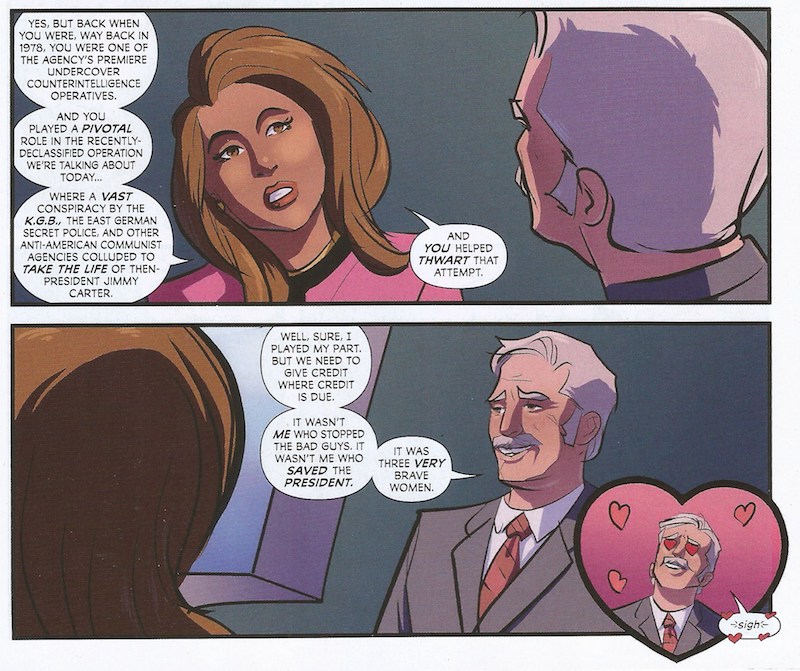
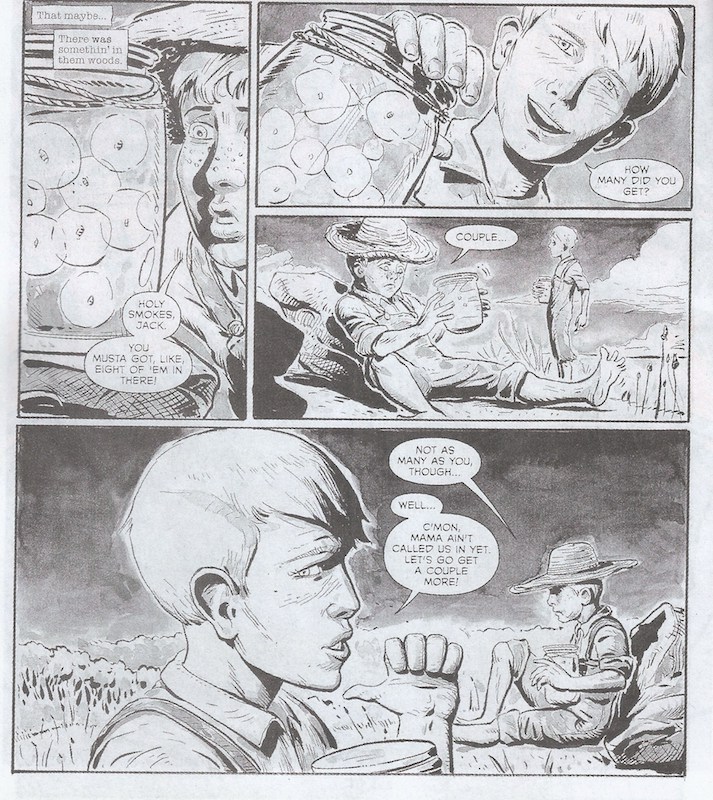
Every time you read about Spider-Man punching a goblin in the face. Every time you become engrossed in the Fantastic Four's latest escapade. Every moment you spend with the X-Men or thrill to the Avengers is due to Stan Lee. Stan Lee died at the age of 95, but he's not really dead. He lives on through his creations.

Welcome! You've found the Pick of the Brown Bag. My name is Ray Tate, and I review comic books. My current subjects consist of Batman, Immortal Hulk, James Bond, Sparrowhawk, The Wrong Earth, X-23 and X-Men Red. First a review of Outer Darkness a brand new book from John Layman and Afu Chan. As always should these reviews be too taxing, you can always pop over to Twitter: #PickoftheBrownBag.

Welcome! You've found the Pick of the Brown Bag. My name is Ray Tate, and I review comic books. My current subjects consist of Batman, Immortal Hulk, James Bond, Sparrowhawk, The Wrong Earth, X-23 and X-Men Red. First a review of Outer Darkness a brand new book from John Layman and Afu Chan. As always should these reviews be too taxing, you can always pop over to Twitter: #PickoftheBrownBag.

Outer Darkness combines the supernatural with science fiction. So does Legends of Tomorrow, but in Outer Darkness the genres blend instead of orbit. The story begins with an introduction to First Officer Joshua Rigg and the crew of an anonymous starship experiencing possession in the first degree.

This hazard catalyzes a conflict between the volatile Rigg and the Captain, who thanks to Chan bears the vim an vigor of a lovely Disney-type cartoon figure.

No mutiny goes over well. The narrative jumps ahead where we find Josh and his shipmate Agwe in dire straits until Layman’s Star Trek love goes into warp.

Captain Christopher Pike in the form of Siddarth a Sikh with Admiral rank offers Rigg a promotion and a way off the hook. Of course, the differences between the Federation and this conglomeration are stark. Pike intended for Kirk to achieve his potential. I'm not sure that Siddarth's ideals are so high minded, especially given this universe's reliance in the occult.

Rigg nevertheless acquiesces. He and Agwe soon embark to The Charon. I really love the hand-drawn star ships in Outer Darkness. The painstaking illustration helps to create a unique, organic, consistent aesthetic.

The remainder of the tale introduces some of The Charon’s diverse crew and further demonstrates the theme of supernatural/science fiction integration. Layman and Chu exemplify the latter with a peculiar variation of the Warp Drive and a decidedly adversarial relationship between the newly appointed Captain Rigg and The Charon's "artificial" intelligence.

For Sparrowhawk, writer Delilah Dawson and artist Matias Basla with candy-coat colorist Rebecca Nalty entice the reader back to the faerie tales of Europe. Like the amalgam of children’s fables, Sparrowhawk combines numerous regional spirits into a vast realm dangerous and ripe for exploration.
In the debut Dawson and Basla introduced Artemisia a child born outside of wedlock but due to her father one of the peerage. Artemisia exhibits a thirst for knowledge and freedom beyond the social mores of the kingdom. Alas, her stepmother blackmails her into a marriage of state. Before the nuptials can begin one of the Faerie folk appears out of a mirror and pulls Artemisia into a magical domain.

In Faerie, Artemisia meets a beast called Crispin who becomes her mentor, at a price. She sacrifices a memory, and it's not as Crispin claims a small one. under Crispin's tutelage, she next encounters and kills a giant. As a result Artemisia undergoes metamorphosis.

Strange, painful but apparently benign. Not so the legendary Wild Hunt to which her first killing belonged. Thus, Artemisia becomes prey.
Here lies my only caveat for an otherwise above average fairy tale comic. Artemisia escapes the Hunt too easily. Throughout mythology, the Hunt is remarkable when it comes to tracking down and killing its quarry. I also find it hilarious that after thwarting the Hunt, which even if possible should be an exhausting exercise, Artemisia slows to a cheerful amble. On this pleasant stroll, Artemisia learns Crispin—surprise, surprise—isn’t on the up and up.
Here lies my only caveat for an otherwise above average fairy tale comic. Artemisia escapes the Hunt too easily. Throughout mythology, the Hunt is remarkable when it comes to tracking down and killing its quarry. I also find it hilarious that after thwarting the Hunt, which even if possible should be an exhausting exercise, Artemisia slows to a cheerful amble. On this pleasant stroll, Artemisia learns Crispin—surprise, surprise—isn’t on the up and up.

She discovers the facts through an encounter with Warren, the son of the Faerie Queen. He’s a bit emo, but can step up when he wants.

As Artemisia furthers her trek she discovers more inhabitants of Faerie and makes more fateful decisions. Crispin increasingly becomes lustful for blood and violence, and he seems to desire that Artemisia become more Faerie for unknown reasons. In any event, Sparrowhawk isn't a dismissible fantasy. It packs a wallop in morality through an engaging character struggling to become her future self.

Mirrors also served as portals in The Wrong Earth. All those who popped across worlds and encountered doppelgängers seem to know about the mirrors, but Number Two, henchwench of classy Dragonflyman rogue Number One, hashes it out especially well.

The minions' outfits nod to The Prisoner. The tailor-seat visual is a callback to Batman when Lesley Gore guest-starred as Catwoman's little kitten Pussycat.
There's only one Number Two on the proper earth. The One from the darker world flew solo or killed his Number Two long ago. The Ones of which there are two contrast drastically. As do the Dragonflies.
Previously, I suggested that little difference existed between the different versions of Dragonfly. This issue, writer Tom Peyer strongly defines the alternates.
Previously, I suggested that little difference existed between the different versions of Dragonfly. This issue, writer Tom Peyer strongly defines the alternates.

Dragonflyman comes off looking better by comparison. The other Dragonfly takes extreme action against a comparatively harmless kook just to cut to the chase.
That said. Lots of things in both earths are askew. On light fm earth, the law is an idiot.

Sure, Two helped Dragonflyman’s partner Stinger. That humanity should be taken into consideration, but the complete expungement of charges leans too much in Two’s favor, and her goofy appeal should only work on a none too serious television series.

The lion’s share of the story focuses on Dragonflyman’s reactions to the darkness of a world that’s a little too similar to our own. The camp veneer dissolves leaving behind a man that feels deep sorrow for this terrible place and its people. He breaks down when confronting the fate of his partner on the dark earth. He tries to help only to be often rebuffed. His prisoners mock him, but Dragonflyman is neither guileless nor inept at crimefighting. He is definitely a hero and distinguishable not only from Dragonfly but also Adam West's Batman.
Writer Paul Constant and artist Frank Cammuso offer up another Stinger backup story.
Writer Paul Constant and artist Frank Cammuso offer up another Stinger backup story.

This one is a little more complex with a sound observation by Stinger that helps him solve the case. Prose pieces by Matt Brady, Rob Staeger and Carol Lay round off the page count.

Tom King presents his first solo Penguin story in Batman. As he did with Catwoman, King suggests that all versions of the fowl fiend are valid.

Most readers are more familiar with Chuck Dixon’s nineties rethink of the Penguin. He turned the master of lethal umbrella-themed thievery into a practical fence and legitimate nightclub owner.
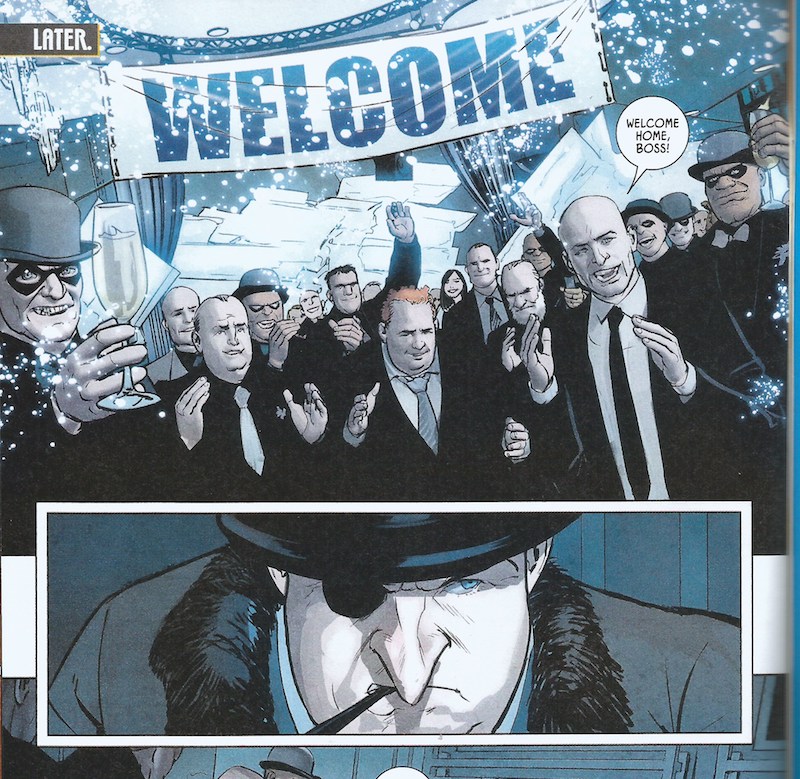
By filling a niche, Dixon saved the Penguin from comic book death numerous times. DC recently attempted to replace the Penguin twice, and failed miserably. Gotham City needs a true Penguin, not an Emperor Penguin or a Penguin Jr.
King’s story lends sympathy to the Penguin in ways that few others have. It turns out that Penguin has a loved one that meets an untimely demise.

That loss is a stone in water, creating ripples. One of those ripples pulses a tactical error in the master manipulator’s plan. Another reveals the root of Mr. Freeze’s trial. A third endangers another of Batman’s family, and and the fourth forges an unexpected alliance.
Throughout the Penguin remains ever proud, dangerous, erudite and canny. Mikel Janin chooses to eschew the monstrous image Tim Burton and Danny Devito created for a more tempered, realistic figure.

The cover to Immortal Hulk pretty much telegraphs what happened after the Avengers corralled the Green Goliath, and quite frankly, this book is disgusting. Albeit in a good way. The severely wet imagery by Joe Bennett, once known more for his babes, is a fine addition to the sub-genre known as body horror. At the same time this book is darkly humorous, with the decapitated Hulk grinning like a maniac. Physics just falls apart for a weirdly happy ending that subsumes the bad guy’s hold over the Jade Giant. I can’t really say more without giving away the game. Suffice to say, we haven’t seen the last of the whole Hulk.

The done-in-one X-23 subtracts two to become 21 Jump Street. Laura and Gabby insinuate themselves in grade school: Gabby the student, Laura the coach. They seek yet another science mad out to do research in cloning using Laura’s DNA. Mariko Tamaki’s story is filled with comedy such as Gabby fleshing out her false identity beyond necessary and Laura throwing herself into her role. Somehow the case ends up with X-23 and Honey Badger fighting a giant robot.

Nevertheless this is a fair play mystery. If you follow the clues and the detectives, you’ll be able to deduce the answer.
Georges Duarte and Chris O’Halloran substitute for series artist Juann Cabal.
Georges Duarte and Chris O’Halloran substitute for series artist Juann Cabal.

Duarte brings a different look to the book that still fits the sisters and facilitates body language and action. Duarte’s depictions of little kids is particularly impressive,

This should be the penultimate issue of X-Men Red’s battle against the Big Bad. Our mystery guest refuses to give up after being literally smacked down by a Storm induced tidal wave and bamboozled by Jean to con the safety of the Big Bad's hostage. The X-Men furthermore uncovered and exposed her masterplan to the world. So the Big Bad's fomenting of fake news starts to erode.

Not really Jean. This issue reminds me a lot of the final act in Batman Returns. Batman defeats the Penguin at each turn by being ten steps ahead of him, and in the end Penguin finally opts for an explosive, blunt conclusion. The Big Bad’s attempt to impersonate Jean and try to recoup the smear campaign is an act of evil desperation. Needless to say, Jean’s tactics like Batman’s are fare more elegant.

Writer Tom Taylor’s solution is utterly brilliant, integral to X-Men continuity but also widely known by anybody who has seen an X-Men film. Jean furthermore calls the cavalry before a rousing promise of an end.

James Bond returns in a new series by Greg Pak, Marc Laming and Triona Farrell that features the son of Oddjob. Ian Fleming introduced Oddjob in the novel Goldfinger. When filmmakers adapted the novel, they changed a few things. American athlete Harold Sakata portrayed Oddjob. A Hawaiian, Sakata’s ancestry was Japanese. So, became Oddjob. Sakata was a human being and a fairly handsome fellow. So, became Oddjob, and it is this Oddjob that sired a charismatic son, created by Pak and Laming.

Bond meets Oddjob Jr. at the Baccarat tables, but soon their interests cohere and then collide.

The language of Bond is action, and Laming does not disappoint. I’m sure Pak detailed some of the fighting in the script, but the lion’s share of credit can be given to Laming. The book opens with Oddjob Jr. energetically taking care of riffraff opposition. This dusting includes his father’s signature move in novel and film.

Oddjob and Bond team up to rid the world of more ne’er do wells before finally sizing each other up in a battle royal that leaves both men bruised and battered. Oddjob though is an unknown quantity. So, Bond isn’t out to kill although licensed to do so.