Pick of the Brown Bag
April 3, 2019
by
Ray Tate
Salutations, Buckaroos. My name is Ray Tate. I’m the creator and writer of the Pick of the Brown Bag, a weekly review blog. Here, I look at best and the worst comic books. For this entry I reveal the merits of...The Adventures of the Super-Sons, Bronze Age Boogie, Chandra, Immortal Hulk, Marvel Team-Up, Red Sonja, The Six Million Dollar Man and Spider-Gwen: Ghost Spider. If you haven’t the time for the entirety, look me up on Twitter: #PickoftheBrownBag

The Hulk and Doc Samson investigate the last known whereabouts of Shadow Base.

Shadow Base is run by a general dick named Fortean. The Base is a clandestine government operation. It aims to weaponize the gamma irradiated through the most repellent means.

The personnel of course long vacated the premises. Instead of clues, our green team find here be monsters.

Artist Joe Bennett beautifully depicts a kaiju styled monster mash. His unlovely opponents clash, and the Hulk's dispatch alludes to a classic Godzilla film.
These attributes should be enough to warrant purchase, yet there's more. The story’s narrator is the deceased Rick Jones.

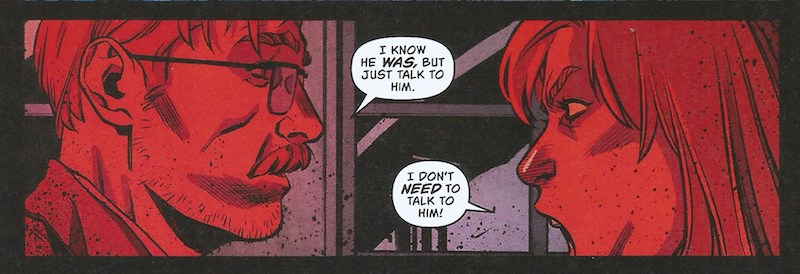
Rick makes a startling insight mirroring that of writer Al Ewing. Bruce Banner died the moment he first transformed into the Hulk. In other words, in Ewing’s philosophy, the Hulk’s immortality always was a given, just waiting to be revealed.
Through Rick Jones' words, the reader discovers one of the kindest individuals in the Marvel Universe. Consumed by guilt, Rick sticks by Doc Banner and the Hulk. He seeks to atone for his cursing Bruce, and even when abused by the Hulk, he can only think of Bruce's safety. Rick's thoughts and feelings make the cover to Immortal Hulk all that more affecting.
Through Rick Jones' words, the reader discovers one of the kindest individuals in the Marvel Universe. Consumed by guilt, Rick sticks by Doc Banner and the Hulk. He seeks to atone for his cursing Bruce, and even when abused by the Hulk, he can only think of Bruce's safety. Rick's thoughts and feelings make the cover to Immortal Hulk all that more affecting.

Gwen Stacy bitten by a radioactive spider, gifted with arachnid powers and hounded by the guilt of failing to save her best friend Peter Parker became Spider-Woman. A series of events, not the least one being jail, cut short her superhero life. Gwen served her time. The whole world knows Gwen Stacy is Spider-Gwen, Spider-Woman, Ghost Spider.
The premise hasn’t moved an iota. Writer Seanan McGuire is content to let Gwen feel her way to a new status quo. Simultaneously, McGuire appears to be building to something big involving the symbiotic suit Spider-Gwen wears. Venom already took over Gwen in a previous volume, but McGuire seems to be working toward something fresh.

Gwen attempts to date Harry Osborn, in this universe a swell guy. When he takes her to a nice restaurant, Gwen discovers a surprising bias. She swings off humiliated and in no mood for romance.

McGuire however doesn’t play the scene for melodramatic nonsense. The date continues at a much friendlier venue, later in the tale.

McGuire however doesn’t play the scene for melodramatic nonsense. The date continues at a much friendlier venue, later in the tale.
In the meanwhile, Gwen makes ends meet by selling her services for unusual jobs that only she can fulfill. McGuire comes up with some clever possibilities. The best being the scientist in need.

Betty Brant, a guitarist for the Mary Janes, and one of Gwen’s friends set her up with a business site. The cops use this social media connection to page Gwen, and she finds herself in the midst of a life-saving situation filled with tension and intricate breakdowns of what must be done to save lives.

Ghost-Spider relates another day in the life of Spider-Gwen, and the reader benefits immensely.

Ghost-Spider relates another day in the life of Spider-Gwen, and the reader benefits immensely.

The newest incarnation of Marvel Team-Up brings Ms. Marvel and Spider-Man together. It’s in fact a flip-book that relates Eve Ewing’s story from two different points of view. No prizes, seriously no prizes, for guessing the two narrative viewpoints.

Spider-Man and Ms. Marvel collide on the Empire State University campus where Peter Parker's friend Dr. Rosario is giving a lecture. Rosario specifically asked Peter to introduce her. The faculty at ESU begrudgingly acquiesced.

I’m out of touch with Spider-Man. This is where I just have to take things for granted. According to the ESU, Peter committed plagiarism, and they rescinded his degree. Rosario nevertheless treats Pete with warmth and kindness. On some level, she must believe in him and respect his accomplishments.
Rosario is the genius behind a mental-transference device, the subject of the lecture. Enter the Jackal.
Rosario is the genius behind a mental-transference device, the subject of the lecture. Enter the Jackal.

The Jackal is a whack-job ESU biology professor named Miles Warren. Warren was so in love with Gwen Stacy that he cloned her. Thus, the Jackal unwittingly triggered the multiple clone sagas that plagued the Spider-Man titles for years.

There’s no really good explanation as to why he turned himself green and furry, nor why security let him in. Perhaps, he's still tenured.
Happily, no clones back up the Jackal. The vernal villain naturally sees Rosario’s device as a means to better his technique. So, this is prep-work before stirring up a new batch. Stop him now!

There’s no really good explanation as to why he turned himself green and furry, nor why security let him in. Perhaps, he's still tenured.
Happily, no clones back up the Jackal. The vernal villain naturally sees Rosario’s device as a means to better his technique. So, this is prep-work before stirring up a new batch. Stop him now!

Marvel Team-Up presents a promising first issue filled with superhero antic. The flip gimmick is a pretty good one, and the Jackal actually harbors a good reason to attempt the crime. Though...I mean honestly. Does he have a Jackal-mobile? Did he take a campus bus? Did not one student notice a furry, dude in the seat next to him? Does he still teach at ESU? Do students look at him scratching his neck with his foot and say, "Oh, hi, Professor Warren. Is it all right if my term paper is a little late?"

Chandra is the star of a Magic The Gathering tie-in. I know beans about Magic. Nevertheless, having never picked up a card, I still enjoyed this book. So much that I put it on my subscription list.
Despite the fantasy setting, Chandra's more like Supergirl rather than Morgan Le Fey. She's a young, fire-casting superhero that travels the realms and deals with trouble. That's really it. I mean. With the exception of The Immortal Hulk, superhero books don't exactly reinvent the wheel.
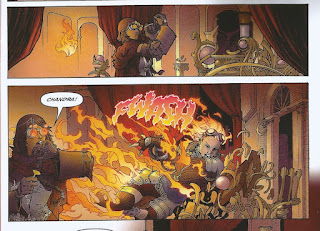
Vita Ayala however does give Chandra support through her mom. Ayla is savvy enough to make mom more than an extension of Chandra. She's got her own life, status and appears to also be an inventor. Chandra's mom is kind of like actress/scientist Hedy Lamarr.
After a power-nap, Chandra runs into abductors of falcon royalty.

Next, she's fighting Ice Ghosts. I'm sure these creatures mean a lot more to Magic players. However, such is the design and the concept that you don't really need background knowledge.

The centerpiece of Chandra's second issue occurs when Tybalt shows up.

Nope. Don't know who he is either, but you can just smell the trickster on him.

Shakespeare created the original Tybalt. He briefly bows onto stage as Juliet's cousin before ending up skewered by Romeo. Tybalt murdered Romeo's friend Mercutio. Oh, sorry. Spoiler Warning and all that.
Tybalt in Chandra is an emotional vampire. He feeds on misery. So, he not only physically attacks Chandra but also mentally abuses the champion with reminders of her failures. Some of which he catalyzed.

What can I say? I like super-heroes. Tough, female characters and gorgeous artwork. Chandra checks all the boxes.
Despite the fantasy setting, Chandra's more like Supergirl rather than Morgan Le Fey. She's a young, fire-casting superhero that travels the realms and deals with trouble. That's really it. I mean. With the exception of The Immortal Hulk, superhero books don't exactly reinvent the wheel.

Vita Ayala however does give Chandra support through her mom. Ayla is savvy enough to make mom more than an extension of Chandra. She's got her own life, status and appears to also be an inventor. Chandra's mom is kind of like actress/scientist Hedy Lamarr.
After a power-nap, Chandra runs into abductors of falcon royalty.

Next, she's fighting Ice Ghosts. I'm sure these creatures mean a lot more to Magic players. However, such is the design and the concept that you don't really need background knowledge.

The centerpiece of Chandra's second issue occurs when Tybalt shows up.

Nope. Don't know who he is either, but you can just smell the trickster on him.

Shakespeare created the original Tybalt. He briefly bows onto stage as Juliet's cousin before ending up skewered by Romeo. Tybalt murdered Romeo's friend Mercutio. Oh, sorry. Spoiler Warning and all that.
Tybalt in Chandra is an emotional vampire. He feeds on misery. So, he not only physically attacks Chandra but also mentally abuses the champion with reminders of her failures. Some of which he catalyzed.

What can I say? I like super-heroes. Tough, female characters and gorgeous artwork. Chandra checks all the boxes.

Mark Russell's Red Sonja is Xena Warrior Princess meets Duck Soup. Mind you. The Emperor, Dragan the Magnificent, is a very venal version of Groucho's lovable pest Rufus T. Firefly. The Emperor seeks Sonja's land of Hyrkania, and the newly appointed Queen Sonja simply sees no reason to give him the deed. This creates conflict and sets Dragan against a foe he's never encountered before.

The famed warrior Domo trained this version of Red Sonja, and the lessons she learned draw easily from the recesses of her mind when determining the strategy to thwart Dragan. Last issue, she sent her thieves including her cousin Kyron to steal Dragon's coffers. Kyron returns with great news.

The theft proves to be a personal consternation to Dragan. At that point, Russell switches the scene to the Empire where Dragan's son and wife rule. You can sort of see what's coming down the road for Dragan. It's likely been Sonja's plan all along.
As Sonja gains ground against Dragan, a new player enters the story offering his services.

Now, Red Sonja becomes an back-hand version of Yojimbo. Although, the protagonist in those films becomes a wannabe antagonist in Red Sonja. He also lacks the lone samurai's cunning.
Russell's story and the presentation by artists Mirko Collack and Bob Q is largely comical, but the bloody consequences of war soon arise. Russell also generates emotion through Sonja's discovery of newfound family. Traditional fans may find this newest addition superfluous or worse, but those fans should be reminded that they're not really reading the Robert E. Howard version of Red Sonja in the first place. For those that believe Red Sonja is a model of feminism, I concur with that, Russell adds to the intrinsic legend of Sonja's homeland with a fighting force of females that eschew the chainmail bikini of their host and the shininess of the Amazons.

The famed warrior Domo trained this version of Red Sonja, and the lessons she learned draw easily from the recesses of her mind when determining the strategy to thwart Dragan. Last issue, she sent her thieves including her cousin Kyron to steal Dragon's coffers. Kyron returns with great news.

The theft proves to be a personal consternation to Dragan. At that point, Russell switches the scene to the Empire where Dragan's son and wife rule. You can sort of see what's coming down the road for Dragan. It's likely been Sonja's plan all along.
As Sonja gains ground against Dragan, a new player enters the story offering his services.

Now, Red Sonja becomes an back-hand version of Yojimbo. Although, the protagonist in those films becomes a wannabe antagonist in Red Sonja. He also lacks the lone samurai's cunning.
Russell's story and the presentation by artists Mirko Collack and Bob Q is largely comical, but the bloody consequences of war soon arise. Russell also generates emotion through Sonja's discovery of newfound family. Traditional fans may find this newest addition superfluous or worse, but those fans should be reminded that they're not really reading the Robert E. Howard version of Red Sonja in the first place. For those that believe Red Sonja is a model of feminism, I concur with that, Russell adds to the intrinsic legend of Sonja's homeland with a fighting force of females that eschew the chainmail bikini of their host and the shininess of the Amazons.

Ahoy Comics, the publishing company that brought you The Wrong Earth, unleashes the Bronze Age Boogie on the unsuspecting republic. This is one strange comic book.
As near as I can figure, the story takes place in two different time zones. Neither of which mirror our own. In the Bronze Age part of our title, a warrior father with a voice I imagine like a bellowing Picard takes his daughter to work.

Fighting zombies and sorcerers in the Bronze Age and even a daughter with anachronistic thoughts and speech is the least weird thing about the story.

The Boogie naturally comes from the seventies. Both eras however coincide with a timeline where chimpanzees become the dominant species. One of those chimps consults with the Bronze Age daughter Brita. The other is some sort of mastermind in the disco age, which is being attacked by aliens in Viroid ships. Possibly a tribute to H.G. Welles.
As near as I can figure, the story takes place in two different time zones. Neither of which mirror our own. In the Bronze Age part of our title, a warrior father with a voice I imagine like a bellowing Picard takes his daughter to work.

Fighting zombies and sorcerers in the Bronze Age and even a daughter with anachronistic thoughts and speech is the least weird thing about the story.

The Boogie naturally comes from the seventies. Both eras however coincide with a timeline where chimpanzees become the dominant species. One of those chimps consults with the Bronze Age daughter Brita. The other is some sort of mastermind in the disco age, which is being attacked by aliens in Viroid ships. Possibly a tribute to H.G. Welles.

Adventures of the Super Sons is simply put outstanding. Peter Tomasi is a consistently good writer, but sometimes he just goes far beyond his level best: Batman and The Frankenstein Monster, the creation of the Hellbat, Lois Lane in the Batmobile, the Blue Falcon and the Super-Pets specials. Now we have this issue of Super-Sons that I just sensed would be good.
What amazes me the most is that I don’t need to summarize anything. Tomasi with artist Scott Godlewski relates an exciting tale that has a point. At the same time, Tomasi gives the reader everything she needs to know about the story so far and the nuances of events unfolding right now.
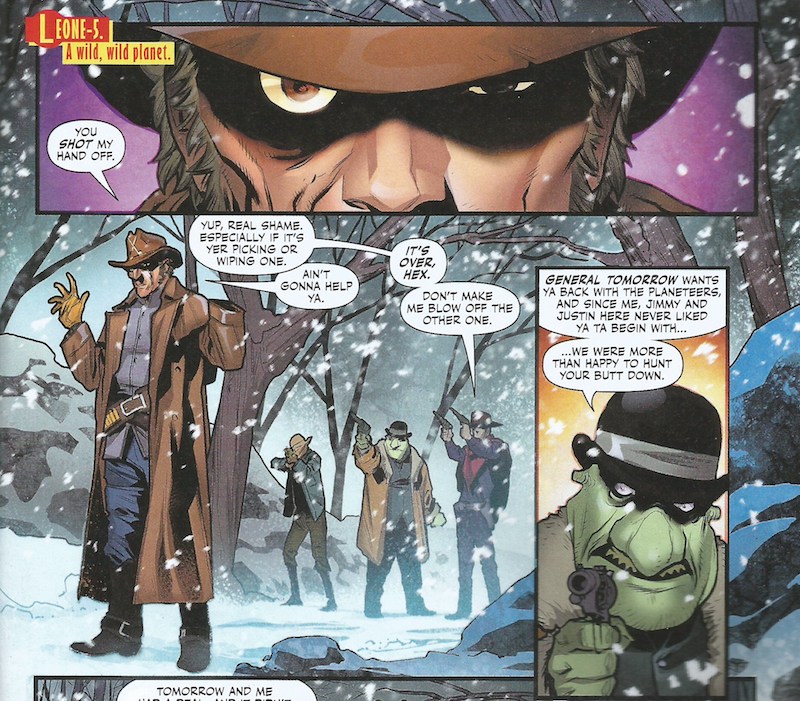
For the extreme newbies out there. It’s not that unusual to find famed bounty hunter Jonah Hex under the guns of aliens. Despite being from the 19th Century, Hex is a time traveler. He visited the future during the waning days of the Bronze Age and the shiny New 52.
The aliens shot Hex’s hand off, but it’s not even smoking. So you can deduce that this is probably not the original Jonah Hex. His youth is also evidence, but immortality and rejuvenation serums are quite common in comic books. By the third page however we discover that Hex is a robot.

The aliens mention General Tomorrow. This is likely a reference to Tommy Tomorrow, a sixties Silver Age science fiction hero who neither looked this sophisticated nor gritty.

Hex’s reasoning for opting out of interplanetary war compliments the original Hex’s rationale for leaving the Civil War. Despite joining the Confederate States, their cause for slavery weighed down on him.
The Super-Sons and the Green Lantern Cadet affect Hex in a multitude of ways. In the end, he throws in with the kids to fight the miniature versions of the world's greatest super-villains. My telling you this however should indicate how important is the plot development. This is really a story about free will even in those programmed without, yearning for more that they can't fully describe. Just taste.
The Super-Sons and the Green Lantern Cadet affect Hex in a multitude of ways. In the end, he throws in with the kids to fight the miniature versions of the world's greatest super-villains. My telling you this however should indicate how important is the plot development. This is really a story about free will even in those programmed without, yearning for more that they can't fully describe. Just taste.

Niko a Japanese agent informed her American "cousins" that a revenge seeking business man built a nuclear missile set to kill Hawaii. The OSI sends Steve Austin, the Six-Million Dollar Man to gather intel. The mission turns into a life and death situation, with Steve and Niko ducking Katanas wielded by Ninja type hit-men wearing menpo masks. Last issue these henchmen felled Steve by chopping off his leg. Things get much worse.

Chance though is in Steve's and Niko's favor, and the means in which the villains of the piece build the missile in the first place provides egress. This allows Steve to show off one of his spiffed up bionics.

I can buy the laser in the eye upgrade. On the other hand some of the changes left me bewildered.

The Six Million Dollar Man must be considered an alternate universe because of the fresh hardware. The original Steve Austin possessed a bionic eye giving him telescopic sight, bionic legs and a bionic arm. The rest of him is organic.
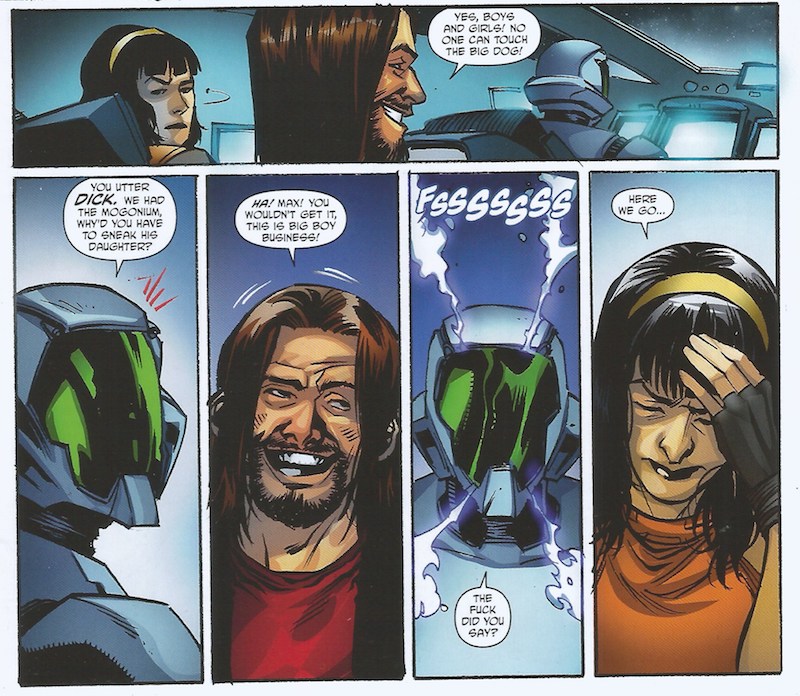
Despite these minor caveats, I quite enjoyed The Six Million Dollar Man. That's largely due to Niko's and Steve's through the fire-friendship and writer Christopher Hastings' mimicry of Lee Majors delivery.

Chance though is in Steve's and Niko's favor, and the means in which the villains of the piece build the missile in the first place provides egress. This allows Steve to show off one of his spiffed up bionics.

I can buy the laser in the eye upgrade. On the other hand some of the changes left me bewildered.

The Six Million Dollar Man must be considered an alternate universe because of the fresh hardware. The original Steve Austin possessed a bionic eye giving him telescopic sight, bionic legs and a bionic arm. The rest of him is organic.
Despite these minor caveats, I quite enjoyed The Six Million Dollar Man. That's largely due to Niko's and Steve's through the fire-friendship and writer Christopher Hastings' mimicry of Lee Majors delivery.