Wednesday, May 15, 2019

POBB May 8, 2019 Part Three

Pick of the Brown Bag
May 8, 2019 Part Three
by
Ray Tate

In the third and final Pick of the Brown Bag installment for May 8, 2019, I take on Agents of Atlas, Doctor Who, Supergirl, The Unbeatable Squirrel Girl and The Unstoppable Wasp.  Tomorrow a whopping huge twitter critique of all the books: #PickoftheBrownBag.


Jody Houser’s last stories in Doctor Who offered a fresh take on Roger Corman’s Z Grade Mystery Science Theater target Attack of the Giant Leeches. 


In this case the Leeches are actually known as the Stilean Flesh Eaters.  Normally they’re scavengers, but they’ve become bolder, leading to one biting the Doctor.  

The Doctor hasn’t encountered them by chance.  She’s being led through time and space by her curiosity over a historical podcast that’s undermining her thunder.  

The podcast informed the Doctor’s companions Ryan, Graham and Yaz about obscure corners in history.  I know what you’re thinking.  The Doctor thought of it as well.  The Doctor of the future is not the podcaster.  

Last issue, The Doctor’s latest investigation into Stilean behavior wound up crossing against the Time Agency.  The Time Agency debuted in the television series with the arrival of Captain Jack Harkness.  The Agency is a human-based time traveling police corps that apparently comprise a Fixed Point in history.  Else the Doctor’s people the Time Lords would have prevented the formation. 


The Doctor's reunion with Perkins and Schultz isn't all that happy.  With each regeneration the Doctor become increasingly anti-militaristic.  She counts the Time Agents as soldiers.  So, she sends Schultz and Perkins on a merry chase while she tracks down the Stilean Flesh-Eaters who have changed considerably.


In many ways, nothing happens in this issue of Doctor Who.  It’s a still point in a larger story, yet within that inertia, Houser entertains the reader with a dead-on characterization of the Doctor expressed in dialogue and action.  Houser’s instincts also give a good showing for the Doctor’s companions who have even less to do, but do it with comedy.  She also employs a judicious discussion about continuity, which makes the book feel even more authentic.

Artist Roberta Ingranata aids Houser with apropos body language and understated facial expression.  Ingranata is a bit more cartoony than Rachael Stott, and as such her Doctor is more flexible while still resembling Jodie Whittaker.


Now that Supergirl discovered the secret behind and head of the cabal demanding the destruction of Krypton and the continued genocide against her surviving people, all that remains is to beat the crap out of the subject.  Because of the species’ abilities, that makes artist Kevin Maguire’s return that more welcome.


No bones to other artists, but the beatdown plays to his abilities of rendering intricate detail and depicting emotion.  Intricate? Says you? Maguire’s really not known for that.  He’s actually more reputable for his simplification of the human form.

We get that as well, but mostly Maguire displays every one of Kara’s powers in exhilarating fashion.  Honestly, I don’t really know why the Rogol Zaar needed to exist, but Marc Andreyko and the Supergirl artists made it with no exception enjoyable.

The way Andreyko handled the beast was more of a reflection of how does Kara react to this bad thing thrust upon her.  The villain of the piece isn’t really anything.  That is to say a name from Superman’s or Supergirl’s past.  The antagonist’s construction at least makes sense, and it was great to see Kara cut loose on somebody that’s definitely not cardboard.

In addition, Andreyko and Maguire give Krypto his due.  Superman gifted Krypto to Kara so she wouldn’t lose herself to revenge.  Krypto makes good on the pledge.  Saving Kara from her rage at a critical moment.    


I’d really like to see Jeremy Whitley, Alti Firmansyah and Espen Grundetjern tackle X-Men continuity.  Maybe then I have a chance understanding it.  It’s Nadia’s, the Unstoppable Wasp’s, birthday party.  The creative team invited every character even marginally associated Hank and Nadia Pym.  Here however is the clever part.  The team include Viv Vision as your guide presenting a clear and concise explanation to every relationship present.
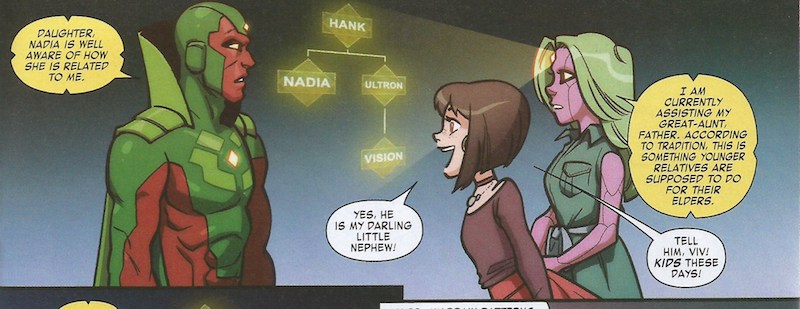

Damn it.  Get her to Charles Xavier’s mansion immediately.  The story begins with Wasp, Scott and Cassie Lang, meeting Nadia for the first time.  Cassie and Nadia hit it off immediately, and she ushers her in for the whole hullabaloo. 


No, your eyes do not deceive.  That is Tigra, looking amazing.  Yes, that is the proper Tigra tail.  Tigra is love.  Her presence did not add to the theoretical score of The Unstoppable Wasp.  Though her inclusion certainly didn’t hurt.  Not one bit.

The issue is mainly a lot of meet and greet character moments with suffused in comedy provided from an overall boisterous atmosphere.  Hercules for example.


I know what you’re thinking.  Is the Winter Soldier vs Nadia cover a cheat?  No.  Though Mockingbird invited him as her plus one out of coincidence, Winter Soldier does have a connection with Nadia and Ying.  


However, this is not the drag-out fight between the Wasp and Winter Solider you’re looking for, nor is it the superhero misunderstanding trope.


The party ends up at a specific club where Nadia gets a spectacular gift from Cassie.  For anybody else the gift just may be insane.  Although for young superheroes who haven’t yet felt the burdens some adult heroes suffer through, it may be the perfect.  


Unbeatable Squirrel Girl teams up with the straight from actual Norse myth Ratatoskr.  The Asgardian Squirrel Chaos God.  They’ve met before.


Usually Squirrel Girl is astonishingly open-minded.  She talked the Rhino down from committing a crime and attempted to reform Kraven the Hunter.  No such leeway for Ratatoskr.  However, she’s actually on Squirrel Girl’s side.


Ryan North’s reasoning for the shifting alliances makes perfect sense given Ratatoskr’s argument, and this leads to some terrific comedy and action involving the duo's battle against two Frost Giants, also in love.  Normally, Squirrel Girl could get behind that love, but not this time. 

Derek Charm’s artwork does an amazing job of blunting any threat posed.  Ratatoskr resembles Bugs Bunny more than her nightmarish countenance of the past, and gains more comedic expression.  The Frost Giants are the spine-headed Klingons of Star Trek and watching their defeat, Ratatoskr’s antics and her attempts to convince Squirrel Girl to trust her amuses to no end.

When the duo put the kibosh on the Frost Giants, Ratatoskr takes on a human form in an outrageous one page multi-panel catwalk—squirrel walk that’s gut-busting.  She finally settles on this unobtrusive number.


Squirrel Girl outstandingly approves, which is weird because Ratatoskr sticks out like a proverbial thumb, especially in the frozen Canadian North.  So far Unbeatable Squirrel Girl is the best excuse for the War of the Realms to take place.


Agents of Atlas or Asians of Atlas is a very dull affair with a combination of new Asian characters and old ones led by former SHIELD agent and Agents of Atlas alum Jimmy Woo.  The story starts off with a mystery in the Pacific that leads two of the new to investigate.
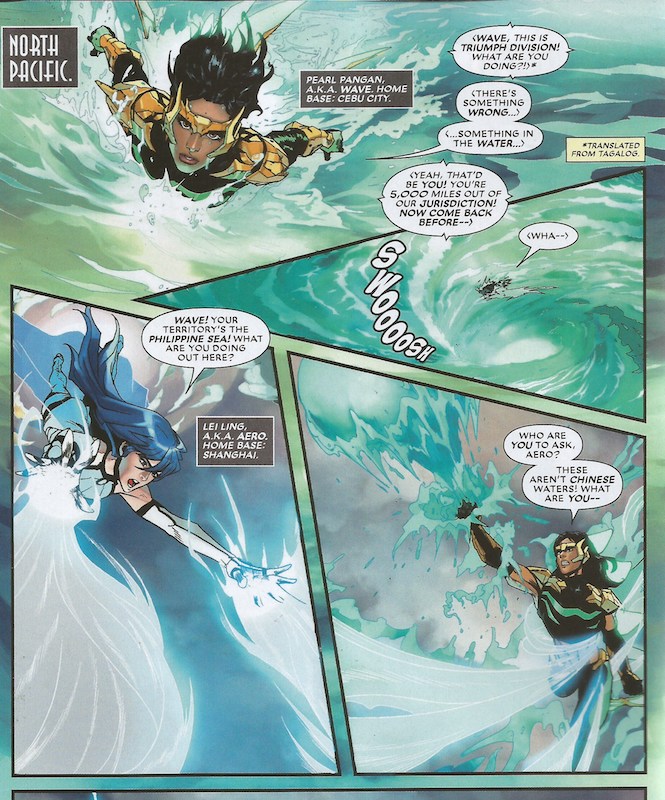

With Pak’s cookie-cutter approach there’s not a lot of room for characterization.  We’ve got an All-Star Squadron knock off of DC’s Tsunami and another coincidentally elemental figure.

Whatever.  The story cuts to Jimmy Woo’s Atlas Academy where Ms. Marvel, Amadeus Cho, Silk and Shang-Chi share pears in a pedantic moment that’s so risible I could actually hear Mike Nelson, Crow and Tom Servo ridiculing it in my head.

It’s during this instance I realized that I’m being bored to death by the Ultimate version of Shang-Chi.  I briefly experienced this version of Shang-Chi in Ultimate Marvel Team-Up.  

This is the younger, hipper incarnation that’s Fu-Manchu free.  The original Shang-Chi is a product of Marvel licensing the Sax Rohmer Fu-Manchu characters back in the seventies.  

The traditional Shang-Chi is the son of Fu-Manchu.  Dr. Fu-Manchu is a would be world dominator that also happens to be Chinese and unfortunately part of the Yellow Peril phenomena, even though that was never Rohmer’s intent.

I won’t diverge into verbose details, but Rohmer had been inspired by a real Chinese man he spotted by chance.  He made up the bulk of Fu-Manchu on the spot.  Fu-Manchu is a doctor of medicine and attended some of the best universities of the time.  I don’t believe Sax Rohmer was a racist in the classical sense.  He was instead an orientalist that just wanted to tell a ripping yarn and make money at it.  You should really look at Fu-Manchu as a classier Chinese Fantomas, a master maniacal criminal created almost a century earlier.

Without a Fu-Manchu background, Shang-Chi is absolutely useless.  Oh, he’s a master of martial arts.  So is Black Widow, two of the White Tigers, Iron fist, Colleen Wing and so many others with and without complementary super powers.  Shang-Chi is only interesting because of his connection to Fu-Manchu.  Without, he’s just a dude with bracelets.

Anyway, as the story continues, Malekith and his Eight Realm Army invades Midgard.  The Agents go to meet this new threat.  Unfortunately they brought Amadeus Cho with them.  

Cho is extremely hard to take in even low doses.  An entirely subjective pronouncement I know, but there it is.  He sucks, and I feel that Pak could have chosen a different Asian jackass for the team: Sunfire immediately comes to mind, a new Golden Girl or anybody else other than the ineffective blundering idiot Amadeus Cho.  


In fact had Pak bothered to put the amount of time and effort in say the White Fox who, ala Puma Man, flies like a real White Fox we might have had at least a half-way decent comic book.  Perhaps she's named White Fox because of the white hair and actually is a Foooooxxxx.  No? Too sexist? Well you got me, because as "god as my witness" I didn't think foxes could fly.


POBB May 8, 2019 Part Two

Pick of the Brown Bag
Part Two
May 8, 2019
by
Ray Tate

For Part Two of the Pick of the Brown Bag, I look at the latest issues of Detective Comics, James Bond, Red Hood and the newest team-up book Red Sonja and Vampirella Meet Betty and Veronica.


Peter Tomasi identifies the Arkham Knight and infuses a deep characterization to his creation.  The Arkham Knight is insane, but insane through a specific protocol. 


The Knight is not a typical Batman foe.  The Knight does not seek fame or riches.  Like Batman, the Knight wants to make Gotham City a better place.  The Knight however sees Batman as a detriment.  The Knight believes Batman’s fearsome mystique causes more harm than good.

The Knight leads an army trained in the art of fighting learned by he.  The army takes a pledge of fealty and suffers when tarnishing the oath.  The Knight lives by a code of conduct that cannot be questioned or defied.  These facets lead to plot twists and enviable cuts to the chase.


The Knight captured Robin, but sought not to harm Damien, reveal his secret or hostage him out.  The Knight wants to recruit Robin to his cause.  As such, the Knight protects him from her disgruntled foot-soldiers, and in the end releases him.

Rather than see the wisdom in the Knight’s actions, Damien returns to his elated father Batman.


There's something heartwarming in the way Batman searches for his captured son, and artists Brad Walker, Andrew Hennessey and Nathan Fairburn help to emit that desperation off the pages.  

Reunited Batman and Robin pool their resources in a father-son detectives' investigation leading to a Batman Returns allusion bound to make you smile.


James Bond deduced that a crew of Russian sailors killed Norwegian seamen over a gold cache meant to fuel Norway's fight against Hitler.  Those Russians capture Bond, drug him and torture him.  Along the way he meets an ally who helps him escape, in the middle of an air-strike.  Bond, James Bond.

This issue is of course a chase and it's a good one illustrated by Ibrahim Moustafa.  This chase however isn't really to be taken super-seriously.  You know Bond will make it.  Young James Bond must become James Bond.  So Parker and Moustafa have a bit of fun with it.  There are temporary truces to kill Nazis.

Admiration from the fairer sex as Bond's nemesis just becomes apoplectic.  A hilarious moment that offers a callback to James Bond films and a very clever means to support James Bond's health within the context of the story.


After learning the Penguin killed his father, Jason Todd alias the Red Hood shot the Penguin at point blank range on national television.  The shot through remarkable chance didn't kill the foul bird.  As a result, Batman told Jason to stay out of Gotham, but Jason returned along with a Batman wannabe named Wing Man and former Teen Titan Blockade, whom he rescued.  The Red Hood's mere presence scared Penguin into his panic room.  This sparked an idea.  As Jason Todd, he took over the Penguin's literally floating casino The Iceberg Lounge and convincingly outmaneuvered Batman at the same time.  After all, Batman's beef is with the Red Hood not Jason Todd.  Zing, Batman, Zing.


In this issue, we find Jason in Paris trying to rekindle a relationship with his normal stewardess girlfriend Isabel.  These quiet, character moments including the one where Jason sweetly remembers a friend contrast potential turmoil back home and in the land that trained Jason Todd after his awakening.

impressed with the nascent issues of Red Hood and the Outlaws I originally purchased, I went all-in and bought the back issues in trade-paperback.  I know about the All-Caste and Jason's origins.  That said.  The All-Caste stuff is confusing as all heck.  A lot of mystical phooey that nevertheless gives artist Pete Woods some opportunities to stretch.  I'm much more interested in the crime aspect of Red Hood.


Jason mixes pleasure with business in Paris.  He confronts DC's version of SPECTRE and pulls a remarkably smart move that's dependent on his being perceived as the bad guy.  The only people that know the Red Hood is in fact a card-burning member of the Batman Family, are the Batman Family.  His Green Hornet method of fighting crime irks the Family because often than not they feel he goes too far.  In this issue, Jason demonstrates remarkable restraint.  He's often considered a wanton killer, but Jason is actually a calculating killer.  He doesn't kill if he doesn't need to.


The story begins with a death in Riverdale.  Amy Chu out of the gate sets up a fair play mystery despite the presence of Vampirella and Red Sonja.


Usually a cut finger according to every Dracula representation, including the original, attracts a vampire, but Vampirella isn't the culprit.  She's the detective along with her Watson, Red Sonja.


Because Amy Chu is writing you can easily shelve this modern day Red Sonja team-up right between issues of her time travel based run.  Vampirella incidentally met Red Sonja in the Dynamite crossover series Prophecy, if you're wondering about their closeness.  The duo quickly learn they're not alone.


I've said this before.  I respect Archie Comics staying power. The gang have been around since the 1940s.  That said, I have no investment in these characters, and I cannot wrap my head around Riverdale.  Betty and Veronica as reporters, investigating a mystery like Nancy Drew twins? That I can accept.

I can also appreciate Betty's and Veronica's intellects.  Even as cartoons they were pretty smart cookies when not fighting over Archie Andrews.  Note how artist Maria Sanpo gives Sonja a sense of humor in the scene.  Like I said.  Sonja and Vampirella are old acquaintances.

Sonja and Vampirella try to protect Betty and Veronica with the old it's too dangerous gag, but the difference lies in the gender.  When a man says something like that, even if true, the line becomes sexist.  When two powerful women say it to Betty and Veronica the line gains more depth.  Number one, Vee and Sonja are the professionals.  Number two, they care what happens to the girls they've just met.  It's just kindness.  Number three, the situation really is too dangerous.  Not that any of these arguments stop the forces of nature.

Soon, Betty and Veronica are outfitting Sonja and Vampirella for subterfuge.  Chu frames the moment with some really good comedic repartee.  Even better than in the graphic I'm sharing, which is amusing as well.  Soon, Sonja and Vee are tricked out as European exchange students.  Their backgrounds quickly add to the hilarity and cameo appearances by the Riverdale gang draw even more comedy.

POBB May 8, 2019 Part One

Pick of the Brown Bag
May 8, 2019 
Part One
by
Ray Tate

There was a glut of comic books to review and quite frankly the giant sized column would have been horrendous to read.  So, I've broken it up into parts.  For this chapter of the largest Pick of the Brown Bag I've ever written, I review the new books Bronze Age Boogie, The Decendent, Excellence, Eve Stranger and Gogor.  I'll also look at These Savage Shores.  As per usual, the Twitter feed will be up and running: #PickoftheBrownBag.


Brandon Thomas returns with co-creator Khary Randolph for Excellence.  Excellence is a brew of Harry Potter, Jedi Knights, Guardian Angels and Isaac Asimov.


Obviously that last law is going to be nettlesome.  

The story begins with a melange of privilege, position, parent and progeny.  It’s the tale of a son and the expectations of his father.  That they happen to be wizards is the spice.


All seems well in the life of the highly respected Brother Raymond Dales.  Unfortunately his son is a late bloomer.  That causes consternation and strife.


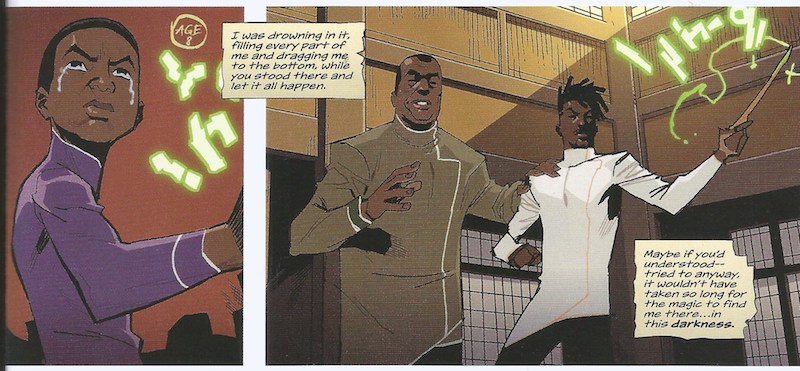
Brother Dales’ consistent lack of pride in his son leads to his ignoring the youth.  Like Darth Vader, the boy—christened Spencer Raymond Dales—channels his anger into the mystical power that’s his birthright.


With this new development, Spencer submits himself to the Aegis.  The Aegis is your basic circle of establishment, but what distinguishes Randolph’s and Thomas’ group is their mission statement and their determination to use magic anonymously.

The Aegis drops him into our reality, and a group of magical rivals follow to thwart him.  Spence’s task consists of getting a man to devote himself to a woman.  


Sounds easy.  He’s going to propose.  All Spence must do is give him a little push. Thaw the cold feet.  At the same time he must outwit the hit squad.  


What they don’t know is that Spence has an ace up his sleeve courtesy of his grandmother.

It’s important for Thomas and Randolph to include a quintessential female character in the story.  Spence’s mother is also more than a match for Brother Dales.  The fourth law the adepts follow after all is sexist.  Perhaps based on the all male Catholic priesthood.   In any case, a writer needs to distinguish between the sexist society of his fiction and his own real belief.  Else you threaten to preclude a potential audience.  Excellence is likely to evolve as Spencer continues his journey, and least one of those laws apt to be struck down.


Gogor by writer/artist Ken Garing appears to be a science fantasy.  When student Armano sees the School of Natural Arts being attacked, he tries to defend his friends and teachers.  

This leads off the beginning chase where right on page one, we discover a truly unique, vibrant world that’s only loosely based upon our own.

Armano’s world actually consists of a series of floating islands.  I’m not going to spoil the impact of the imagery, which is breathtaking in execution and scope.


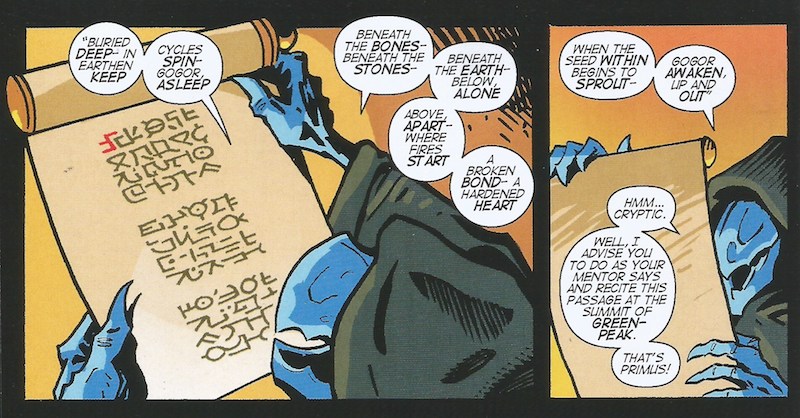
In time Armano meets a fellow traveler who helps him decipher the scroll his rector entrusted.  

In many ways, Gogor is a mixture of genres.  On the one hand you have blasters from science fiction.  On the other hand, the opposition is riding giant ants, a scientific impossibility.  Armano is clearly from the realm of magic and martial arts.  Then we have the scene by the campfire which so often happens in the western.  Finally, at the end of the story kaiju.  Garing puts these parts together seamlessly in a visual narrative an inviting exotic and diverse cast.


In the waning 1920s Charles Lindbergh piloted a single-engine plane from New York to Paris.  The first continuous transatlantic flight brought him international fame.  Lindbergh intended to recoup the laurels into a political career.  

History had other ideas.

In 1932 somebody abducted the Lindbergh baby boy.  The kidnapers later murdered the child.  Authorities arrested Richard Hauptmann for the crime.  


Despite the physical evidence, Hauptmann denied all charges.  Though not as conspiracy rich as Jack the Ripper or the Kennedy assassination, the Lindbergh murder attracted its share.

In Descendent, writer Stephanie Phillips and artist Evgeniy Bornyakov introduce their story with a modern second kidnapping of a child that mirrors the Lindbergh baby abduction.  

Carter Miller is a budding Nazi with aim for the White House.  He and his young wife Jean have a son named Jack, and just like Lindbergh, they find a random note in the crib.

Phillips and Bornyakov make use of an obscure peculiarity in the Lindbergh note.  The abductors included a symbol, whose meaning remains a mystery.  Viewed in a certain way, it looks like an eye.


Descendent is the stuff of The X-Files.  Phillips and Bornyakov have that area covered as well.  Dr. Amanda Mansfield and David Corey are a far cry from Mulder and Scully, but they serve the general purpose.  With David recognizing the symbol, and another kidnapping, cult and conspiracy activity seem in full swing.


The difference between Descendent and other conspiracy based media lies in the quality of the writing.  Phillips ability is evident in the smoothness of the dialogue, and her ear of every day talk that livens possible dull scenes.


The conversation between the guards, ordinary but fun characterizes them neither as bad or good but every day Joes that are just doing their jobs.  It’s this kind of writing that can be seen in characters outside of the threat zone that makes Descendent an overall strong, interesting read. Because ultimately its too early to tell about the whole Lindbergh thing.  So the hook to Descendent is pure technique.


Eve Stranger is the name of David Barnett’s and Phillip Bond’s new protagonist.  This is part Run Lola Run and part Bourne Identity.  Eve wakes up in various places with no memory of her previous actions.


The approach and the bigger story differentiates Eve Stranger from its fictional precedents.  Eve does things that a normal person would, like call the cops.


Without evidence, there’s not much the police can do.  Although Eve’s world seems to stop and start.  That’s not what happens externally.  So, the people behind Eve build immunity.  Eve’s continued attempts to draw attention fizzle, and she in turn looks like a harmless kook.


Eve though is far from harmless, and the proponents in no way benign.  Eve’s current assignment should she decide to accept it is to free a senator’s son from a group of abductors, quite the theme this week.

Though I like to keep secrets, Barnett doesn't.  He divulges the lion's share of Eve Stranger's makeup, and spins a subplot out of the Alias action so beautifully choreographed by Bond.  And then there's what may be a bigger picture hinted at in the cartoony back up by artist Liz Prince.


That's right Eve Stranger could all be a sham.  The larger than life story perfect for fiction just may be a fiction within a more mundane fiction.  Eve Stranger could just be an ordinary small town reporter with vivid dreams and a wild  imagination.

Normally, saying it's all been a dream is a cop out.  This sort of plot resolution only worked on Newhart, but because Barnett foreshadows it as a possibility and adds another meta-layer, Eve Stranger succeeds.  


Bronze Age Boogie seems to restart.  The issue introduced a chimpanzee based alternate universe that buzzed alongside of the science fantasy of a father and his daughter Brita Constantina fighting rogue mages and zombies.   

This issue transports Brita to the seventies where archetypes of the period film genre including a bad ass black woman Lynda Darrk fights Invading Martians. 


The fight takes them into apartment of Jackson Li, martial arts master, of course.

It’s difficult to say what Bronze Age Boogie is about.  My opinion so far is that it’s a series of loosely connected short stories thematically inspired by cult movies.  Things happen fast in these stories and there’s little room for character development.  Writer Stuart Moore instead relies on the reader to recognize Coffey and Bruce Lee nesting inside of Darrk and Jackson as he tosses them at a War of the Worlds situation.  The stories are well crafted in the sense of touchstones and overall plot mechanics as well as How point a gets to point b.  I like what I'm reading, but it's largely an echo and just as hollow.


These Savage Shores is the opposite of hollow.  This is a vampire story but with remarkable originality that resonates with the writing of the old masters, such as Bram Stoker and Poe.  

The story is set in India.  In a previous issue, we meet Alain Pierrenfont.  Alain was a vampire.  Emphasis on the was.  He met his demise not at the hands of a vampire hunter who followed him but Bishan.


Bishan is a guardian, a near deity who can change his shape at will.  He protects the young Prince as he loves Royal house member Kori.  These are poor definitions for the well-researched work.  I'm just breaking it down into digestible frameworks.  The truth is that Kori is much more than handmaid.  Bishan is much more than mystical guardsman.  The vampires are more than just vampires as is the hunter.


The art by Sumit Kumar adds a rich, layered texture to Ram V's words.  If this were just a prose tale, the description would fill books upon books.  These depictions as well seem like the works of old.