Wednesday, June 19, 2019

POBB June 12, 2019

Pick of the Brown Bag
June 12, 2019
by
Ray Tate

Welcome to the Pick of the Brown Bag, a weekly critique of current comic books.  I deal In the best and the worst.  This week, no worst and several deep dives.  

Our topics for part one include Detective Comics, Red Sonja Birth of the She-Devil, Supergirl and Unbeatable Squirrel Girl.  Should time be fleeting, pop on over to Twitter and search for #Pick of the Brown Bag.


Robert E. Howard gave Red Sonja no proper origin.  In "Shadow of the Vulture," she bears flintlocks and sabers to conquer a favorite general of the Ottoman emperor Suleiman.  That is the last we see of Sonja.  One story.  Gone in in a scarlet flash. 

The Powers That Be at Marvel transplanted Sonja to Conan's Hyborian Age.  They gave her a rape-revenge background and a goddess to grant her extra oomph.  The goddess also demanded chastity from Sonja.  Marvel infamously concocted the notion that no man could bed Sonja without first defeating her in fair combat.  Demeaning for all sexes.

Dynamite adopted the Marvel version of Red Sonja.  However, over the years, Sonja's new custodians adjusted the Marvel origin.  In the second or third go-around, they got rid of the deific intervention.  They eliminated the rape.  They dumped the whole conquer her and you can have her business.  That occasionally comes up as comedy relief.  Sonja though now can bed whomever she pleases.

Luke Lieberman's latest redo mostly adheres to the Dynamite origin story.  Apparently, the last survivor of a village raid, Sonja survives through sheer willpower and the hapenstance of Ozzyus, a barbarian with a conscience. 


He adopts Sonja and raises her as is own.  He teaches her how to fight, and she in turn teaches others, like Sashanna.


Sonja now a young adult seeks Sashanna.  Her friend fell in the most dire of straits.  The trail leads Sonja to a Sultan, quite full of himself.


There's no way that this can turn out well.  In truth, he's playing right into Sonja's hands.   Because of the premise, Sonja is something of a detective in this story.  

Amy Chu gave us a seasoned Sonja with a striking intellect.  In essence, Chu related the adventures of Sonja, her potential realized.  Mark Russell's concurrent Queen Sonja likewise unfolds a tale with a Red Sonja tutored by the finest of warriors.

Luke Lieberman gets back to barbarian basics by revisiting Sonja's past and uncovering a few unknown facts.  This however is the lusty, busty, full-bodied Red Sonja Frank Thorne fans remember as the true character, and as such its an entertaining treatment of the character.

As Sonja continues her hunt, her youthful excess brings her to moral ruin.  Lieberman characterizes her as impulsive, capricious and unseasoned, which is exactly in this stage what she should be.  The Sonja that actually tracks down the Sultan is a glimmer of what she can become.


Thor villain Malekith conquered eight of the nine Realms in Mighty Thor and The War of the Realms.  Only Midgard resists.  As a result, it’s crossover season.  I’m not paying attention to the main story or the overall Big Event.  Out of rare respect I’m not going add Stupid.  That said.  Every War of the Realms tie-in has been worth something.  A triumph, really.

Unbeatable Squirrel Girl, to which I subscribe, blows you away, and not in the ordinary manner.  Ryan North in fact creates a layered comic book, exploiting War of the Realms in ways you cannot imagine.

Squirrel Girl soused out some Frost Giant activity in the colds of the North.  Sporting a smashing new outfit designed by her mom, Doreen Green can’t help but be struck by the pristine beauty of her homeland.  


North usually emphasizes the left hemisphere of Squirrel Girl’s brain.  You’re never surprised when you find a discussion of binary code in Squirrel Girl.  Perhaps the first time, but now you know Squirrel Girl is way more than just a funny book.

Still, Robert Frost accompanied by moving imagery that’s still roaming within the cartoon stylings of Derek Charm is most unexpected.  It gets even more surprising from there.

Squirrel Girl encounters the Norse more often than say Spider-Man.  Strange fact I know.  She counts Loki as a friend, and he’s guested in numerous issues.  Ratatoskr is an actual Norse myth.  She is a familiar who takes the form of a squirrel that runs up and down the World Tree to message between the eagle and the serpent at opposite ends.  In Squirrel Girl she is a chaos god, which isn't a far leap. 

Though enemies, Ratatoskr and Squirrel Girl teamed up to fight the Frost Giants and Malekith.  In this issue Squirrel Girl learns Ratatoskr’s reasoning, and it raws her.


The rationale splits her truce with Ratatoskr, but North doesn’t just stop there.  One of themes in Squirrel Girl is that everybody can do better.  Reform is always an option. 

Though Squirrel Girl is quite willing to bring a beat down, she would rather talk it out.  She once convinced the Rhino to turn over a new leaf.  Although Squirrel Girl doesn’t fully trust Ratatoskr, she knows she can do better.


Love the eye works.  Charm helps sell the scene.  So begins the journey of Ratatoskr’s self-discovery.  Ratatoskr begins to better herself and resumes her team up with Squirrel Girl.  This institutes some adjustment.


Heh.  I know what you're asking yourselves right now.  Why isn't he harping about Squirrel Girl flying like a real squirrel does.  Eliminating the gliding actual Flying Squirrel, and Rocket J. from Frostbite Falls, squirrels amazing though they are do not fly.  Neither do Doreen and Ratatoskr.  A Frost Giant under Ratatoskr aided their travel.  Yup.  She whacked them.  One of Doreen's powers is resilience, and Ratatoskr is a god.  Once again, Charm just knocks it out of the park, pun intended, with his rueful looks for Ratatoskr, in the form of Rachel.  Mainly because she likes the form and it reminds her of vow to Squirrel Girl.  

There's still more to be found in Unbeatable Squirrel Girl. North refuses to cast the Frost Giants as just the enemy, as just monsters.  He gives them names.  He establishes loving relationships, friendships, and fosters a culture, based of course on ice and snow.  Some of these moments are comedic, but other times, the Frost Giants resemble the Inuit.  As North humanizes them, you don't look at them as mere things to be killed and you can sympathize with Doreen's goals for bloodless resistance.


Peter J. Tomasi and Brad Walker put a lot of thought and time into the creation of Arkham Knight.  The body armor the Knight wears updates with verisimilitude.  The functionality of the armor as well as the design sheathes the wearer completely.  Made of light weight material, it allows for quick action and decisive fighting ability.  

Because the Arkham Knight is certifiable and not really evil, the armor's not meant to intimidate but to inspire and engender trust.  The Knight seeks to replace Batman, but not for the usual reasons.  The Knight does not believe Batman to be old or too extreme or too light-handed with his enemies.  The Knight ironically views Batman as a detriment to the mental health and sustainability of Gotham City.

The Knight behind the armor also knows the importance of a face, which the Knight reveals on numerous occasions when attempting to recruit others to the cause.  The meaning of the Knight's name bears depth.  There's a reason why the Knight references Arkham Asylum and why some of her followers include the Arkham inmates, defeated in stunning detail by Brad Walker's whirling dervish of a Batman.


The story so far pitted Batman and Robin against the Knight's machinations all of which consist of systematically destroying Batman's legend.  From the eradication of bats to the absolution of the darkness.  None of which is remotely a good idea in any world.  The Knight however sees the bat as pestilence and the darkness a symptom of the Batman.  In the Knight's mind Batman is the harbinger of the darkness.
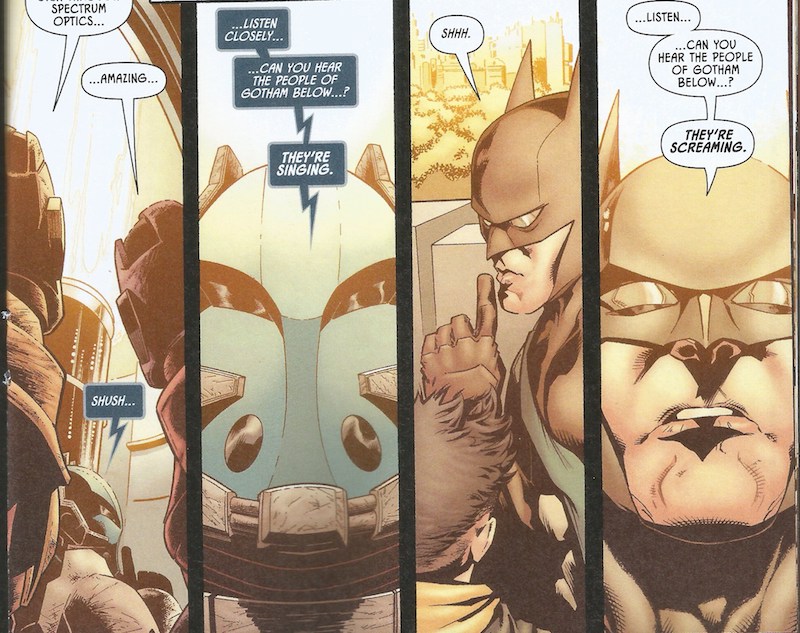

The tale furthermore created a strong enough threat.  The Knight alone is a vicious opponent.  The Knight in addition leads a band of brothers and sisters who have bought into the vision.  The Knight in turn teaches them how to battle like ancient knights, and this army more than the Arkham inmates proves to be more than a match for Batman.  


If you think that Tomasi and Walker are making the Knight a Mary Sue of a character, the key to Batman's survival is that he anticipated someday facing such opposition.  

Somewhere in Batman's history, he had the witty thought of, "hey, what if I have to battle old-time knights? What's the method of tilting combat then?"  It's right up there with Michael Keaton's nut-buster device in Batman's glove.

The Arkham Knight is one of the most satisfying Batman stories in decades not written by Tom King.  Tomasi has a flair for Batman, but his tales are usually quite out there: Frankenstein dissection, Frankenstein/Yeti team-up, retrieving and resurrecting Robin, the Hellbat designed with love by the Justice League.  The Arkham Knight is a straight-forward detective story with a remarkable antagonist that deserves to be beaten by nobody but Batman.


In a way there's little depth to Supergirl. This is essentially Kevin Maguire and Eduardo Pansica prettily depicting space battles between House of El and the cabal of sphincters that got together and killed Krypton.  Their illustrations, each style a recognizable contrast, nevertheless flows in unison.

That said.  Supergirl's reaction to Jonathan Kent is the most eye-opening thing in the story.


The real important bit of information to draw from the scene is that Superman and Supergirl can overcome Einstein's Time Dilation.  That is one twin travels close to the speed of light while the other twin remains on earth.  The traveling twin returns and finds his twin ancient.  Supergirl is shocked to see an older Jonathan Kent.  On one level, we should be shocked that she knows who Jonathan Kent is. 

So, before Brian Bendis took over the Superman titles, DC sort of warmed up the seat for him.  DC restructured Superman's New 52 origin story through the schemes of Mr. Mxyzptlk.

You must give DC props in this scenario.  They didn't do things by halves.  Superman's entire timeline restored and reordered to include among other things: his inevitable marriage to Lois Lane, his and Lois' less than inevitable parentage of Jonathan Kent, introduced without too much explanation and fanfare.  They also made certain Batman and Wonder Woman played vital roles in the lives of the couple. 

Supergirl's relationship with Superman, Lois and Jonathan changed.  Instead of being a relatively new hero to Superman, she pretty much synchs with Melissa Benoist's Supergirl.  So, she knew Jonathan Kent while he grew from baby to kid.  She's an older first cousin and acts that way toward him.


Writer Marc Andreyko is so good that you just acknowledge this change and accept the previously unexplored relationship.  In other words, with Star Trek, if you want to know some of the background on Khitomer, you watch the Undiscovered Country.  It you want to see any Supergirl and Jonathan Kent adventures in past issues of Superman or Supergirl, those don't actually exist.

Outside of the relationship material and the surprising fact that Jor-El is alive, Supergirl and the assassin Rogol Zaar fight for mental-control of his axe.


Oh, she dares all right.  Andreyko emphasizes the difference between Supergirl at the beginning of the story and this defacto conclusion.  She was bent on seeking revenge for Krypton.  Superman countered her want by gifting her Krypto.  

It's difficult to be full-blown cold-blooded killer when you've got a super-powered fuzzy companion watching your six.

Krypto reminds Supergirl of the rest of her life, and because of that, Supergirl seeks not revenge but justice for Krypton.  That doesn't mean she's going to wear kid gloves when dishing it out.

No.  These opponents can take it, and Supergirl's more than happy to oblige.

Wednesday, June 12, 2019

POBB June 5, 2019

Pick of the Brown Bag
June 5, 2019
by
Ray Tate

The Pick of the Brown Bag returns for a kit and caboodle of comic book reviews including The Adventures of the Super Sons, Batman, Black Cat, Captain Marvel, Ghost Spider, Marvel Team-Up, Red Sonja and The Six-Million Dollar Man.  If you haven’t a moment for the full Pick of the Brown Bag, the POBB also has a Twitter presence with fresh capsulized reviews: #PickoftheBrownBag.


Japanese agent Niko discovered that Amari a countryman billionaire secretly built an ICBM primed as revenge for Hiroshima.  She calls her American “cousins.”  They alert the Office of Scientific Intelligence.  The OSI sends Steve Austin, the Six Million Dollar Man.  This however isn't the television version of the character, nor the Steve Austin from Martin Caidin's novel.


Steve in this story is at least ninety percent bionic.  Whereas even in the novel he was mostly human.  The change just allows artist David Hahn.  What's important is that comic book Steve sounds a helluva lot like Lee Majors. 


Set early in Steve’s career, the adventure sends he and Niko  on a collision course with a Japanese secret society. 


The katanas prove to much for Steve’s bionics, and after kiboshing the missile threat, retreat is the only option.

Steve jury rigs repairs, which creates a running gag of malfunctioning bionics.  He and Niko try to get off the island and contact OSI.  The secret society’s reach however extends to Niko’s true cousins, and we find several very subtle moments in the drama between them.


I can’t help think that if Niko were a male cousin, the situation would play out differently.  Because she’s female, she’s disposable, the rationale being that the woman as usual wasn’t thinking rationally.  So, for attempting to venture where a women shouldn’t go, man's cerebrum, she must be rewarded with death.


NIko’s reaction isn’t like her those of her male relations.  Fully emotional, her feelings do not impede her serving the greater good.  The fluidity of the tears through the panels is one of The Six Million Dollar Man's greatest moments.

Things lighten considerably when Steve and Niko mistake a group of Russian pilots for the harbingers of ICBM doom, but they are in fact keen on preventing this disaster as well.  The Six Million Dollar Man is nostalgic without feeling dated. Hahn's artwork is ideal for bionic errors and actions.  Writer Christopher Hastings makes this story about real people and real consequences in a fictional setting.


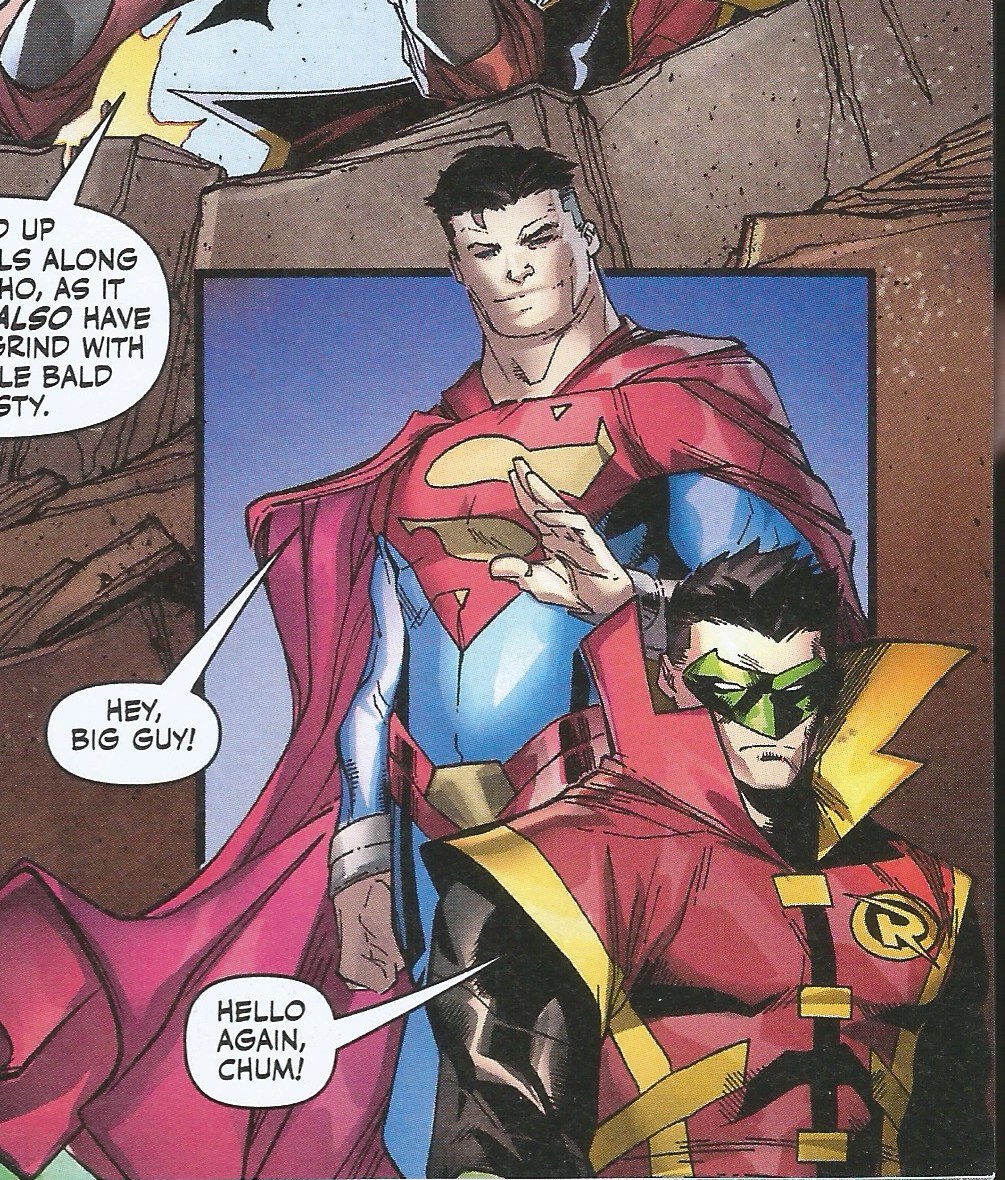
Space, the silly frontier.  These are the voyages of Damien Wayne, Robin, and Jonathan Kent, Superboy.  Together known as the Super Sons.  

The Super Sons wound up on Takron-Galtos, infamous prison planet from the Legion of Super-Heroes.  On Galtos they met a group of alien super-villain fanboys.  Naturally the creeps see the earth as the ultimate trophy.  Escape led the Super Sons to a Jonah Hex robot who threw in with them upon gaining free will.  Courtesy of Super Sons ally and Green Lantern cadet Al-X.

Now, Hex’s former owner has one question.


Writer Peter J. Tomasi exhibits no ambition other than to make Super Sons as much of a blast as possible.  He seems to be having fun throwing as many darts as he can, often all at once, and seeing how many hit the target, even the bullseye if lucky.

Best of all, Adventures of the Super Sons is a cross pollinator.  You can pick up an issue and start to read it at any point in its run.  You’ll get more from the book if you are a hardcore comic book reader, but it’s not a requirement.


For example, the adult versions of Superboy and Robin show up amongst the cavalry.  I don’t need to understand who these fellows actually are or from whence they come.  Tomasi gives an explanation, but honestly, it doesn’t matter.

Tomasi furthermore updates old concepts.  As mentioned, western gunfighter Jonah Hex is a robot.  Silver/Space Age hero Tommy Tomorrow is a general with a bit of scruff.  Fellow period science fiction adventurer Space Cabbie gets a huge makeover.

In terms of plotting, it’s a basic good vs evil with the added spice of a teleporting device called the Hypercube.  Mathematicians are probably calling foul right now.  It’s an actual mathematical concept but given extra-dimensional abilities through comic book law.


Since I was a boy, I loved Batman with all my heart.  It started with the comics, then the reprints.  It filtered through the television show, then in syndication, and continued forever until….  

I stopped loving Batman when he stopped being a detective.  When he stopped being a decent man.  When he became twisted by editorial and writers who basically sucked from the get go or burnt out.  

After the Crisis hit, Batman remained Bronze.  Certainly, the Powers That Be rejuvenated him.  That’s kind of the point, but he was still the Dark Knight Detective and the Caped Crusader.  He never was one or the other  

John Byrne reintroduced him to Superman, in Man of Steel, and Wonder Woman in Legends.  It would take Grant Morrison in the nineties to restore his membership in the Justice League.

The end began with No Man’s Land.  Truly one of the all time stupidest stories ever conceived.  Earthquake levels Gotham.   Funny, isn’t there a Superman? I never became a regular reader of Batman titles again.  Multiple substitute Batgirls combined with retro-planted alien technology alienated me further.   Ultimately with one reeking issue of The Brave and the Bold, I grew so angry that I engaged in a total boycott of DC Comics.  

I would not relent until the New 52.   Gail Simone and Adrian Syaf healed Barbara Gordon and Paul Levitz gladly returned the Huntress, not to mention Power Girl.  Supergirl landed as a confused alien.  Scott Snyder and Greg Capullo revivified Batman, using the Court of Owls as their elixir vitae.  Geoff Johns cemented Batman in the DCU through the Justice League, and Grant Morrison added that Batman and Superman worked together as the world's finest team soon after that.  

As Scott Snyder started to lose the box that he was supposed to think outside of, Tom King came along with a plan that began in issue one.  


This isn't bull.  This is "The Purloined Letter."  It's been staring us in the face all along.

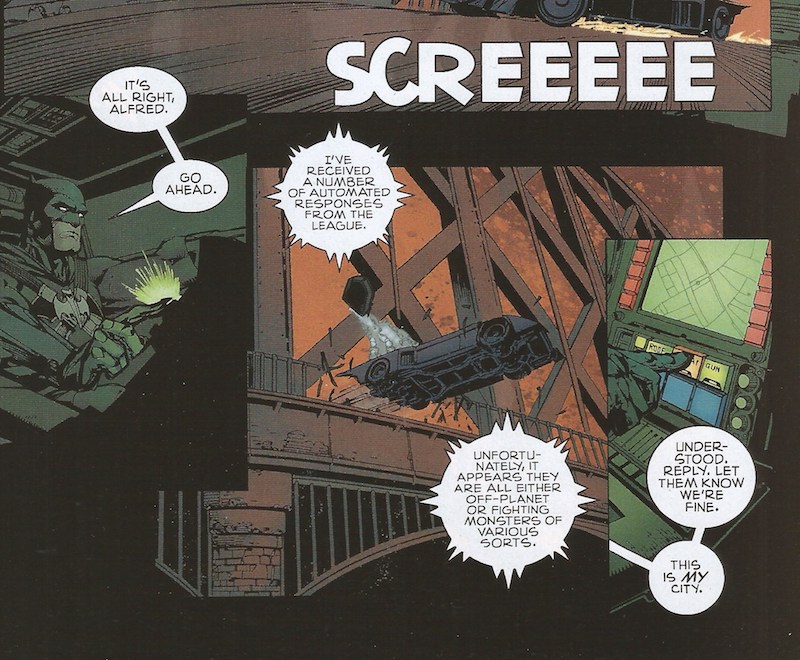
Batman in his debut for the New 52 Rebirth attempted to steer a plane...from the outside.  


Batman didn’t just want to save Gotham.  He intended to save everybody on the plane as well.  That’s just what Batman does.


The Big Bad certainly could have triggered his cabal when all of Batman’s super friends were out of helping range.  He would simply need spies watching for the right moment.


At first a fortuitous premise, Gotham and Gotham Girl showing up to rescue Batman now becomes suspicious.


That said, it’s unlikely that they knew the full extent of the Big Bad’s desires.  


I imagine the Big Bad flew a false flag.  He or she developed Gotham and Gotham Girl as heroes and exploited their gratitude to Batman.  He saved their family when they were children.

Gotham and Gotham Girl therefore acted as pawns which the Big Bad disposed of in pivotal actions within the grand scheme.  I cannot believe Gotham would willfully give up his sanity to become a super killer or Gotham Girl would allow herself exposed to madness of the Psycho-Pirate.

The ubiquity of the Psycho-Pirate and his utility allowed the Big Bad to orchestrate Bamtan's invasion of Bane's stronghold.  

Predicting who Batman would use in his assault must have been flexible.  The wager is on Batman choosing Catwoman, imprisoned in Arkham Asylum for crimes she didn’t commit.


I cannot see The Big Bad factoring in Bronze Tiger or Punch and Jewlee.


The Bonnie and Clyde were never part of Batman's Rogues Gallery.  

Now things get dicier.  The Big Bad must give Batman and Catwoman their freedom to reignite a relationship.  He must allow Batman to prove Catwoman’s innocence.  He must let Batman do good for his ultimate evil to fruit.  That’s his sacrifice.

The War of Jokes and Riddles predates the Big Bad’s chess mastery.  So that is as it was.  Poison Ivy’s attack cannot be part of the Big Bad’s web, and I disagree that the Joker is capable of playing along. The Joker is wild.  We can dismiss some of the intricacies to an inaccurate narrator.  Somebody who gives the Big Bad way too much credit.

This begs the question what on earth does the Big Bad’s partner get out of his collusion?  What does the juxtaposed fight choreographed in this issue mean?  Did it even happen? Is it a metaphor for Batman’s greatest loss? Did Batman go back after failing to convince the Batman Family of the conspiracy to fight the menace by himself?

So many questions.  So few answers, yet I read on because Tom King makes Batman too compelling to stop.


Created by Marv Wolfman and Dave Cockrum, Marvel introduced Felicia Hardy in the late seventies Amazing Spider-Man.  She’s a street level femme fatale jewel thief with one impressive gimmick.  


These apparently supernatural moments later evinced as pre-rigged snafus.  Better than a superpower since it demonstrates a tactical mind.

Black Cat proved popular enough to earn a richer background.  Turns out thievery runs in her family.  She’s the daughter of a jewel thief that Spidey encountered early in his career.  

Walter Hardy respected Spidey for his fairness.  He told stories about him to his young daughter.  Felicia developed a crush for the web-slinger.  Later she and Spider-Man become lovers, before he marries MJ of course.  In the MC2 universe, MJ and Felicia are the best of friends.  

All of this material suggests a happy-go-lucky character committing a series of cool heists before calling it quits and joining Spidey on a web.  Alas...

The Black Cat stories are often confusing, sometimes tragic and in the case of Kevin Smith, repulsive and infuriating.  
Because Wolfman’s got a serious jones for psychological trauma, Black Cat dropped down a Freudian well.  He created Black Cat as a mentally unstable personality.  She becomes obsessed with Spider-Man.  When pursuing a relationship with a Spidey, she refuses to acknowledge his secret identity.  Then there’s her criminal nature.  Numerous writers made Felicia’s desire to steal a compulsion rather than a vocation.  Kevin Smith felt it necessary to have her experience a retro-planted rape.  ‘Nuff said.

Jed MacKay’s freewheeling breeze is easily the best Black Cat story since the offbeat Wolverine and Black Cat team-up by Palmiotti, Gray and Linser.


Generally speaking, Felicia is more of a breaking and entering type of criminal.  


She doesn’t usually hobnob with the upper crust, but this kind of change of environment is a staple among thieves in fiction.  So, I can simply rationalize it as somehow she got invited to a big gala.  If Lupin the Third can manage it, why not Felicia?

Felicia appears to mingle.  During this time, MacKay introduces something that’s the only thing that caused me pause.

Black Cat lacks superpowers.  She instead uses specialized equipment to commit her crimes.  The claws are part of her gloves, not organic.  I suppose I can dismiss this as nanotechnology, but it’s asking me to take a big leap.  Like where did a girl from the poor side of town get this kind of gear?  Steal it, I suppose.  Oh.  Never you mind then.  Carry on.  

The Black Cat as the graphics imply is an anthology title.  The first story by MacKay and a superb Travel Foreman captures the essence of the Black Cat and sheds the unnecessary.  The second story by Nao Fuji is a cute two pager.

MacKay returns with Mike Dowling for the third tale.  The Black Fox returns.  Black Fox is another of Spider-Man’s thieves, introduced about five years after the Black Cat.  McCay redefines him as a debonair David Niven styled Phantom and links him cleverly with the Black Cat’s father.  The premise of this tale is a doozy.


With a guest appearance of a period hero appropriate for the occasion.  Hint, it’s not Blade.


After teaming up with the Web-Warriors, Spider-Gwen returned to her proper earth to face the music in the form of a prison sentence.  As a result, everybody knows Gwen Stacy is Spider-Woman, including the bad guys.

A wannabe Kingpin, the lycanthrope on the cover, decides to get rid of Spider-Gwen.  He directs bombs planted at the Mary Janes’ comeback concert.  The Mary Janes consist of the young female cast of Amazing Spider-Man led by Mary Jane Watson.  Gwen kills it on drums.


Gwen acts fast to prevent the band from suffering from the blast, but the number of bombs thwart her.  Forcing her to carry out more rescue operations.

Whereas her lack of secrecy appeared to be a burden this issue, writer Seanan McGuire demonstrates that it can also be a boon.


The police officer staying late may not have been so quick to help if not for the fact that she knows Spider-Woman is Gwen Stacy, daughter of police Captain Stacy.

With the information in hand, Gwen uses her unique symbiotic powers to locate the Big Bad.  The duel between Spider-Gwen and the lycanthrope is vicious, snarky and satisfying.  

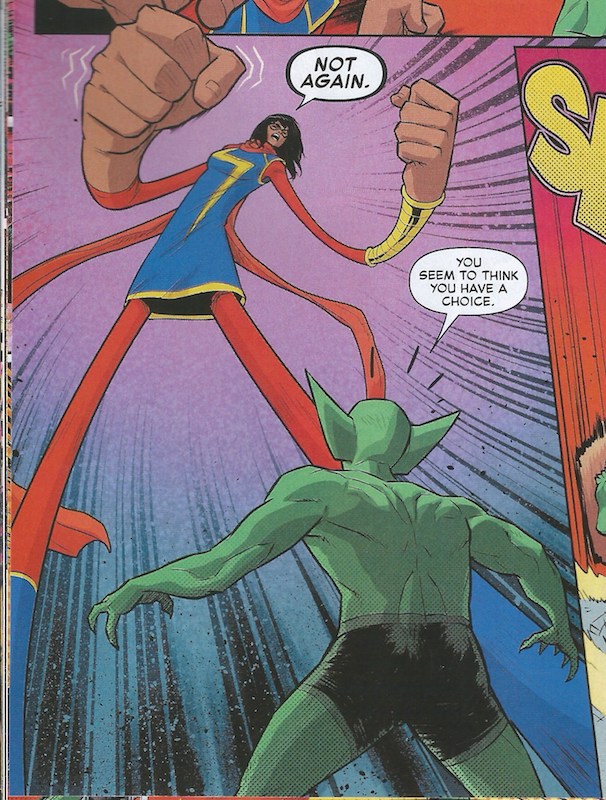
Marvel Team-Up is a multiple entendre featuring Spider-Man and Ms. Marvel.  Marvel team-up get it?  This debut arc also relied on a mind-swap.  Spidey in Ms.  Ms. in Spidey.


This issue concludes the arc with a switch that highlights a new Marvel character's great intellect. It matters that she's a she.

This however isn't just a yay feminism story.  Not that there's anything wrong with that.  Ms. Marvel is young and inexperienced.  She gets to express her emotions like a kid, and Spidey for once gets to be the adult.


He's serious with Ms. Marvel, because she needs it.  Always with the jokes for everybody else.  

Spidey and Ms. Marvel together put the kibosh on the Jackal while they're at it.  Somebody really needs to revoke his tenure at ESU.

Marvel Team-Up is a simple tale elegantly retold through the choices of heroes, crackling dialogue and spruced up with some dynamite artwork and effects.


Captain Marvel returns to the Pick of the Brown Bag in a War of the Realms tie-in.  As far as Big Stupid Events go, War of the Realms is pretty easy to understand.  Thor villain Malekith made alliances with the eight realms and teamed up with some fellow Thor villains.   Now Midgard is all that remains to complete his collection.  Marvel’s heroes are keen to disappoint him.


The story opens with Black Widow and Bucky tearing through the Enchantress’ undead forces.  Art is on a high for the Black Widow since Flaviano illustrated her in the Soskas' highly recommended Black Widow.  Annapaola Martello and Tamra Bonvillain follow suit.

As Natasha reaches the Enchantress for a major beat down, something strange happens.  A vision appears in her mind.  This vision catalyzes Black Widow’s call to the star of Kelly Thompson’s picture.  Captain Marvel.


Captain Marvel guested in War of the Realms Strikeforce Avengers, or whatever it was called.  Poor characterization sunk her role in that one-shot.  Thompson gets her and includes a sweet moment between old friends.


Natasha comes back from the dead, and she has to hide the fact from the general public, for some reason.  Cap is too overwhelmed by his guilt to mention it.  His doppelgänger killed her.  Although Cap did lend her Bucky.  Deadpool is Deadpool.  Nobody else remarks about how great it is for Natasha to return.  The joyful scene is much more like it.  I’m ecstatic Nat is back as well.  Let's hope the cinematic universe pays attention.

When Natasha describes her vision, she and Carol go to retrieve Dr. Stephen Strange already in the thick of things.


Before too long, the trio face the Enchantress, and she’s pulling more than rabbits out of her fancy headgear. 


The Enchantress’ tactic opens the door for Thompson to remind readers why Stephen no longer practices medicine.  Draw rare humor from Natasha and generate comedy from the match of Dr. Strange and Captain Marvel.


Mark Russell demonstrates Red Sonja’s chess moves as the war between the Zamorans and the Hyrkanians persists.  Would be emperor of the world and Rufus T. Firefly’s evil, twin brother Dragan sets his sights on Red Sonja’s homeland.  

What he couldn’t predict is that Sonja happened to return.  What he also couldn’t predict is that while Sonja wasn’t paying attention, the Hyrkanians unanimously elected her queen.  

At first Sonja rejected the idea, but using the teachings of legendary warrior Domo, she steered her people and allies in the successful direction of guerrilla warfare.  On the run, she and her countrymen thwart the mighty Zamora empire.


Last issue Dragan learned an important open secret and sets his only good plan into motion.  Kidnap Sonja’s cousin and make demands.


Sonja however learned her lessons from Domo well.  In an unusually dramatic moment in what must be classified as a black comedy, Sonja chooses boldly to save the many against the few or the one.