Wednesday, August 14, 2019

POBB August 7, 2019

Pick of the Brown Bag
August 7, 2019
by
Ray Tate

Welcome to the Pick of the Brown Bag.  I am Ray Tate.  I review comic books.  This week, it’s Batman, Black Cat, The Future Foundation, The Immortal Hulk, Red Sonja and Vampirella Meet Betty and Veronica.  If the Pick of the Brown Bag blog experience is is too much for you, and you need a decision right away, check me out on Twitter for encapsulated reviews: #PickoftheBrownBag. 


Finally! An issue of Batman I can talk about without divulging major spoilers.  Okay.  So, you know that Bane took over Gotham.  What you didn’t know is that he has the government's blessing.


That’s right.  Captain Atom guest-stars in Batman.  If you don’t know who Captain Atom is, don’t you worry.  It doesn’t actually matter.  

He’s there to represent a piss-poor government willing to acquiesce to a mass murdering strongman who keeps the peace by instilling fear.  


So that slow-witted orangutan stuffed in an ill-fitting two-piece suit is the President in DC comics as well as our sad reality.

Joe Gill and Steve Ditko created Captain Atom for Charlton in the sixties.  When Charlton went belly-up, DC bought the properties as a birthday gift for artist turned managing editor Dick Giordano.  

We see the original Captain Atom for the last time in the Crisis on Infinite Earths.  Post-Crisis, DC resurrected Captain Atom in the late eighties for his own series.  


That’s where he gained the distinctive metallic look being battered about in the graphics of Batman.  

Unlike the original, DC introduced the new Captain Atom as a military man.  That carries over to the New 52.  It’s a real surprise to see Captain Atom in these pages.  Batman’s met Captain Atom only once or twice in the Bwa-ha-ha-ha-ha era of the Justice League books.  

Normally, I’d feel the need to keep Captain Atom’s appearance un-spoilt, but nah.  I can’t imagine there being a massive Captain Atom fanbase.  

Captain Atom talks to another surprise guest star, and honestly, I can’t really think of this as a spoiler either.  He’s been part of the Batman Family for years.  Tim Drake.
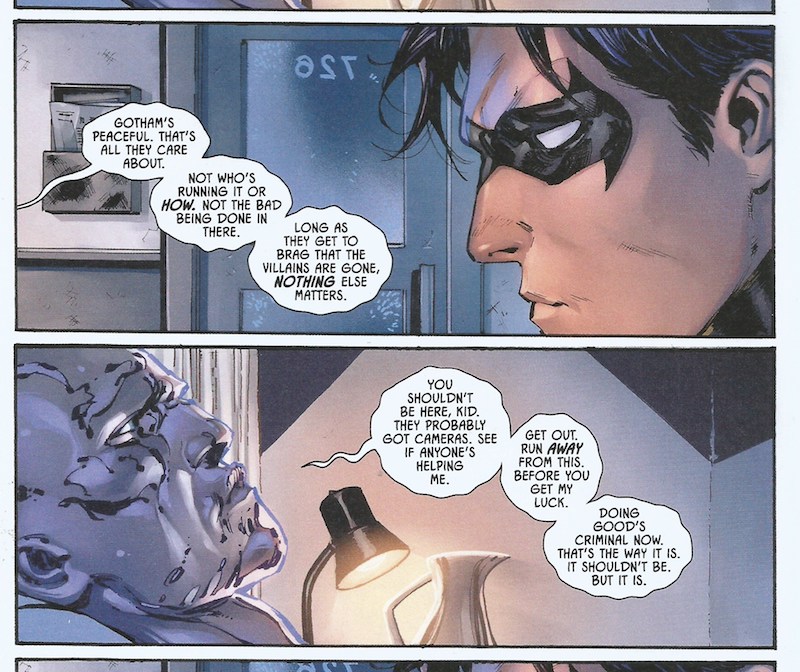


King ignored the strange business happening with Tim Drake in other titles.  He’s appeared in Batman before while simultaneously missing in continuity proper.  So, yeah.  The fact is King needed a level-headed Robin to balance out the crazy one.

Don’t worry though.  Dick Grayson isn’t dead.  He’s just screwy in the head.

Marvel changed up the Hulk some time ago.  Everybody at the gamma bomb test developed into a Hulk.  This is why Betty Ross is the Red She-Hulk.  


When Al Ewing rethought the Hulk, he came up with the idea that the Hulks are immortal.  Hence, the boast.  This idea may be the result of a single line in The Avengers where Bruce Banner admits: “I got low.  I didn’t see an end.  I put a bullet in my mouth.  The other guy spit out it out.”


The consequences of this evolution include the resurrection of Rick Jones.  Once the blue Hulk, now getting better after being buried a few years.  


The Hulks rescued Rick from the machinations of Shadow Base.  An evil organization that seeks to exploit the Hulks for weaponry.   They fused Rick with the Abomination.  Though the Abomination isn’t the Soviet spy you know.  

The Abomination is a suit of bio-armor now married to General Fortean, the head of Shadow Base and overall royal prick.  Together they look like something The Guyver threw up.  

Normally, the Immortal Hulk is heavy drama flying under the banner of body horror.  This issue however is one of the lightest.  It’s still poignant, but it’s also an outright comedy.


That’s Joe Fixit, the formerly Gray Hulk that used to be a Vegas bon vivant in the nineties.  He’s now stuck in the form of Bruce Banner.  He’s talking with reporter Jackie McGee, the homage to Jack McGee from the television series.

In addition to the Hulks, you have Gamma Flight.  Former Alpha Flight members teamed up with former Jennifer-the first and best She-Hulk-Walters villain Titania.  Titania's married to Crusher Creel, who needs no more explanation.  


Fortean infiltrated Gamma Flight’s space headquarters and killed Walter Lankowski.  His death may not be permanent.  As he is a former gamma recipient that became Sasquatch.  That said.  He also let a demon possess him.  Whatever the case, Lankowski's condition wouldn’t be so permanent if not for Hulk absorbing his gamma radiation, saving a helluva lot of people in the process.  

Gamma Flight’s revenge leads to an expected twist involving old CIA shenanigans covered in the hilarious docudrama Men Who Stare At Goats and a rousing cliffhanger that's heroically upbeat.  The Hulk and Bruce Banner are of one mind.  They intend to end humanity to save planet earth.  However that ensue, you cannot help but root for the would be destroyers because in the short term, they kill nobody and save everyone in their vicinity.  Fortean on the other cold bloodily murders innocent people himself or through proxies.  I look forward to Fortean beating.


Jonathan Hickman and Steve Epting created the Future Foundation during their run of the Fantastic Four.  It consisted of Alex Power, Dragon Man, a young clone of FF villain the Wizard and some hyper-intelligent mutant Mole People—Mole Man’s little yellow army—as well as a few Futurama styled floating heads.  

The new comic book debuted in the back pages of last week’s Fantastic Four, but if you’re lukewarm on the FF, the ten page preview isn’t necessary for your enjoyment or comprehension. 

The Future Foundation starts in the FF with Alex’s brother Julie Power on a huge downward spiral.


Funny, Captain Marvel also experienced a severe kick in the teeth from life.  Meanwhile, the Future Foundation is lost in alien caverns surrounded by carnivorous creatures.   

The newest team-member and Wakandan whiz-kid Onome along with Tong refit Dragon Man to become a teleporter.  Dragon Man for those not in the know is A.I.  Because of power restraints, they can only teleport twice.


One of the things I like about Jeremy Whitley’s Future Foundation is the bond between the siblings.  Julie doesn’t get angry at her brother’s intrusion, she’s instead happy to see him.  

The sibs make cracks at each other, but these are as well all in good fun.  When she expects to be admonished, Alex just gives her a hug.  It’s all really lovely.

Julie only gets pissed when Alex jumps the gun on the teleportation.  She hasn’t fixed herself up yet.  

The Foundation’s problem gives Julie purpose, reminding her of the hero she used to be and still can be.  


Once she rescues the team at light speed, she joins up with Future Foundation.  It’s a pretty meaty preview with a reveal of the appealing cartoony art by Will Robson that will be seen in the ongoing title.

The Future Foundation explores space to retrieve the remains of the Molecule Man.  The Molecule Man is a reformed villain who Galactus in The Ultimates referred to as one of the most powerful entities in the multiverse.  Molecule Man also became a friend of the Future Foundation.


For that reason, we find Yondu escorting the newest member of the team Julie Power through corridors of a prison planet.  Whitley spends a lot of time establishing the setting.  Perhaps this will become Marvel’s Takron-Galtos.


Julie of course is not under arrest.  It’s a sham scenario.  The Foundation detected the Molecule Man in the prison.  He’s been scattered through the cosmos like Doctor Who’s Key to Time.  This lady has something to do with the Molecule Man, even if she doesn't know it.  So, she's got a get out of jail free card.


The jailbreak naturally doesn’t go as planned.  The presence of an unexpected prisoner requires a secondary escape, but this will require a more hands on approach.

It’s during these moments that Whitley properly introduces the Future Foundation members that may not ring any bells with the readers.

Bentley reminds me of Damien Wayne.  Visually he looks like the post-Crisis Superboy.  At least he comes by his attitude honestly, and it’s actually an improvement on the Wizard.


Onome is Bentley’s opposite.  She’s the very model of poise and organization.  Yet they both have the same goals.  To serve the Future Foundation and rescue their friend the Molecule Man as well as anybody else who haps their way.


Last issue Black Cat and her crew broke into Stephen Strange’s abode.  They did this with the help of a Stephen Strange villain who didn’t seem so bad, but turned out to be just as name promised.

Upon retrieving the Star-Stone, Xander the Merciless powered up and he didn’t thank Black Cat or her crew for the opportunity.

Now, Black Cat and her crew consisting of mad chemist Doc Korpse and former military man Bruno Grainger are trying to survive a magical onslaught.  

Our story begins with the charming introduction of Bats, a ghost Bassett who in a tear-inducing moment mistakes Black Cat for another Marvelite.  


This is so hilarious.  Under the impression that Black Cat is Bats’ one true-love, he follows her through the house and aids her whenever he can.


Another aspect of this book to enjoy is how the back up stories with Black Cat’s former mentor and now employer the Black Fox ties into the current story.


Running gags include Korpse refusing to believe in the supernatural elements that present themselves before his very eyes and the fact that Black Cat though a thief won’t even allow Stephen Strange’s living caduceus to suffer a bad fate.
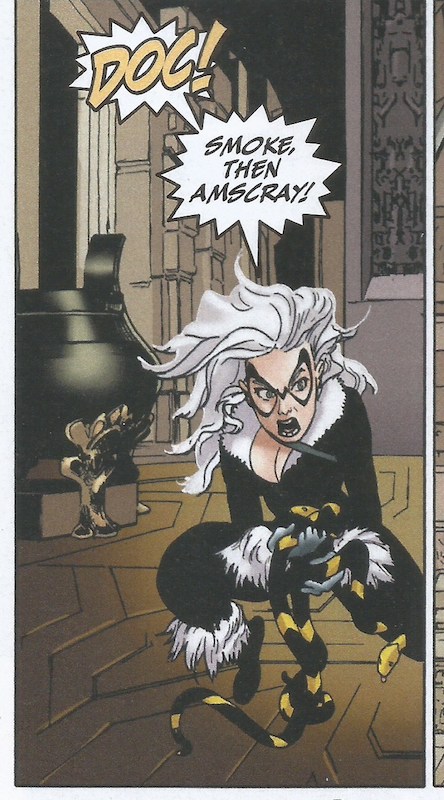
Don't harm the snakes.  Leave the snakes...Alone.

Although I’m forced to accept that Black Cat now fosters a bad luck super power I still do not hesitate.  Writer Jed MacCay is easily the best thing that ever happened to the Black Cat.

Murder comes to Riverdale.  Vampirella and a still time-displaced Red Sonja follow. 

While investigating, Vee and Sonja meet Betty and Veronica, who decided to emulate Nancy Drew and Chloe Sullivan.  


The girls establish false identities for Vee and Sonja.  The women hide in plain sight amongst Riverdale High’s ranks as European exchange students.

Though attempting to keep a low profile, Sonja quickly impresses the sports department and earns a place on the team.  Apparently co-ed.  Nothing I ever heard of, but it’s Riverdale.  

Chu characterizes the coach as fully invested in sports and Riverdale.  He wants to win.  So, Sonja being bumpy in all the right places doesn’t phase him one whit.

In the third issue of Betty and Veronica meets Vampirella and Red Sonja, writer Amy Chu superimposes another mystery, which appears to involve time travel.
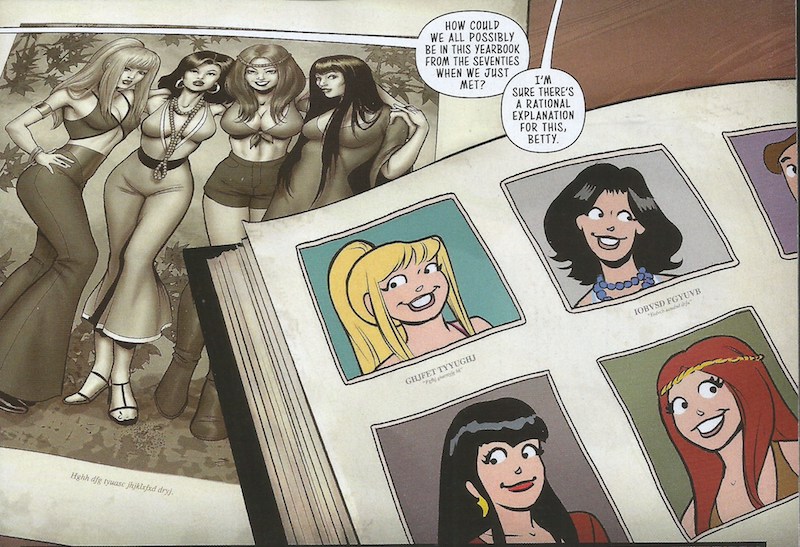

How Betty and Veronica, Vampirella and Red Sonja end up in the Sixties is anybody’s guess and forthcoming.  

Naturally, the art depicting the sixties Riverdale matches the Dan DeCarlo classic look of Archie Comics.  Maria  Sanapo’s sumptuous, realistic artwork was impressive enough, but the inclusion of the toon versions of Vee and Sonja are a bonus.

Regarding the out-of-the-gate mystery, Chu introduces new clues that nevertheless escape Sonja’s grasp. 
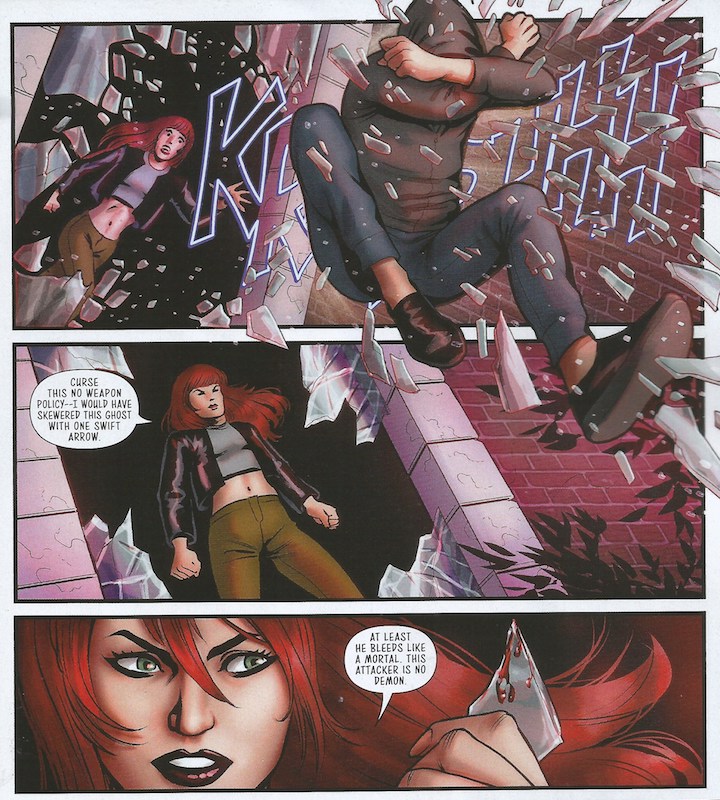

She also summarizes some leads in the victims.  All you need do is pay attention.  Although I question whether Chu will be so obvious in the reveal.  I can see a couple of more complex ways this series can go.

Speaking of complexity, Chu takes pleasure in sending up the Betty and Veronica personae.  Not only is Betty the smarter of the two, she is way deep.


Meanwhile, Chu notes some practicalities that traditional Vampirella writers glossed over.

Believe it or not, after her gory debut on Drukulon courtesy of Forrest J. Ackerman and Tom Sutton, Vampirella is seldom seen drinking blood.  That includes the Warren magazine.

Vampirella’s sanguine thirst plays a part in the cliffhanger which culminates in the concurrent homicidal investigation and punctuates the strangers in a strange land comedy. 


Wednesday, August 7, 2019

POBB July 31, 2019

Pick of the Brown Bag
July 31, 2019
by
Ray Tate

Welcome to the Pick of the Brown Bag, a weekly comic book review blog run by yours truly Ray Tate.  For this installment, I look at Batman Secret Files, Fantastic Four, Heathen, Knights Temporal, John Carter, Warlord of Mars Attacks, Manor Black, Red Hood and the Outlaws Annual and Sabrina the Teenage Witch.  Should you not have time to drink deep from the riches of the POBB… 


…fresh capsules are available on Twitter: #PickoftheBrownBag.

Two books by Cullen Bunn came out this week.  Knights Temporal from Aftershock and Manor Black from Dark Horse.  


Knights Temporal is a glossy version of Highlander subtracting the beheading and the Quickening, which is where a lot of the Higlander’s fun comes from.  


So minus the good stuff, what do you have left? Dialogue just sits there.  We lack a point of view character.  The whole exercise really seems like a draft for a movie or television series just waiting for a cast and director to animate.  No doubt the words would be infused with a little more oomph by a good script writer.

The story board by Fran Galan is excellent, but it adds to the predictability.  For example, you just knew the contrasting, bouncy trickster character would behave in such a fashion.  


She’s actress bait.  A ballsy, lively figure with the artifice of complexity.  Just tame-sexy enough to skirt the edges of PG-13.  Doing I Dream of Jeannie censors proud, she doesn’t even show her navel.  Through the entire book she in fact, keeps accumulating clothing.


Not that I think nudity would help the dull prose.

I just find it odd that any potential exoticism would be snuffed out right from the get-go.  Leaving the whole affair to be rather dreary.  

Occurring before the fall of the Knights Templar, the valiant Knight Auguste follows a sorcerous enemy Gaspard into a legendary forest.  

Auguste meets up with the trickster Jane Foole.  Really? Jane Foole?  That’s annoying.  She leads him into a time tunnel. 

Apparently, he travels through the ages, loses his memory at some point and continues the hunt for Gaspard again and again.

Now in the present, or near future, he defends against Gaspard’s frog-thing.  That’s not a euphemism.


Froggy went a courtin’ for death!  Frogs.  Inherently non-threatening.  Often cute as and the size of buttons.  

As the story continues, the jig may be up when some old dude recognizes Auguste.  Fortunately, a "twist" ending saves us from having to listen to what most would have dismissed as dementia.


Manor Black also by Bunn and writing partner Brian Hurtt is much more original and much more interesting.  The story begins with some black folk in a van trying to escape a what the hell is that.

On the surface, the thing appears to be the kid with the Darkman fetish on the cover, but how did he do what he did to the van? What did he do? What does he want with the travelers? Questions without answers entice the reader.

From the incident with the van, we cut to what I presume to be the Manor Black.  Here an old man walks through a creepy visual narrative courtesy of artist Tyler Crook.  He ends up marveling at an hourglass filled with blood.


Again, what the hell is that? The most predictable thing about Manor Black are the dead predecessors.  Someone propped up their corpses around a dinner table.  They chat with the old man as superimposed ghosts.  Obviously, you've got a little Texas Chainsaw Massacre mixed with seances in the scene.  The rest of the story doesn’t remind me of anything, and that’s in its favor.


Bunn, Hurtt and Crook juxtapose these scenes with the sheriff's department's investigation of the van incident.  When it comes to fiction, non-existent and/or stupid constabulary are pet peeves of mine.  These cops are not stupid, and what happens in the sheriff’s office comes as a shock.  I'm happy to say that it won’t be the last the reader experiences.

In previous issues of Sabrina the Teenage Witch our platinum haired heroine settled in to her new home of Greendale, where she vowed no more spells.


Sabrina’s been spelling all over the place.  That’s a good thing because here be monsters.  Sabrina's aunts Hilda and Zelda were so concerned that they went into the woods where Sabrina fought a beast and have yet to return.


Veronica and Andy Fish’s artwork enhances the emotion in Kelly Thompson’s story which only drifts farther from Sabrina’s classic tales by a few degrees until the very end.  As such, Thompson achieves the proper balance of making things interesting while not forgetting why Sabrina gained her cult fame in the first place.

For example, though Greendale is Sabrina’s traditional home in the comics, Thompson reintroduces it as new territory here.  Still no explanation of Nancy Drew growing up in Bayport.  Anyway, Harvey Kinkle, Sabrina's historical Darren Stevens resides in Greendale, and he's a townie.


Thompson’s new wrinkle for Kinkle? A rival.  Thompson being a skilled writer furthermore uses Ransom and Harvey in other ways to benefit her story.  Ransom is one half of a brother-sister student pair.  Both have a secret that Sabrina keeps, and Ransom actually doesn’t know.  Kinkle possesses insider knowledge.


Thompson is clearly steering the witches in her version of Sabrina in a Wicca direction with a good dose of feminism along for the ride.  For most, that's redundant.  

The showstopper of the book is a perfect blend of writing and art that would have blown the budget on any live action television show.  These final scenes depart drastically yet somehow fittingly from previous Sabrina adventures.


The outcome also answers the question of just how powerful Sabrina is and can become.  Sabrina's appearance in Archie Comics was a weird thing to begin with.  Brunette, Blonde, oh, yeah, and a powerful white-haired witch.  


In Stan Lee’s and Jack Kirby’s world of Norse mythology, Odin was the All-Father, he was the King of Agard, father to Thor and Loki.  The stories they related potrayed Odin as stern but fair and full of love for his sons.  I’ve always took that Odin as gospel, pun intended.  


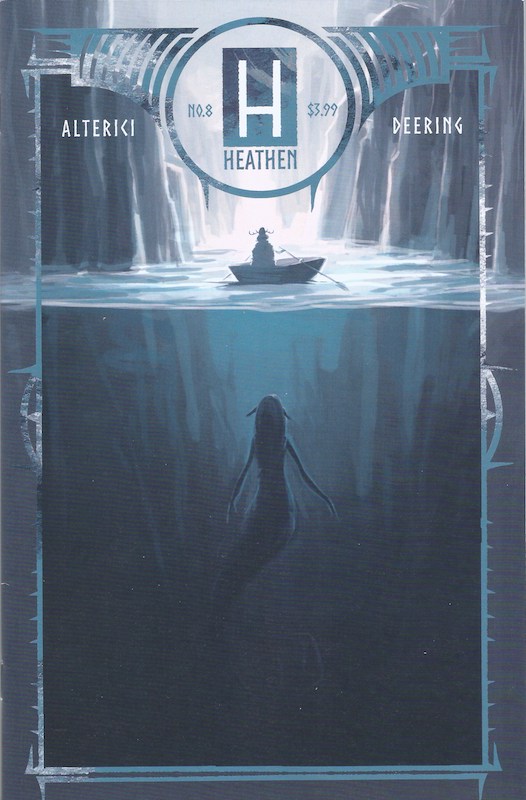
The Odin of Heathen is a bit of a prick.  The Norse top god wants Aydis, a Viking Girl, dead.  She kissed a girl.  Her father rather than acquiesce to his village’s demands—kill the deviant or marry her to a man—set her free to pursue her destiny.  Aydis had a plan.  She intended to show the world what a Viking girl who likes girls can do.  She freed Brynhilde from the Ring of Fire.  And this is the part that really raws Odin, who set Brynhild up for this punishment, she asked nothing in return.

Aydis learns that Brynhild actually had been freed before only to return as part of Odin’s curse.  Aydis, plucky and young, decides she will truly free Brynhild from her curse allowing her to be with Sigurd, her true love.  Odin made him immortal so he would be forever kept from Brynhild.  Odin is a bit of a prick.  

Last issue, Odin ended his former wife Freya’s reign of love by slaughtering her favorite mortal and using the Valkyries as his agents of execution.  Did I mention that Odin is a bit of a prick?


He furthermore broke the truce Adydis established with the mermaids.  Her inadvertent actions endangered her shipmates and now Aydis finds herself rowing the Northern Sea. 

Writer/artist Natasha Alterici takes another step away from the traditional and more familiar Nose myths to set up a meeting with Heimdal, who is not what you think of.  It’s yet another interesting twist on the familiar, while we share the pain of characters we’re invested in.


A dream girl fell out of a slimy wannabe President’s head.  In the ethical world of The Queen of Bad Dreams, Figments as they’re called have rights.  The Judge tracks down wayward Figments and brings them in for questioning.  They can either be integrated in the real world, returned to the dreamer or in the case of a nightmare, dispensed.

In many ways, The Queen of Bad Dreams is Utopian.  Humanity evolved past racism and homophobia.  As well these future humans give concern to the stuff of aether.

Our central characters Inspector Judge Daher Wei and Figment Ava stop in at the Judge’s ex-wife’s home where she introduces Ava to her daughter Selene.  Ava's beauty and charisma creates underlying friction.  Judge Wei though is on the up and up, fearing for Ava's existence, looking for a temporary safe haven until her matters can be resolved.


Ava's presence catalyzes a surprising chain of informational events that run parallel to the investigative narrative.  The whole of the story  climaxes with the Judge confronting Emerson Chase in a very satisfying splash page.


John Carter Warlord of Mars created by Tarzan’s hard-working Edgar Rice Burroughs.  Burroughs harbored no illusions.  He never imagined equating his writing with profundity or art.  He simply wanted to make an honest buck entertaining his readers.  Burroughs would have loved Jeff Parker’s latest mashup, pitting John Carter against Topps Cards ghoulish, bellicose Martians.  The story begins on Barsoom, the Burroughs name for Mars, framed by John Carter’s postbellum Virginian vernacular. 


John Carter gets the best of the Martians, but there are simply too many of the little bastards.  Even the great Green Martian Tars Tarkas can do only so much.


With the Atmosphere Factory of Helium destroyed, Dejah Thoris, Princess of Mars makes a fateful decision.


In this opening, Parker demonstrates a superb appreciation for Burroughs’ works.  Characterization all rings true, and little details like the mention of John's and Dejah's son Carthoris adds to the authenticity of the drama.


Parker next cuts to the present day where he introduces the sort of typical Mars Attacks cast, updated for modern times.


Balancing out the two scientists.  An every man who gains verisimilitude through a plausible explanation.


I honestly didn’t know what to expect after this surprising spin through time.  What I couldn't imagine is instantaneous gratification.

Mars Attacks really, really fast.


And inexplicably to science.  Our central figures end up together on a road trip to a particular cave where John Carter Warlord of Mars sleeps.


In issue two of Warlord of Mars Attacks, the Martians take their usual glee in utter destruction, lording their superior weaponry as they decimate we poor humans.  


Hate to say, but this scenario is accurate.  Any sufficiently advanced conquerer would have very little trouble eliminating or enslaving us.

Meanwhile our heroes compare notes.  We discover that we’re in a present day informed by Burroughs in the same way Dr. John Watson informed readers about Sherlock Holmes.

Dean Kotz’s art is really remarkable.  Kotz excells when demonstrating the Martian talent for butchery.  He also presents the depiction of a friendly conversation with normal people.  And makes that visually interesting.

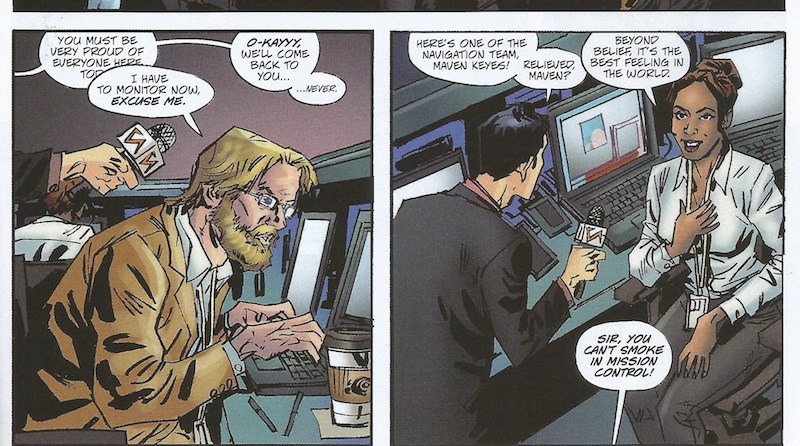
Ramon, Dr. Norman and Maven Keyes finally reach their destination.  

John Carter and all of Burroughs’ creations never age or age slower than normal humans.  Tarzan and Jane have a son just like Dejah Thoris and John Carter.  Korak and Carthoris grow independently with respect to their parents who stay perpetually youthful. 

Parker doesn’t explain that, letting comic book logic do the talking for him.  He does come up with a witty reason for how Mars can be a dead world according to all our probes and the diverse, exotic Barsoom at the same time.

Given that this is primarily an action adventure book, Parker just throws in this hypothesis for fun.  It also characterizes the focus group.  

Parker never forgets what this book is about.  Dialogue from the Martians will please Tim Burton fans.  Their various devices drop snugly into the armada, and Kotz's art frequently captures the essence of the Topps Cards hedonistic sadism.  On the flip side, Parker nods to Burroughs fans who want heroes.  Savage and skillful champion.  What difference does one John Carter make to a Martian invasion.


You may as well ask what difference does one Doctor make to a Dalek invasion.  

For the Red Hood and the Outlaws Annual, Scott Lobdell addresses the fates of Bizarro and Artemis last seen bravely sacrificing themselves to save Gotham City and each other.


They end up as Lobdell left them off in the regular series.  Somewhere far from the now.


Red Hood and the Outlaws is nothing, new nothing groundbreaking, but the execution is superbly entertaining.  As the story unfolds, our strangers in a strange land discover what happened, and it’s not a pretty sight.


Once Lobdell establishes the rules of the game, he proceeds to add little details such as Artemis' separation from Mistress, her Mjonlir-like battle-axe.


Lobdell treats Red Hood and the Outlaws in every iteration as misfit superheroes.  They don’t exactly play like the other heroes, and Lobdell derives a lot of comedy from the fact.  Red Hood and the Outlaws Annual is no different.

A wannabe Big Bad learns the extremely painful lesson of what happens when you mess with a Superman that lacks a Boy Scout code.  It’s a great screwball moment, carried out in Warner Brothers cartoon style translated more realistically by Adam Pollina and Steve Firchow.

In the second half of the story Lobdell, Pollina and Firchow show the passage of time with a simple short hand visual. In the span, Bizarro and Artemis join the resistance movement, and we find some strange representations of familiar figures.


This isn’t the first time the Joker’s been portrayed as a good guy.  It is the first time however the Joker’s never been a villain.  Having never met Batman, he never falls into the vat of chemicals.  Perhaps, he never wore the Red Hood.  It’s an ironic twist given the name of the book.  Lobdell in a sense provides a Red Hood without a Red Hood.

As we delight to the antics of Jack Knife, the plot grows more complex.  A traditional sphincter re-emerges with a threat to not just this universe but the one from which Artemis and Bizarro sprang.  This gives the concluding act a great sense of urgency.


Despite promoting the rogues gallery currently operating in Tom King’s run of Batman, despite not being written by Tom King, the anthology Secret Files is pretty good.  Only one story celebrates villainy.  Three simply give us Batman beating the crap out of Arkham Asylum inmates.  We begin with the Joker.


As you can see by the legend, Andy Kubert comes up with the short story, and he proves to be just as able a writer as artist.  The Joker’s night is filled with pain and humiliation.  Just the way we like it.  I’m not familiar with the artist accompanying Kubert, but he maintains the point of view and adds to the comedy with the Joker’s pitiable expressions.

Collin Kelly and Jackson Lanzing with artists Carlos D’Anda and Luis Guerrero put together a strong Batman tale that demonstrates his detective and disguise skills.


When he stands revealed, things go father south for the villain of the piece who I shan’t reveal.  Batman’s enemy poses a good threat, giving the story added depth, and the final panel will make you smile.  The Dark Knight really isn't that dark.  I've been trying to tell people that for years.


Batgirl writer Mairghread Scott pits Batman against the Riddler in a battle of wits.  She lays out clues for a fair play puzzle and introduces a curious habit the Riddler has when recognizing his defeat.  

Professor Hugo Strange is a Golden Age Batman villain.  In the Bronze Age, he learned, stole and protected Batman's secret identity.  In the New 52, Strange alive and well no longer possesses that knowledge.  He now obsesses over the mystery of Batman's alter-ego.  Steve Orlando exhibits Professor Hugo Strange’s madness in a nasty piece of murder and psychosis.  

Tim Seeley writes Bane with Patrick Gleason on the art detail.  Seeley's story creates a pretense of sympathizing with the devil.  This is in part due to Bane being inspired by the heroic masked wrestlers of Mexico.  The punchline though delivers Bane's nasty surprise.


Dan Slott introduces a new twist to The Fantastic Four.


I’ve never heard of this “annual transmutation.”  I guess if you study past volumes of the Fantastic Four, the Thing on average transforms back to Ben Grimm on a yearly basis.  That said, taking away his FF signal device so he can enjoy his honeymoon with new wife Alicia undisturbed is just asking for trouble.


The peril of course comes in the form of the Hulk.  This is not a spoiler.  The Hulk is on the cover.  Slott parallels the Hulk's arrival on the island paradise with Godzilla's frequent stops in Tokyo and of late Hawaii and San Francisco.  We see a disturbance in the water before the manifestation.

This is not the Hulk and Thing’s annual brawl.  Phillip Masters the Puppet Master controls the Hulk.  In a sense, the Hulk is actually Mecha-Godzilla before the genuine green guy burns off the fake skin.

Seeking revenge or just laughs, Dr. Doom gifted the Puppet Master Power Cosmic Clay.  Slott’s enhancement is pretty slick.  You need that kind of force to compel the Hulk, especially nowadays.


The Puppet Master intends to break up the Thing’s honeymoon with Alicia.  Oh, and he wants to kill Ben.  He always hated Ben Grimm.  Who knows why.  

You’re probably asking why he would threaten Alicia.  They’re not blood.  Alicia is his stepdaughter.  Though he expressed honest love for her before, he’s just crazy enough to dismiss her.  Phillip Masters is one of the most mercurial of the Marvel psychopaths, and underestimated too often.  This issue of The Fantastic Four rights that.