Pick of the Brown Bag
January 8, 2020
by
Ray Tate
The Pick of the Brown Bag is strong in this one. Welcome. My name is Ray Tate, and I review comic books. For this edition I look at: The Amazing Mary Jane, Black Cat, The Butcher of Paris, Doctor Who, Ghost Spider, The Immortal Hulk, Red Sonja and Robotech Remix. If you haven't time for the meatier critiques, check me out on Twitter: #PickoftheBrownBag.

This week's "Orphan 55" became a controversial episode of Doctor Who ostensibly because of its grim, prediction for the earth. One that appears to counter the future history we've thus seen on the series.
I however suspect the controversy is actually due to the Doctor taking the practical stance of supporting climate change like every other scientist. The Doctor always supported alternative energy.

In reference to oil: "It's about time the people who run this planet of yours realize that being dependent on a mineral slime doesn't make sense."
As for the pretense, the Doctor in the classic episode "Pyramids of Mars" faces an alien menace whose race gave rise to the Egyptian Gods.

Sarah Jane however points out that they could just leave. With respect to the period, she's from the future, and things turn out fine. So, the Doctor smiles and steers the TARDIS to a timeline where their departure happens. Sutekh reduced the earth to a wasteland.
The Doctor traveled to parallel timelines at least since the seventies, real time. Indeed, "Pyramids of Mars" is more philosophically controversial than "Orphan 55."
"Orphan 55" is a brilliant, terrifying horror/science fiction hybrid. Featuring an extraordinary monster, that makes me hate Prometheus even more. The monster incidentally is a variation of another beast seen in a prior episode. I'll not say which since that would ruin the surprise.
The Doctor's commentary and the implications about climate change give the episode added depth. At heart, this episode is designed to scare the stuffing out of you. The Doctor however does not obliterate the timeline. She just survives and ensures the survival of others. Small spoiler.
"Pyramids of Mars" surmises that without the Doctor, the earth would have met a natural demise long ago. Sutekh is actually part of the earth's true timeline. He should have succeeded. Instead, the Doctor through time travel intervenes. To quote Bill Potts: "Perhaps there's just some bloke. Wandering around, putting everything right when it goes wrong." Or a bird.

The Doctor Who comic book debuts a new volume for 2020 with a fresh story written by Jody Houser. Illustrators Roberta Ingranata and Enrica Eren Angiolini also return for this adventure. It's another tale of two Doctors which begins in the TARDIS amidst some spiffy background imagery.

The Doctor is only too pleased to ferry her companions to Woodstock. Alas. The TARDIS diverts them to 1960s London.

The Doctor suspects a rationale for the change in venue. The answers may lie in her past. In the television episode "Blink," the Weeping Angels maroon the David Tennant Doctor and companion Martha Jones in 1969. Ingranata and Angiolini present some fantastic likenesses of our friends.

The Doctor splits the team. She will talk with Martha. The others will keep an eye on her past self.

Houser's story is a fancy with numerous applaudable moments. Ryan raises the horror movie trope associated with "splitting up." The Doctor carries pictures of her past portraits. The fam note the Tennant Doctor's "dramatic coat." Houser comments on how the current Doctor is more empathic. Her encounter with Martha Jones is revealing. Martha fell in love with her Doctor. The Doctor learned that toward the conclusion of his season. Now, she can properly address Martha's feelings.

Though the Doctor's guilt can be expected, she's actually being a little too hard on herself. The Doctor and Rose fell in love, and his separation from Rose wounded him something fierce. Martha in fact always felt in competition with Rose, lost on the other side. She's horrified and impressed when Rose actually manages to return, albeit briefly. Had the Doctor teamed with Martha first, who knows? Romance has been an option since 1963 when Susan introduces us to her grandfather the Doctor.

Duplicates abound in Robotech Remix. I haven't thought of Robotech in years. Reading the new Robotech from Brandon Fletcher brings back lots of memories presented in a new way.

Rick Hunter is a dick. Sure that's the alternate universe Rick Hunter strangling our Dana Sterling, but come on. He's always been a dick.
He also appears to be cheating on Captain Lisa Hayes with another damn singer. This one named Aahna.

Other multiverse shenanigans abound. Dana's Dad Max Sterling and Zentradi pilot Miriya aren't an item.
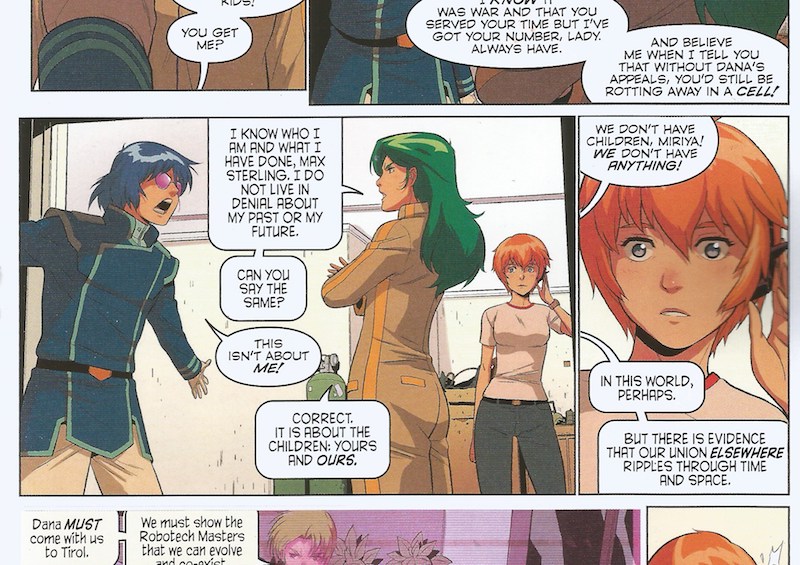
They apparently will not have Dana Sterling as their daughter. Though everybody loves and respects our Dana, visitor from another earth. She in turn does what she does best. Saves the day.

This time from zombie Zentradi warriors. Yep. Things are different, jumbled and entertaining in Robotech Remix.

You can argue that some of the changes in Ghost Spider's earth don't really amount to much. She gets bitten by a radioactive spider instead of Peter. Her Dad though is still a police captain. Her universe has a Captain America. Of course, she's black. In any case, lately, there hasn't been an emphasis on the things that distinguish her earth from Marvel earth proper. Sure, writer Seanan McGuire brought two Jackals together, but it's the Jackal. One's a scientist. The other is a stalker-clone master. It's splitting green hairs.
This issue of Ghost Spider slams you with many differences between Earth-Gwen and Earth-Peter. Slighter change. Mary Jane Watson and Gloria Grant are gay. They're also a couple.

That's just icing on the cake. The Fantastic Four never happened on Earth-Gwen. Instead, Johnny and Sue Storm became brother-sister models/influencers.

What the hell? Right? The gist of this issue is a hostage situation at a bank.

Ghost Spider of course thwarts this hilarity after exchanging amusing dialogue with her father. Everybody knows Gwen is Ghost Spider. That fact actually enhances the comedy. However, the hostage situation, and Gwen's gift to her pals in the Mary Janes do not make up the lion's share of the story.

This is just one chapter in the entirety. McGuire and artists Ig Guara, Rose Kampe and Ian Herring give readers a taste of a stronger tale involving the kidnapping of Johnny and Sue.

There's a lot about that development that intrigues. First, the contrast in art. Johnny and Sue posing on a sunlit beach full of vanity and optimism. They however fall victim, and when they return, things grow dark. The other factor lies in their ages. Sue and Johnny are young adults, and this is a very odd abduction given their ages. That probably fascinates me the most.

Mary Jane Watson, straight or bi actress, sometimes married to or in unwedded love with Peter Parker. She's in the movie about Mysterio's life directed by Quentin Beck, disguised as a famous Marvel film director.

So, yeah. Mary Jane really feels for Quentin and appreciates that he's doing all of the film on the up and up. Within reason. Like a lot of low budget flicks, things haven't been peachy. The latest is the loss of Spider-Man.

The abandonment in some ways refers to the doomed Spider-Man musical production on broadway. That's okay. Mary Jane's got the solution.

A little CGI or Mysterio illusion and Bob's your uncle. Of course, even with the money influx rescuing effects and sets, the paparazzi try to scoop and spoil. Fortunately, Mysterio gave some ex-associates jobs.

Screwball is a lot of fun. She's much better here helping out and restraining her penchant for self-promotion than hitting for Arcade in Elektra.

She and the entire film crew will need all their guile because the Sinister Six is up and about, gunning for Mysterio and company. Seeking revenge for an embarrassing comeuppance.

Black Cat teams up with the Beetle's daughter in order to break into Danny Rand's corporate headquarters.


It's another heist! It makes sense and gibes with Marvel continuity. You all knew that Iron Fist is Ray Palmer rich in the Marvel Universe. Right?
Anyhow, the heist goes awry when, well, I'm not going to spoil that little titbit. Because the visual is surprising and laugh out loud funny. This also calls back to the Dr. Strange issue. Animals love Black Cat.

I will spoil that Danny Rand and miniature Iron Fist Pei who I encountered in the superb Contagion interrupt the crime for some fun-filed fisticuffs. The dialogue associated with Iron Fist is absolutely hilarious. If I had to pick out something amiss in the issue, it would be a minor disconnection between the main story and the epilogue.
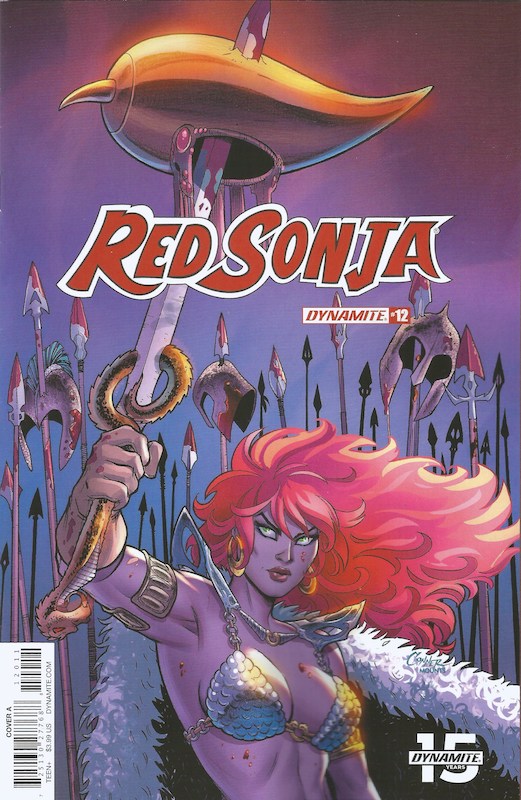
Red Sonja unanimously elected Queen of Hyrkania due to her tutelage under the Master Warrior Domo. She learned everything he had to teach, and in this issue, it all comes to fruition at a chokehold on a strategically vital bridge.

The fight between Sonja and Dragan the wannabe emperor of the world ends in a satisfying conclusion filled with blood and beheadings.

Though Mark Russell and artist Mirko Colak demonstrate the drama of fighting, they do not glorify war. Sonja sought to survive and save her people. She wanted none of this. She takes no pleasure in any of the battle. That pragmatism and displeasure distinguishes Russell's Sonja from others' who paint a different yet still valid picture of the She-Devil with a Sword. As to Dragan, he dies not in bloodlust or the veneration of his threat. Dragan dies in a whimper.

It's always a surprise when Vampirella is actually the most normal element in a story.

An alien, sun-loving vampire with a penchant for showing skin is nothing when compared to a smoosh of Clive Barker and Brian Yuzna films.

Got Your Nose
The silver dude is Pendragon. Pendragon used to be an old stage magician. Vampirella adopted him in a peculiar parallel to the way the Marvel Family adopted Uncle Dudley.

The silver shapeshifting ship is actually the alien entity Passion. She's like the Robert Patrick Terminator only an ally. In one disturbing scene, she burbles and buds naked, silver women to combat evil minions.

Please, no nipples and vagina, we're American. Frankly, I find the lack of genitals more disturbing. On the other hand this is nothing like the nightmarish trailers for the movie Cats. So, thank you for that.
In another scene, Passion armors Vampirella. This moment exemplifies V's comparative normalcy.

Vampirella looks perfectly sane in that armor. Even had this fashion materialized in the nineties it would have paled next to some of the multi-patched, jagged edged body plating prevalent in the era.
Technically speaking, Passion is embracing Vampirella. You can even read something in her reply of "Our pleasure." If you wanted to be comic book vanilla the silver women could have simply turned their arms into shields. No, this is subtextual weirdness. Passion kinkily wants to envelop Vampirella. Who can blame her?
Vengeance of Vampriella takes readers back to when Harris Comics steered the Warren magazine heroine through an impressive run of issues. These comics detailed the new villain Lady Nix's attempts to rule the world as an envoy to her masters. Be careful what you wish for.

Lady Nix is less clothed than Vampirella. The book doesn't flaunt nudity. Rather, it teases it. Nix and her idiot cohort Hemorrhage worship an amalgamation of bodies fused in misery. If that's not Barker, I don't know what is. As to the plot...um....it kind of escapes me.

Somebody or something resurrects Vampirella. She intends to reclaim the earth from these Lovecraft yo-yos. Nix kind of wants V to stop her, but she wants to have fun tormenting her in the process. I get the impression that Nix would be happier with hit-and-run tactics. Engage Vampirella get in a few good smacks but run away to play again.
Honestly, Vengeance is more of a what the hell will they do next kind of book. You're here for the spectacle and the nods to horror history not necessarily for the barely structured plot.
Immortal Hulk began as a straight-up horror themed comic book, but it was still based in science fiction. The Hulk cannot die. When you kill Bruce Banner, at night, he emerges as the Hulk. Writer Al Ewing put together a story that used many of the traditions in the Hulk but provided a thoroughly different execution. The same can be said for this current issue.
The Hulk is now more of a team. He defeated Shadow Base led by General Fortean. The baby Thunderbolt Ross. So, he took over the headquarters, recruited some of the people and with Doc Samson, Rick Jones and Betty Ross intends to end the human world.
That involved last issue his attacking Roxxon Oil. As with any bad guy, the Minotaur counterattacks using some familiar faces in the Hulk's rogue's galleries. The Hulk however is known to battle monsters.

That hasn't changed. The execution however and the powerful art of Joe Bennett has. From the seamless shift to horror, to philosophy, to corporate and military overreach to kaiju. The Immortal Hulk.
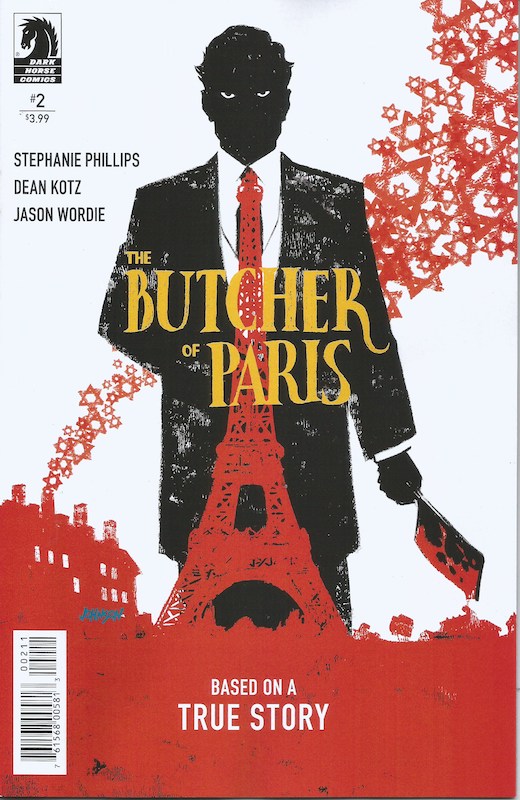
In the second issue of Butcher of Paris writer Stephanie Phillips and artist Dean Kotz emerge with some of the gruesome details of the true-crime case.

The Nazis and the Surete seek the Butcher for different reasons. The Nazis identify him as a link in the chain of an underground railroad that spirits Jews out of Vichy France.
The Surete of course want to serve justice and protect the people of France, while tolerating the Nazi rule of the city. Phillips brings modern criminology technique that allows Kotz to present imaginative, pulpy terror to the proceedings.

I'm of two minds. The scene can be considered a misstep, making light of the monstrous. On the other hand, the somewhat benign and sexual Mabuse like phantasm fits with the French preoccupation with Mystery Men and diabolical criminal masterminds in fiction. So, yes, this old inspector might conceive of something quite innocent to us that would appear positively vile to himself.
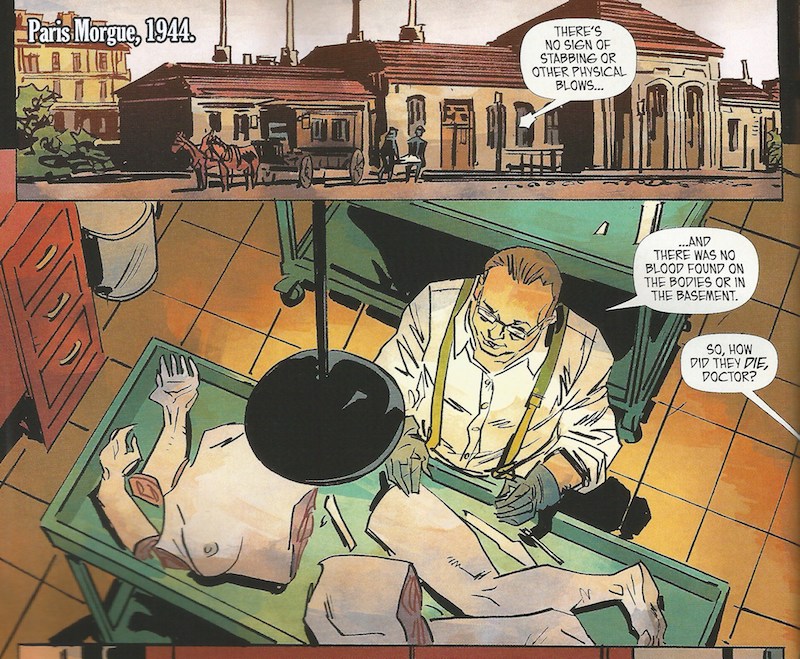
The truth of the matter is rancid. Have some nudity. It's from pieces of a body. Enjoy. So, a little bright fantasy is welcome. No matter what, one thing remains true. Phillips characterizes the Nazis, even those earnest and intelligent as thoroughly unpleasant bastards.