Sunday, July 26, 2020

POBB July 25, 2020

Pick of the Brown Bag
July 25, 2020
by
Ray Tate

Welcome to the latest Pick of the Brown Bag.  I hope you're enjoying the more in-depth reviews.  Albeit, at a slower rate.  For this posting, I look at the newest Starring Sonya Devereaux.


First, Jaws--affectionately known as Bruce--terrorized audiences.  Then, Grizzly--affectionately known as Grizzly--brought tears to the eyes of ten year olds everywhere.  


Grizzly is so very good.

Alas, plausible, huge animals devouring tourists became passé.  Filmmakers would find ways to crossbreed such creatures for new frights.


Or, not.


Sonya Devereaux faces the latest of these hybrids.  Only, she doesn't.  Sonya Devereaux is a fictional actress who stars in cheesy movies.  The comic book presents her current film.  


To establish the rules, the creative team of Todd Livingston and Nick Capetanakis open the issue by exploiting a wraparound segment featuring a horror hostess in the vein of Elvira.


Mmmmn.  The state of double-entendres and the land of bad puns were made for eerie emcees of late night television.  

You'll note that Capetanakis along with inkers Brendan and Brian Fraim and colorist James Couts execute traditional styles.  This emphasizes that what you're reading is fiction reflective of our reality.    


The artists and writers offer a smart, successful woman who plays dumb and often dumber in her movies.  She's not a cartoon, though her characters just may be.  

In fact we've only seen a glimpse of Sonya Devereux's truest self when talking to a fan at a convention.  The rest of the time, she's performing either for Ivanna Cadaver, lovely, simply lovely, or an entertainment reporter.


The prologue and epilogue could have been a throwaway construct.  Instead, Ivanna, between gags, conducts a light but serious interview with Sonya about the flick.  This serves to reinforce the conceit of the premise.


The whole scenario reminded me in a good way of the DVD extras from Katrina's Nightmare Theater on the Scorpion Releasing line.


Sonya's character joins a defective A-Team to search for a missing archeologist.  What they find is a Spider-Shark and a Snake-Bear that decimates the cast.


Starring Sonya Devereux's movie opens with a killer twist, which may be a spoof on The Suicide Squad.  It's not exactly funny just strange.  The comedy hits hard when a Lyle Waggoner figure shows up as the insufferable bureaucrat archetype.  Is he something more?


Nah.  Just a tight ass.  That LOL giggle will carry straight through the story, appearing when you least expect it to give you a chuckle.  Throughout, the pacing of the often clever jokes is superior to anything you would see in a movie from this genre.  

Our team gathers, and it's a superb spectrum more woke than the actual A-Team.  More like The Fast and The Furious franchise or the underrated Losers.


Ah, yes, the T in our A-Team.  Sonya stays like that through the lion's share of the book.  There's quite a bit of snappy writing and artistry in this scene.  Not just a woman showing off her ample chest in a bikini.  This is the television version of the film.  Ivanna is a television hostess.  So, no nips just cleavage and sultriness.  In fact Sonya and the rest of her female cast mates showed more skin in her last issue  "on video."

You should draw your focus on other aspects of the torso, particularly the super thin tactical gear the men wear.  


This is a brilliant visual goof.  They look like they've donned tricked out Walmart greeting vests.  I think only one of them have pockets that actually open.  The costuming is exactly what you'd expect from a low budget film with monsters given a higher production values than the typical CGI dreck.  


The Shark-Spider is a delight.  It's scientifically bankrupt.  As is the Snake-Bear.  The chimeric creatures and their attacks do not add up to funny.  Oh, look, it's a send-up of Jaws. Ha.  Ha.  No, no.  Sonya Devereaux goes way, way over the top and comments on the fine traditions of shlock on the way to the summit.

For example, our missing archeologist, remember her, loses her pith helmet, and some other clothing, when she runs afoul of a severely misplaced Russian Ilsa.


If you don't know who Ilsa is, I'm almost motivated to say good for you.  When you see a sexy female dressed as a Nazi, you're looking at a reiteration of Dyanne Thorne's Ilsa, She-Wolf of the S.S.  Femme Fatale Nazis spied in cinema before Ilsa, of course, but those actresses executed their roles dramatically.  Nazi sexploitation from the female perspective began with Ilsa.

Not to worry.  Livingston and Capetanakis pump the gratuitous suspense values considerably.  However, this is the television version of Spider-Shark vs. Snake-Bear.  So, you'll not see any explicitness or nastiness ahead.  More like hapless actors being splattered with ketchup and an abundance of poor science leading to absurdity.  

The latest from Sonya Devereux maintains a delicious spicy, bad sci-fi quotient and delivers on the promise of the title.  It also goes farther than other issues with wtf twists that turn at a breakneck speed.  Take away the jokes, film this seriously with the budget proposed, and you would come away from the viewing completely dumbfounded. 

Wednesday, July 8, 2020

POBB July 6, 2020

Pick of the Brown Bag
July 6, 2020
by
Ray Tate


Farewell to the maestro.


Welcome to the Pick of the Brown Bag, this time around, it's Avengers Empire.  I would refer to Empire as Empire with a Y, but the spellcheck just hates that.  Any time I go back to edit, it thoughtfully corrects my error.  I also don't think Empire with a Y deserves being learned.  It's not even real English.  It's like Pig-Brit.  So herein, it's Avengers Empire.  


Empire is the Big Stupid Event of the Marvel comic book season.  The Kree and the Skrull put aside their differences to exterminate the Cotati.  That's a lot like Superman and Lex Luthor getting together to expunge hippies.


If you don't know who the Cotati are, don't worry about it, because baby, they are obscure.  They're a sentient plant species that thrived in the Kree solar system and play a part in the 1970s Avengers saga of the Celestial Madonna.


Stop me if you've heard this one before.  Steve Englehart and Don Heck create a Vietnamese female master of the martial arts.  So far so good.  Inclusive and bad ass.


Dubbed Mantis, she learns her skills from renegade Kree priests.  The Priests of Pama unlike the bellicose Kree seek peace and harmony.  They don't get it, but they seek it.


In this pursuit they tend to the Cotati.  So, basically, they're alien Buddhist gardeners who strike a home on earth only to be harassed by the warlike Kree.  

That's not too nutty.  I mean we are talking about comic books.  Englehart and Heck could have just made Mantis a really dangerous Buddhist monk, but I guess that would be too much like Kung-Fu.


The priests train Mantis because they believe her to be the Celestial Madonna.  Okay.  Now, we're getting into trippy territory.  

Why not train the girl, just because?  Why do you need a scuzzy ulterior New Age motive?  Kung-Fu sometimes featured a female Buddhist monk, and the Shaolin trained the girl just because.

You can argue that Englehart and Heck presented a hero in rebellion against her destiny.  I've heard that position before, as well as Mantis eventually freely choosing that destiny.  Honestly though, I find the whole Mantis/Celestial Madonna thing kind of sleazy.

Englehart and Heck produced the perfect mate for Mantis.  A dead guy reanimated by the Cotati, who returns at an opportune moment in Avengers Empire.  


I never thought that much of the Swordsman.  Cheapjack Black Knight, nine times out of ten a super-villain betraying the Avengers.  Now, with fungus.

So, let me just tick off the boxes.  Despite everything accomplished, woman's only importance is to be a vessel.  Check.  Necrophilia.  Check.  Plant-Animal Loving.  Why not.  Check.  

Englehart wanted to see his plan fruit so badly that when he left Marvel, he completed his masterstroke in Justice League.  Here, he and the phenomenally underrated Dick Dillin presented the consummation.  


That's just weird.  Not the sex scene itself.  Just the idea of going to another company and saying, "At last! Now I can orchestrate the sex scene between Mantis and her Ficus!"  

Willow as Englehart christened her in the DC Universe furthermore enamored every male Justice Leaguer on that mission.  Essentially, she became the femme version of Eros.


I'm not bad. I'm just drawn that way.

After producing the Celestial Messiah this time at Marvel Comics, Mantis went on to become an even more highly confusing character.  She turned green.  I guess because she made it with a plant.  She sported some antenna.  Because artists mistook hair sprayed and shaped into antenna as literal antenna.  

Mantis though is a human being.  That was the whole point.  Forging her into the ideal mortal vase for the perfect rose bush grown on fertilizer.

It's no wonder James Gunn and the writers of Guardians of the Galaxy thought Mantis was an alien.


Empire continues the shaky claim of saga for the Cotati.  The tale begins when Iron Man mimics his cinematic counterpart and dreams of the Cotati slaughter on the Blue Area of the Moon.  

Captain Marvel also gets an SOS from the Celestial Brain, whatever that is, and before you know it, we're off to the moon.


I'm not wild about Avengers Empire.  Addressing the plight of the Cotati and a dubious alliance between Kree and Skrull just seems perfunctory.  As I pointed out I wasn't a fan of the Celestial Madonna business either.  So I admit to being bias about the continuation of a storyline that should have died some time ago.

That said, Al Ewing does give me a better She-Hulk than I've seen recently.  The last version of She-Hulk I loved served as part of A-Force.  This dumber, pumped up one is better than the Gray She-Hulk in that dopey mini-series and Jason Aaron's debut She-Hulk.


I also like Ewing's treatment of Thor.  He's very cosmic, expressing the age and wisdom of an ancient alien.  He may not be as knowledgable as Tony, but like his counterpart in cinema, he's no dummy.

Ewing had the opportunity to write for Captain Marvel before, but that was during a period that she started a second Civil War, or something.  She and Black Panther set at each other's throats.  It's nice to see Ewing's Captain Marvel without any drama.  Save that inexplicably brought up by Iron Man.

What the hell, Tony.  I also question given that line the colorist giving Carol's nose a boozy red sheen.  Nobody else gets a boozy red nose.  Just Carol.  Iron Man also delivers the Avengers Assemble speech, and that just feels wrong when Cap is on hand.  Maybe Ewing just wanted to experiment with something novel.  Not every experiment succeeds.

Wednesday, July 1, 2020

POBB June 30, 2020

Pick of the Brown Bag
June 30, 2020
by
Ray Tate


How dare you.  

I am not letting you take these words as your own, you Turner Diaries humping Nazis.  

Fuck you.


And while we're at it fuck your attempts 
to claim Hawaiian shirts.  I don't wear them myself, but your perversion of innocent pop culture is unacceptable.

You know what you can have?  White dunce caps.  They fit.

And with that out of my system, welcome to the Pick of the Brown Bag.   For this issue, I review Harley Quinn and the Birds of Prey, Book Two: Electric Boogaloo.  No, no, it's not subtitled Electric Boogaloo.  I'm just following my long tradition of referring to sequels with the delightful phrase Electric Boogaloo.

Oh and fuck you, Nazis.


Okay, now that that's out of my system.  Amanda Conner and Jimmy Palmiotti present the second issue of the first credible Black Label series.  Although you should have bought Harley Quinn Book One, you needn't have read it, in order to understand the current issue.  In fact, each book so far stands on its own.  

The story began with Harley Quinn seeking revenge and justice against the Defeo Mortgage Company.  She did this through over the top violence.  If you're not interested to see what transpired as the trigger, Palmiotti and Conner summarize on the first page, and no more.


Book Two actually begins thusly.  Harley Quinn is in Gotham City ostensibly looking for payback against the Defeo Mortgage Company.  GCPD's Renee Montoya quickly detains and apprehends Harley.  The newest incarnation of the Birds of Prey sit in on the conversation as interested parties.


Harley recently reacquainted herself with the Birds on the train ride to Gotham City.  They appear to be here just to satisfy their curiosity, which is a fine rationale for any detective.  Palmiotti and Conner pepper the dialogue with double-entendres and Harley insanity, and honestly, I didn't find it all that funny.  Humor's subjective.  Cassandra Cain's voiceless reactions?  Hilarious.


I harbored a long loathing for Cassandra Cain.  Not just as an unnecessary Batgirl substitute, but also as anti-feminist and a symbol of creative laziness.  I won't get into a long tirade about how DC kept giving just anybody a Batgirl costume rather than heal the bona fide version.


I'll just say that introducing a female character as an illiterate mute sends the wrong message.  Dressing her up from head to toe in a black costume that makes her resemble a Batman-styled dildo is equally depressing.  

I've stated that Cassandra Cain is a handy substitute for any character any editor doesn't allow in another book.  Say you wanted Catwoman to team up with Batman? No.  Can't have that.  Just get some White Out then for the dialogue and some India ink to cover the figure.  Scribble some ears.  Boom Cassandra Cain.  

Amanda Conner and Jimmy Palmiotti make Cassandra Cain my favorite character in the book. 

Although Black Label books aren't supposed to be part of continuity, the creative team nevertheless explain some plot details using continuity, DC's broad gamut and their own.  One of the things they cover is Batgirl.  Old Blue Eyes is Back.

Yes, absolutely correct.  They're blue, Baby.  Blue.

Thank you, Alex Sinclair.  Not only do you give me colors that pop like candy, but the proper blue-eyed Barbara Gordon.  

Batgirl only makes a cameo appearance, but it's an important cameo.  Palmiotti and Conner use this one cameo to demonstrate that this is Babs Gordon back as Batgirl, or never crippled in the first place in the Harleyverse.  


They find a funny and realistic means to knock her out of the action.  They also demonstrate that Babs approves of Cassie.  She lends Cassie a Batgirl costume.  The action furthermore displays Babs' confidence in her alter-ego as Batgirl.  She doesn't feel threatened by Cassie.  

Conner's art for Cassie turns this appalling character around.  She's mute, but it's no longer just some hack writer's trick trying to circumvent the creation of dialogue.  The body language and her expressions characterize Cassie Cain.  Babs' amusing "Chatty Cassie" is as well a nice touch that bolsters both of the players in the scene.  You also can tell that Cassie's intelligent by the look in her eyes, the way she behaves and literate, given her reading the amusing signings on Babs' cast and her use of a phone.  Why couldn't DC have introduced this character?  Not as a Batgirl substitute, mind you.

When Cassie chooses a uniform, Conner goes above and beyond the leather fetishist's wet dream--funny given this is a Black Label book.  She designs something attractive and practical to signify Batgirl without contributing to the outright theft of the persona that DC abetted.


Sanctioned by Gotham PD, Cassie and the Birds of Prey with Renee Montoya follow Harley's lead to the Joker.  The battle exhibits knowledge of Joker tactics, a surprising amount of police effectiveness, a smooth working relationship with the capes and cowls, a helicopter tailing in which the women pilot and a great Black Canary moment.  

Conner and Palmiotti perform another coup.  Once again, there's this aspect of stand-alone quality in Harley Quinn.  If you hadn't read about Harley's previous encounter with the Defeo Corporation, you may just very well believe that the entirety of Book Two is Harley's vengeance upon the Joker, delivered through the sword of Birds of Prey.  This presumption works out beautifully for an entertaining reading experience.  Even if this is one component of Harley's planning.


The Palmiotti and Conner Joker is a substantial criminal.  The post-Crisis Joker is largely one-note; which of Batman's cast will he cripple and/or kill next.  Who had Sara Essen in the Dead Pool?  Scott Snyder and Tom King re-energized the Joker for the New 52.  Conner and Palmiotti though produce a decidedly unique Joker.

Palmiotti's and Conner's Joker is sane and evil.  You can tell by the way he intelligently observes situations.  He also doesn't seem to understand why so many people follow him into hell.  He is quite willing to take advantage however.

By the way, Harley Sinn's slight boobage reveal is about as explicit as the book gets.  So, those looking for anything in the vein of the piss-poor strangle-fuck sequence in Batman Damned will be disappointed.  That wasn't explicit either.  So if you've got some kink on your mind.  Put it out.

Harley Sinn derives from Conner's and Palmiotti's regular Harley Quinn series.  She's an ideal psychopathic foil for the Joker who displays his sadism, his sexism and overall crudeness.  Harley Sinn is the henchwench you expect a killer to have.  Harley Quinn was always just too nice to be part of the Joker's lethal schemes.  In fact, Paul Dini and Bruce Timm put together Mad Love to explain how the Joker essentially brainwashed Arkham Asylum's Dr. Harleen Quinzel.  They presented Harley as the Joker's mentally and physically abused victim.  

With that in mind, Conner seldom illustrates the Joker as playful.  Conner depicts the Joker with a difference.  He's creepy instead of comical.  She adds this motif in the art that identifies with body horror, emphasizing that the Joker's visage is a result of a chemical bath.


It makes him more unsettling.  She also displays the hate in his eyes.  The Conner and Palmiotti Joker isn't out for laughs.  He's out for himself, to kill the world and leave a smile on every face.  That is only implicit in the artwork, not the writing.  While a lot of writers in the past accented the Joker's spree and serial killings, Palmiotti and Conner make the Joker as well a larcenous villain.  Indeed, the Joker began his criminal career as a murderous blackmailer.  

The Joker's wealth is key to this story.  It creates a surprising opportunity to reintroduce another Palmiotti/Conner creation that I'll not spoil here.  Suffice to say that you really should have expected her appearance.

Conner and Palmiotti write the Joker more like a criminal overlord set in a science fiction world.  We get to see his practical use of firearms.  He's a known quantity in Gotham City.  So all the first responders know of his love of for bombs.  Palmiotti and Conner also make modified use of his 1950s penchant for robots.  I've never been a fan of villains.  Some I'm happy to see.  Batroc for example.  I found the Joker to be tiresome in the post-Crisis.  The New 52's talent made the Joker fascinating again, and this version of the Joker is remarkable in so many ways.  Conner and Palmiotti somehow make the Joker threatening without relying on mass murder.  They make him even dangerous in a sound defeat.

Book Two read as a whole is a massive blowback against the Joker, set up by Harley Quinn, yet this visceral battle against the Birds of Prey is a means to an end.  Her total obliteration of the Joker's threat relies on a super-powered heist, and even this is part of a complex counterattack against the corrupt Defeo Mortgage Company.

Wednesday, June 17, 2020

POBB June 16, 2020

Pick of the Brown Bag
June 16, 2020
by
Ray Tate

I’m hoping to get the Pick of the Brown Bag up and running at full speed now that a decent complement of comic books arrives at the store each week.  However, a bad update put my Mac out of commission, requiring me to erase the hard drive and reinstall Sierra.  Thank goodness, it wasn’t Microsoft.  The Apple Support people were helpful, gave me tricks to try and walked me through the inevitable erasure.  I was able to restore my Mac and the peripherals with little difficulty once I had the time.  So without further ado.  Here’s the review of the pricey 80th Anniversary Catwoman Special.


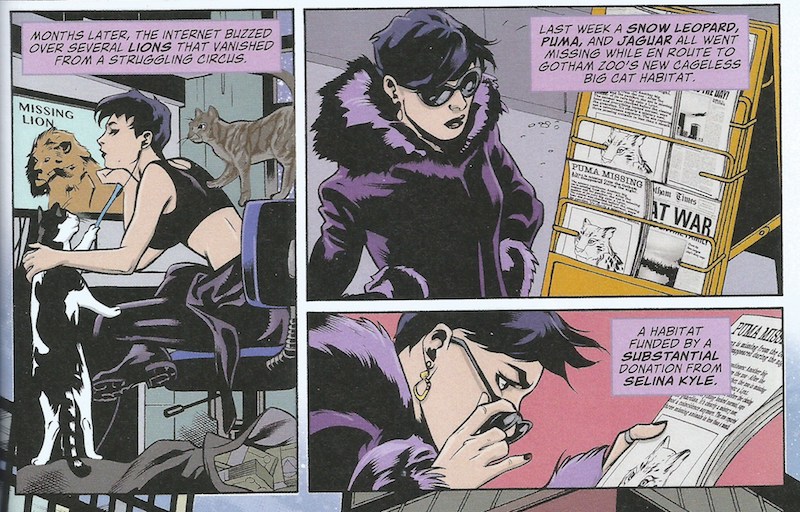
In short, buy this.  Yes, it’s ten bucks, but it’s one-hundred pages lacking a single ad, square bound in prestige format with excellent paper stock.  You get for the coin ten brand new Catwoman short stories, each well-written with superb artwork.

In the first, “Skin of the Cat” Paul Dini, Emanuela Lupacchino, Mick Gray and Laura Allred relate a quintessential Catwoman tale in which she combats a crazed animal lover.  


Despite the modern trimmings, the tale could have occurred at any point in Catwoman’s history.  It’s devoid of continuity references and instead introduces an origin for a new Gotham villain as well as emphasizes Catwoman’s ecological leanings.  The art aesthetically demonstrates a full range of subjects.  Selina’s svelte body, animal anatomy and a grotesque villain.


Depictions of Catwoman’s historical looks and a pin-up bookmark each story.  Pin-up artists include Babs Tarr, Ty Templeton, Steve Rude, Tula Lotay, Tim Sale and Brennan Wagner, Jim Balent, Jae Lee and June Chung and a reproduction of Darwyne Cooke’s classic.


In Ann Nocenti’s “Now You See Me” Selina hides her ill-gotten goods but notes the new Big Brother system in Gotham’s employ.  This attracts a crooked security guard allowing Robson Rocha, Daniel Henriques and Alejandro Sanchez the opportunity to flex some playful fight choreography muscles.


The fight, the interplay between crook and arch-criminal would be enough, but Nocetti also includes within the brevity of pages a sharp supporting cast-member and a background scheme that’s fair played throughout the visual narrative.  A treat for the most observant.

Tom King continues to plot out the canon of Batman with a special short that’s filled with humor and warmth as well as breathtaking artwork from usual suspect Mikel Janin and Jordie Bellaire.  


The name of the story “Helena” will give away the subject. Knowing however doesn’t undermine the quality and comedic surprises in the tale.  

Incidentally, the original Huntress of Earth Two assumed this sobriquet because a criminal ends Catwoman’s life and her father, blaming himself, vows never to be Batman again.  As seen in Tom King’s Batman Annual, because Catwoman outlives Batman in the New 52, Helena becomes the second Batwoman. 

Speaking of multiple earths, Jeff Parker in “Catwoman of Earth” revisits the swinging sixties Catwoman with the one man visual team of Jonathan Case emulating in pen and ink Julie Newmar.

Catwoman’s spoiling of an alien invasion is, dare I say, Purrrrfect.  It’s more than just kicks.  Parker’s characterization for the sixties Batman Catwoman with her acceptance of the inevitable and her acquisition of a new female helpmate in a roar of feminism rings true.

Liam Sharp’s “Cat of Nine Tales” cleverly exemplifies how Catwoman is more than just a whip and hips.  She’s a cunning thinker and a thief from the gentleman jewel lifter school.  As such, she attempts to eschew violence when purloining.  It’s a whopping three pages, but covers much territory in the span.  I can’t post any of the art without giving away the fun short.  Suffice to say, it’s nice stuff.

Mindy Newell wrote the first Catwoman mini-series of the Post-Crisis and a startling Catwoman chapter play in the pages of Action Comics Weekly.  She returns to scribe an era specific complex character piece called “Little Bird.”


Newell’s version of Catwoman is the most hard-boiled.  Even harder than Frank Miller’s introduction.  Newell embraced the idea that Catwoman was a dominatrix prostitute, contrasting her with a nun sister named Maggie.  Her Catwoman killed without compunction, and Newell in fact ruthlessly eliminated her companion Holly.  

Since Newell’s for mature readers Catwoman, others such as Jo Duffy either softened or undid Newell’s inventions.  Newell takes stock of these alterations.  She grants her Catwoman more depth through a happy spot in her childhood that provides the catalyst to the plot.  She with Lee Garbbett and Alex Sinclair to visually soften Selina even more.  All these tweaks seem to be Newell’s choice because I feel that DC gave all the writers carte blanche for the special.  So, Newell really didn’t need to make this a story that fit with Catwoman’s evolution.

Next up, Chuck Dixon, Kelley Jones, Danny Miki and Steve Oliff mold a short Catwoman encounter with another of Batman’s rogues.  The identity will become apparent by the second page, but I see no reason to spoil even that.  The tale’s visceral, quick and entertaining.  Dixon writes Catwoman as a villain who ran or depending on the period still runs with other villains.  The tone is distinctive.  Keen readers will in addition note some historical references.

Will Pfeifer, Pia Guerra and John Kalisz really surprised me with “Conventional Wisdom.”  The meta story depicts Selina attending a convention in which she and the lives of the Batman Family rogues are make believe.  


The satisfying solution to the story involves a classic villain but nobody you’ll suspect despite this shtick being right up his alley.  No, it’s not Ally Babble.  Stop going there.

The reliable Catwoman writer Ram V produces the very best Maggie/Catwoman story I’ve read.  I’ll be honest, as always.  I hate Maggie.  

I never really cared for the madonna/whore duality from Newell.  I also broke with Ed Brubaker’s run of Catwoman when he had Black Mask torture the girl, turning her into a vegetable that became a symbol for Catwoman’s guilt. 

Ever since, when Maggie showed up in any Catwoman story, I became wary and often departed.  I thought this road trip  would be the clunker in the anthology, but Ram V with Phantom artist Fernando Blanco pulls off a miracle as far as I’m concern.  He grants Maggie dignity and gives her dimension.  True he fudged continuity a wee bit, but I’ll not complain about Maggie getting back her tongue.  That was a nasty story.

Ed Brubaker and Cameron Stewart revisit their era of Catwoman complete with Holly Robinson, whom Brubaker memorably resurrected without any explanation.  Happy to say nobody loses their tongues, though some Jokers end up with sour grapes when Catwoman teaches readers “The Art of Lockpicking.”  A high octane paced story with equal parts comedy, sometimes a little dark.