Sunday, April 16, 2023

POBB April 10, 2023

Pick of the Brown Bag
April 10, 2023
by
Ray Tate

It's been awhile, but I'm still here.  Welcome to The Pick of the Brown Bag!  The continuing saga of a man that desperately wants to read and review his comic books but finds himself in a constant time crunch.


In 1963, writer Arnold Drake and superb realist art maestro Bruno Premiani created The Doom Patrol.


The Doom Patrol consisted of Cliff Steele, Rita Farr, Larry Trainor and Niles Caulder.  They were a quartet of misfits that suffered at the hands of fate. 


No, no.  Not him.   

Soon to be arch-nemesis General Immortus catalyzed the crippling of Niles, who became known as the Chief.  


Actress Rita Farr on a jungle shoot inhaled toxic fumes and transformed into the giant/miniature Elasti-Girl.  


Race car driver Cliff Steele wrecked on the track resulting in his brain surviving in a robot body.  The second Robot Man.


Larry Trainor, a test pilot, encountered deadly radiation which required him to be swathed head to toe in specially treated lead lined bandages.  A being lived in that radiation and now lives in Larry.   He granted Larry purpose as the Negative Man. 


The Doom Patrol concluded their original run with issue one-twenty-one, where their creators took an unusual step.


The Doom Patrol sacrifice themselves for fourteen ordinary Joes in a small Maine fishing village.  

For about ten years, the Doom Patrol remained dead.   The Chief however designed Cliff Steele's robot body too well.  Cliff's metallic remains, which protected his human brain, washed ashore.  Robotics genius Will Magnus, creator of the Metal Men, discovered him and redesigned Cliff's form.


Thus begins the reformation of the new Doom Patrol, who though not forgotten will have even less impact than expected on future versions of the team.


The fact of the matter is that of all the various protagonists introduced in various incarnations of the Doom Patrol, only Crazy Jane, created by Grant Morrison and artist Richard Case, had any staying power.   

Morrison's Doom Patrol series is truly a marvel to behold, pun not intended.  I enjoyed every weird issue.   However, Morrison inadvertently fed the beast nicknamed Dead Chicks and/or Damaged Chicks.  He brought back Larry Trainor and the Chief, but omitted Elasti-Girl.  He also revealed the Chief never was crippled in the first place or healed himself.


Yeah.  That's pretty unfair in a universe that crippled Barbara Gordon needlessly for twenty-five years.  

Fortunately, John Byrne had the next substantial crack at the Doom Patrol, and he rebooted them from scratch.  The original quartet with a clean slate history appeared in their own series under the care, and it was indeed care, of the artist/writer.


DC revisits Doom Patrol frequently, but never would I have imagined the Doom Patrol becoming a stream-series.  That incarnation of the Doom Patrol draws on the entirety of the characters' and the team's histories.  So does the newest comic book.  

Dennis Culver, Chris Burnham and Brian Reber steer the latest reiteration of the Doom Patrol into Gotham City.  

The so-called Unstoppable Doom Patrol is part of The Dawn of DC.  I have no idea what that "dawn" business means, but I can tell you what it doesn't mean.  The premiere of Unstoppable does not represent an origin issue or the very first appearance of the Doom Patrol in a rebooted universe.  The Doom Patrol is a known quantity in a shared universe.


Not a well liked quantity.  But a known quantity.  This animosity toward the Doom Patrol developed in the offshoot titles.  While the Doom Patrol always considered themselves freaks.  The citizens they ended up protecting more often did not.  The original Doom Patrol formed to set an example.  To demonstrate that people who are different can nevertheless contribute to society in meaningful ways.  Cliff, Rita, Larry and the Chief became accepted when they formed a "superhero" team.  


The new mission statement draws upon the original.  It actually works even better in the now than it would have then.  We are more aware of mental stress because everybody all over the world got a taste of it during the bad days of the COVID epidemic.  

The idea of the Doom Patrol trying to pre-empt what amounts to a "mental health" misunderstanding is very plausible.  There's even an excellent scene where the new model of the Chief reasons it out with Batman, who naturally, guest stars.
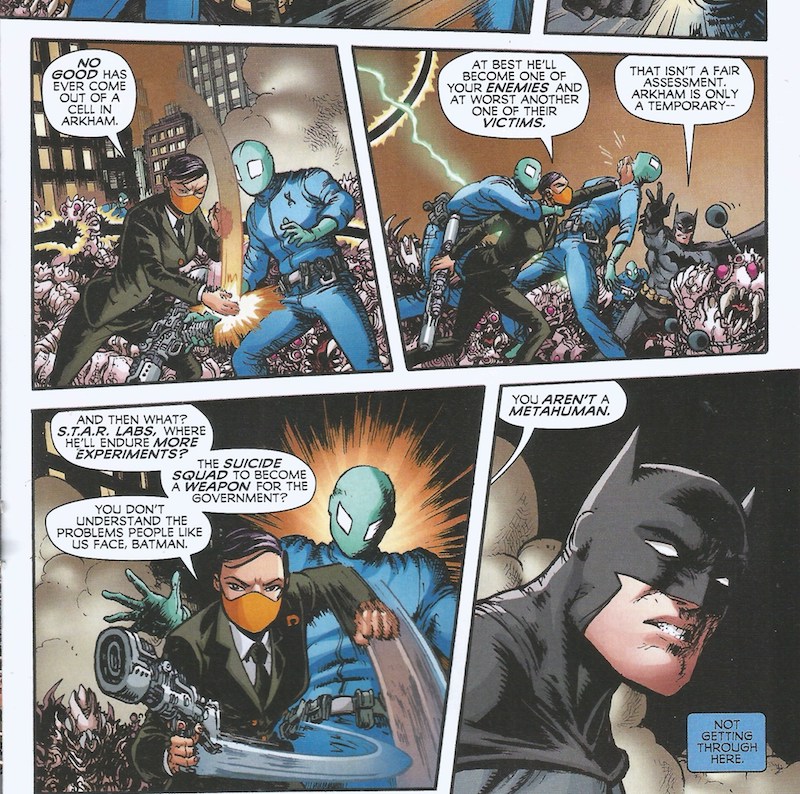

Batman has in fact come to the same conclusion at times.  During the New 52 era, Batman encountered the Birds of Prey.  Then they consisted of Black Canary, Katana, Starling and Poison Ivy.  After a fight against the Talons, enforcers for the Court of Owls, he remanded Poison Ivy back to the Birds of Prey's custody.  He believed Ivy was better off with them than in Arkham.  True.  She was indeed doing good while not being a do-gooder.

Batman isn't a massive guest-star in this Doom Patrol debut, but his presence gives the team context.  Batman is not only aware of the Doom Patrol.  He also knows the Chief's secret, which I'll not reveal here.  His knowledge arises from more than masterful deduction.  

Bunham and Reiber present a classic Batman.  As mentioned, the reader isn't on ground level.  The DC Universe has been thriving.  This is neither the Batman's, Robin's or the Doom Patrol's first appearance.  They appear to be old colleagues.  The Chief in fact mentions the Justice League and the Flash.  This is in keeping with tradition.  The Powers That Be only removed the Doom Patrol from the DC Universe proper when they shifted Grant Morrison's series to the Vertigo imprint. The Doom Patrol have always been part of the DCU.

In addition to the engaging plot, Batman cameo and the technical excellence, The Unstoppable Doom Patrol offers much more to recommend.  Elasti-Woman takes a page from her stream-series counterpart portrayed admirably by April Bowlby.


After Rita Farr joins the original Doom Patrol, she gains full control of her elasticity.  The stream series however suggests that her abilities and emotions are tied together.  Thus, Burnham's depiction of a droopy faced Rita Farr, chastised by the Chief, nods to the Bowlby depiction.

The Doom Patrol face a body-horror derived giant monster that looks to have come strait from Brian Yuzna's and Stuart Gordon's H.P. Lovecraft factory.


The fact that the beast is smacking around its tormentors and or custodians grants it sympathy.  It hasn't done anything particularly nasty to any innocent bystander, and the creature/person's wardens aren't particularly likable.  

The creative team reverse engineer Crazy Jane.  From her original Grant Morrison version-to Vertigo-and now back again to her original, with a slight but smile-worthy twist.  She's a very strange superhero.

Robot Man isn't just the brawn of the team; arguably Rita fills that role.  He's also the voice of reason. 


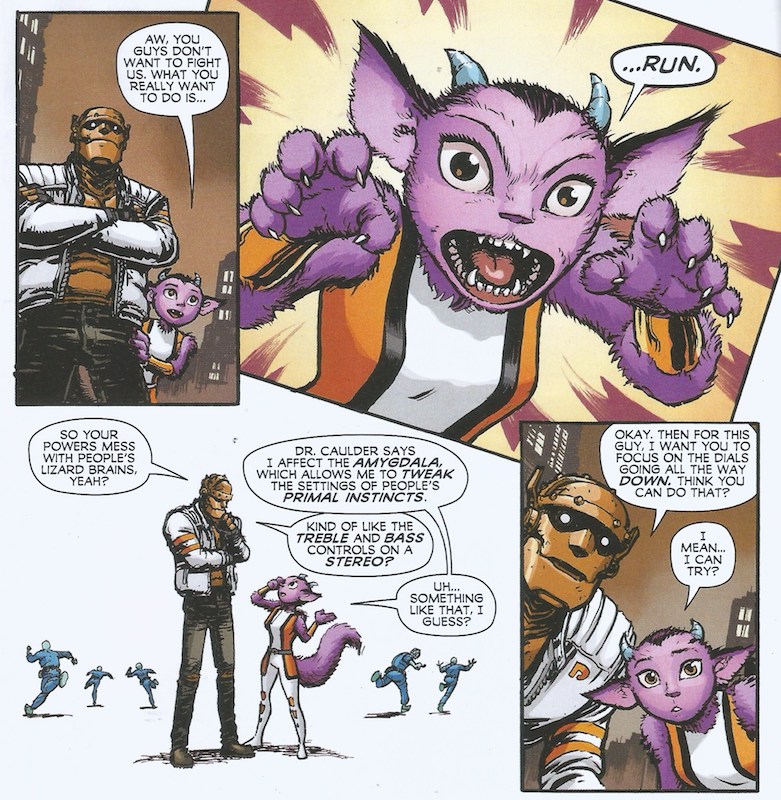
The new character Beast Girl, an overt callback to Teen Titan Gar Logan, is quite entertaining and provides a lot of youthful bounce and humor.

In other words, what we have here is a perfect debut that will appeal to all Doom Patrol fans, Batman followers, comic book art aficionados and for those that like there super-hero/science fiction tales with a touch of weirdness.


Tuesday, February 21, 2023

POBB February 20, 2023

Pick of the Brown Bag
February 20, 2023
by
Ray Tate

Welcome to the Pick of the Brown Bag.  A comic book review blog created, owned and operated by yours truly, Ray Tate.  This week in the POBB I look at The Harrower from Boom Comics.


Harrow, according to Merriam-Webster, is a "a cultivating tool set with spikes, teeth, or disks and used primarily for breaking up and smoothing the soil."  In the old days, it also meant to "pillage and/or plunder."  Both definitions apply to the monster. 


Isn't it nice when the art and creature live up to the ballyhoo of the cover?  

I'm not spoiling anything.  Any chance that this is just some real estate swindler dressed up in a spooky outfit is laid to rest on page four.  

Justin Jordan and Brahm Revel want you to see this creature, neither in shadows nor fog.  Nevertheless their story is filled with mystery and suspense.  

Let's tackle the suspense first.  This is a comic book that follows the Joe Bob Briggs mantra of a good drive-in flick:  "Anybody can die at any time."  


Characters that you think will be the continuing protagonists don't make it out of this premiere issue alive.  Characters you think are on the up and up, or at least uninvolved, turn out to be "High Priests."

The mystery lies in just what the hell is this thing, what is its nature and how it came to be.  Revel and Jordan appear to take their cues from the superior episode "Die Hand Die Verletz" of the superior horror series The X-Files.  


The adults know something is really going on, and has been going on for decades.  They however keep their kids in the dark.

The horrors takes place in Barlowe, NY.  The setting pays homage to Haddonfield located in John Carpenter's classic Halloween.  Barlowe is a town that's small and isolated, but the townsfolk are educated somewhat sophisticated Northerners.  Not the populace of Deliverance South where one may expect a crazed religious cult to spring up.


The kids learn about the Harrower in school, as local folklore.   These lessons undermine the reality of their situation.  


Thus is born a potential hero.  Our mystery man is the Sheriff's son who knows more about the Harrower than all the rest.

Things come to a head on a lonely stretch of road surrounded by the woods.  Modern horror movie conventions play out, but Jordan and Revel plant extra seeds of plausibility.


There may be a perfectly mortal reason why the burst tire of the car strands the group as well as why cell phone coverage suddenly deadens.  I also like how Revel and Jordan separate the group.  The whole situation appears perfectly reasonable, especially given that they're still within the civilization of Barlowe, NY.  It's not like the kids are in nowheresville, podunk capitol of the world.  They're on familiar ground.  They have every reason to believe nothing is going to happen to them.  Alas.

Wednesday, February 1, 2023

POBB February 1, 2023

Pick of the Brown Bag
February 1, 2023
by
Ray Tate

The Pick of the Brown Bag returns with a seriously belated Happy New Year to all POBB readers.  This week I look at a brand spanking new title from Marvel Comics.


The Scarlet Witch is of course not new.  She's a classic Silver Age character created by Stan Lee and Jack Kirby.


Arriving as a member of the Brotherhood of Evil in The Uncanny X-Men, Wanda Maximoff alias the Scarlet Witch debuted as a villain and a mutant with the power to affect probability.  

In other words if she used a Hex Bolt, on say, a table, all the probabilities that the legs would break at the same time amounted to one-hundred percent. 

When the original Avengers disbanded, Captain America formed a new team consisting of Hawkeye, Quicksilver and the Scarlet Witch.  All players on the opposite side.


He intended to reform these individuals and he succeeded.  Wanda became a consistent Avenger for about thirty years real time.

My First Avengers comic book.

At some point, don't ask me when, Wanda transformed into her namesake.  Then she became an arch magic user, though apparently not on Stephen Strange's level.  


I don't even know if she possesses a mutant power anymore.  If she does, she uses it rarely.

I've never really warmed up to the Scarlet Witch, but I never hated her either.  For me she was just basically one of the Avengers in the same way that Saturn Girl was always one of the Legion of Super-Heroes.  


That said.  I love Elizabeth Olsen as the Scarlet Witch, and I suspected her portrayal of the character might influence the new title.  In fact writer Steve Orlando's take is unique.

Wanda always struck me as living in her costume.  Rarely did she dress incognito.  She didn't have a secret identity, nor a life outside of the world of superheroes or sorcery.  Before anybody objects.  Saying that she fell in love with and married the Vision.  I know all that.  Just bear with me.

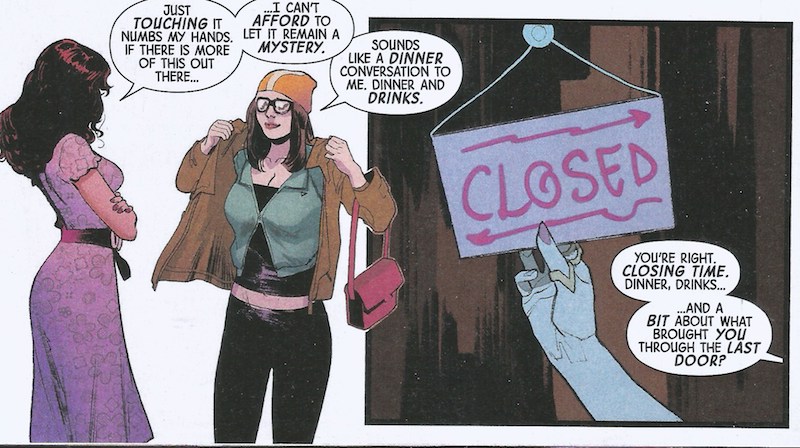
Orlando gives Wanda an interest outside of capes and cowls.  He creates for her a curiosity shop.  It's in The Emporium that the story proper starts.  The real beginning of Scarlet Witch occurs on page five and does so with no Crash-Bang-Wallop.


Scarlet Witch's Darcy shares similar physical attributes as well as a name with Dr. Darcy Lewis of Thor fame.  Dr. Lewis appeared in Wandavision.  So, you may be inclined to go, hmmmn.  However, the comic book Darcy doesn't exhibit Dr. Lewis' genius.  Just her taste in hats.


Pacing is one of the Scarlet Witch's greatest assets.  Orlando gives his story time to establish.  He grants the characters moments to interact, and he allows Wanda's brother Quicksilver to provide a sounding board for her new venture.  Not to mention distinguish himself from his past self: a hot-headed sphincter that had a creepy attachment to his sister.  

Not so in Scarlet Witch.  Orlando provides playful brother-sister interactions that are positively blissful.  


All of these scenes take place in the generous span of six pages.  These pages combined with five more also allots artist Sara Pichelli with the opportunity to demonstrate her ability to render natural movements and actions.  These fluid every day instances contrast with the nevertheless skillful bombast in the prologue and the second act.  Strong inks by Elisabetta D'Amico facilitate the power in Pichelli's pencils.  In addition, Matthew Wilson's colors mix and match with earthy aesthetics and soothing pastels.  


Those of greater need include Jarnette.


Jarnette hails from the Italian town of Armatrice, which has a pestilence problem in the form of Jackson Day, the Controller.


I don't recall this particular Controller appearing anywhere else.  He's not the Iron Man villain.  His blue skin and white hair may mark him as Kree.  Never you mind.  

He possesses the same power as the Mandrill, the Purple Man and Eros.  This makes him rather skeevy.  And his buttoned down disco shirt doesn't help matters.


Although Day succeeds in getting the upper hand for a moment, this fellow isn't in Wanda's weight class.  So, Scarlet Witch stands out also for being a done in one forty page adventure.  That brevity only enhances the value of the book.


Tuesday, November 22, 2022

POBB November 21, 2022


Pick of the Brown Bag
November 21, 2022
by
Ray Tate

Welcome to the Pick of the Brown Bag.  I'm Ray Tate, and this week I take a break from such books as Batgirls, Nightwing and The Human Target, which inadvertently became frequent subjects, to cast an eye at The New Golden Age and Star-Girl The Lost Children.  I promise to review some Marvel and indy books in the near future.

I would include #PickoftheBrownBag for Twitter users, but what with Elon Musk burning Twitter to dust, that doesn't seem logical.  I'm still sticking with Twitter for now and will post some short thoughts of the books under that hashtag, but you know....ah...well...c'est la vie.  Twitter had a good run.

So, for the current and future postings, I'm going to add something to the first paragraph just before the body of the review.

Pick up The New Golden Age and Star-Girl The Lost Children.  Even if you're not keen on the well-written stories, the art in both will wow you.  See? That was easy.  


The Golden Age boasts the pedigree of writer Geoff Johns, artists Jerry Ordway, Todd Nauck, Steve Lieber, Diego Olorteguei, J.P. Mayer, Scott Hanna, Scott Kollins, Viktor Bogdonovic, Brandon Peterson and Gary Frank.  

With color art by Nicolas Filardi, John Kalisz, Matt Herms, Jordan Boyd and Brad Anderson, Golden Age clocks in at forty-eight pages with no--repeat--no ads.  But is it worth the five dollar price tag?  Affirmative.

The story opens with young Helena Wayne enjoying a snowy day in Gotham City.  


Created in 1977 by Paul Levitz and Joe Staton, Helena Wayne is the daughter of Batman and Catwoman.  Helena becomes the Huntress to avenge her mother's death.


For those not in the know, DC thrives on the concept of parallel earths and the multiverse.  Defined in the name.  

The above scenario occurred on earth two.  Gardner Fox and Carmine Infantino who gave us The Flash of Two Worlds. conceived earth two for pure entertainment.  Other writers used the concept to explain character ages.


Historically Batman existed for eighty plus years.  He doesn't look like he's aged a stick.  It's a fictional conceit, but how to explain it in context?  The Powers That Be split Batman in two.  


The then modern Batman from the seventies' Bronze Age actually began his career in the nineteen sixties.  


The original led his life on earth two.  He started in 1939, married Catwoman, had a daughter and retired his cowl at the same time his counterpart built his considerable reputation.  More or less.

Writer Johns rationally points out that by now the earth two Batman would be dust.  So he takes the Batman Family on a new spin.  


Johns distinguishes this Batman and Catwoman duality in another way.  Catwoman and Batman plied their trades against the character backdrop of the Justice Society.  The 1940s group that started all superhero associations in comic books.


The story nevertheless focuses on Helena Wayne enjoying a snowy day in Gotham City.  What could be more innocent? Reading on, we discover Helena's being watched.


This is no child's nightmare.  
.  


The villain of the piece flits through this new earth two's history at will.  Past, present, future.  


His motive is suitably bizarre and it laces the proceedings with intense drama.  Furthermore, the figure appears to tie-in with Johns' other major work that's flying under the radar.  


The Star Girl Spring Break Special suggested that somebody or something kidnapped all the hero sidekicks from time and space.  The Golden Age introduces readers to those partners in heroism.

Johns even creates dummy Who's Who in the DC Universe entries for these new heroes and villains.  


So, yes, The Boom's entry states she first arrived in Flash Comics #10, but that's utter rubbish.  Flash Comics literally relates another, more innocuous story.

With the creation of Robin in 1940, Bob Kane and Bill Finger invented the kid sidekick.  The concept of the sidekick still didn't catch on until much later.  Most of the Justice Society did not have kid sidekicks.  

Johns cheekily contradicts that they did.  The heroes just don't remember them because some force abducted them from history.  

The New Golden Age closes on the death of Batman.  This moment which factors historically into a lot of JSA stories of the past becomes pivotal in kicking off a new mystery to be solved by the daughter of Catwoman and Batman, the new Huntress of earth two.

As previously stated, The Golden Age also reignites the mystery Star-Girl's been investigating with the Red Arrow, Emiko Queen, sister of the Green Arrow.  


You can be forgiven for not knowing who Emiko Queen is.  She's relatively new and partially the result of Willa Holland's wonderful portrayal of Oliver Queen's sister Thea on The Arrow.


To confuse matters more, Emiko actually did manifest in The Arrow during its final seasons.  Emiko played by Sea Shimooka.


The Lost Children begins with the obscure heroes TNT and Dan Dynamite engaging in a typical high speed chase in pursuit of garden variety bank robbers.  An indication of a more innocent time.


Though Johns created new sidekicks in The Golden Age, I'm here to tell you.  These guys actually are historical heroes from the comics.  They just didn't make it big.  


They're part of "...and others."

Of course TNT also represents Johns' double joke.  The original Star-Spangled Kid, the former sobriquet of Stargirl, naturally started in Star-Spangled Comics.   So, The Lost Children in a way continues the umbrella titled book from the 1940s.

Anyway.  Courtney's and Emiko's investigation takes them to the research of a now elderly Dan "Dynamite" Dunbar.


As you can see, Courtney's as in the dark about some of these sidekicks as we are...psst...that's because many never appeared in any comic book until now.

Perhaps I'm getting ahead of myself though.  Maybe you don't even know who Star-Girl is.  


Geoff Johns and Lee Moder created a new Star-Spangled Kid, whom Johns based on his late sister Courtney.  

Make no mistake. For Johns, Star-Girl is real personal.  She's appeared in several iterations on television, including Smallville and Legends of Tomorrow, before gaining her own television series.  Its her current state that influences the story and background of The Lost Children the most.


Actress Amy Smart makes Coutney's mom the everyman, moral compass of the show.  Because of Smart's humanistic treatment of the character, Courtney's mom gains much more substance in the very first issue of this series.


Courtney's step-dad Pat Dugan is actually an old 1940s hero named Stripesy.  Nowadays he tools around in a big mechanical suit, known as STRIPE.  Johns transforms Pat.  He becomes more relaxed to match his essayer Luke Wilson.


The natural fusion between television series and comic book character combined with her multiple appearances forms a more interesting and richer superhero.  Stargirl still boasts the optimism that Johns wanted to preserve for his sister's memory, but Courtney is now more seasoned than before.  She's measured rather than headstrong.  That makes her an ideal partner for the Red Arrow as they investigate the mystery of The Lost Children.

While writing this entry for the POBB, Kevin Conroy died.  In every interview I saw, every appearance, I just knew.  This guy was one of the good ones.


The underrated Island City

His death hits hard, but Kevin lives on as Batman.  
Hopefully forever.